
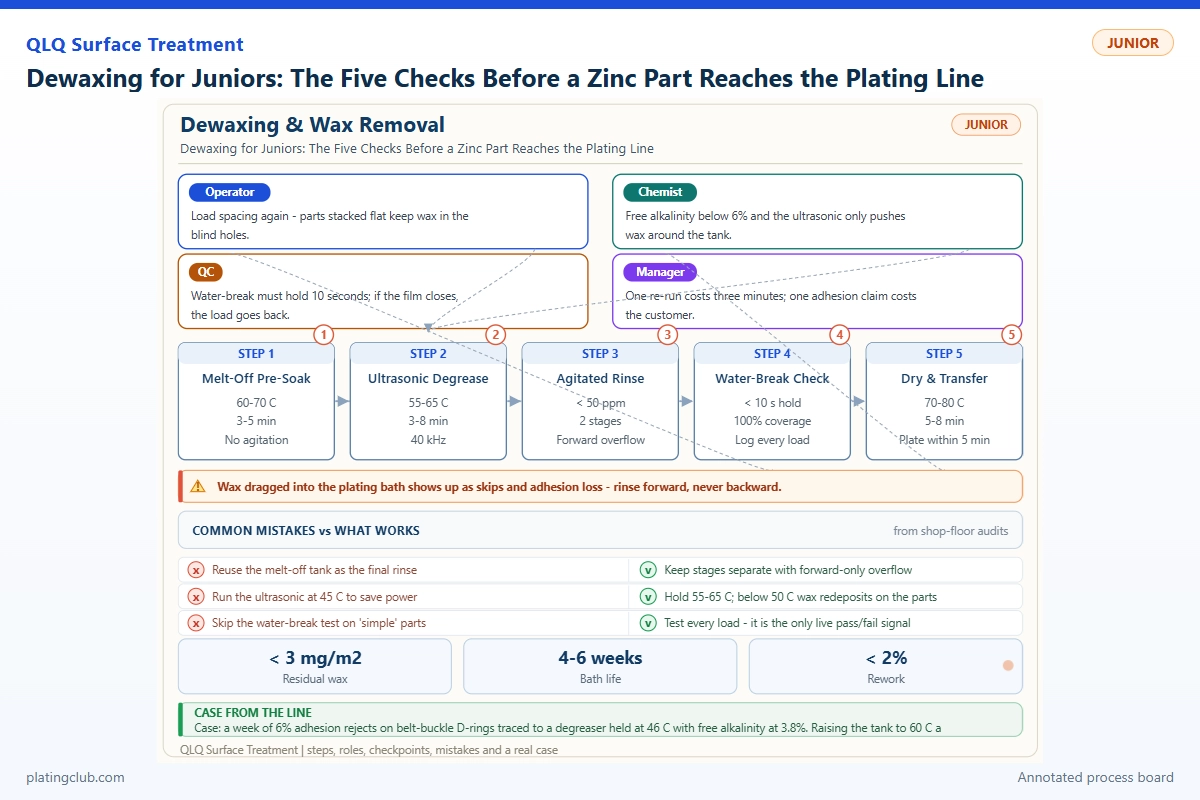
Polishing wax is invisible until it fails a salt-spray test three weeks later. This is the junior-level routine that keeps it out of the plating line: five checks, each with a number you can read off a gauge, and a clear rule for stopping the load.
5
Checks per load
< 3 mg/m2
Residual wax
< 5 min
Transfer window
The five checks and their pass numbers
| # | Check | Pass number | How to read it |
|---|---|---|---|
| 1 | Melt-off pre-soak | 60-70 C, 3-5 min | Dial thermometer, every shift |
| 2 | Ultrasonic tank | 55-65 C, 3-8 min, 40 kHz | Controller display + load clock |
| 3 | Agitated rinse | < 50 ppm, 2 stages | Conductivity meter on the final rinse |
| 4 | Water-break test | Film holds 10 s | Dip a sample, watch the sheet |
| 5 | Dry and transfer | 70-80 C, plate within 5 min | Oven timer + transfer log |
What the wax actually is (and why water alone will not move it)
| Wax type | Where it comes from | What removes it | Trap |
|---|---|---|---|
| Hard buffing compound | Polishing wheel (stearate + abrasive) | 60-70 C melt-off then alkaline | Solidifies again on cold parts |
| Soft/emulsion wax | Fine finishing wheel | Alkaline ultrasonic 55-65 C | Redeposits if alkalinity < 6% |
| Finger oils | Handling after polishing | Ultrasonic + rinse | Invisible to the eye |
| Pumice residue | Deburring media | Agitated rinse + spray | Settles in blind holes |
Shift log that proves the check was done
| Time | Tank C | Free alkali % | Water-break | Action |
|---|---|---|---|---|
| 07:00 | 62 | 7.4 | Pass | Load 1 started |
| 09:30 | 58 | 6.1 | Pass | Top-up 0.8 kg |
| 12:00 | 51 | 5.2 | Fail | Stop, re-run load, rebuild tank |
| 14:00 | 63 | 7.0 | Pass | Line running |
Watch out
A tank that 'looks clean' at 45 C is the classic junior trap - wax melts at 60-70 C, and below 50 C it just slides from one part to another.
Common mistakes and the fix
| ✗ Feel the part and call it clean | ✓ Do the water-break test - it is the only live signal |
| ✗ Top up the tank with cold water | ✓ Top up warm and re-check free alkalinity |
| ✗ Run a full basket to save cycles | ✓ Fill to 60% so cavitation reaches every part |
| ✗ Dry slowly while the rack waits | ✓ Plate within 5 minutes of drying |
What each role watches
| Operator | "Keep the load clock running: 3-8 minutes, and never start the next basket early." |
| Chemist | "Free alkalinity 6-9%: below 6% the emulsified wax goes back onto the parts." |
| QC | "Water-break failure means the load re-runs - no exceptions, no 'just this once'." |
| Manager | "Log the re-runs. Two re-runs a shift is a tank problem, not a people problem." |
From the shop floor
Case: a junior on the night shift ran the ultrasonic at 47 C for a week because 'it looked fine'. Six percent of D-rings failed adhesion. The number told the story: below 50 C, wax re-deposits.
FAQ
How do I know the water-break test passed?
Dip a clean sample and lift it out: the film should stay unbroken for at least 10 seconds. If it closes into droplets, the part still carries wax.
Can I skip the melt-off tank for small parts?
No. The melt-off stage takes the bulk of the compound off cheaply; without it the ultrasonic tank loads up in days.
What if the plating line is not ready when the load is dry?
Keep the load in the 70-80 C oven and re-check the water-break before plating - dry time is not the problem, cold dirty parts are.
Who records the checks?
The operator records them and QC initials them. The log is what turns a claim into a conversation.
Where to go next
- Level guide for this trade: Dewaxing & Ultrasonic Cleaning — technician levels
- Other levels: Intermediate, Senior, Management
- Owner view: Process Overview for owners
- Supplier view: Chemistry & Supply · Find content by trade + level