
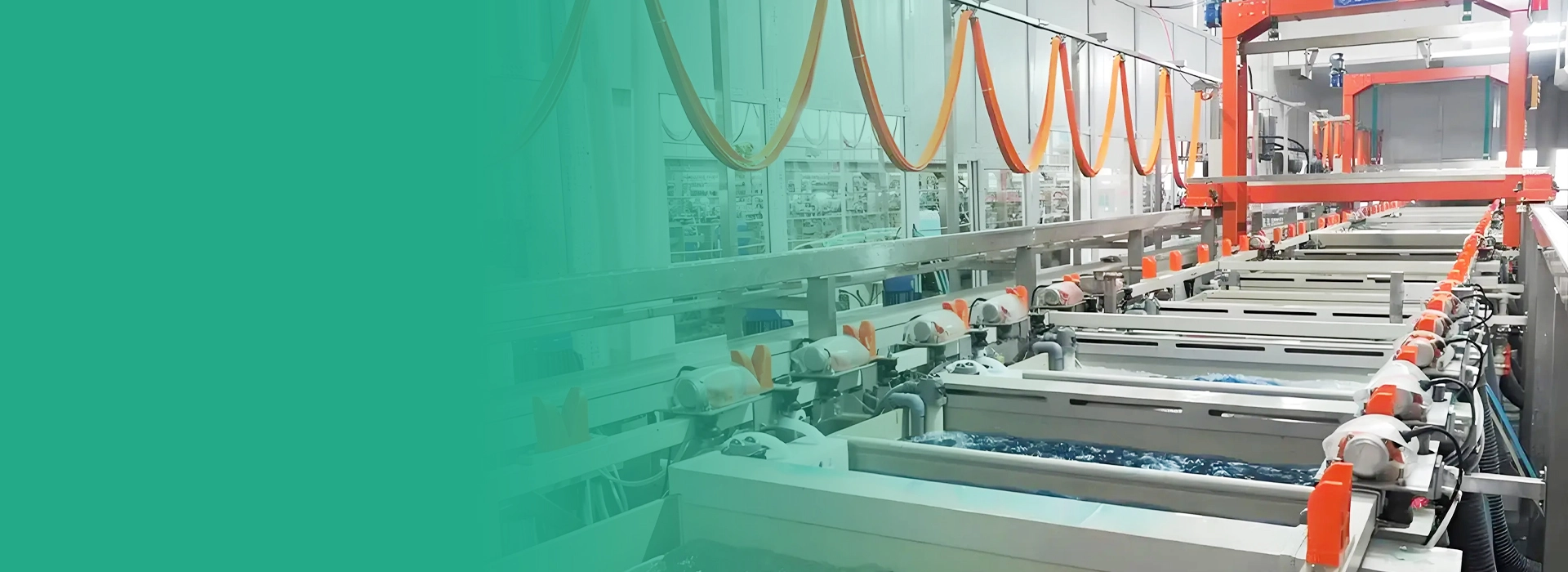
Spray Painting Pretreatment — Degreasing, Phosphating & Adhesion
The complete pretreatment guide for zipper sliders and hardware before spray painting. Surface energy, cleanliness and conversion coating control adhesion quality.
Why Pretreatment Matters for Paint Adhesion
60–80% of paint failures start at the pretreatment stage — never skip or rush it
The 5-Step Pretreatment Process
Clean → Rinse → Condition → Convert → Dry. Every step counts.
1Degreasing (Alkaline Cleaner)
Remove stamping oil, anti-rust oils and handling grease. Alkaline cleaner at 60–70 °C with ultrasonic agitation for complex shapes. Water break test: surface must hold a continuous water film for ≥30 s.
2Water Rinse (2-Stage Counter-Flow)
Remove alkaline residues immediately. Contaminated rinse = drag-in that kills the phosphate bath. DI water final stage < 50 μS/cm.
3Surface Conditioning (Titanium Salt)
Colloidal titanium phosphate activation — creates seeding sites for uniform phosphate crystal growth. Without this step, phosphate crystals are coarse and uneven, ruining adhesion.
4Phosphating / Passivation
Zinc phosphate or iron phosphate conversion coating. The crystalline layer anchors paint and stops under-film corrosion. Zinc phosphate gives denser coverage for steel parts.
5Drying (Dehydration Oven)
Bake off residual moisture before painting. Any trapped moisture = blistering in the curing oven. Target: completely dry, ≤ 0.1% moisture on surface.
Pretreatment Methods Compared
Choose based on substrate, volume and quality requirement
| Method | Substrate | Coating Weight | Adhesion | Corrosion Protection | Cost |
|---|---|---|---|---|---|
| Zn Phosphating | Steel / Zn alloy | 2–4 g/m² | Excellent | High | Medium |
| Fe Phosphating | Steel | 0.5–1.5 g/m² | Good | Medium | Low |
| Chromate Passivation | Zn / Al | — | Good | Very high | Low |
| Nano-Ceramic | Mixed metals | — | Good | High | Medium |
| Blast + Solvent wipe | All | — | Fair | Low | Low |
📌 Pretreatment Cheat Sheet
FAQ
How do I know if degreasing worked?
Zinc phosphate vs iron phosphate for zipper sliders?
Can we skip surface conditioning?
How long between drying and painting?
Is chromate pretreatment still used?
Painting Line Animation — Hang, Pretreat, Spray, Cure (12s Cycle)
Animated schematic — reduced-motion users see a static layout.
One-Stop Line Supply — Common Buyer Questions
Can QLQ supply the pretreatment and spray painting equipment for my hardware coating line together?
Yes, QLQ can supply pretreatment cleaning equipment and spray painting equipment as part of a coordinated surface-treatment line. Share your part material, production target and required finish so the equipment and chemical requirements can be reviewed together. Explore the one-stop line supply, chemicals and process support options to plan your project.
Can I buy the paints, varnishes and protective coatings from QLQ as well, instead of finding separate suppliers?
Yes, QLQ supplies paints, varnishes and protective coatings alongside its surface-treatment equipment. The specific products and pretreatment route need to be confirmed for your substrate, desired appearance and coating requirements. See the complete equipment and chemicals supply overview to discuss a coordinated purchasing plan.
I am setting up a painting line for zinc alloy bag hardware; can QLQ help with pretreatment, equipment selection and operator training?
Yes, QLQ offers equipment selection, layout planning, installation and commissioning, operator training and process support for new production projects. Discuss pretreatment cleaning and drying together with the spray painting equipment and coating materials, with the final supply and support scope confirmed for your project. Start with the turnkey surface-treatment line overview and share your parts, capacity target and available workshop space.
Get a Free Quote Today
Send us your samples or drawings — our engineers reply within 24 hours with pricing and technical advice.
Contact Us