
Surface Preparation — trades and people
This workshop covers 3 trades. Open any trade to see the level guide, or jump straight to the level you hire or train for. Each trade page carries the equipment scene, the parameters and the mistakes that matter at that level.
Search by trade + level (barrel senior), by defect (blistering), or by parameter (brightener dosing). Full-text and title search across the whole site.
Trades in this workshop
How the four levels are judged
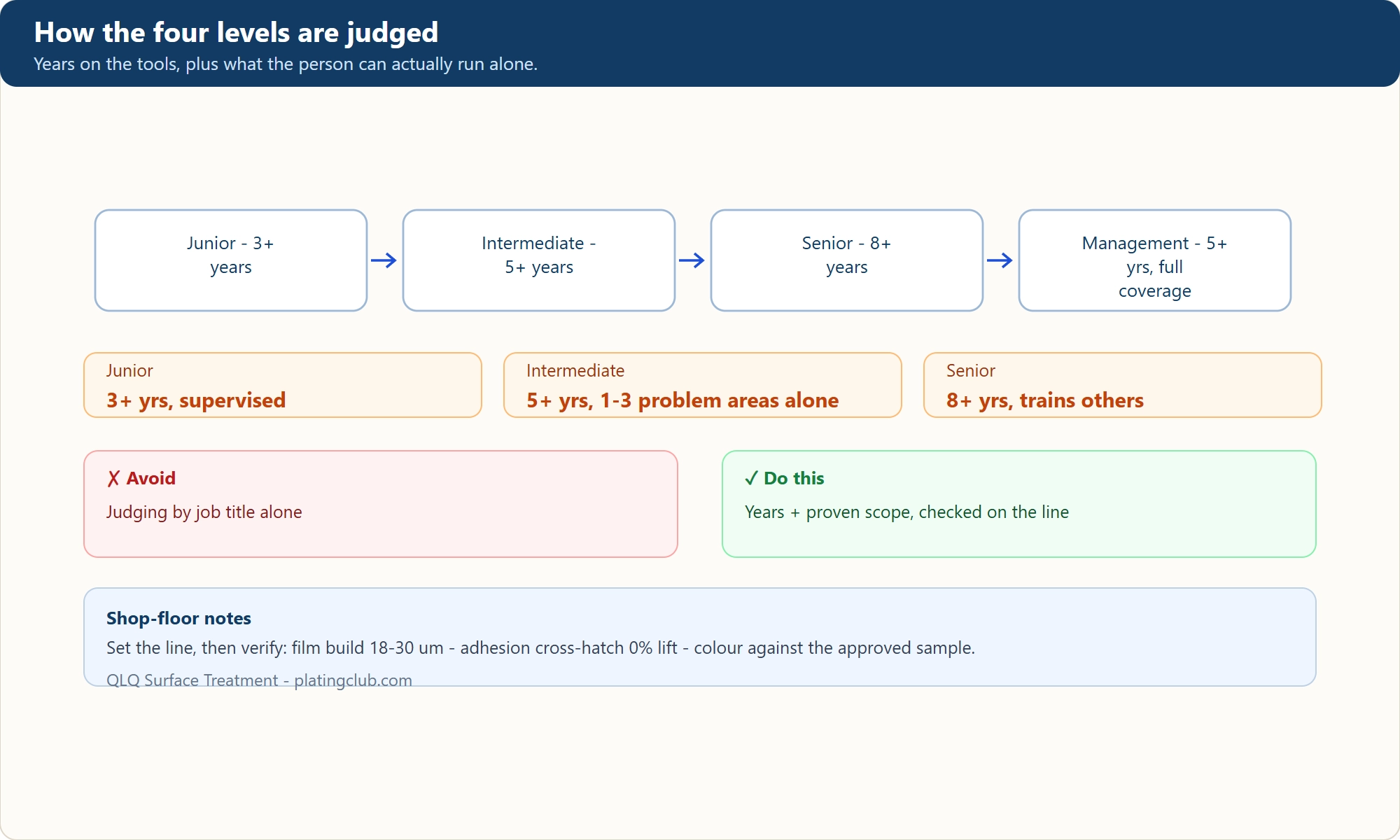
- Junior (1-3 yrs) — Runs the SOP, reads the parameter sheet, spots common defects
- Intermediate (3-5 yrs) — Knows why a parameter moves, reads data, diagnoses root causes
- Senior (5-8 yrs) — Owns the process window and the link to upstream/downstream steps
- Management (8+ yrs) — Cost, yield, rescue plans, team and customer communication
Not sure where a topic sits? Use the trade + level picker, or open the full knowledge map. Owners can start from the process overview.
Pretreatment stages and control points
| Stage | Chemistry | Typical condition | What it prevents |
|---|---|---|---|
| Degrease | Alkaline or solvent | 50-60 C, 3-8 min, concentration per TDS | Patchy plating, poor adhesion |
| Electroclean | Alkaline with current | Cathodic then anodic, 2-5 min | Residual film in recesses |
| Acid pickle | HCl or H2SO4 | Room temp, 1-5 min | Oxide skin, smut |
| Activation | Dilute acid dip | 10-60 s before transfer | Passivation during transfer |
| Rinse | Two-stage counterflow | Conductivity monitored | Carry-over contamination |
Rinse quality is measured, not assumed. Log conductivity at the last rinse.
Defects traced back to pretreatment
| Symptom | Cause | Fix |
|---|---|---|
| Patchy, dull deposit | Oil film left on the surface | Extend degrease, check bath loading and temperature |
| Blistering | Smut or oxide under the deposit | Improve pickle and rinse, shorten transfer time |
| Poor adhesion at edges | Drying between stages | Keep parts wet, reduce time in air |
| Stains after plating | Contaminated final rinse | Change rinse water, check DI quality |
FAQ
How long can parts wait between pretreatment and plating?
Seconds, not minutes. A passivated surface plates badly even if it looks clean.
Is ultrasonic cleaning worth it?
For parts with blind holes and tight recesses, yes - it reaches where spray cannot. For flat open parts, good degrease plus rinse is enough.