
QLQ zinc alloy surface finishing equipment and process QLQ zinc alloy surface finishing equipment and process

Professional Zinc Alloy Surface Finishing Solutions

Hanger Painting

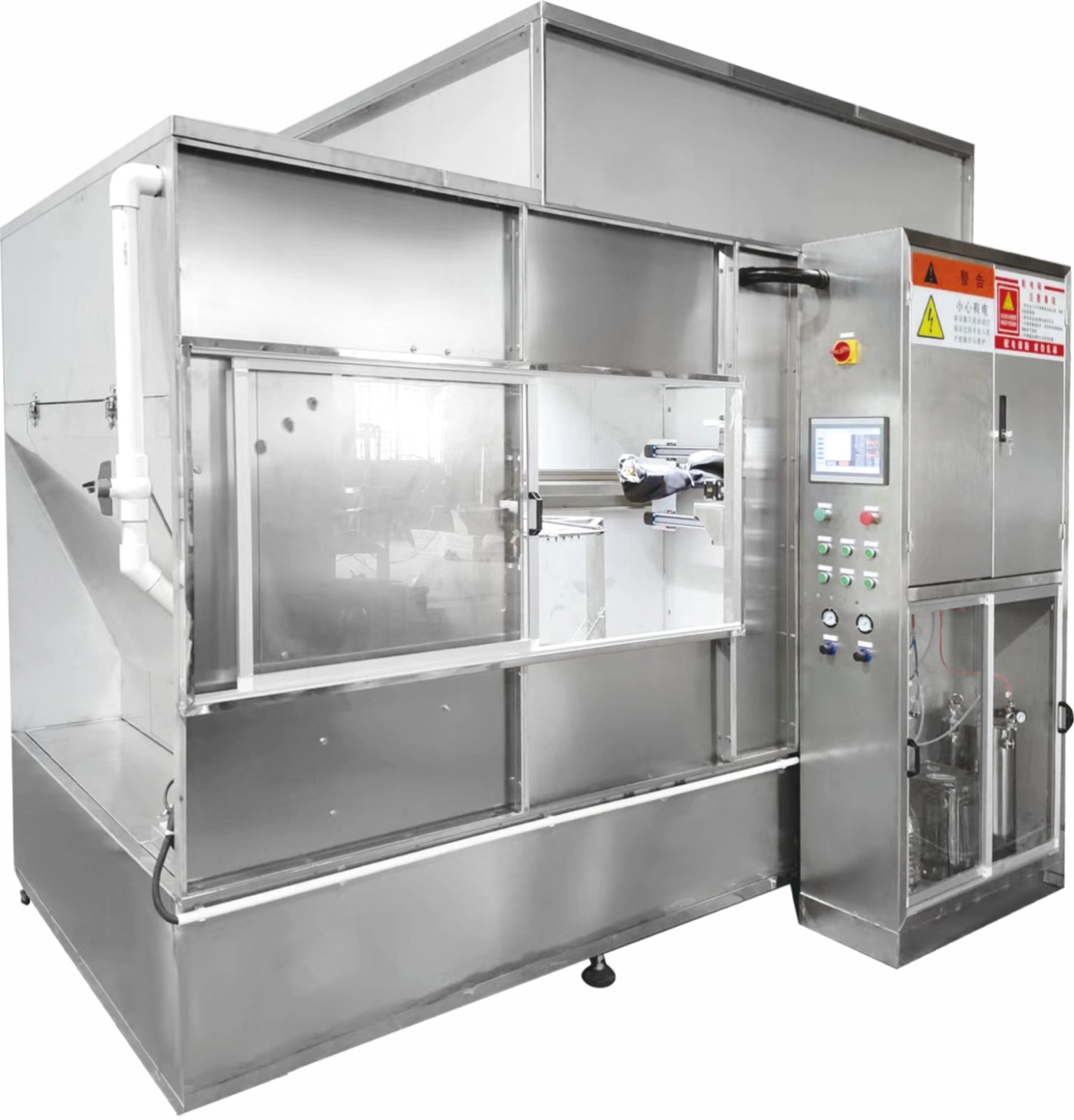
Automatic rack spray-painting machine - parts hang on the line and pas
Automatic rack spray-painting machine - parts hang on the line and pass a filtered spray booth - QLQ workshop photo

Hanger Spray Painting — Electrostatic & Air Spray for Precision Parts

The premium painting method for large, delicate or cosmetic-grade hardware. Electrostatic wrap-around gives uniform film and up to 40% paint savings.
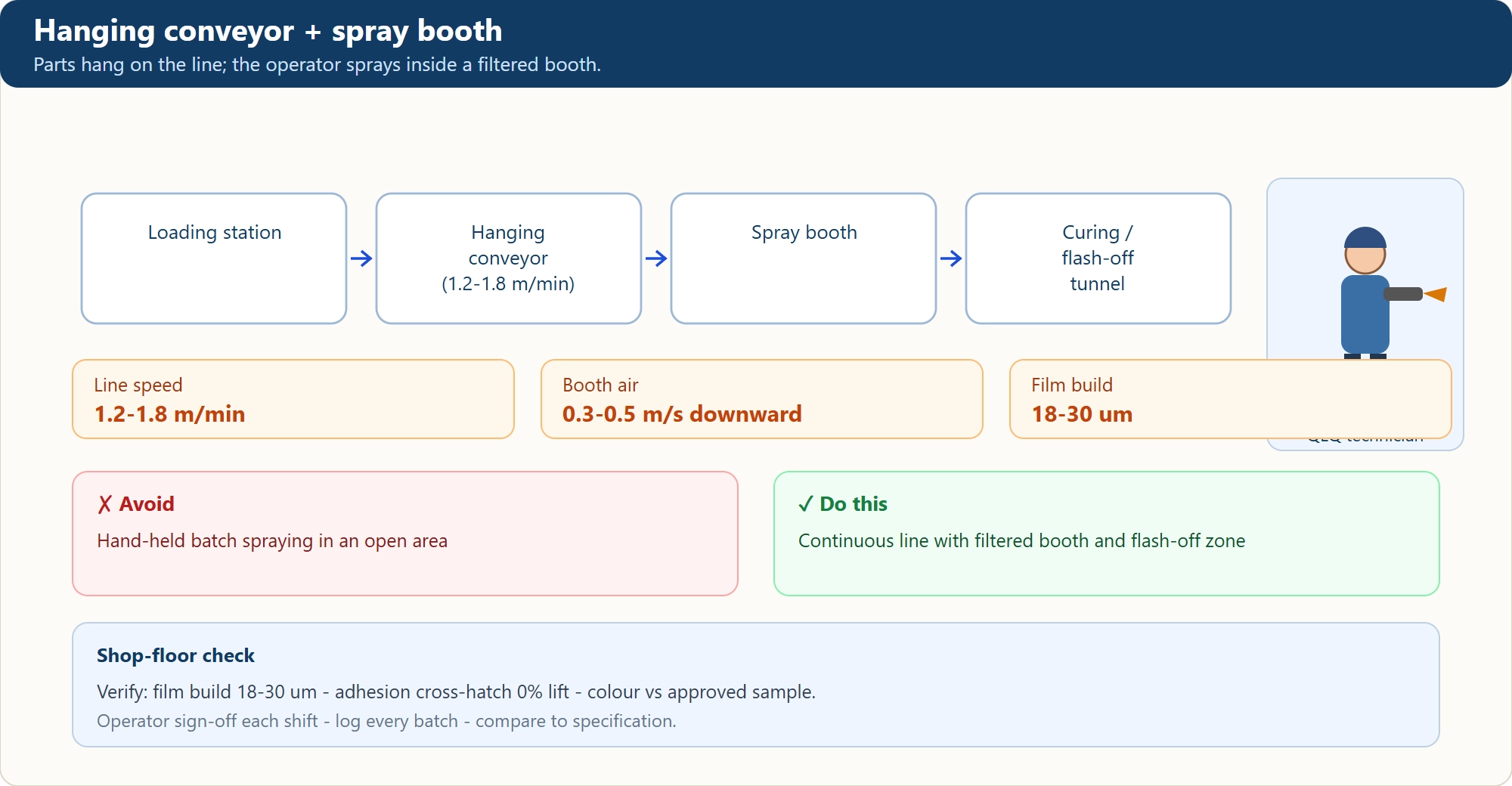
Hanging conveyor + spray booth
Hanging conveyor + spray booth - Parts hang on the line; the operator sprays inside a filtered booth.

The Hanger Painting Process

Fixture → Ground → Spray → Flash → Cure — precision at every step

1Electrostatic vs Air Spray

Electrostatic: paint particles are negatively charged (−60 to −90 kV) and attracted to the grounded part — paint wraps around edges and into recesses. Air spray: mechanical atomization only, no wrap. Electrostatic saves 30–40% paint on complex shapes.
Key Parameters
Electrostatic voltage: 60–90 kV
Gun-to-part distance: 15–25 cm
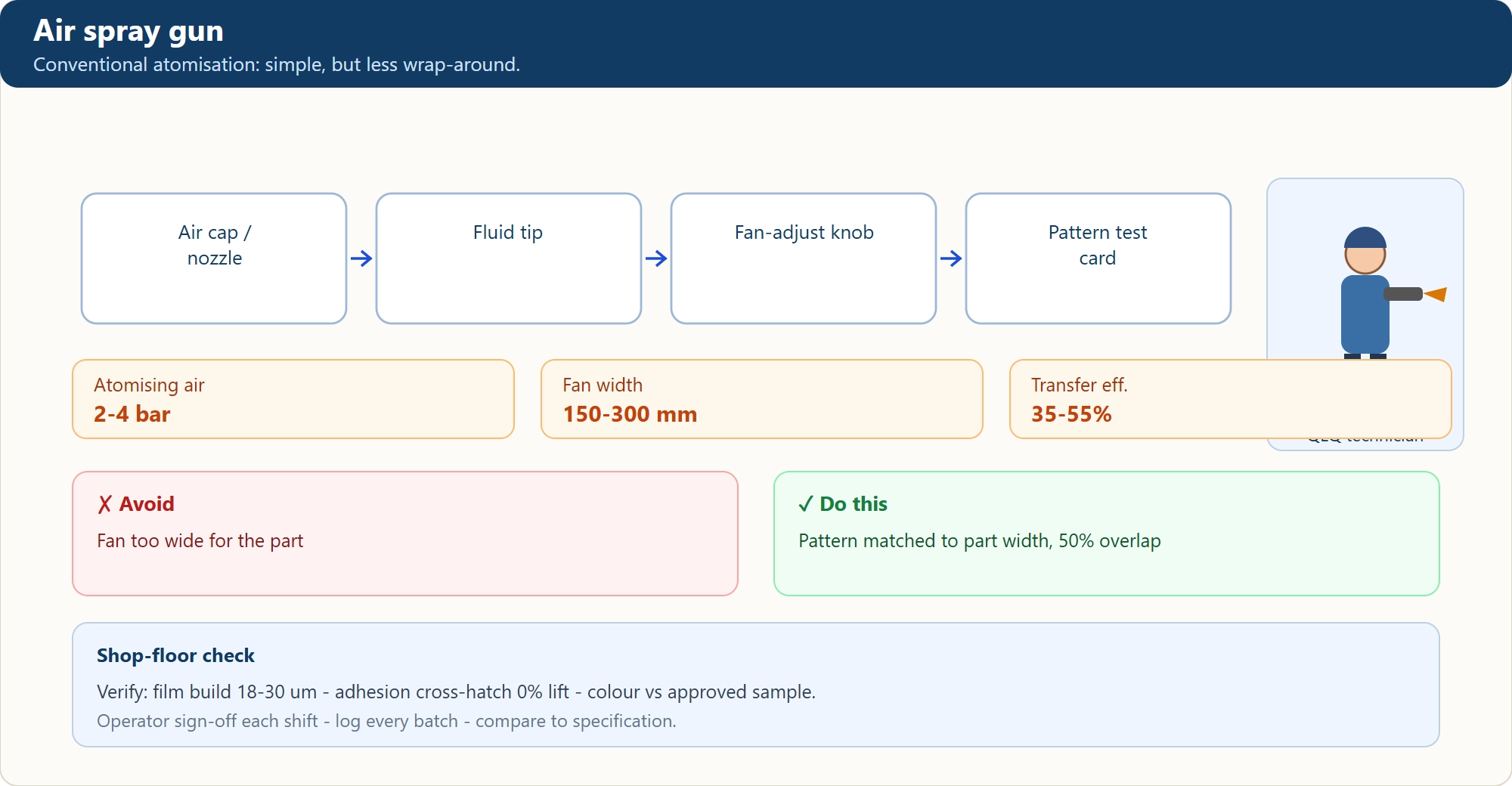
Air spray pressure: 0.2–0.5 MPa
Transfer efficiency: ES: 60–85% / Air: 30–50%
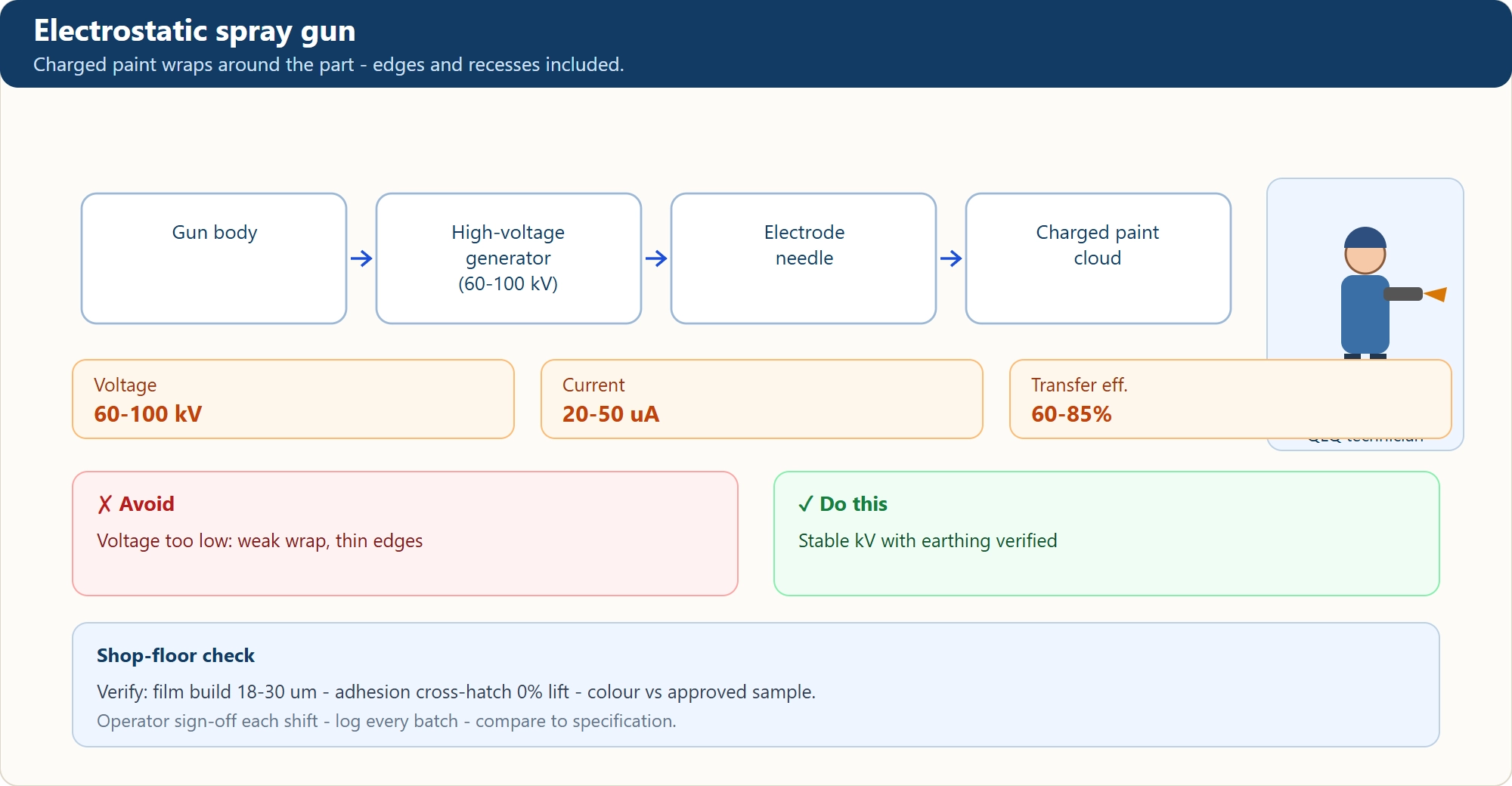
Electrostatic spray gun
Electrostatic spray gun - Charged paint wraps around the part - edges and recesses included.
Air spray gun
Air spray gun - Conventional atomisation: simple, but less wrap-around.

2Conveyor & Hanging Fixtures

Overhead conveyor with adjustable-speed drive. Hook spacing must prevent part-to-part contact on curves. Grounding is critical for electrostatic — dirty hooks = no charge = no wrap.
Key Parameters
Conveyor speed: 1–5 m/min
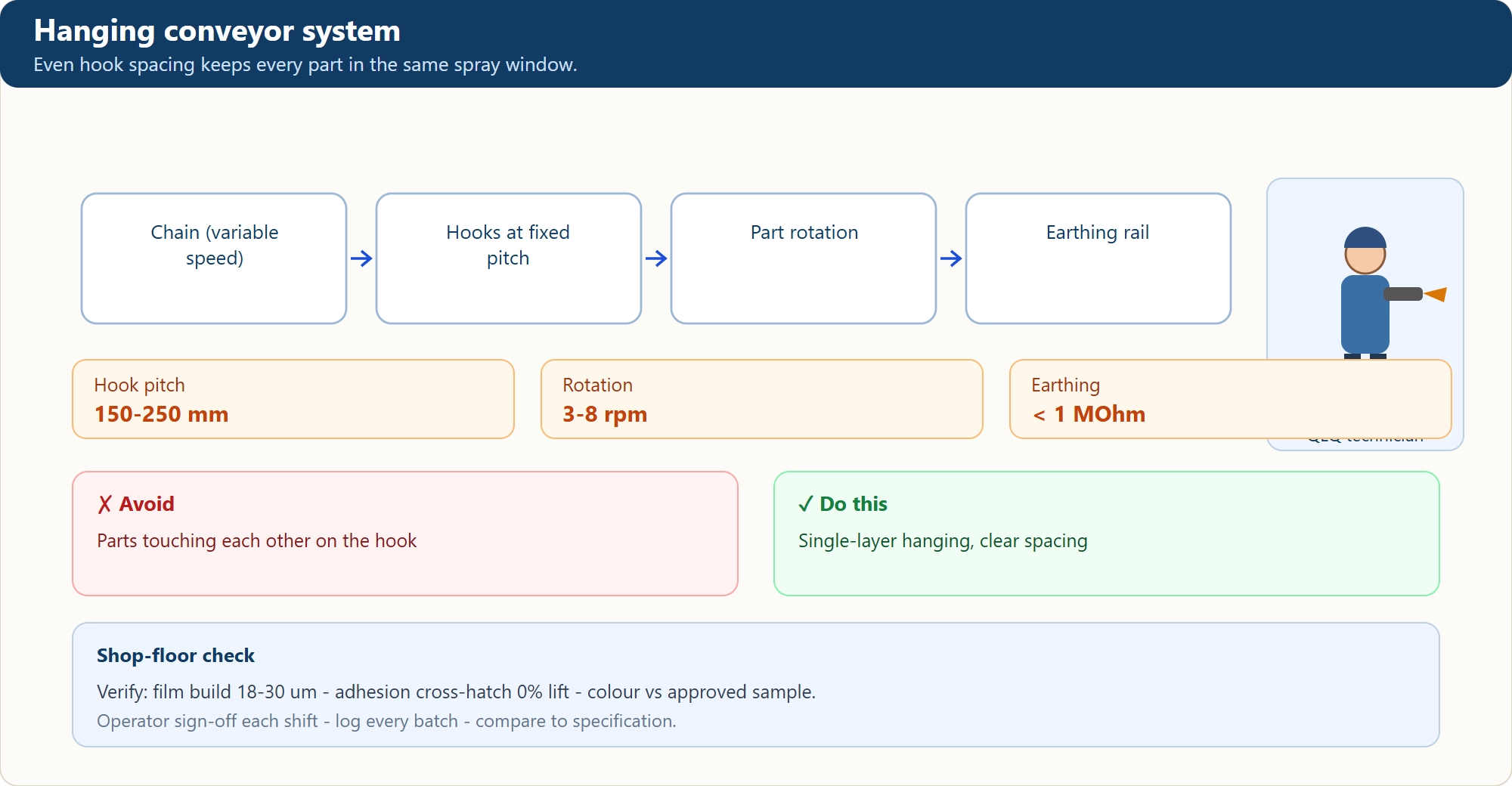
Hook spacing: 100–300 mm
Ground resistance: < 1 MΩ
Hanging conveyor system
Hanging conveyor system - Even hook spacing keeps every part in the same spray window.

3Manual vs Robot Spraying

Manual for small batches and complex shapes; robot for high-volume repeatable runs. Robot eliminates operator variance — consistent stroke speed, distance and overlap. ROI at >2000 pcs/day.
Key Parameters
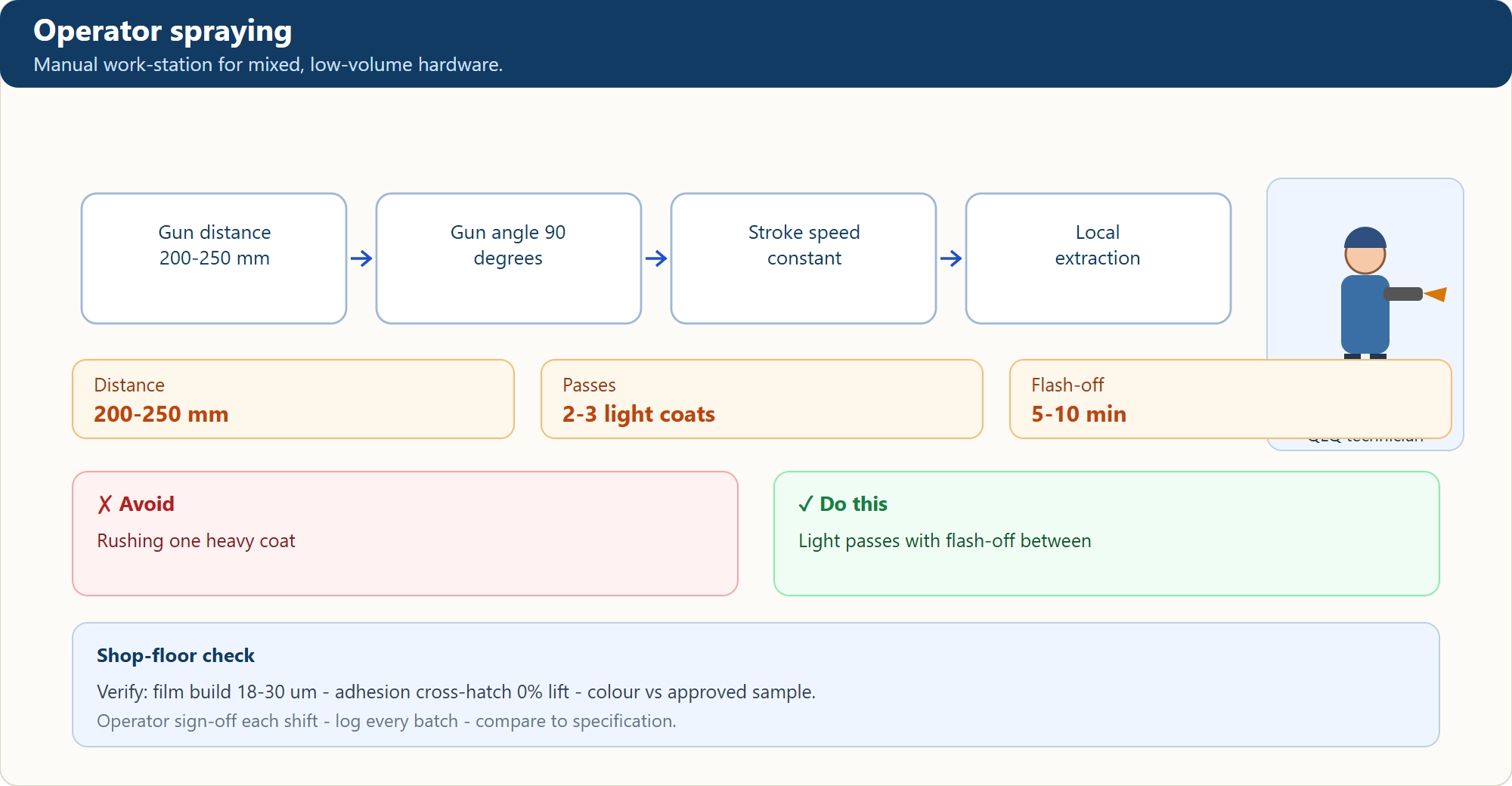
Manual speed: 0.3–0.6 m/s stroke
Robot repeatability: ±2 mm
Overlap: 50% for even film
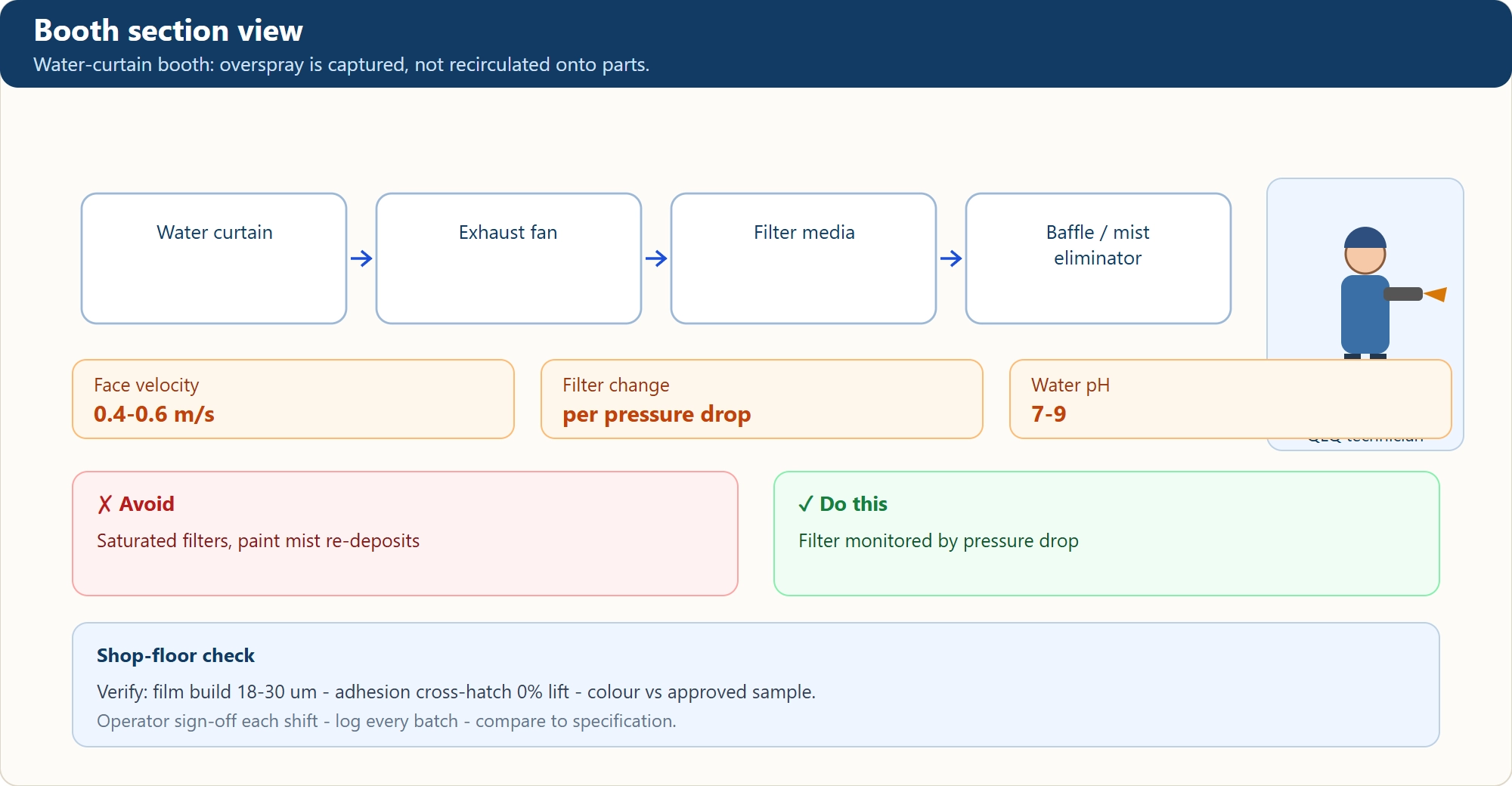
Booth section view
Booth section view - Water-curtain booth: overspray is captured, not recirculated onto parts.
Operator spraying
Operator spraying - Manual work-station for mixed, low-volume hardware.
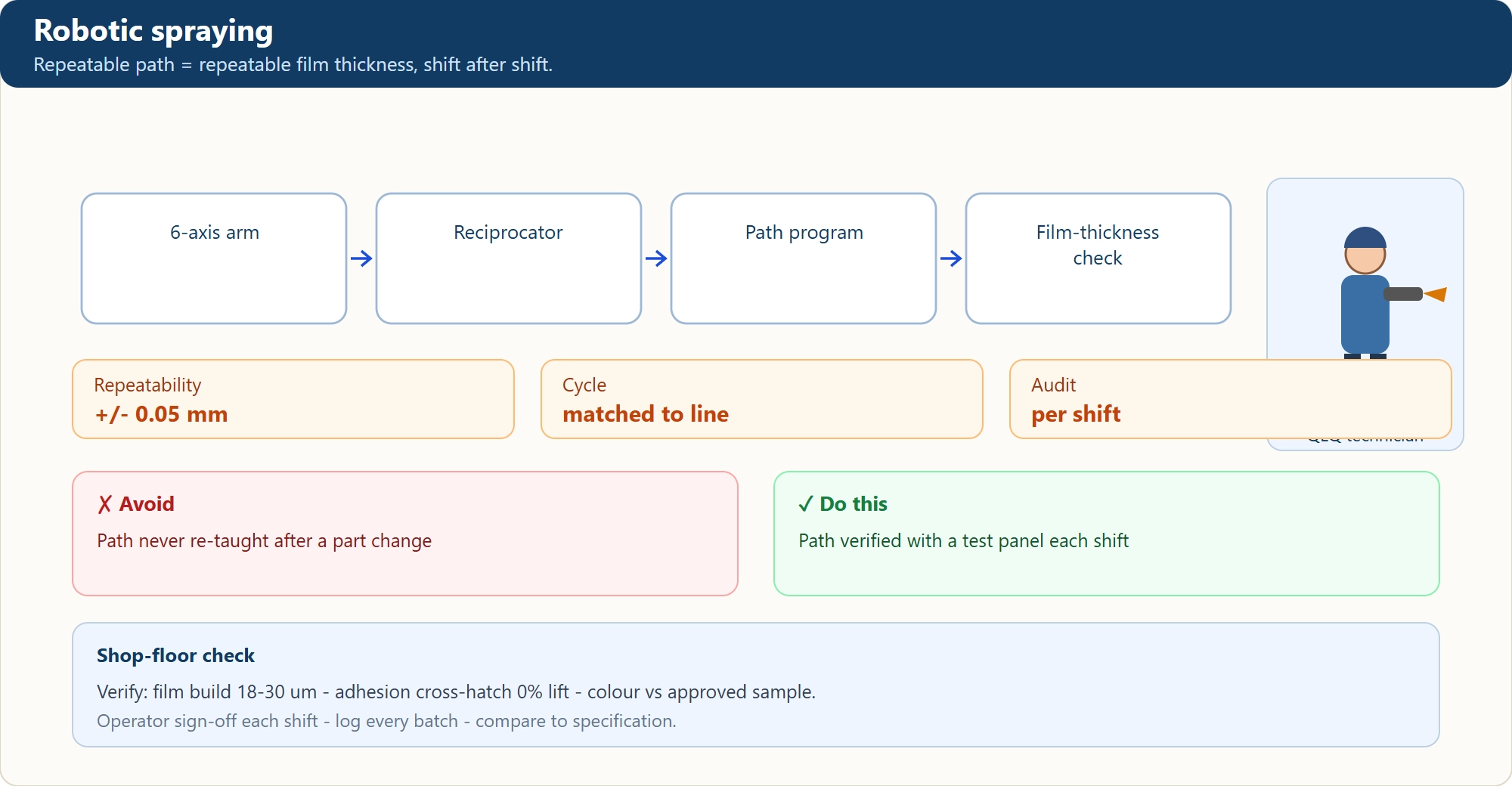
Robotic spraying
Robotic spraying - Repeatable path = repeatable film thickness, shift after shift.

4Film Uniformity Control

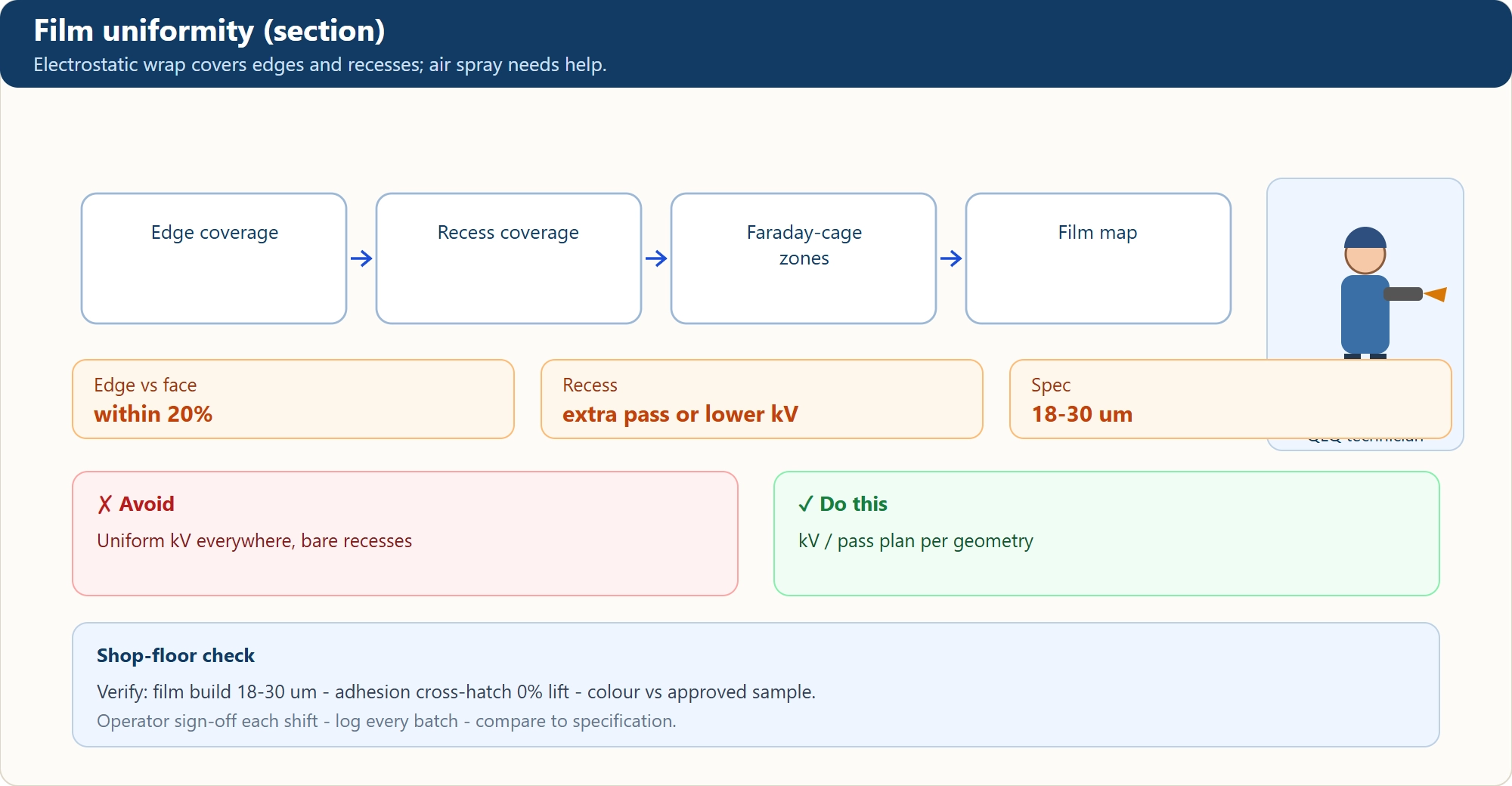
Electrostatic wrap gives ±5 μm uniformity vs ±15 μm for air spray. Arm speed, gun distance and voltage stability are the three levers. Use a film thickness gauge at 5 points per part.
Key Parameters
Uniformity (ES): ±5 μm
Uniformity (air): ±15 μm
Check points: 5 per part
Film uniformity (section)
Film uniformity (section) - Electrostatic wrap covers edges and recesses; air spray needs help.
▼

Electrostatic vs Air Spray Comparison

Transfer efficiency, wrap and film uniformity side by side

ParameterElectrostatic SprayConventional Air Spray
Transfer efficiency60–85%30–50%
Paint savings vs air30–40%—
Wrap-around effectYes — coats edgesLine-of-sight only
Film uniformity±5 μm±15 μm
Part complexityAny shapeSimple geometries
Equipment costHigherLower
Safety requirementExplosion-proof, groundingStandard ventilation

📌 Hanger Painting Cheat Sheet

ES voltage60–90 kV
Gun distance15–25 cm
Conveyor speed1–5 m/min
Transfer efficiency (ES)60–85%
Film uniformity (ES)±5 μm
Hook ground< 1 MΩ
Robot ROI threshold> 2000 pcs/day
⚠ Never ground through paint buildupPaint buildup on hooks insulates them — parts lose their ground, electrostatic wrap drops to zero, and film thickness becomes erratic. Strip hooks every 8–12 hours of production. A quick continuity check with a multimeter catches bad hooks before they cause rejects.

FAQ

Can I paint plastic parts with electrostatic?
Yes, but plastic is non-conductive. You need conductive primer (carbon-loaded) or an ionic air blower to pre-charge the surface. Alternatively, use air spray on plastic.
What is the optimal gun distance for 80 kV?
20–22 cm for solvent-based paint, 18–20 cm for waterborne. Closer than 15 cm risks arcing; farther than 30 cm loses wrap efficiency.
How to fix Faraday cage effect on deep recesses?
Faraday cage = paint particles can't enter a recess because the charged particles deposit at the opening. Reduce voltage to 40–50 kV for recessed areas, or use a combination of electrostatic for the surface and air spray for the pockets.
What conveyor speed for 30 μm dry film?
At 20 μm/pass with a 50% overlap pattern, 2–3 m/min gives 30–35 μm. Measure wet film with a comb gauge and adjust speed to hit target dry film after curing.
Is robot painting worth it for 500 pcs per day?
Probably not — manual spray with a skilled operator is more flexible at low volumes. Consider a reciprocating gun mover (single-axis) as a stepping stone before full robot.

Get a Free Quote Today

Send us your samples or drawings — our engineers reply within 24 hours with pricing and technical advice.

Contact Us

Rack painting: fixture design rules

RuleWhySymptom if broken
Contact on a hidden facePaint cannot reach contact pointsBare dots on visible faces
Minimum 100 mm part spacingSpray shadow between partsThin film on facing sides
Drain path designed inHeavy film runs on vertical facesSags at the bottom edge
Hanger earthed and cleanElectrostatic wrapPoor coverage in recesses

FAQ

How do we reduce repainting on racks?

Fixture first, then gun settings. Most rework traces to contact points and shadows, not to the paint.

Can one rack run multiple colours?

Only with a full cleaning cycle. Colour contamination shows as specks under the new coat.