
Professional Zinc Alloy Surface Finishing Solutions
Barrel Painting
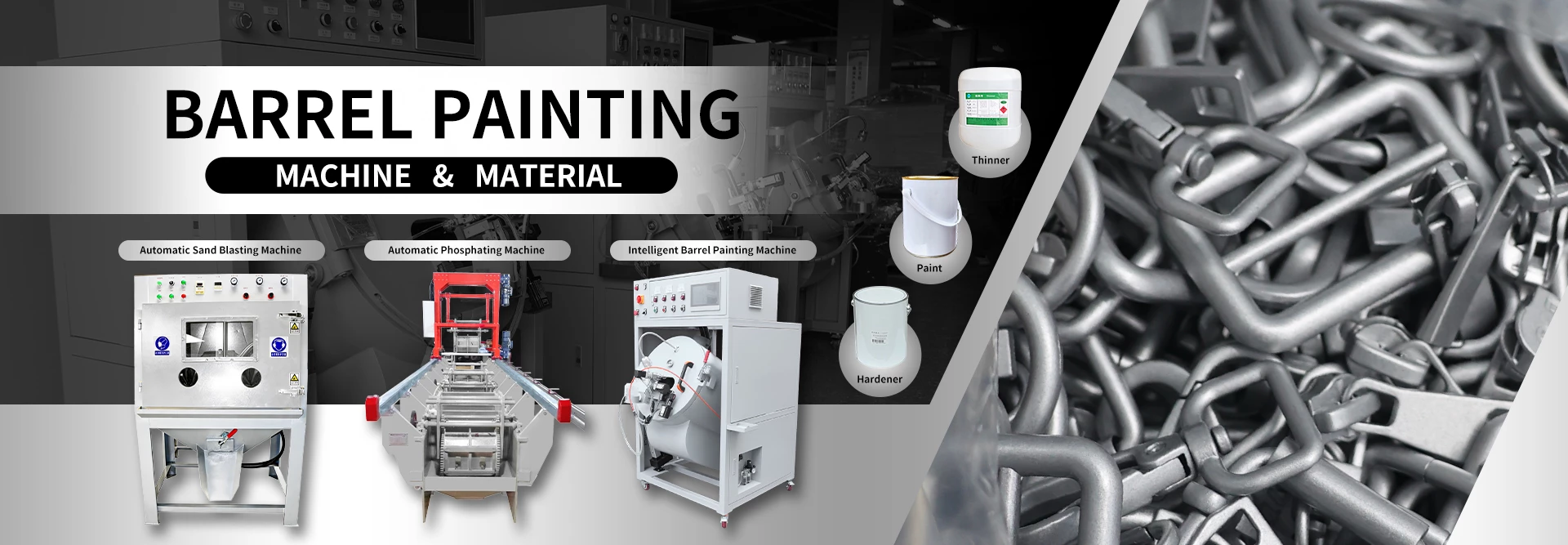
Barrel Spray Painting — High-Volume Batch Coating for Small Hardware
Mass-production painting for zipper sliders, buttons and tiny hardware. Tumbling barrel + spray gun, controlled rotational speed and multi-pass thin coats.
The Barrel Painting Process
Tumble, spray, flash, repeat — the production rhythm for high-volume small parts
1Barrel Spray Machine Setup
Tilted rotating barrel (30–45°) with a fixed spray gun aimed at the rolling bed of parts. The tumbling action exposes every surface to paint mist. Adjust tilt angle to control dwell time.
Key Parameters
Barrel tilt: 30–45°
Barrel diameter: 500–800 mm
Gun position: Fixed, aimed at part bed
2Barrel Speed & Paint Parameters
Speed 15–25 rpm — too fast = parts pinned by centrifugal force, no tumbling; too slow = uneven coverage. Atomizing air pressure 0.3–0.5 MPa. Fan width matched to barrel opening.
Key Parameters
Barrel speed: 15–25 rpm
Atomizing pressure: 0.3–0.5 MPa
Fluid pressure: 0.1–0.3 MPa
Fan width: 150–250 mm
3Multi-Pass Thin Coating
3–5 thin passes with 30–60 s flash-off between coats. Thick single-layer paint runs, sags and traps solvent — thin layers cure evenly and build a smooth finish. Total film build 30–60 μm.
Key Parameters
Passes: 3–5
Flash-off: 30–60 s
Layer thickness: 10–15 μm/pass
Total build: 30–60 μm
4Unload & Inspection
Dump barrel contents onto a vibratory screen to separate parts. Remove any fused pairs (two parts that stuck together). Visual inspection under D65 light for coverage uniformity.
Key Parameters
Separation: Vibratory screen
Inspection: 100% visual
Fused pairs rate: < 0.5%
▼
Barrel vs Hanger Painting — When to Choose Barrel
Volume and part size are the deciding factors
| Factor | Barrel Painting | Hanger Painting |
|---|---|---|
| Part size | Small (< 30 mm) | Small to large |
| Volume per shift | 10,000–100,000 pcs | 500–5,000 pcs |
| Uniformity | Good (tumbling effect) | Excellent |
| Paint waste | Higher (over-spray on barrel wall) | Lower |
| Surface damage risk | Low (parts tumble on each other) | None (suspended) |
| Operator skill needed | Medium | High |
📌 Barrel Painting Cheat Sheet
Barrel speed15–25 rpm
Tilt angle30–45°
Atomizing pressure0.3–0.5 MPa
Passes3–5 thin coats
Flash-off between coats30–60 s
Total film build30–60 μm
Fused pair rate target< 0.5%
💡 Batch Consistency TipsLoad weight must be ±5% between batches — too few parts = over-sprayed and fused; too many = under-sprayed centers. Log barrel speed and air pressure every batch. Rotate spray gun nozzle every 500 cycles to maintain fan pattern.
FAQ
What is the ideal load weight for a 600 mm barrel?
3–5 kg for small sliders, 2–3 kg for tiny buttons. The rule: parts should occupy 40–60% of barrel volume, leaving room for tumbling action.
How to fix orange peel texture in barrel painting?
Orange peel = atomization pressure too low or viscosity too high. Increase atomizing air to 0.4–0.5 MPa or thin paint 5–10% with recommended thinner.
Can barrel painting do metallic or pearl colors?
Yes, but use a clear top-coat pass to protect the metallic flakes. Metallic pigments settle fast — keep the paint agitated in the pressure pot.
Why do some parts come out with bare spots?
Bare spots = shadowing. Parts concave shapes that face away from the gun don't get paint in a single pass. Re-orient the gun angle or add a second gun from a different position.
How to clean the barrel between color changes?
Run 2–3 kg of plastic pellets + solvent for 5 min at 20 rpm, dump, then air-blow the barrel. Solvent wash only — never scrape the barrel wall.
Get a Free Quote Today
Send us your samples or drawings — our engineers reply within 24 hours with pricing and technical advice.
Contact Us