
Plating Workshop — trades and people
This workshop covers 5 trades. Open any trade to see the level guide, or jump straight to the level you hire or train for. Each trade page carries the equipment scene, the parameters and the mistakes that matter at that level.
Search by trade + level (barrel senior), by defect (blistering), or by parameter (brightener dosing). Full-text and title search across the whole site.
Trades in this workshop
How the four levels are judged
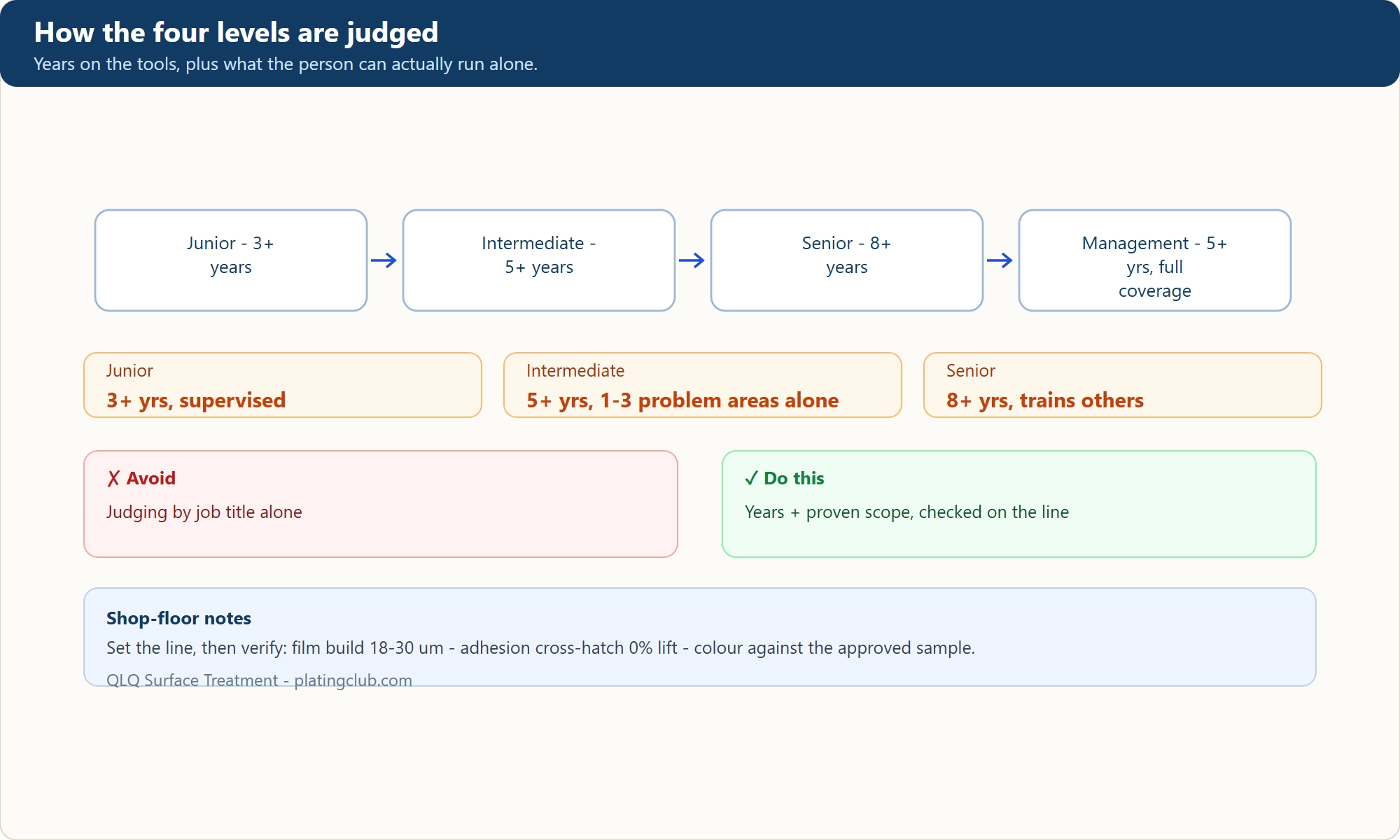
- Junior (1-3 yrs) — Runs the SOP, reads the parameter sheet, spots common defects
- Intermediate (3-5 yrs) — Knows why a parameter moves, reads data, diagnoses root causes
- Senior (5-8 yrs) — Owns the process window and the link to upstream/downstream steps
- Management (8+ yrs) — Cost, yield, rescue plans, team and customer communication
Not sure where a topic sits? Use the trade + level picker, or open the full knowledge map. Owners can start from the process overview.
Line layout: what has to be next to what
| Zone | Contains | Why the position matters |
|---|---|---|
| Load / unload | Racking station, jigs, inspection light | Keeps handling marks away from the finished area |
| Pretreatment | Degrease, pickle, rinse cascade | Short transfer distance to plating |
| Plating | Tanks, rectifiers, filters, agitation | Rectifier close to the tank reduces voltage drop |
| Post-treatment | Passivate, seal, dry | Drying right after sealing avoids water marks |
| Wastewater | Collection, dosing, sludge | Gravity flow where possible |
Throughput and thickness are a trade
- Doubling current halves time but narrows the thickness window
- Rack density changes current distribution more than bath chemistry
- Measure thickness at three positions per rack, every shift
FAQ
How many tanks do we need to start?
A single-line shop usually runs pretreatment, copper, nickel, decorative and two rinses between stages. Adding a spare rinse tank is cheaper than rework.
Can one line run decorative and functional work?
Not at the same time without contamination risk. Share the pretreatment, separate the plating tanks.