
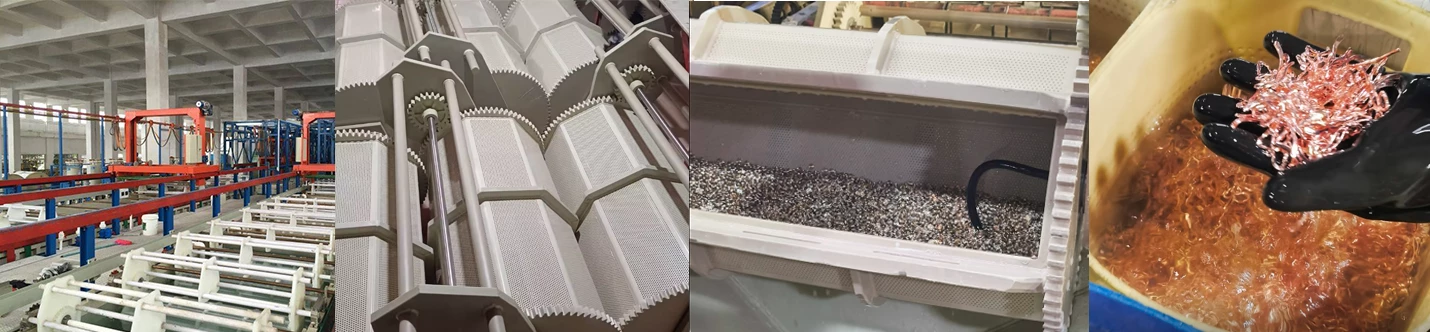
Professional Zinc Alloy Surface Finishing Solutions
Acid Copper
Barrel Acid Copper Plating — Build Thickness & Leveling
Acid copper for barrel plating: CuSO₄ 180-220 g/L, H₂SO₄ 50-70 g/L, Cl⁻ 60-80 ppm, 20-30 °C, 1-3 A/dm². Brightener and leveler control, high-current burn prevention.
Why Barrel Acid Copper
Acid copper builds thickness, fills surface imperfections and creates the mirror base for nickel and color plating
Barrel vs Rack — Acid Copper Comparison
How barrel acid copper differs from rack for small parts
| Parameter | Barrel Plating | Rack Plating |
|---|---|---|
| CuSO₄·5H₂O | 180-220 g/L | 200-250 g/L |
| H₂SO₄ | 50-70 g/L | 60-100 g/L |
| Cl⁻ | 60-80 ppm | 60-100 ppm |
| Temperature | 20-30 °C | 20-35 °C |
| Current density | 1-3 A/dm² | 3-6 A/dm² |
| Barrel rotation | 8-15 rpm | N/A |
| Plating time | 20-60 min | 15-40 min |
| Deposition rate | 0.3-0.8 μm/min | 0.5-1.5 μm/min |
| Burn risk management | Cathode rod movement + rotation | Direct current + air agitation |
▼
Barrel Acid Copper — Process Steps
Building thickness with brightener-leveler control in the rotating barrel environment
1Bath Make-up & Control
Copper sulfate + sulfuric acid + chloride ions. Brightener and leveler are added via continuous dosing pump. Temperature control is critical — above 30 °C causes additive breakdown.
Key Parameters
CuSO₄·5H₂O: 180-220 g/L
H₂SO₄: 50-70 g/L
Cl⁻: 60-80 ppm
Temperature: 20-30 °C
Brightener: 0.5-5 mL/L
2Barrel Immersion & Rotation
Load barrel with alkaline-copper-struck parts. Barrel rotation exposes fresh surfaces and prevents 'basket effects' where interior parts get no current.
Key Parameters
Barrel rotation: 8-15 rpm
Current density: 1-3 A/dm²
Anodes: Phosphorized copper (0.04-0.06% P)
3Brightener & Leveler Dosing
Proprietary brightener produces mirror-bright deposits. Leveler fills micro-scratches. Additives are consumed during plating — replenish via ampere-hour dosing.
Key Parameters
Brightener consumption: 80-150 mL/kAh
Leveler consumption: 30-60 mL/kAh
Wetting agent: 1-3 mL/L for pitting control
4Burn Prevention — Barrel-Specific Controls
High-current-density areas on barrel edges can burn. Solutions: cathode rod reciprocation, periodic current reversal (PR), and maintaining Cl⁻ above 60 ppm.
Key Parameters
Cathode rod movement: Reciprocate 20-50 mm stroke
PR current: Forward 8 s / Reverse 1 s (optional)
Cl⁻ minimum: ≥ 60 ppm
5Rinse & Transfer to Nickel
Thorough rinse removes acid copper drag-out. Carry-over of Cu²⁺ into nickel bath causes metallic contamination (rough black deposits in nickel).
Key Parameters
Rinse stages: 2-3 counter-current + 1 DI
Cu²⁺ limit in rinse: < 10 ppm before nickel transfer
▼
Acid Copper Troubleshooting
Fast diagnosis for barrel acid copper defects
| Problem | Most Likely Cause | Barrel-Specific Fix |
|---|---|---|
| Burning at barrel openings | Current density too high for barrel geometry | Reduce current 20%; increase rotation to 12+ rpm; install cathode shields |
| Dull / hazy deposits | Low brightener or high temperature | Check brightener consumption vs kAh; verify temp < 30 °C |
| Rough / nodular deposits | Suspended solids or anode sludge | Filter bath through 5 μm cartridge; bag anodes |
| Poor throwing power inside barrel | Cl⁻ too low or current too low | Check Cl⁻ ≥ 60 ppm; increase current 10-15% |
| Pitting / porosity | Insufficient wetting agent or Cl⁻ | Add wetting agent 1-2 mL/L; verify Cl⁻ level |
📌 Acid Copper Cheat Sheet
CuSO₄·5H₂O180-220 g/L
H₂SO₄50-70 g/L
Cl⁻60-80 ppm
Temperature20-30 °C
Barrel current density1-3 A/dm²
Barrel rotation8-15 rpm
Brightener consumption80-150 mL/kAh
Anode typePhosphorized Cu (0.04-0.06% P)
⚠ Chloride ion control is critical in barrel acid copperCl⁻ below 50 ppm: burnt haziness and poor leveling. Cl⁻ above 120 ppm: brightener over-consumption, anode passivation. In barrel lines, Cl⁻ drift happens faster due to higher drag-in/out rates from barrel rotation. Test every 2 hours during production and maintain a chloride ion selective electrode on-line.
FAQ
Why is barrel acid copper current density lower than rack?
In barrel plating, effective cathode area is larger than the part surface — the barrel surface and 'idle' parts also receive some current. Also, the resistive barrier layer created by the barrel mesh reduces voltage efficiency. Result: the same current gives lower per-part deposition rate in barrel than rack.
How do I calculate barrel current setting?
Estimate total surface area of parts in the barrel (≈ batch weight ÷ avg part weight × avg part area). Multiply by desired current density (1-3 A/dm²). Start at the low end (1 A/dm²) and increase if plating is too slow or coverage is good.
Can I run acid copper without alkaline copper strike?
Only on steel or copper substrates. On zinc alloy — absolutely not. Acid copper directly on zinc causes displacement (cementation) and catastrophic adhesion failure.
What brightener system do you recommend for barrel acid copper?
For barrel lines, choose a brightener formulated for high-agitation environments. Standard rack brighteners foam excessively with barrel rotation. We use QLQ-BC-1 barrel-specific acid copper brightener — low-foam, wide current density window.
How often should I carbon-treat the acid copper bath?
Every 4-6 weeks or 100 Ah/L. Brightener breakdown products accumulate and cause poor leveling. Carbon filtration (2-4 g/L activated carbon, 2-4 h circulation) restores bath performance.
Acid Copper Barrel Line — Animated Schematic
Animated schematic: tumble barrel rotating in the copper sulfate bath with titanium basket anodes — reduced-motion users see a static layout.
Get a Free Quote Today
Send us your samples or drawings — our engineers reply within 24 hours with pricing and technical advice.
Contact Us