
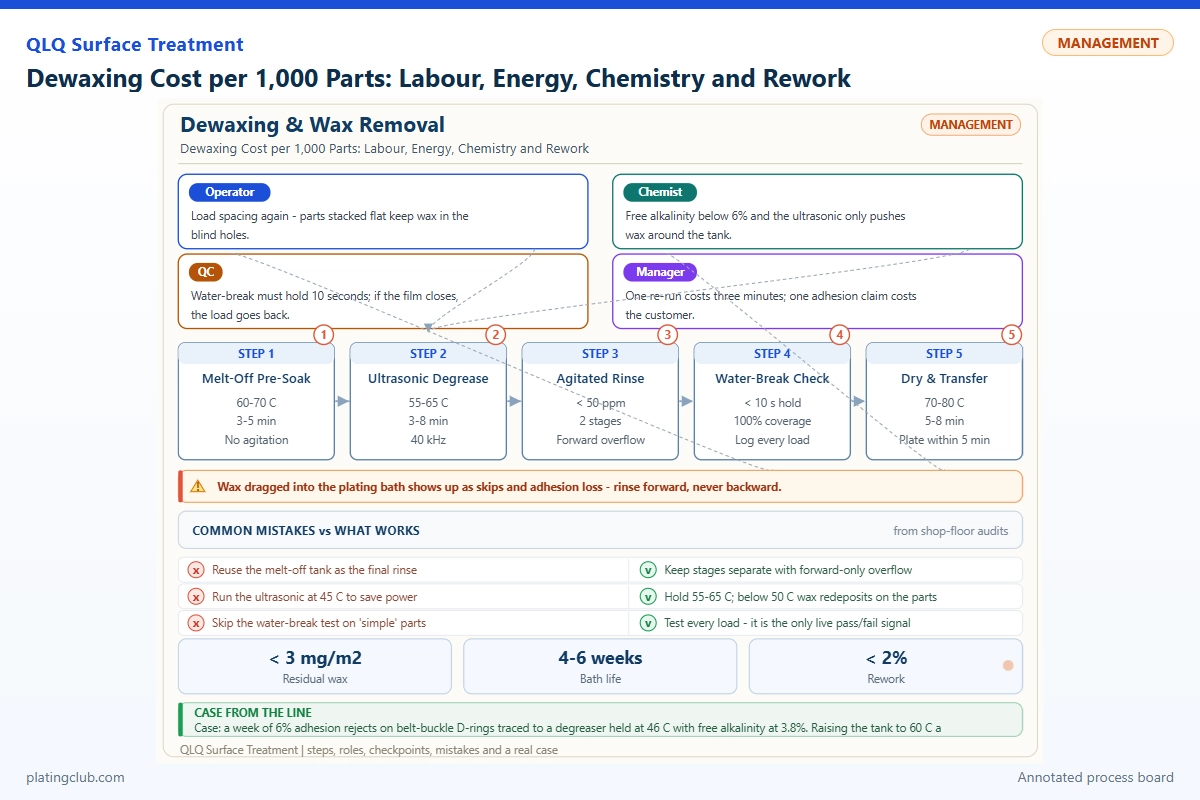
Every manager knows the cost of the plating bath and almost nobody knows the cost of the wash before it. This model puts dewaxing on one page per 1,000 parts, with the three automation cases that pay back inside a year.
EUR 32-48
Cost per 1,000
40-60% of cost
Rework share
< 12 months
Automation payback
Cost build per 1,000 parts (single shift, 600 L tank)
| Cost line | Typical | Range | Lever |
|---|---|---|---|
| Labour | EUR 14.00 | 10-20 | Basket handling and logging time |
| Chemistry | EUR 3.60 | 2.5-5.0 | Bath life and dose control |
| Energy (heat) | EUR 4.80 | 3.5-7.0 | Tank covers, set-back overnight |
| Water + wastewater | EUR 2.90 | 1.5-4.5 | Cascade rinsing |
| Rework | EUR 9.00 | 2-25 | Water-break discipline (biggest lever) |
| Total | EUR 34.30 | 20-55 |
Three automation cases and their payback
| Case | Capex | Annual saving | Payback |
|---|---|---|---|
| Automatic dosing + titration | EUR 2,800 | EUR 3,400 (chemistry + rework) | 10 months |
| Tank covers and night set-back | EUR 650 | EUR 1,900 (energy) | 4 months |
| Basket rotation jig | EUR 1,100 | EUR 2,600 (rework) | 5 months |
Management dashboard (five numbers, weekly)
| Metric | Target | Source | Owner |
|---|---|---|---|
| Cost per 1,000 parts | < EUR 40 | Cost sheet | Production manager |
| Rework rate | < 2% | Water-break log | QC |
| Bath life | > 4 weeks | Build record | Chemist |
| Energy per 1,000 | < EUR 5 | Meter | Maintenance |
| Claim count | 0 | Sales | Owner |
Watch out
Rework is 40-60% of the cost on a bad week and almost invisible on a good one. Put the re-run count on the same board as the plating reject rate - they move together.
Common mistakes and the fix
| ✗ Measure cost per litre, not per 1,000 parts | ✓ Per-part maths is the only comparable number |
| ✗ Buy a bigger tank instead of fixing discipline | ✓ Rework dominates; fix the gate first |
| ✗ Cut tank temperature to save energy | ✓ A 5 C cut costs more in rework than it saves in power |
| ✗ Leave the tank hot overnight | ✓ Covers and set-back cost under EUR 700 and pay back in months |
What each role watches
| Operator | "Log re-runs by reason; unreasoned re-runs get counted twice." |
| Chemist | "Titrate daily and keep the bath inside a 2-point alkalinity band." |
| QC | "Publish the weekly rework rate next to the plating reject rate." |
| Manager | "Review five numbers weekly; do not accept 'the wash is free'." |
From the shop floor
Case: a 30-person shop measured dewaxing for the first time and found EUR 51 per 1,000 parts, with rework at EUR 21. Covers, dosing control and a rotation jig brought it to EUR 36 within four months - a EUR 7,900 annual saving on one tank.
FAQ
Is dewaxing really worth a cost model?
It is usually 3-6% of surface-finishing cost and the easiest place to find rework. The model takes an afternoon to build.
How do I separate dewaxing rework from plating rework?
Log the stage where the defect was caught. Water-break failures are dewaxing by definition.
What is a realistic target for small hardware?
Under EUR 40 per 1,000 parts with rework below 2%. Most shops start between EUR 45 and EUR 60.
Where to go next
- Level guide for this trade: Dewaxing & Ultrasonic Cleaning — technician levels
- Other levels: Junior, Intermediate, Senior
- Owner view: Process Overview for owners
- Supplier view: Chemistry & Supply · Find content by trade + level