
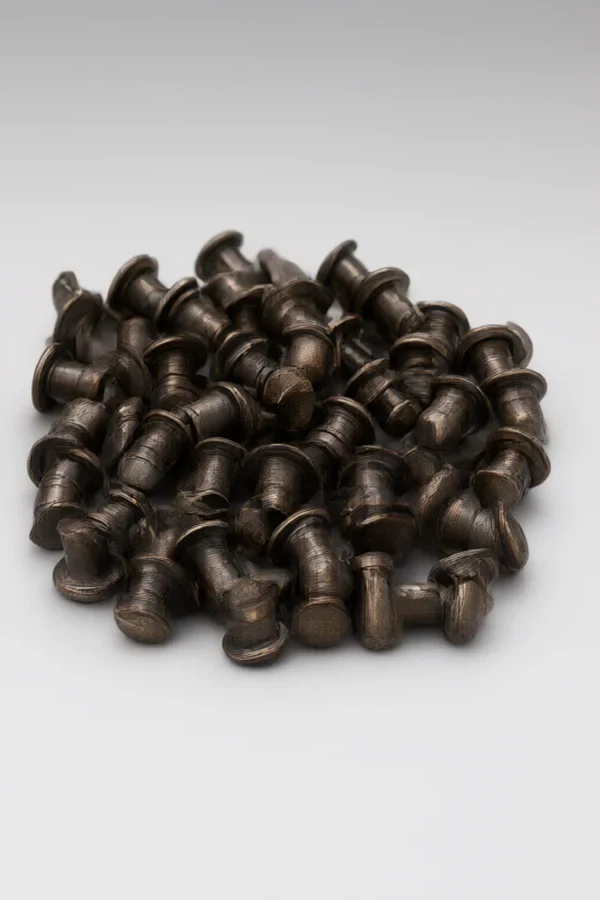
Barrel plating is the workhorse process for small zinc alloy hardware - sliders, buttons, D-rings, rivets and loops. Parts tumble inside a rotating perforated barrel, allowing thousands of pieces to be plated in one load. The trade-off is contact marks and a slightly less uniform deposit than rack plating, so barrel masters control load size, current density and rotation speed with discipline.
This guide focuses on Zinc Alloy Rivet & Brad Set finished as Antique Bronze Plated - one product, one process, from the master's notebook: what can go wrong, how the SOP runs, what chemistry is in the tank, and how to prove the result.
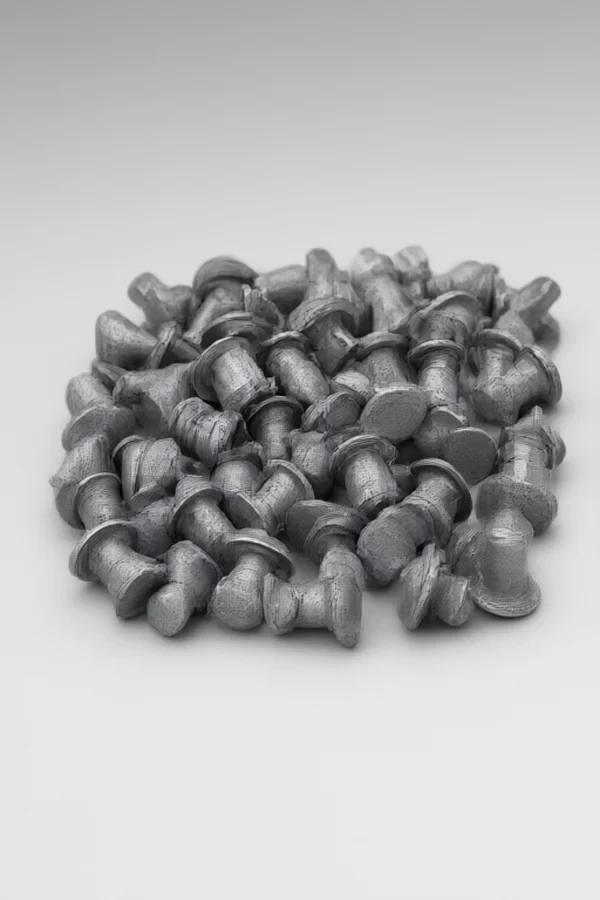
10 Common Problems & Solutions - Zinc Alloy Rivet & Brad Set
Field-tested by workshop masters: the ten defects plating and painting shops see most often on zinc alloy rivet & brad set, with root causes and the exact fix used on the production line.
| Problem | Root Cause | Master's Fix |
|---|---|---|
| 1. Skip plating / contact marks | Load too high, current too high at barrel make/break | Reduce load to 40-60% volume, ramp current after immersion, pre-treat thoroughly |
| 2. Burns at the barrel mouth | Current density peaks on outer parts | Reduce total current, use larger perforations, slow rotation slightly |
| 3. Poor coverage in recesses | Low throwing power or too short a cycle | Extend plating time, raise complexant level, lower current density, improve bath agitation |
| 4. Roughness and nodules | Particulate contamination in bath | Continuous 5-10 um filtration, bag anodes, carbon-filter weekly |
| 5. Pitting on plated surface | Hydrogen bubbles trapped by excess brightener | Reduce brightener, add wetting agent, verify rotation speed |
| 6. Adhesion failure after bend test | Pre-treatment fail or missing copper strike | Improve pre-treatment, verify water break, use cyanide-free copper strike on all zinc |
| 7. Dull or hazy deposit | Brightener depleted or bath temperature low | Analyze and replenish brightener, hold 55-62 C, run Hull cell |
| 8. Batch-to-batch color variation | Current / time drift or bath imbalance | Fix load, current and time per spec; log every barrel; Hull cell each shift |
| 9. Orange-peel on flash colors | Bright nickel surface too rough | Improve nickel leveling, polish substrate before plating, verify brightener balance |
| 10. Streaking from retained solution | Barrel internal rinse insufficient | Add drag-out recovery and internal rinse cycles after each bath |
Key Measures to Improve Quality
The daily disciplines that separate a 98% line from a 99.5% line:
- Run a Hull cell test every shift on copper and nickel baths.
- Measure thickness by XRF every 2 hours on 5 parts per barrel.
- Start one salt-spray sample per day per product.
- Log pH, temperature, current and rotation on every barrel.
- Use an ampere-hour meter to drive brightener dosing.
- Carbon filter each bath weekly or every 5 kAh.
- Replace anode bags monthly; inspect contacts weekly.
- First-article sign-off on the first barrel of every new lot.
SOP - Step-by-Step Operating Procedure for Zinc Alloy Rivet & Brad Set
Workshop SOP with time, temperature and control points. Post this at the tank line.
Formula, Technical Parameters & Test Standards
Two-bath system: cyanide-free alkaline copper strike + bright nickel. Working volumes per 1,000 L.
Bath / Formula (working concentrations)
| Cyanide-free alkaline copper - Cu metal | 8-12 g/L (complexed copper salt) |
| Cyanide-free alkaline copper - complexing salt | 120-180 g/L |
| Copper bath pH | 9.0-10.5 |
| Copper bath temperature | 45-55 C |
| Copper current density (barrel) | 0.5-1.5 A/dm2, 8-14 V |
| Copper brightener | 3-8 mL/L, replenish 80-150 mL/kAh |
| Bright nickel - nickel sulfate NiSO4.6H2O | 240-300 g/L |
| Bright nickel - nickel chloride NiCl2.6H2O | 45-60 g/L |
Bath / Formula (continued)
| Bright nickel - boric acid | 40-50 g/L |
| Nickel pH / temperature | 4.0-4.8 / 55-62 C |
| Nickel current density (barrel) | 1-3 A/dm2 |
| Nickel brightener A (carrier) | 5-10 mL/L |
| Nickel brightener B (secondary) | 0.5-1.5 mL/L |
| Wetting agent | 0.5-1.0 mL/L |
| Flash bath (gold / gunmetal) | 0.05-0.3 um, 1-3 min, 0.3-1.0 A/dm2 |
Operating Parameters
| Barrel load | 15-30 kg standard, 50 kg absolute maximum |
| Barrel volume fill | 40-60% of barrel volume |
| Rotation speed | 4-8 rpm (slower for delicate parts) |
| Copper plating time | 20-40 min |
| Nickel plating time | 30-60 min |
| Flash / topcoat time | 1-3 min |
| Rectifier | 12 V DC, 500-1,000 A per barrel |
| Temperature control | +/-2 C on copper and nickel |
| pH check | Hourly on both baths |
| Hull cell test | Every shift on both baths |
| Ampere-hour meter | Drives brightener dosing automatically |
| Filtration | 5-10 um, 2-3 turnovers/h, continuous |
Inspection & Test Standards
| Standard | Requirement |
|---|---|
| ASTM B456 | Electrodeposited coatings of copper + nickel + chromium - service condition grades |
| ISO 4525 | Nickel and chromium coatings on zinc alloy |
| ASTM B571 | Adhesion of metallic coatings |
| ISO 9227 / ASTM B117 | Neutral salt spray 24-72 h per customer class |
| ASTM B487 | Measurement of coating thickness by cross-section |
| ASTM B568 | X-ray fluorescence thickness measurement |
Workshop Line Data for Workshop Managers
Reference capacity and utility data for planning this barrel plating line (cu + ni + antique) around zinc alloy rivet & brad set.
| Line / Cell | Barrel Plating Line (Cu + Ni + Antique) |
| Batch / Rack Load | 35 kg / barrel |
| Cycle Time | 80-100 min / barrel |
| Daily Output (10-hour shift) | 120,000-140,000 pcs |
| Installed Power Demand | 145 kW |
| Operating Staff | 5 operators + 1 QC |
| Floor Area | 275 m2 |
| Water Consumption | 30 m3/day |
Master Tips from the Workshop Floor
- The barrel is a resistor, not a rectifier - parts at the centre of the load need time, not voltage. When coverage fails, extend time before raising current.
- Never let a barrel start current while the rectifier is hot; ramp current over 10-15 s to avoid burning the outer parts.
- The best quality barrel line looks boring: same load, same current, same time, every barrel. Variation is the enemy.
- An ampere-hour meter is the cheapest quality investment - it turns brightener dosing from guesswork into arithmetic.
QLQ engineers can review your line, supply bath chemistry, paint systems and equipment, and support a pilot run with your own parts. Send samples or drawings - our engineers reply within 24 hours with pricing and technical advice.
Published by QLQ Surface Finishing - your partner for zinc alloy surface treatment: pre-treatment, dewaxing, barrel and rack plating, spray painting, lacquering, electrophoretic coating, QC and packaging. Process values are production references; validate against your bath analysis and customer specification before scale-up.