

Copper & Nickel Base Layers
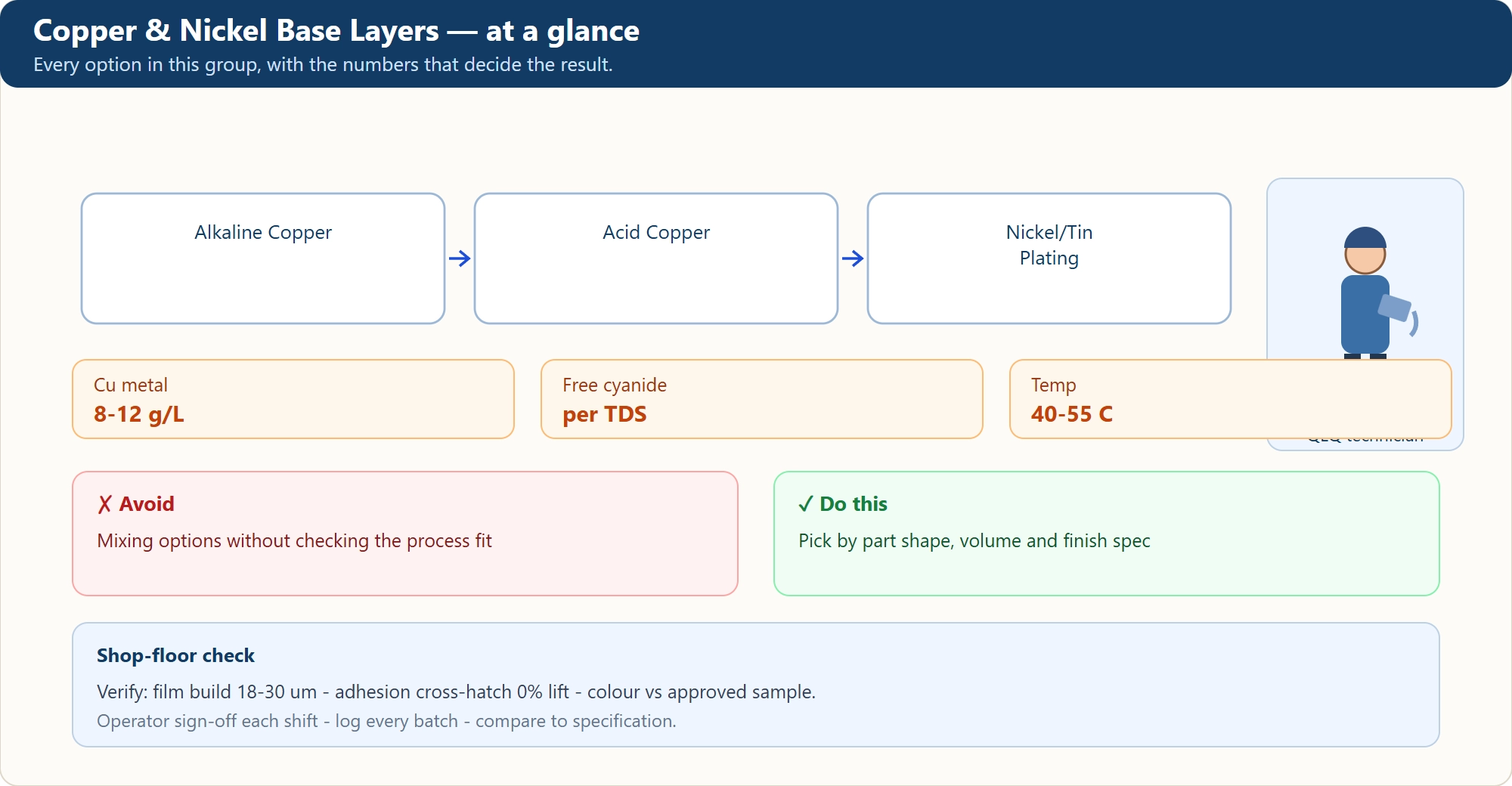
Copper & Nickel Base Layers groups every process in this section. The overview below shows all options side by side - click any card to open the full process page with working parameters, step-by-step procedure and QC checks.
How to choose
Part shape, batch size and the finish specification decide the route. Every page in this group lists working parameters and the checks that must pass before shipping. Ask QLQ engineering if your case sits between two options.
Why copper and nickel sit under the final finish
On zinc-alloy castings and steel parts, a copper strike levels the surface and absorbs the mechanical polishing marks that the die leaves behind. The nickel layer above it builds the brightness, provides the corrosion barrier and carries the final decorative deposit. Skip either layer and the top coat shows the substrate: sink marks, pinholes and a colour that shifts with the viewing angle.
The three routes below cover most production cases. Choose by substrate, spec and throughput - not by which bath is already in the tank.
Copper routes: cyanide strike vs acid build-up
| Item | Alkaline (cyanide) copper | Acid copper |
|---|---|---|
| Main salt | Cu metal 8-12 g/L, free cyanide per TDS | CuSO4 180-220 g/L |
| Acid / pH | pH 10.5-11.5 | H2SO4 50-70 g/L |
| Temperature | 40-55 C | 20-28 C |
| Typical thickness | 2-4 um strike | 8-20 um build-up |
| Best for | First layer on zinc alloy; adhesion | Levelling and thickness; brightening |
| Watch out | Cyanide handling and waste treatment | Chloride 40-80 ppm - too high gives dull, rough deposits |
Working ranges only. Confirm against the supplier TDS for your bath and part geometry.
Nickel and nickel-tin: what to expect
| Layer | Typical bath | Thickness | Appearance after top coat |
|---|---|---|---|
| Bright nickel | Watts-type, pH 3.8-4.4, 50-60 C | 6-12 um | Bright, levelled, good colour uniformity |
| Nickel-tin (65/35) | pH 3.5-4.5, 50-60 C | 3-8 um | Slightly warmer tone, excellent corrosion resistance |
| Semi-bright nickel | Sulphur-free, 50-60 C | 8-15 um | Duplex system with bright nickel above |
Nickel thickness drives salt-spray hours more than any additive. Specify hours, not just microns.
Defect → cause → fix
| Symptom | Most likely cause | First move |
|---|---|---|
| Blistering after top coat | Organic contamination in copper bath or poor rinse | Carbon treat copper, check rinse water conductivity |
| Poor adhesion on zinc alloy | Weak or skipped cyanide strike | Re-strike 2-4 um, verify peel test |
| Dull / hazy nickel | Low chloride, low temperature or excess brightener | Analytical check, Hull cell panel |
| Colour mismatch batch to batch | Nickel-tin ratio drifting | Titrate tin, hold 60-70% Sn in deposit |
| Pitting in recesses | Air or grease trapped in blind holes | Air agitation + pre-wet before racking |
QC checks before shipping
- Adhesion: cross-hatch or bend test on 3 parts per rack
- Thickness: XRF on flat and recessed areas, log min and max
- Appearance: colour under D65 light against the approved golden sample
- Salt spray: per contract hours, coupon from the same rack
- Record bath analysis, temperature and current density with the batch
FAQ
Can we skip copper and plate nickel straight on zinc alloy?
Only with a dedicated nickel strike and tight process control. For decorative parts that must pass salt spray, the copper layer is the cheaper insurance - it stops the zinc-nickel interaction that shows up later as blistering.
How thick should the nickel be for outdoor hardware?
Decorative indoor parts are usually fine at 6-8 um. For outdoor hardware specify 12-20 um bright nickel, or a duplex semi-bright plus bright system, and verify with salt spray rather than thickness alone.
Does nickel-tin replace nickel for gold-tone finishes?
It changes the undertone. Nickel-tin gives a warmer base that suits gold and champagne colours; bright nickel gives a cooler base that suits silver and chrome. Test both against your target colour chip.
What is the most common reason a batch fails salt spray?
Too-thin nickel at edges and recesses, plus rinsing gaps between copper and nickel. Check current density distribution on the rack before changing the bath chemistry.