
Tunnel Oven
Tunnel Baking Oven Design & Planning Guide" specifically tailored for Zinc Alloy Zipper Pulls and Bag Accessories.
regarding production capacity (10,000–20,000 units/day) and the specific curing requirements of Zinc Alloy (sensitive to temperatures over 150°C), QLQ have designed a 3-Pass Return Loop Tunnel Oven. This design saves floor space while maximizing curing time.
🏗️ Tunnel Oven Technical Design & Specifications
Design Concept: 3-Pass Loop System
Instead of a straight 60-meter line which takes up too much factory length, the conveyor makes 3 passes (U-turns) inside the oven chamber. This provides the necessary 40-45 minute curing time in a compact footprint.
Overall Dimensions
Physical Length: 20 Meters
Physical Width: 2.5 Meters
Internal Height: 1.8 Meters (Allows for 1-meter long racks + clearance)
Total Curing Path: 60 Meters (3 passes x 20m)
Production Speed: 1.0 to 1.8 Meters/Minute (Variable)
Construction Materials
Panels: 100mm Rock Wool Sandwich Panels (Double-sided 1.0mm Galvanized Steel). Insulation density 100kg/m³ to keep heat inside and the outer skin cool.
Internal Floor: Stainless Steel 304 (Easy to scrape clean of dripped paint).
⚙️ Mechanical & Electrical Configuration (380V System)
1 Conveyor Track System
Type: QXG-5T Enclosed Overhead Track. This is the industry standard for light hardware. It prevents dust/grease from the chain falling onto the product.
Chain: Heavy-duty forged steel chain with ball-bearing wheels.
Lubrication: High-temp automatic oiler (Graphite based).
Hangers: C-Type Hangers spaced at 300mm intervals.
2 Drive Unit (The Motor)
Power: 3.0 HP (2.2 kW) with Reducer.
Control: Inverter (VFD) Brand Name (e.g., Mitsubishi or Delta) is mandatory to adjust speed for different curing recipes.
Tensioner: Heavy-weight spring tensioner at the exit to keep the chain tight.
3 Heating System (The Heart)
Method: Electric Finned Tubular Heaters + Hot Air Circulation.
Why Finned? Smooth rods turn red and burn out. Finned heaters dissipate heat to the air faster, lasting longer and reducing fire risk.
Air Circulation: 4 Units of 1.5kW Centrifugal Fans on the roof to push hot air down and create a "Rolling Heat" effect. This ensures the top and bottom of the rack are the same temperature.
💰 Budget & Costing Plan (1.5x Factor Applied)
Total Estimated Project Cost: $68,250 USD
| Component Item | Quantity | Specifications | Unit Cost (USD) | Total Cost (USD) |
| Oven Structure Body | 1 Set | 20m x 2.5m x 1.8m, 100mm Insulation | $22,500 | $22,500 |
| Conveyor System | 80 Meters | QXG-5T Track, Chain, Curves, Tensioner | $150 / m | $12,000 |
| Drive Unit | 1 Set | 3HP Motor + VFD Control Box | $2,250 | $2,250 |
| Heating Elements | 60 Pcs | 2.0 kW Finned SS304 Heater (380V) | $75 | $4,500 |
| Circulation Fans | 4 Sets | 1.5 kW High-Temp Fan | $900 | $3,600 |
| Control Cabinet | 1 Set | SCR Temp Control (Precision ±1°C) | $5,250 | $5,250 |
| Air Curtain | 2 Sets | Mounted at Entry/Exit (Keeps heat in) | $900 | $1,800 |
| Installation Labor | 1 Team | Welding, Wiring, Commissioning | $12,000 | $12,000 |
| Spare Parts Kit | 1 Set | Extra heaters, chain links, fuses | $4,350 | $4,350 |
⚡ Heater Configuration Details
Heater Specs
Type: W-Shape Finned Tubular Heater (Stainless Steel 304).
Voltage: 380V / 3-Phase balanced load.
Power: 2.0 kW per piece.
Total Power: 120 kW (Divided into 3 Zones).
Mounting: Mounted on the Side Walls behind baffle plates. Never mount heaters on the bottom where paint drips can fall on them (Fire Hazard).
Temperature Logic for Zinc Alloy
Zone 1 (Pre-Heat): 80°C. Flashes off the solvent.
Zone 2 (Curing): 110°C - 130°C. The main cross-linking zone.
Zone 3 (Holding): 110°C. Ensures thorough cure.
Safety: High-limit thermal fuses installed in every zone. If temp hits 160°C, power cuts instantly to prevent Zinc deformation.
🚧 Construction & Installation Notices
Grounding & Earthing
The conveyor track MUST be perfectly grounded. Static electricity builds up in spray shops. Without grounding, the paint transfer efficiency drops, and you risk a spark explosion.
The "Clean" Tunnel
Do not use standard steel for the inner walls if possible. Use Stainless Steel or Galvanized Sheet painted with High-Temp White Paint. This reflects light, allowing operators to see fallen parts, and prevents rust scales from falling onto the fresh paint.
Expansion Joints
Metal expands when hot. The track inside the oven will expand by approx 2-3cm at 150°C. The installation team must leave Expansion Gaps in the rail joints, or the track will buckle and jam the chain.
Explosion Relief
Even with water-based paints, steam pressure builds up. The oven roof must have a "Pop-Hatch" (a loose panel) that can lift open to release pressure if an explosion occurs, saving the main structure from collapsing.
🛠️ Maintenance & Cleaning Routine
Weekly: The "Drip" Check
Paint drips from the racks and accumulates on the floor and heater guards.
Action: Scrape the floor. If paint builds up on the Finned Heaters, it acts as insulation, causing the heater to overheat and burst. Clean heaters = Long life.
Monthly: Chain Lubrication
The high heat evaporates standard grease.
Action: Inspect the automatic oiler. Use Molybdenum Disulfide (MoS2) or Graphite high-temp oil. Do not use standard grease; it will drip onto the products.
Quarterly: Air Balance
Check the circulation fans.
Action: If the fans vibrate, the bearings are dry. If the air ducts are clogged with paint dust, the temperature uniformity fails, leading to "Two-Tone" color defects (one side of the rack is darker than the other).
Yearly: Calibration
The temperature sensor (Thermocouple) drifts over time.
Action: Place a Data Logger on the conveyor chain and run it through the oven. Compare the actual air temp with the digital display. Adjust the offset in the control cabinet.
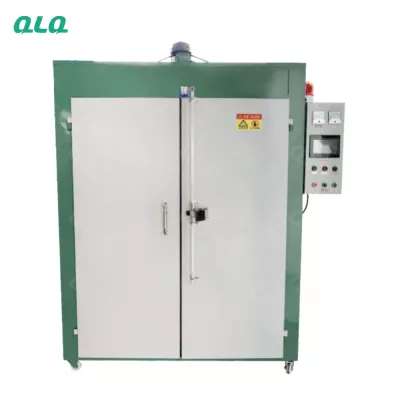
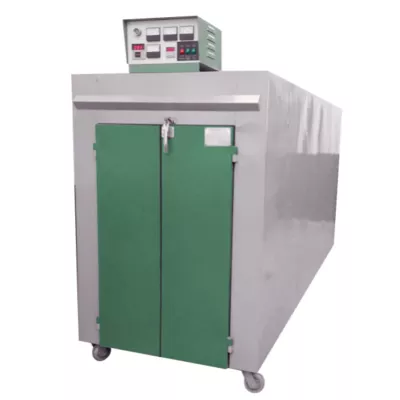
QLQ-OVM Automatic oven machine
precision industrial oven for electroplating and painting
Sort
- Recommended
- Newest