
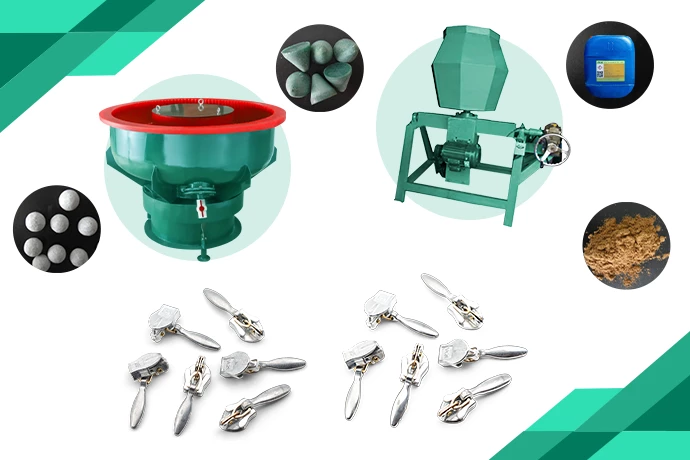
🌀 Machine & Media Configuration
1 The Vibratory Bowl Finisher
Type: 300L or 600L Curved-Wall Bowl.
Lining: PU (Polyurethane) lining is mandatory. Do not use rubber (too much friction) or unlined steel (destroys parts).
Motor: Variable Frequency Drive (VFD) is recommended to adjust amplitude.
Separator: Integrated Dam Gate with Interchangeable Screen Deck.
2 Grinding Media Selection Strategy
Rule: The media must be small enough to touch the corners, but large enough NOT to get stuck in the zipper pull hole or buckle slot.
A For Rough Cut (Deburring & Smoothing)
Material: Resin Bonded Plastic Media (Urea/Polyester).
Shape: Cone (General) or Tetrahedron/Pyramid (For corners).
Why Plastic? It is lighter than ceramic. It cushions the Zinc parts to prevent denting while cutting away the parting lines.
Color Code: Usually Brown or Blue.
B For Fine Polish (Brightening)
Material: High-Density Porcelain (Ceramic).
Shape: Cylinder (Angle Cut) or Ball.
Why Porcelain? It is non-abrasive. It burnishes (hammers) the surface to close the pores and create a shine.
Color Code: White.
🧪 The Two-Step Process (Recipe)
Step 1 The Rough Cut (Deflashing)
Goal: Remove the "Gate" mark and parting line. Smooth the surface skin.
Media: Plastic Cones (Medium Grit).
Chemical: [QLQ] Cutting Fluid (Acidic or Neutral).
Ratio (Part : Media): 1 : 4.
Time: 2 – 4 Hours.
Water: Continuous Dosing (Flow-through).
Step 2 The Fine Polish (Coloring)
Goal: Create a glossy surface for Plating/Painting.
Media: Porcelain Cylinders (Fine/No Grit).
Chemical: [QLQ] Polishing Liquid (Contains brighteners and lubricants).
Ratio (Part : Media): 1 : 4.
Time: 30 – 60 Minutes.
Water: Batch System (Closed loop) creates better foam and shine.
📊 Standard Operating Procedure (SOP)
Phase 1 Loading & Ratio Control
The "1-to-4" Law
For every 1 bucket of Zinc parts, you MUST have 4 buckets of Stones.
Risk: If you use 1:2, parts will collide with parts. Zinc is heavy; when two zipper pulls hit, they dent.
Total Load: The bowl should be 80% full of the Total Mix.
Phase 2 Chemical Dosing
Flow-Through Method (Recommended for Cutting)
Dose [QLQ] Cutting Fluid mixed with water (2%) continuously at 5 Liters/Hour.
Drain is OPEN.
This flushes out the metal dirt and plastic sludge immediately.
Batch Method (Recommended for Polishing)
Fill water to cover the load. Add 500ml [QLQ] Polishing Liquid.
Run for 45 mins.
Drain is CLOSED.
This builds up a thick foam which cushions the parts and creates a mirror finish.
Phase 3 Rinsing
Action: Open the drain. Turn on high-pressure water spray bars.
Time: Run for 10 minutes until water runs clear.
Chemical: Add [QLQ] Cleaning Agent during rinse to remove the oily film from the polishing compound.
Phase 4 Unloading & Screening
Action: Drop the Dam Gate.
The machine vibration pushes the mass onto the screen.
The Screen: Must be sized correctly.
Holes < Parts: Stones fall through; Parts stay on top (Standard).
Holes > Parts: Parts fall through; Stones stay on top (Reverse).
Visual Check: Ensure no stones are lodged in the zipper holes.
Phase 5 Drying (Critical)
Method A: Centrifugal Dryer (Spin)
Basket spin with hot air. Fast but risks spotting.
Method B: Corn Cob Dryer (Vibratory)
Heated bowl filled with [QLQ] Corn Cob Grit.
The cob absorbs water and wipes the part clean.
Result: Stain-free, dry surface.
🕵️ Quality Control & Inspection
1 The "Lodging" Test
Method: Take 100 finished zipper pulls. Shake them.
Defect: If you find > 1 stone stuck in a hole, you chose the wrong media size.
Fix: Switch to Angle-Cut Cylinders or larger Cones.
2 The "Impingement" Check
Method: Hold the part under light. Look for tiny "dents" or "peck marks."
Defect: This means the load ratio was too high (Too many parts) or the amplitude was too high (Too violent).
Fix: Add more stones (Change to 1:5 ratio). Lower motor speed (Hz).
3 The "White Film" Check
Method: Wipe the dried part with a black cloth.
Defect: White powder residue.
Cause: Poor rinsing or dirty drying corn cob.
Fix: Increase rinse time. Change [QLQ] Corn Cob Grit.
🚀 Efficiency & Productivity Hacks
1 The "Dual-Motor" Setup
Install a Variable Frequency Drive (VFD).
High Speed (50Hz): For the first 2 hours (Fast Cutting).
Low Speed (30Hz): For the last 30 mins (Polishing).
Benefit: Reduces cycle time by 20% without damaging parts.
2 Auto-Dosing System
Instead of the operator pouring a cup of [QLQ] Compound (which is inaccurate), use a Peristaltic Pump.
Benefit: Saves 30% chemical cost. Consistent quality batch-to-batch.
3 The "Pre-Sort" Station
Zinc die-casting gates (sprues) should be snapped off before entering the machine.
If you throw the sharp gates into the machine, they act like knives and scratch the good parts.
4 Magnetic Separation (For Steel Media only)
If you use Stainless Steel Balls (for high luster), use a Magnetic Belt to lift parts out (if parts are steel) or a Magnetic Drum to pull media out. Since Zinc is non-magnetic, use a Reverse Screen to separate.
📝 Costing & Consumables Table
| Item | Specification | Usage Rate | Note |
| Rough Media | Plastic Cone (Brown) | Wear Rate: 1-2% per hour | Replace when too small to scrub. |
| Fine Media | Porcelain Cylinder (White) | Wear Rate: < 0.1% per hour | Lasts for years. |
| Cutting Agent | [QLQ] Cutting Fluid | 2-3 Liters / Batch | Acidic. Removes oxide. |
| Polishing Agent | [QLQ] Polishing Liquid | 0.5 Liter / Batch | High foam. |
| Drying Media | [QLQ] Corn Cob (20 Mesh) | Change weekly | Absorbs water/oil. |
| Electricity | 5.5 kW Motor | 5.5 kWh per hour | Main cost driver. |
Master's Experience Share
"Vibratory finishing is the bottleneck of the factory. Plating takes 45 minutes; Vibratory takes 4 hours.
My advice: Do not buy one giant 600L machine. Buy four 150L machines.
Why? You can run 4 different products/colors at the same time. If one giant machine breaks, production stops. If one small machine breaks, you still have 75% capacity."