
The First 90 Seconds: A Real-World Case of Degrease Decision-Making
It was a typical morning shift in a zinc alloy plating workshop, and the team was preparing for a new batch of zipper sliders. The operators had just completed the polishing step, and the sliders looked clean under the raking light. The first step in the plating process was degreasing, a critical phase that could make or break the entire batch. The lead technician, with a practiced eye, ran a quick water-break test using the raking light. The result was alarming—visible water beads forming on the surface of the sliders, indicating the presence of residual soil or contaminants.
The team quickly realized that the sliders had not been adequately cleaned after polishing. The degrease chemistry was within the standard range, but the water-break test failed, revealing a hidden issue. The operator hesitated, recalling a similar situation from a few months ago when a batch had been lost due to blistering after plating. That time, the team had missed the early signs of a degreasing failure, and it had cost them 40,000 pieces. This time, they couldn’t afford to make the same mistake.
Instead of proceeding with the plating step, the team decided to re-degrease the batch using a more aggressive formula and extended the degrease time. The result was a successful water-break test, and the sliders passed all subsequent inspections. This incident highlighted the importance of the first 90 seconds after polishing—when decisions about degreasing can determine the fate of an entire batch. It also underscored the value of a structured decision tree that considers soil level, chemistry, and the water-break test. The lesson was clear: in zinc alloy plating, the first 90 seconds after polishing are not just a routine step, but a critical checkpoint that can save or destroy a batch.
Key Parameters for Degreasing Zinc Alloy Sliders
To ensure a successful degreasing process, several critical parameters must be carefully controlled within specified ranges. The degreaser concentration should be maintained between 10-30 g/L, as both under- and over-concentration can lead to inadequate cleaning or excessive corrosion. The pH of the degreasing solution is also crucial, and it should be kept within 10.5-10.8 to ensure optimal cleaning performance without damaging the zinc alloy surface. The degreasing temperature must be maintained between 45-55 °C to ensure proper emulsification and removal of contaminants.
The degrease time is another critical factor, and it should be set between 60-90 seconds. This ensures that all surface contaminants are effectively removed without over-exposing the metal to the degreaser, which can lead to surface etching. The conductivity of the rinse water after degreasing must be kept below ≤5 µS/cm to prevent any residual ions from interfering with the subsequent plating steps.
For the activation step, the sulfuric acid concentration should be within 1-3%, and the activation time should be between 20-40 seconds. The pH of the degreasing solution after the process must remain below ≤11 to maintain the integrity of the metal surface. The water-break test should be conducted within 0-20 seconds, ensuring that the surface is free of any residual contaminants.
The composition of the degreasing solution also plays a significant role. Sodium hydroxide (NaOH) concentration should be maintained between 3-8%, while sodium carbonate (Na₂CO₃) should be kept within 1-2% to enhance cleaning efficiency. Surfactant concentration should be between 0.5-1.5% (sodium silicate acts as the dispersion buffer - it holds dislodged soils in suspension so they do not re-settle on parts) to ensure proper wetting and soil dispersion. Sodium silicate should be kept within 0.5-1.5% (sodium silicate acts as the dispersion buffer - it holds dislodged soils in suspension so they do not re-settle on parts) to prevent corrosion. Lastly, the degreasing process must be conducted at a temperature that does not exceed ≤70 °C, as higher temperatures can lead to excessive surface etching and reduced part integrity.
The Decision Tree: From Symptom to Root Cause
The first indication of the problem came during the initial water-break test. Under the raking light, the sliders showed a clear failure, with visible water beads forming on the surface. This was a red flag. The team immediately suspected that the degrease step had not been performed correctly. The first course of action was to re-degrease the batch using a slightly more aggressive formula and extending the degrease time. However, this fix did not yield the expected results. The water-break test was still failing, and the sliders continued to show signs of residual soil.
At this point, the team began to question the initial assumption that the degrease chemistry was the primary issue. They revisited the parameters and checked the pH of the degreaser, which was within the acceptable range of 10.5-10.8. The temperature was also within the required 45-55 °C, and the degrease time had been extended to 75 seconds, well within the 60-90 second window. The rinse water conductivity was ≤5 µS/cm, and the activation step had been performed with 1.5% H2SO4 for 30 seconds, which was within the 1-3% and 20-40 seconds ranges.
The problem was not immediately obvious. It was only after a more detailed analysis that the team discovered the root cause: the degreasing solution had a higher than normal concentration of sodium hydroxide (NaOH), which was 10% instead of the standard 3-8%. This deviation had not been flagged during the initial check, and it was the unexpected amphoteric behavior of the zinc alloy that had caused the water-break test to fail. The high NaOH concentration had not only failed to clean the surface but had also created a film that interfered with the subsequent plating steps.
This case highlighted the importance of the decision tree. The initial symptoms—water-break failure and residual soil—had led to the first attempt to fix the problem through extended degrease time. However, the real root cause had been an overlooked deviation in the degreaser composition. It was only after a more thorough investigation that the team was able to identify the issue and correct it, preventing a potential batch failure.
Workshop Insights: Smells, Shift Changes, and the Art of Degreasing
The workshop itself has a distinct character, shaped by the chemical processes that take place within its walls. The air often carries a faint, acrid scent from the degreasing solution, mingling with the sharper tang of sulfuric acid used in activation. These smells are familiar to the team, but they also serve as subtle indicators of process conditions. A change in the degreaser’s odor, for instance, can signal contamination or a deviation in concentration.
Shift changes are a critical moment in the workshop, where the handover of responsibilities can make or break a batch. During these transitions, the operators must ensure that all process parameters are accurately recorded and communicated. A momentary oversight—such as a missed pH check or a misread temperature—can lead to a cascade of errors later in the plating process. It’s a delicate balance of discipline and intuition, and the team has learned that the most effective solutions often come from experience rather than rigid protocols.
One of the senior technicians, who has been with the company for over two decades, once said: “You can’t degrease a greasy pig by waving a wand.” His words echo through the workshop, a reminder that even the most advanced chemistry cannot replace the need for proper technique and attention to detail. However, there are moments when even the most experienced team struggles to pinpoint the exact cause of a failure. In this case, the high sodium hydroxide concentration was a deviation that had not been immediately noticed, and the team had to rely on a combination of testing and intuition to identify the root cause.
Uncertainty is an inevitable part of the process, and it’s in these moments that the true skill of a surface finishing engineer is tested.
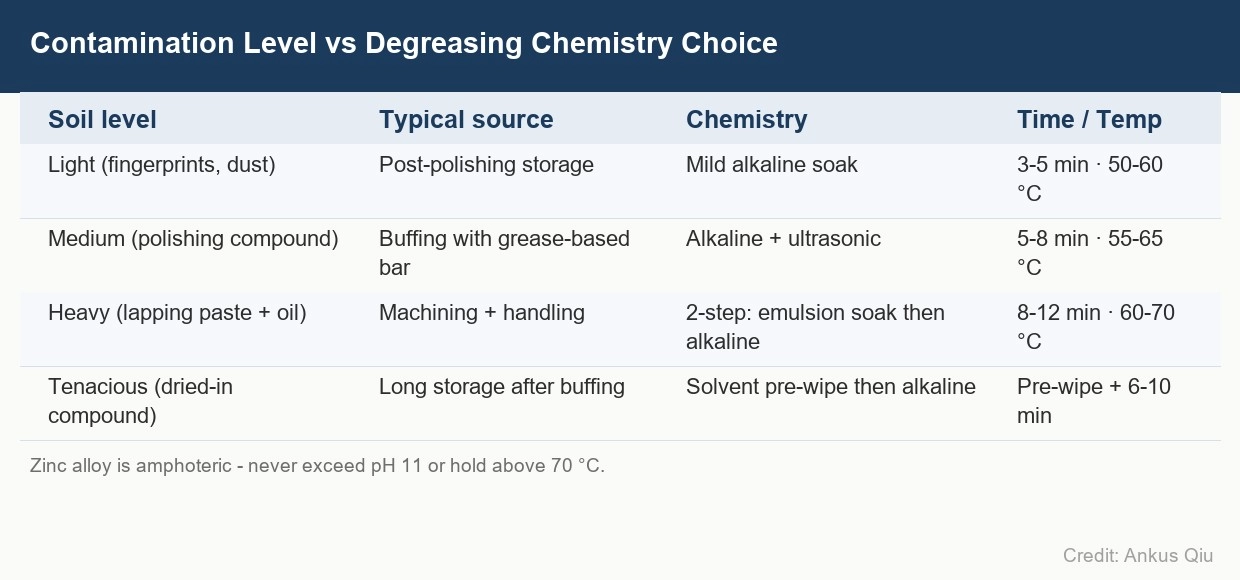
TABLE1: Soil/Chemistry Matrix
TABLE2: Water-Break Checklist
Standards and Final Notes
The degreasing process for zinc alloy sliders must adhere to industry standards to ensure consistent quality and performance. ASTM B117 provides guidelines for salt spray testing, which is essential for evaluating the corrosion resistance of plated surfaces. ISO 1456 outlines the requirements for degreasing processes, ensuring that contaminants are effectively removed before plating. Additionally, ASTM D523 is used to measure surface gloss, which can be an indicator of the effectiveness of the degrease and subsequent plating steps. These standards help maintain the integrity of the final product and ensure that the zinc alloy sliders meet the necessary specifications for durability and appearance.
In zinc alloy plating, the amphoteric nature of zinc necessitates careful control of the degreasing and activation steps. The use of alkaline solutions must be limited to pH ≤11, and the temperature should not exceed ≤70 °C to prevent surface degradation. The activation process, typically involving 1-3% H2SO4 for 20-40 seconds, must be precisely controlled to ensure proper surface preparation. These parameters are critical for achieving a high-quality finish and preventing issues such as blistering or poor adhesion.
— Ankus Qiu, lead process engineer, 25 years commissioning and auditing zinc-alloy plating lines for zipper and hardware factories
Frequently Asked Questions
1. What soil levels require immediate re-degreasing?
If the water-break test shows visible water beads or poor wetting, it indicates the presence of soil or contaminants. This is a clear sign that re-degreasing is necessary before proceeding to the plating step. Soil levels that are not effectively removed can lead to defects such as blistering or poor adhesion during plating.
2. How long should the water-break test be conducted?
The water-break test should be performed within 0-20 seconds after the degrease step. A successful test will result in a continuous, smooth film of water across the surface, indicating that the degrease has been effective. If the test shows water beads or poor wetting, it is an indication that the degrease process needs to be revisited.
3. What role does sodium hydroxide (NaOH) play in degreasing?
Sodium hydroxide is a key component in degreasing solutions, acting as a surfactant and emulsifier. It helps break down oils and contaminants on the metal surface. However, its concentration must be carefully controlled—typically between 3-8%—as excessive levels can lead to surface etching or the formation of a film that interferes with subsequent plating steps.
4. Why is pH an important parameter in degreasing?
The pH of the degreasing solution must be kept within 10.5-10.8 to ensure effective cleaning without causing damage to the zinc alloy surface. A pH that is too low can reduce the cleaning efficiency, while a pH that is too high can lead to over-etching and surface degradation.
5. What is the recommended sulfuric acid concentration for activation?
The activation step typically requires 1-3% H2SO4 for 20-40 seconds. This concentration is sufficient to activate the zinc surface without causing excessive etching or damage.
6. Why is the first 90 seconds after polishing critical for degreasing?
The first 90 seconds after polishing is a crucial window for degreasing because any residual soil or contaminants must be removed before they become embedded in the surface. A failure to act within this timeframe can lead to poor plating results, such as blistering or poor adhesion.
What Would You Like to Solve?
Have you encountered a degreasing issue that remained unresolved despite following standard procedures? Share your experience in the comments below—let’s troubleshoot together.
— Ankus Qiu, lead process engineer with 25 years commissioning and auditing zinc-alloy plating lines for zipper and hardware factories across SE Asia and Europe. Case data drawn from customer line records (2025-2026 audits); degreasing chemistry ranges reflect common industry practice per ASTM B322-adjacent shop standards.