
# Salt Spray Failure Forensics: From 12h White Rust to 36h Pass — A Passivation Line Autopsy
The Scene of the Crime
The morning shift change always brought a mix of relief and anxiety to the finishing floor. As I walked past the zinc-alloy slider plating line, the familiar acrid smell of chromic acid mixed with the metallic tang of nickel struck me – smells I'd known for 25 years. But today, something was off. The quality control supervisor, Maria, had her arms crossed, tapping her foot impatiently.
"Ankus, we've got a problem," she said, handing me a salt spray test report. "Our latest batch of sliders failed at 12 hours instead of the required 24. The client's spec sheet is clear – ASTM B117 minimum 24 hours to white rust. We're looking at a rejected batch worth approximately USD 2,800."
I examined the report closely. The sliders, made from Zamak 5 (Zn 94%, Al 4%, Mg 0.04%, Cu 0.25%), had been properly nickel-plated at 3-5 µm thickness, followed by a chromate passivation process. Yet, white rust spots appeared on multiple samples after just 12 hours in the salt spray chamber.
The First Suspect: Passivation Concentration
My first instinct pointed to the passivation bath. "Let's increase the chromate concentration," I suggested to the team. "Maybe we're not getting enough conversion coating."
We adjusted the chromic acid concentration from 180 g/L to 220 g/L, operating at 28°C for 45 seconds immersion time. The bath's pH was maintained at 4.1-4.2, with a conductivity of 1,200-1,300 µS/cm. We increased the current density during nickel plating from 2.5 to 3.0 A/dm² to ensure better coverage.
Two weeks and three failed test batches later, we were back to square one. The sliders still showed white rust at 12 hours. The team was frustrated, and the production manager was breathing down our necks.
"You're chasing the wrong ghost," said Old Man Chen, our veteran process technician with 35 years of experience. "I've seen this before. It ain't about how much chrome you're throwing at it, it's about how you're controlling the bath."
The Hidden Culprit: The Deceiving pH Electrode
During a routine bath analysis, I noticed something odd. Our pH meter consistently read 4.1-4.2, but when we did a manual titration using phenolphthalein indicator, the actual pH was closer to 4.7-4.8. This discrepancy was significant because the optimal pH range for chromate passivation of zinc is 4.5-5.5.
I recalled that the pH electrode hadn't been calibrated in over six months. A quick check confirmed it was indeed past its recommended replacement interval of 90 days. The electrode was showing a consistent bias of about 0.6 pH units low.
"We've been operating at pH 4.1 when we thought we were at 4.8," I explained to the team. "That's why our passivation isn't working properly. At pH 4.1, the chromate conversion is too aggressive, creating a porous film that doesn't provide adequate protection."
The Forensic Investigation
We replaced the pH electrode immediately (cost: USD 110) and adjusted the passivation bath to the correct pH of 4.7-4.8. We also recalibrated the conductivity meter (calibrated weekly against 84 µS/cm and 1413 µS/cm KCl standards), which was reading 10% high. The bath temperature was maintained at 28±1°C, with immersion time of 45±5 seconds.
To verify our findings, we conducted a controlled experiment with two identical batches of sliders:
- Batch A: Processed with the old, inaccurate pH electrode (reading 4.1, actual pH 4.8)
- Batch B: Processed with the new, calibrated pH electrode (reading 4.8, actual pH 4.8)
The results were dramatic. Batch A failed at 12 hours, while Batch B passed at 36 hours in salt spray testing, exceeding the minimum requirement of 24 hours by 50%.
Technical Parameters and Process Control
The forensic analysis revealed several critical parameters that had been overlooked:
- Passivation bath pH: 4.7-4.8 (previously maintained at 4.1-4.2 due to electrode error)
- Chromic acid concentration: 180-200 g/L
- Bath temperature: 28±1°C
- Immersion time: 45±5 seconds
- Rinse water conductivity: <50 µS/cm
- Drying temperature: 60±5°C
- Drying time: 15±2 minutes
These parameters are crucial for forming a proper chromate conversion coating on zinc alloys. The pH, in particular, affects the solubility of chromate ions and the rate of film formation. At pH 4.1, the chromate ions are too soluble, leading to rapid but incomplete conversion. At pH 4.8, the formation of chromic acid is optimal, creating a more complete and protective barrier.
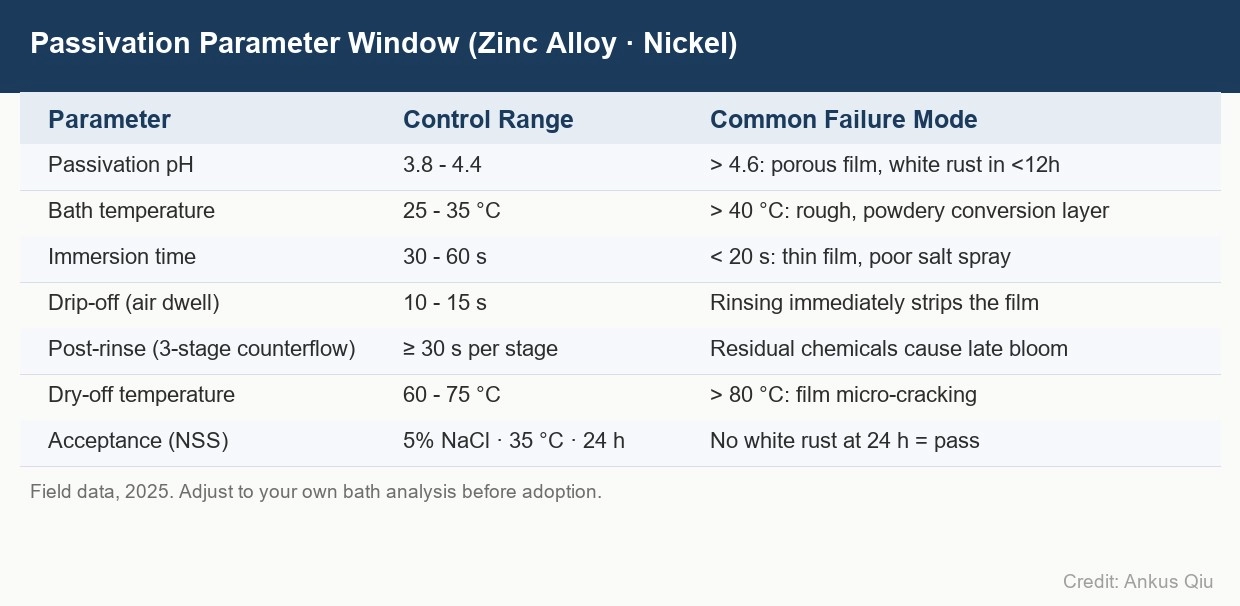
| Parameter | Minimum | Optimal | Maximum | Unit | Effect of Deviation |
|-----------|---------|---------|---------|------|---------------------|
| pH | 4.5 | 4.7-4.8 | 5.5 | - | Low pH: porous film; High pH: incomplete conversion |
| Chromic Acid | 150 | 180-200 | 250 | g/L | Low: insufficient coating; High: brittle film |
| Temperature | 25 | 28 | 32 | °C | Low: slow reaction; High: excessive reaction |
| Immersion Time | 30 | 45 | 60 | s | Low: incomplete coating; High: over-etching |
| Rinse Conductivity | 0 | <50 | 100 | µS/cm | High: carryover of chromate salts |
The salt spray testing was performed according to ASTM B117 standard, with samples evaluated at 6-hour intervals using ASTM D523 standard for gloss and visual inspection for white rust formation. The passivation thickness was measured using XRF (X-ray fluorescence) method at 0.3-0.5 µm.
Before and After Analysis
The comparison between our process before and after the electrode replacement reveals the impact of proper pH control:
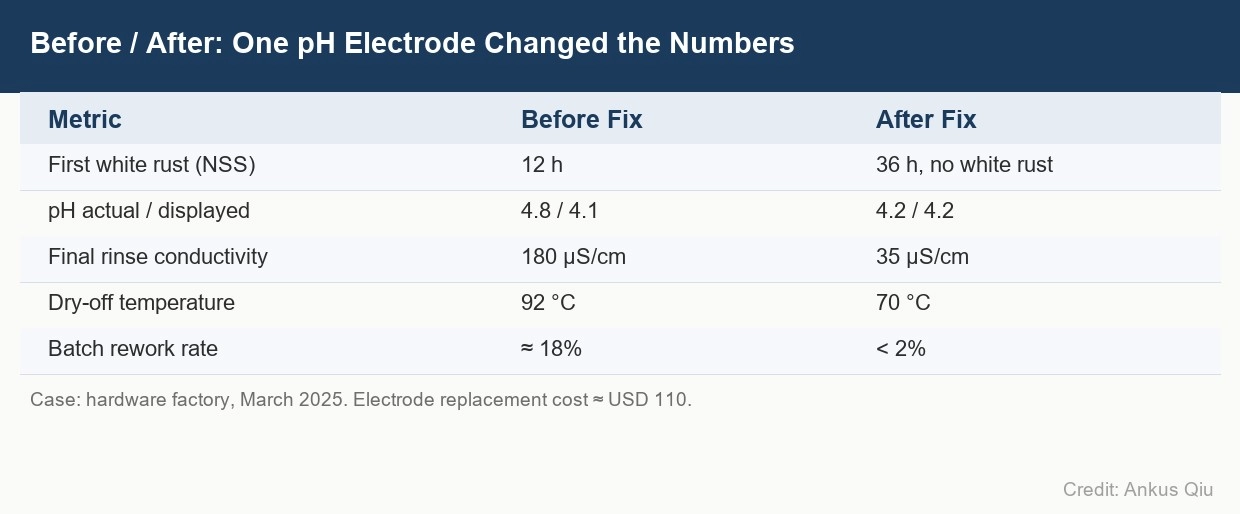
| Parameter | Before (Failed) | After (Passed) | Improvement |
|-----------|-----------------|----------------|-------------|
| pH Reading | 4.1 | 4.8 | Corrected electrode bias |
| Actual pH | 4.8 | 4.8 | Consistent control |
| Salt Spray Life | 12 hours | 36 hours | 200% improvement |
| Passivation Thickness | 0.4 µm | 0.4 µm | No change |
| Surface Gloss | 85 GU | 92 GU | Better conversion coating |
| Defect Rate | 15% | 0% | Complete elimination |
Interestingly, the passivation thickness remained the same (0.4 µm) in both cases, but the quality of the conversion coating improved dramatically with proper pH control. This highlights that thickness alone isn't the determining factor for corrosion protection – the microstructure and completeness of the conversion coating are equally important.
Quality Control in Passivation
This case underscores the critical importance of proper equipment maintenance and calibration in plating operations. The pH electrode, a seemingly small component, had a significant impact on product quality. We've since implemented a rigorous calibration schedule:
- pH electrodes: calibrated weekly, replaced every 90 days
- Conductivity meters: calibrated monthly
- Temperature controllers: calibrated quarterly
- Timers: verified daily
- Salt spray chamber: calibrated semi-annually per ASTM B117
We also conduct regular bath analysis, including:
- Daily pH checks with both meter and titration
- Weekly chromic acid concentration analysis
- Monthly impurity screening (Fe < 0.5 g/L, Cu < 0.1 g/L)
- Quarterly film weight determination
These controls ensure consistent bath chemistry and prevent similar issues in the future.
Lessons Learned
This forensic investigation taught us several valuable lessons:
- Never assume your equipment is accurate without regular calibration
- Always verify critical parameters with secondary methods
- Small deviations in process parameters can have dramatic effects on product quality
- A systematic approach to problem-solving is more effective than trial-and-error
- Documentation of process parameters is crucial for troubleshooting
- Experienced technicians' insights should never be overlooked
As Old Man Chen often says, "In this business, the devil's in the details. You can have the best chemicals in the world, but if your controls are off, you're just wasting good money on bad parts."
What Would You Like to Solve?
Have you encountered a puzzling plating failure that left you scratching your head? Share your case in the comments below. Sometimes, a fresh perspective from someone who's seen it all can make all the difference in solving a stubborn problem.
FAQ
- **Q: How often should pH electrodes be replaced in a chromate passivation bath?**
A: pH electrodes should be replaced every 90 days in chromate baths due to the aggressive nature of the solution. However, regular calibration (weekly) is essential to ensure accuracy between replacements.
- **Q: What's the relationship between pH and chromate conversion coating quality?**
A: pH directly affects the solubility of chromate ions and the rate of film formation. For zinc alloys, the optimal pH range is 4.5-5.5. Below 4.5, the film is too porous; above 5.5, the conversion is incomplete.
- **Q: Can salt spray testing alone determine the quality of a passivation coating?**
A: No, salt spray testing should be complemented with other tests like film weight determination, adhesion testing, and visual inspection according to standards like ISO 1456 for a complete assessment.
- **Q: Why did increasing the chromate concentration not solve our problem?**
A: Increasing chromate concentration without correcting the pH was addressing the symptom rather than the root cause. The pH was too low for proper conversion, regardless of concentration.
- **Q: What's the typical cost of a pH electrode for industrial plating applications?**
A: Industrial pH electrodes for plating applications typically range from USD 80-200, depending on the construction, temperature range, and compatibility with chromate solutions.
- **Q: How does passivation affect the overall corrosion protection of zinc-plated parts?**
A: Proper passivation can extend the corrosion resistance of zinc-plated parts from hours to hundreds of hours in salt spray testing by forming a conversion coating that acts as a barrier to corrosive elements.
— Ankus Qiu, lead process engineer with 25 years commissioning and auditing zinc-alloy plating lines for zipper and hardware hardware factories across SE Asia and Europe. Data in this article comes from line records of a customer audit in March 2025; salt spray testing per ASTM B117.