
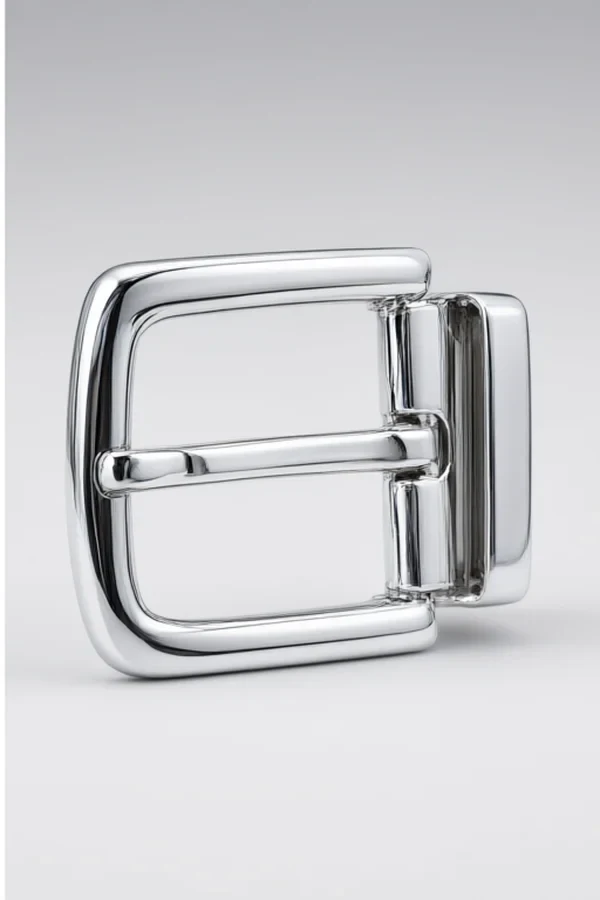
Pre-treatment decides whether the final plating or painting survives. A perfect plating bath cannot save a badly prepared surface: oil, oxide, hard-water film and embedded abrasive all sit invisibly between the substrate and the first deposit. For zinc alloy hardware the pre-treatment sequence is a balance - strong enough to make the surface chemically active, but controlled enough that the zinc itself is never etched.
This guide focuses on Zinc Alloy Belt Buckle finished as Bright Chrome Plated - one product, one process, from the master's notebook: what can go wrong, how the SOP runs, what chemistry is in the tank, and how to prove the result.
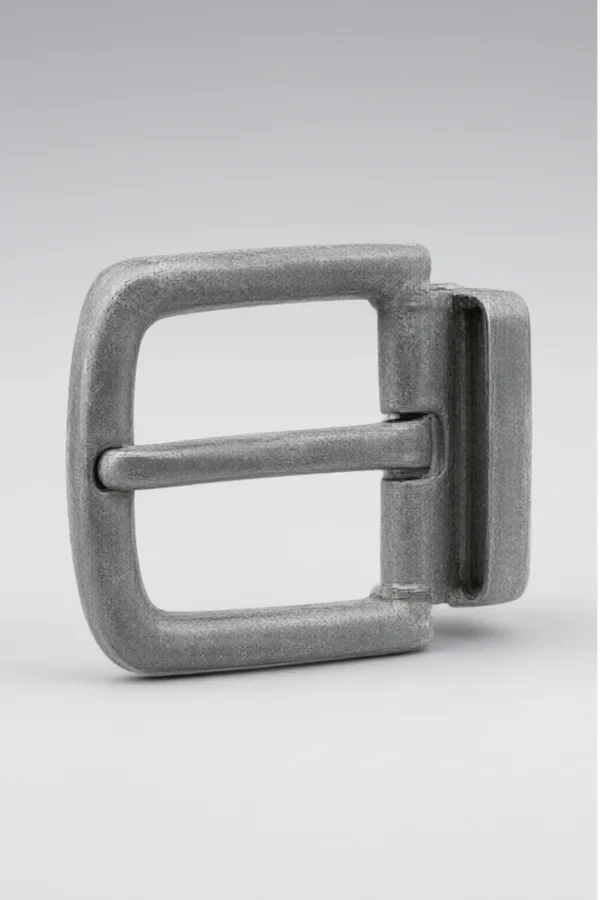
10 Common Problems & Solutions - Zinc Alloy Belt Buckle
Field-tested by workshop masters: the ten defects plating and painting shops see most often on zinc alloy belt buckle, with root causes and the exact fix used on the production line.
| Problem | Root Cause | Master's Fix |
|---|---|---|
| 1. Water-break failure after cleaner | Oil loading too high or cleaner temperature low | Increase temperature to 65-70 C, extend time 2 min, replenish cleaner by titration |
| 2. Spotty etch or rough surface | Acid activation too strong or too long | Reduce acid to 5-8%, cut time to 20-40 s, add inhibitor, check acid concentration |
| 3. Poor adhesion of first deposit | Incomplete activation or surface re-oxidized before plating | Shorten transfer time, keep parts wet, re-activate 15-20 s if delay |
| 4. White haze on zinc surface | Cleaner pH above 10.5 or temperature too high | Correct pH to 9.0-10.5, reduce temperature, verify silicate inhibitor |
| 5. Hydrogen blistering on rack line | Cathodic electroclean too long | Reduce electroclean to 1-2 min, use periodic reverse current |
| 6. Contamination carry-over between stations | Insufficient rinsing or slow cascade flow | Add counterflow rinse, raise flow to 3-5 turnovers/h, verify drain time |
| 7. Chalky hard-water film | TDS too high in rinse or cleaner | Switch final rinse to DI below 10 uS/cm, add chelant to cleaner |
| 8. Non-uniform activation in blind holes | Air pockets block solution contact | Tilt rack, add air agitation, pre-wet parts 1 min before acid |
| 9. Grey etched grain boundaries | Chloride contamination or over-long acid time | Replace acid, control time 20-40 s, check water purity |
| 10. High drag-out losses | Poor drainage geometry | Increase rack angle, add drip zone, extend dwell 20-30 s |
Key Measures to Improve Quality
The daily disciplines that separate a 98% line from a 99.5% line:
- Titrate every cleaner every 4 hours and the acid activator every shift.
- Run a water-break test on 5 parts from every rack or barrel.
- Plate one adhesion coupon per shift and cross-hatch test it.
- Monitor final rinse conductivity daily; keep below 10 uS/cm.
- Log dwell and drag-out time on every shift card.
- First-article approval after every bath make-up.
- Keep a transfer-time timer at the exit station.under 30 s wet-to-wet
- Monthly internal audit of the pre-treatment line against ASTM B322.
SOP - Step-by-Step Operating Procedure for Zinc Alloy Belt Buckle
Workshop SOP with time, temperature and control points. Post this at the tank line.
Formula, Technical Parameters & Test Standards
Typical pre-treatment chemistry for zinc alloy hardware (working volumes per 1,000 L station).
Bath / Formula (working concentrations)
| Alkaline soak cleaner | 40-60 g/L, 60-70 C, 3-5 min, pH 9.0-10.5 |
| Ultrasonic electrocleaner (cathodic) | 50-70 g/L, 50-60 C, 1-3 min, 2-4 A/dm2, pH 9.0-10.5 |
| Acid activation - sulfuric acid | 5-10% v/v + inhibitor, room temperature, 20-60 s |
| Acid activation - hydrochloric acid (alternative) | 5-8% v/v + inhibitor, room temperature, 20-45 s |
Bath / Formula (continued)
| Desmut solution (for oxide film) | 3-8% acid + 1-2 g/L wetting agent, 15-30 s |
| Aluminum parts (if in mixed line) | 5% nitric acid + 2% ammonium bifluoride, 15-30 s |
| Final rinse quality | DI water below 10 uS/cm |
| Surface pH after rinse | 6.5-8.0 |
Operating Parameters
| Rack line station time | 60-90 s per station, 6-8 stations |
| Barrel line stage time | 3-5 min per stage at 4-6 rpm rotation |
| Water-break requirement | Continuous film for 30 s on every part |
| Rack angle for drainage | 15-20 degrees, no solution pooling |
| Dwell / drip time | 20-30 s over drag-out recovery tank |
| Rinse cascade flow | 3-5 turnovers per hour |
| Cleaner temperature | 60-70 C, +/-3 C control |
| Activation control | 20-60 s; over-activation etches grain boundaries |
| Transfer time to plating | Under 30 s, parts must stay wet |
| Analytical control | Cleaner titrated every 4 h; acid checked every shift |
Inspection & Test Standards
| Standard | Requirement |
|---|---|
| ASTM B322 | Standard practice for cleaning metals prior to electroplating |
| ISO 4520 | Preparation and chromate treatment of electroplated zinc |
| Water-break test | Continuous film for 30 s |
| ASTM B571 | Adhesion of metallic coatings - bend and thermal-shock methods |
| ISO 9227 | Neutral salt spray for downstream coating acceptance |
| Drag-out target | Below 5% of bath volume per rack/barrel |
Workshop Line Data for Workshop Managers
Reference capacity and utility data for planning this 6-station rack pre-treatment line around zinc alloy belt buckle.
| Line / Cell | 6-Station Rack Pre-treatment Line |
| Batch / Rack Load | Rack 450 pcs / rack |
| Cycle Time | 10-14 min / rack |
| Daily Output (10-hour shift) | 4,500 pcs / 10 racks |
| Installed Power Demand | 70 kW |
| Operating Staff | 4 operators + 1 QC |
| Floor Area | 120 m2 |
| Water Consumption | 14 m3/day |
Master Tips from the Workshop Floor
- The plating line starts at the pre-treatment exit - if the part dries before it reaches the tank, activation is lost.
- Measure drag-out by weighing a rack before and after drip; every litre saved is chemistry, water and effluent cost saved.
- A dull zinc surface after activation means the acid is too weak; a grey frosted one means it is too strong. Read the surface, not the clock.
- Keep one dedicated rinse cascade for the acid station - acid drag-in is the fastest way to poison an alkaline cleaner.
QLQ engineers can review your line, supply bath chemistry, paint systems and equipment, and support a pilot run with your own parts. Send samples or drawings - our engineers reply within 24 hours with pricing and technical advice.
Published by QLQ Surface Finishing - your partner for zinc alloy surface treatment: pre-treatment, dewaxing, barrel and rack plating, spray painting, lacquering, electrophoretic coating, QC and packaging. Process values are production references; validate against your bath analysis and customer specification before scale-up.