
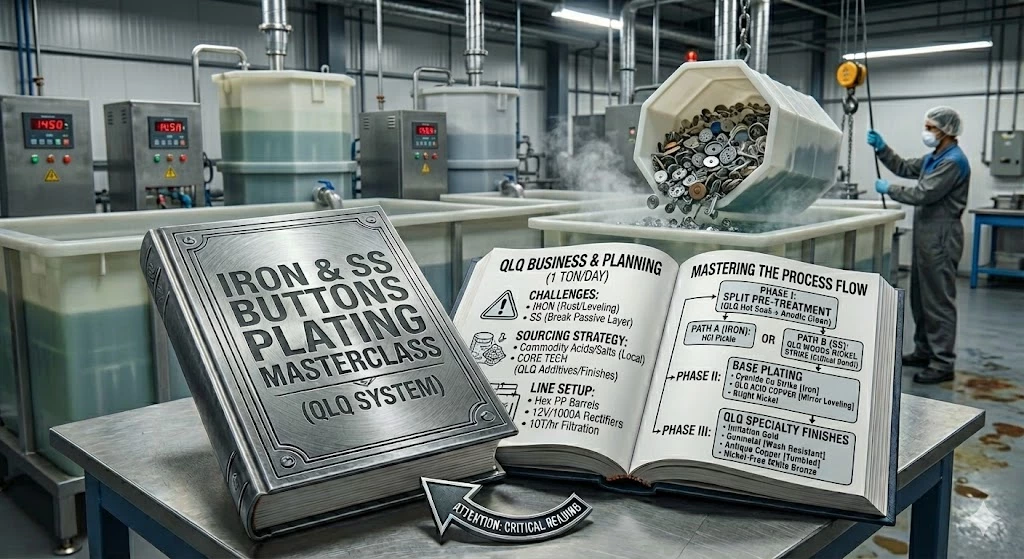
Professional Barrel Plating Workshop Planning: Iron & Stainless Steel Buttons (QLQ System)
Application: Jeans Buttons, Snap Fasteners, Rivets, Eyelets.
Base Materials: Iron (Carbon Steel) and Stainless Steel (304/316).
Capacity: 1 Ton/Day (High-Throughput Semi-Automatic Line).
Key Challenge:
Iron: Preventing rust and ensuring leveling (smoothing out rough stamping marks).
Stainless Steel: Breaking the "Passive Layer" to ensure the plating doesn't peel off.
Sourcing Strategy:
Commodities (Acids, Anodes, Base Salts): [Purchase Locally] to save costs.
Core Technology (Additives, Activation, Finishes): [QLQ Product] for performance and technical guarantee.
Production Line Overview
Barrel Configuration:
Iron: Standard PP Hexagonal Barrel ($\phi300 \times 600$mm).
Stainless Steel: High-mesh PP Barrel (to prevent small buttons from sticking).
Rectifiers: 12V/1000A (Iron needs higher current density than Zinc).
Filtration: 10 Tons/hr continuous filtration for Copper and Nickel tanks.
Phase I: Pre-treatment (The "Split" Process)
Iron and Stainless Steel require different activation paths. The line should be designed to handle both.
Step 1: Hot Soak Degreasing (Common for Both)
Purpose: Remove heavy stamping oils and polishing compounds.
Chemicals:
[QLQ Product] Steel/SS Degreasing Powder: 60–80 g/L (High alkalinity).
Parameters: 70–80°C, 10–15 mins.
Step 2: Anodic Electrolytic Degreasing (Common for Both)
Difference from Zinc Alloy: We use Anodic (+) cleaning here. Iron/SS does not dissolve like Zinc, and Anodic cleaning removes smut better.
Chemicals:
[QLQ Product] Anodic Electro-cleaner Salt: 50–70 g/L.
[Purchase Locally] Sodium Hydroxide: (If needed for pH adjustment).
Parameters: 60–70°C, Current: 5–8 A/dm², Time: 1–3 mins.
Polarity: Workpiece as Anode (+).
Step 3: Acid Pickling / Activation (The Critical Divergence)
PATH A: For Iron (Carbon Steel)
Purpose: Remove Rust and Scale.
Chemicals: [Purchase Locally] Hydrochloric Acid (HCl): 30–50% concentration + [QLQ Product] Acid Mist Inhibitor.
Time: 1–3 mins (Until surface is clean and grey).
PATH B: For Stainless Steel (The "Woods Nickel" Strike)
Purpose: Stainless steel is passive. Standard acid won't work. You must use a Woods Nickel Strike to bond to the surface.
Chemicals:
[Purchase Locally] Nickel Chloride: 200–240 g/L.
[Purchase Locally] Hydrochloric Acid: 100–120 ml/L.
[QLQ Product] Woods Nickel Additive: (Improves coverage).
Parameters: Room Temp. High Current Impact (5–10 A/dm²) for 2–5 minutes.
Phase II: Base Plating (Leveling & Protection)
Step 4: Cyanide Copper Strike (Mandatory for Iron)
Note: Acid Copper cannot be plated directly onto Iron (it will create loose "immersion copper").
Chemicals:
[Purchase Locally] Copper Cyanide: 40–50 g/L.
[Purchase Locally] Sodium Cyanide: 60–70 g/L.
[QLQ Product] Copper Grain Refiner: Consult QLQ.
Parameters: 50–55°C, 20 mins.
Step 5: Acid Copper Plating (High Leveling)
Crucial for Buttons: Buttons often have rough stamped edges. QLQ Acid Copper provides "Mirror Leveling."
Chemicals:
[Purchase Locally] Copper Sulfate: 200–220 g/L.
[Purchase Locally] Sulfuric Acid: 50–70 g/L.
[QLQ Product] Acid Copper Brightener (B) & Leveler (A): Use automatic dosing.
Parameters: 25°C (Chiller required), 3–5 A/dm², 40–50 mins.
Step 6: Bright Nickel Plating
Chemicals:
[Purchase Locally] Nickel Sulfate/Chloride/Boric Acid.
[QLQ Product] Nickel Brightener System: Consult QLQ.
Parameters: 55°C, pH 4.0–4.5, 20 mins.
Phase III: Color Finishes (QLQ Specialty Processes)
Iron/SS buttons are often fashion items, requiring specific trends.
A. Imitation Gold (Brass Alloy)
Description: Replaces real gold. Matches 18K/24K color.
Chemicals: [QLQ Product] Imitation Gold Salts.
Parameters: 35°C, 30-60 seconds.
B. Gunmetal / Black Nickel (Tin-Alloy)
Description: High wear resistance for jeans buttons (which go through washing machines).
Chemicals: [QLQ Product] Gunmetal Salts.
Parameters: 60°C, 8–10 mins.
C. Antique Copper / Bronze (Vintage Look)
Process:
Plate Thick Copper (Cyanide or Acid).
Blacken with [QLQ Product] Antique Blackener.
Tumble/Burnish: Use a tumbling barrel to wear off the black from the raised logos/text, revealing the copper underneath.
D. Nickel-Free Finishes (EU Standard)
Important: If the client requires "Nickel Free," replace the Bright Nickel (Step 6) with [QLQ Product] White Bronze (Copper-Tin-Zinc).
Phase IV: Post-Treatment
Step 7: Passivation
Chemicals: [QLQ Product] Anti-Tarnish Dip.
Step 8: Baking (Hydrogen Embrittlement Relief)
Note: Only necessary for High Carbon Steel or Spring Steel parts. Standard low-carbon iron buttons do not usually require this.
Temp: 200°C for 2 hours.
Step 9: Lacquering
Chemicals: [QLQ Product] Water-based Clear Lacquer.