
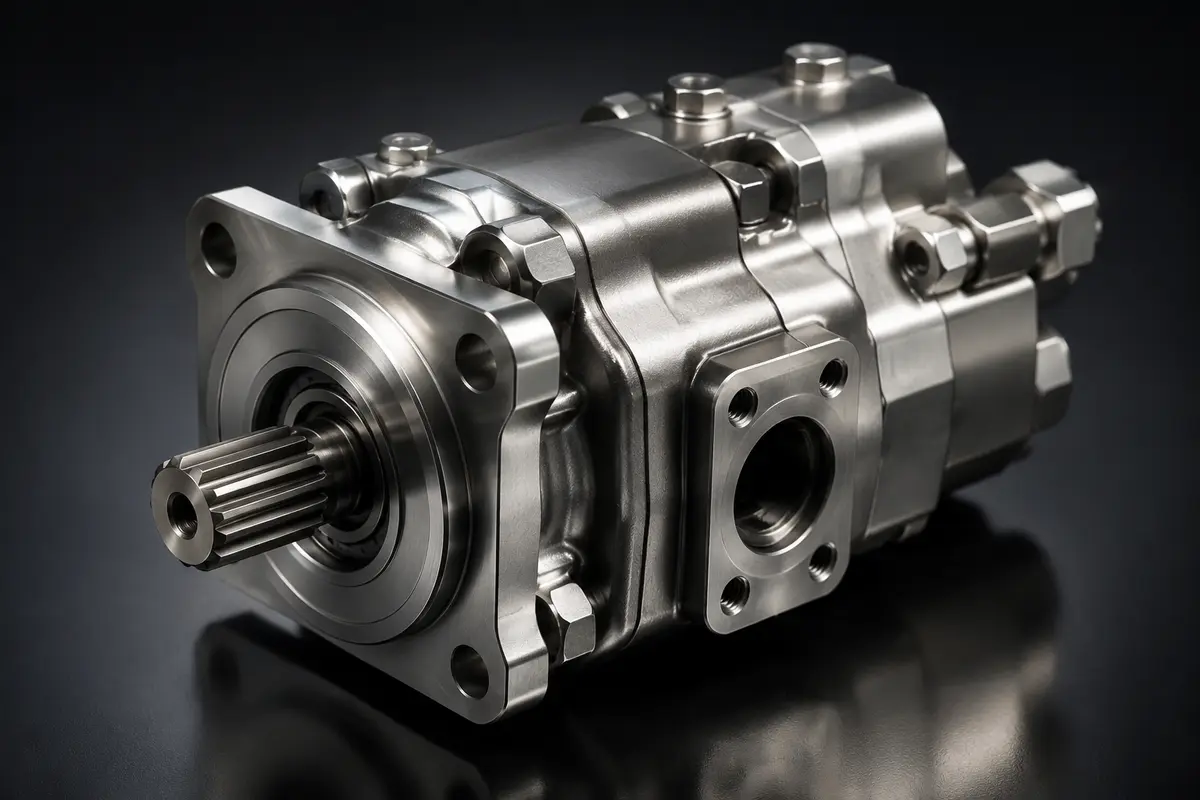
Key Takeaway: Electroless nickel plating (ENP) is fundamentally different from electrolytic nickel — it uses a chemical reduction process instead of electric current, producing a coating of perfectly uniform thickness regardless of part geometry. For complex-shaped industrial components, threaded parts, and internal surfaces, ENP is often the only viable solution. This guide breaks down the chemistry, properties, and application scenarios to help B2B buyers make informed coating decisions.
Two Paths to a Nickel Finish — But Very Different Results
At a glance, both processes deposit a nickel layer onto a metal substrate. But the mechanism — and the resulting properties — couldn't be more different.
Electrolytic nickel plating relies on external DC current. The workpiece is the cathode; nickel anodes dissolve into the bath. Nickel ions migrate under the electric field and deposit on the part surface. The problem? Current density varies across the surface. High-current areas (edges, corners, protrusions) build up thicker coating. Low-current areas (recesses, holes, internal threads) get thin or no coating. This is called the "dog-bone effect" — and it's the Achilles' heel of electroplating.
Electroless nickel plating eliminates current entirely. Instead, a chemical reducing agent — typically sodium hypophosphite — drives the reaction. Nickel ions are reduced to metallic nickel on the catalytic surface of the part. Because there's no electric field, the deposition rate is identical everywhere the solution touches. The result: a coating that's within ±2 μm thickness variation across the entire part, including blind holes, threads, and complex internal geometries.
ENP vs Electrolytic Nickel — Head-to-Head
| Property | Electroless Nickel (ENP) | Electrolytic Nickel |
| Driving force | Chemical reducing agent (NaH₂PO₂) | External DC electric current |
| Coating uniformity | ±2 μm across entire surface | Varies — thick on edges, thin in recesses |
| Composition | Ni-P alloy (2–14% phosphorus) | 99%+ pure nickel |
| As-plated hardness | 500–600 HV (as-plated); up to 1100 HV heat-treated | 150–400 HV |
| Corrosion resistance | Excellent — amorphous structure resists attack | Good — but porous at thin thicknesses |
| Solderability | Good (especially low-P grades) | Excellent |
Phosphorus Content: The Secret Behind ENP Performance
Unlike electrolytic nickel (which is nearly pure), electroless nickel is a nickel-phosphorus alloy. The phosphorus content — determined by bath chemistry and pH — directly controls the coating's properties:
ENP Grades: Low-P, Mid-P, High-P
| Grade | P Content | Hardness (HV) | Best For |
| Low-P | 1–4% | 650–700 (as-plated) | Alkaline environments, solderability, high hardness without heat treatment |
| Mid-P | 5–9% | 500–600 (as-plated) | General purpose — best balance of corrosion resistance and cost |
| High-P | 10–14% | 450–550 (as-plated) | Maximum corrosion resistance (acidic environments, oil & gas), non-magnetic, superior ductility |
High-phosphorus (10–14%) ENP is the premium grade. At these levels, the coating becomes nearly amorphous (non-crystalline), which eliminates grain boundaries — the pathways through which corrosion typically attacks metals. This is why high-P ENP can withstand 1,000+ hours of neutral salt spray (ASTM B117) at just 25 μm thickness, while electrolytic nickel at the same thickness may show rust spots in 200 hours.
Heat Treatment: Unlocking Maximum Hardness
One of ENP's most valuable features is its response to heat treatment. When heated to 400°C (752°F) for one hour, the amorphous nickel-phosphorus matrix transforms — precipitating hard Ni₃P intermetallic particles throughout the coating. The result: hardness jumps from ~500 HV to 900–1100 HV, rivaling hard chrome plating. This makes heat-treated ENP the coating of choice for:
- Hydraulic cylinder rods and pistons (wear resistance + corrosion protection)
- Valve components in oil & gas (resists H₂S and CO₂ corrosion)
- Plastic injection molds (release properties + abrasion resistance)
- Food processing equipment shafts (FDA-compliant, non-toxic)
Heat Treatment Trade-offs to Consider
- Corrosion resistance may drop 10–20% after 400°C treatment — the precipitation of Ni₃P creates micro-galvanic couples between the phosphide particles and nickel matrix
- Coating turns from semi-bright to a yellowish-gray — aesthetic applications may require an additional flash coat
- Substrate must tolerate 400°C — not suitable for heat-sensitive alloys (certain aluminum grades, tempered steels near their tempering threshold)
- Ductility decreases significantly — heat-treated ENP becomes brittle; not recommended for parts subject to impact or flexing
When to Choose ENP Over Electrolytic Nickel
Ask these four questions when specifying your coating:
- Does your part have complex internal geometry? Threads, blind holes, undercuts, narrow passages → ENP is the clear choice. Electrolytic nickel simply cannot plate what the current can't reach.
- Is wear resistance critical? Heat-treated ENP (900–1100 HV) outperforms all but hard chrome. For sliding wear applications, ENP with PTFE co-deposition offers self-lubricating properties.
- Is the environment chemically aggressive? High-P ENP resists acids, alkalis, and salt spray far better than electrolytic nickel. It's the standard for offshore oil & gas equipment and chemical processing hardware.
- Do you need precise dimensional control? Because ENP deposits uniformly, post-plating grinding is often unnecessary. For precision components with ±5 μm tolerances, this saves significant machining cost.
Need Expert Advice on Nickel Plating for Your Parts?
At PlatingClub, we offer mid-phosphorus and high-phosphorus electroless nickel plating services for industrial hardware, precision components, and oil & gas equipment. Our quality control includes XRF thickness measurement, salt spray testing, and microhardness verification — with full traceability documentation.
Contact us at [email protected] to discuss your electroless nickel plating requirements and receive a technical proposal within 24 hours.
Disclaimer: This guide is for informational purposes. Coating specifications should be validated for your specific substrate material, operating environment, and industry standards. Always consult with your plating supplier and reference applicable ASTM/ISO standards.