
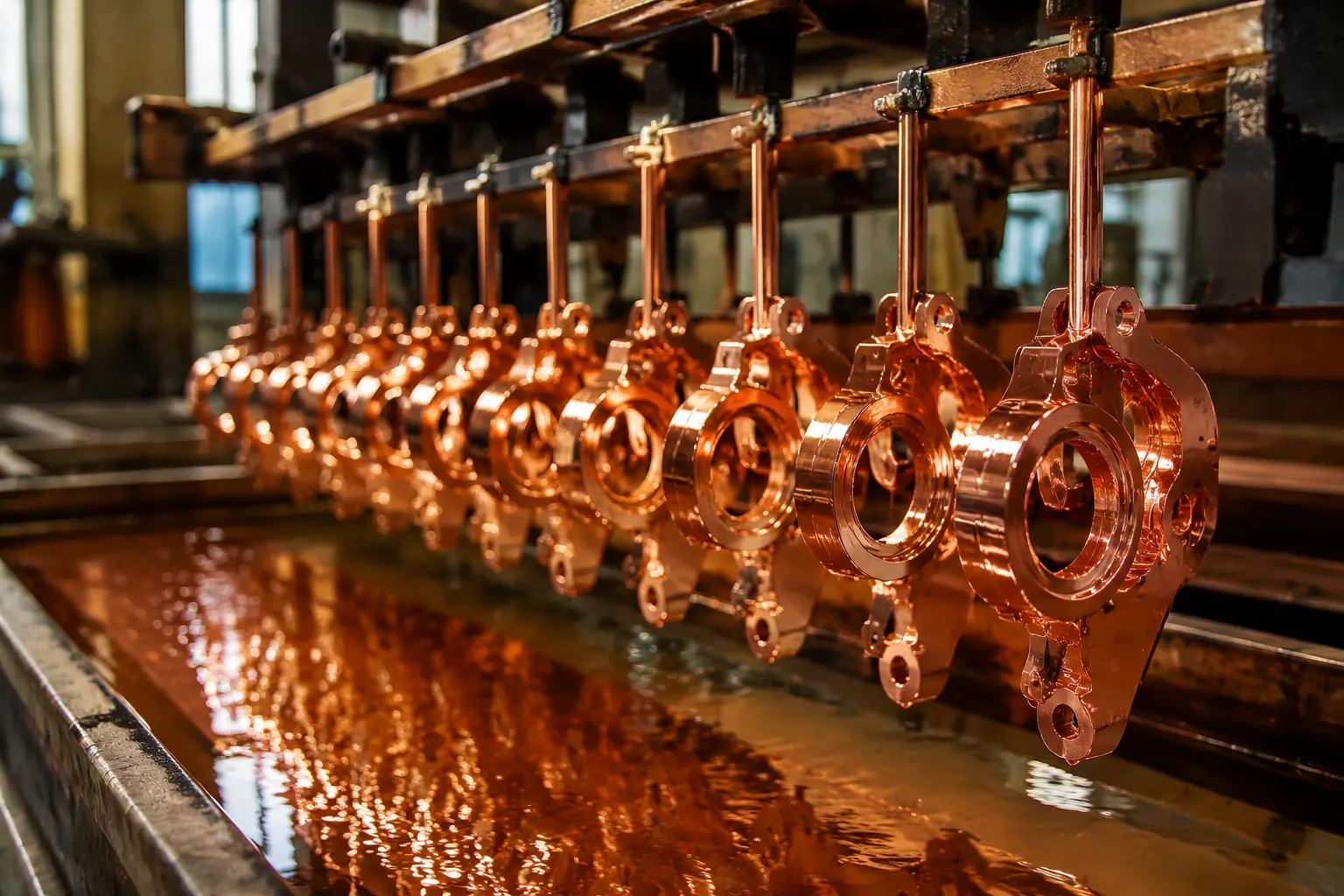
When procurement managers and engineers evaluate metal finishing for industrial components, copper electroplating often operates behind the scenes — quite literally. As the most widely used undercoat layer in multi-layer plating systems, copper provides the essential foundation that determines the performance, adhesion, and longevity of the entire coating stack.
At PlatingClub, our rack and barrel copper plating lines process hundreds of thousands of components monthly for automotive, electronics, and industrial hardware applications. This guide covers the three primary copper plating chemistries, their selection criteria, and what quality-conscious buyers should look for.
Quick Facts: Copper Electroplating
- Primary Role: Undercoat / strike layer for adhesion and leveling
- Typical Thickness: 5–25 μm (industrial); up to 500 μm for electroforming
- Key Advantage: Fills microscopic surface defects, creating a smooth base for nickel, chrome, or gold topcoats
- PlatingClub Capacity: Rack and barrel plating available; bath volume 12,000+ liters
Three Types of Copper Electroplating
1. Cyanide Copper Plating
The traditional workhorse for strike plating on steel, zinc die-cast, and aluminum substrates. Cyanide-based baths deliver exceptional throwing power — the ability to deposit uniform copper into recessed areas and complex geometries. Typical bath operates at 40–60°C with 1–4 A/dm² current density.
- Excellent adhesion on difficult substrates
- Superior throwing power
- Fine-grained, ductile deposit
- Toxic bath chemistry (strict waste treatment)
- Lower plating speed vs acid copper
- Cannot plate directly on some alloys
2. Acid Copper Plating
The high-speed option for build-up and leveling after an initial strike layer. Sulfuric acid-based baths with organic brighteners produce mirror-bright, highly leveled deposits ideal for decorative applications. Operates at 20–35°C with 2–8 A/dm² — roughly 2–3x faster than cyanide copper.
Acid copper is the preferred choice for:
- Electroforming — building thick copper shells for molds and precision parts
- PCB Manufacturing — through-hole plating and circuit traces
- Decorative Undercoats — creating the flawless surface needed for bright nickel + chrome finishes
3. Pyrophosphate Copper Plating
A mildly alkaline alternative that bridges the gap. Pyrophosphate copper offers good throwing power without cyanide toxicity, making it suitable for printed circuit boards and components where environmental compliance is paramount. However, bath control is more demanding and throughput is lower than acid systems.
| Property | Cyanide Copper | Acid Copper | Pyrophosphate |
|---|---|---|---|
| Plating Speed | Moderate | Fast | Slow-Moderate |
| Throwing Power | Excellent | Moderate | Good |
| Brightness | Semi-bright | Mirror-bright | Semi-bright |
| Substrate Range | Steel, Zinc, Al | Cu strike required | Steel, Cu alloys |
| Environmental | Strict controls | Lower impact | Lowest toxicity |
Why Copper Is the Essential Undercoat
In multi-layer plating — such as copper → nickel → chromium on steel hardware — the copper layer performs three critical functions:
- Adhesion Promotion: Copper bonds strongly to both the steel substrate and the nickel topcoat, preventing delamination under thermal cycling and mechanical stress.
- Surface Leveling: Copper's excellent micro-throwing power fills scratches, pits, and machining marks, reducing the polishing required before final finishing.
- Corrosion Barrier: A continuous, pore-free copper undercoat blocks corrosive agents from reaching the base metal, extending service life in humid or mildly corrosive environments.
Quality Checks Buyers Should Request
When sourcing copper-plated components, verify these specifications with your plating supplier:
Copper Plating Quality Checklist
- Thickness Verification: XRF or coulometric measurement per ASTM B487 / ISO 2177. Specify minimum thickness at defined measurement points.
- Adhesion Test: Bend test (ASTM B571) or thermal shock (300°C / 30 min) — no blistering or peeling acceptable.
- Porosity Check: Ferroxyl test or electrographic porosity test for corrosion-critical applications.
- Surface Appearance: Uniform color (salmon-pink to bright copper), free from burns, nodules, or step-plating.
- Bath Analysis Records: Request certificate showing Cu content, H₂SO₄ ratio, chloride ppm, and organic brightener levels within specification.
Choosing Between Rack and Barrel Copper Plating
The processing method significantly impacts both cost and quality:
Rack Plating — Individual parts mounted on racks ensure uniform current distribution and zero part-on-part contact. Ideal for large components, tight-tolerance parts, and premium finishes. Higher unit cost but superior consistency.
Barrel Plating — Parts tumble in a rotating barrel for high-volume, small-component processing. Lower cost per piece. Suitable for fasteners, connectors, and hardware where minor contact marks are acceptable. PlatingClub's barrel lines handle up to 50 kg per load.
Need Copper Plating for Your Components?
PlatingClub offers rack and barrel copper electroplating with full bath analysis, XRF thickness verification, and ISO-compliant process control. Cyanide and acid copper baths available. Contact our engineering team for a process consultation.
Copper electroplating may be invisible beneath the final finish, but its impact on product quality is unmistakable. Selecting the right chemistry, process parameters, and plating method — and verifying results with rigorous quality checks — ensures your components meet both aesthetic and performance requirements.
Published by PlatingClub — Your Partner in Industrial Metal Surface Finishing. Serving automotive, electronics, hardware, and consumer goods manufacturers with precision electroplating solutions since establishment.