
Why this keeps coming up
Barrel Thickness Vs Time is one of the recurring questions on finishing forums — and answers online usually jump to a single fix. There isn't one: the symptom has several causes, each confirmed differently, each fixed differently. This is the diagnostic sequence our lines run.
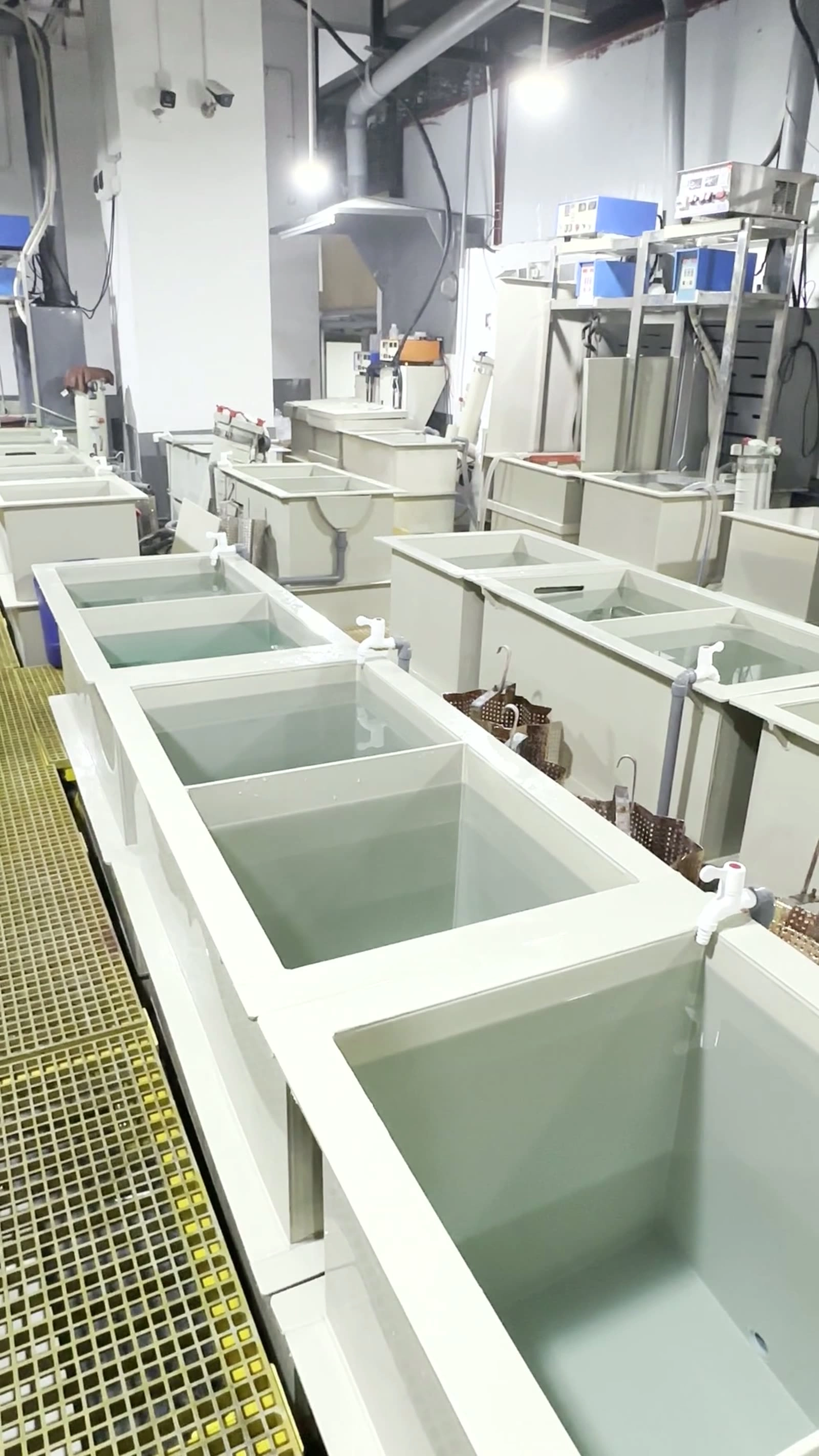
Triage: symptom → confirm → first move
| Observation | Likely cause | Confirm by | First move |
|---|---|---|---|
| Thickness below spec on time | Dose under-counted | Amp-min per kg log | Recalculate by weight, not barrel count |
| Outer parts thicker | Normal barrel gradient | Sample by position | Extend cycle; sample per spec points |
| Cycle drifting longer | Contact resistance rising | Dangler tips check | Clean/replace danglers |
| Burns after time extension | CD ceiling reached | Burn map by position | Split load or lower current |
| Thickness scatter widens | Load size variance | Weigh-in records | Standardise load weight |
The fix set with windows
- Fix 1 — dose by weight — Amp-min per kg is the real dose: target = thickness × area per kg ÷ efficiency; log every load
- Fix 2 — sample plan — Thickness at 3 positions × 2 parts per 10 kg; outer-center-inner
- Fix 3 — contact health — Dangler tips dressed daily; contact resistance spot-check weekly
- Fix 4 — load discipline — Standard load cards by part family; flat parts get media to prevent nest
- Fix 5 — cycle chart — Publish thickness vs minutes curve per family; engineers adjust by data, not memory
Case method
A barrel line ran fixed 30-minute cycles 'because it always did'. Dose logging showed one family needed 38 minutes and another only 22 to hit spec. Publishing per-family curves cut average cycle 12% while thickness audit failures fell. (Method illustration: build your own curves from sample data.)
On the floor: recognise, record, escalate
| You see | You do | You never do |
|---|---|---|
| Thin reading | Re-read per gauge manual, log position | Add 10 minutes and hope |
| Burn marks | Note position in barrel, report | Scrap parts silently |
| Weigh-in skipped | Weigh it now, flag the miss | Estimate the weight |
| New part family | Ask for the load card before running | Copy last family's settings |
Engineer notes
- One variable per corrective action; verify with the confirm-by column.
- Records beat memory: log every trial on the tank card.
- Two failed actions in a row is a senior call — escalate with your log.
Safety: barrels, hoists and live bus bars share one line. Heat gloves for loads, lock-out before contact service, never reach into a running barrel.
FAQ
How do I know the cycle is long enough?
The load card: amp-min per kg target. Gauge the sample parts at cycle end, log the numbers.
Parts at the barrel door plate thicker — fix?
Normal gradient. Extend time and sample to spec points; add a door baffle if it exceeds range.
Mixed families in one barrel — how to dose?
Don't. Split by family; mixed loads dose to the heaviest area part and burn the rest.
Why are we over-cycling?
Fear and missing curves: without per-family data, planners pad time. Curves pay back in a month.