
Professional Zinc Alloy Surface Finishing Solutions
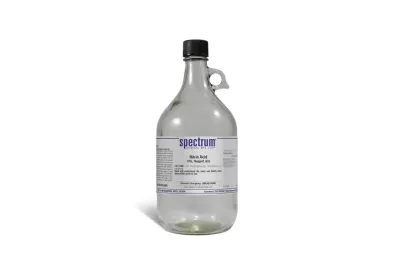
Boric Acid
Boric Acid
Vygenerovat QR kód
-
Estimated Delivery:Oct 02 - Oct 06
-
Free Shipping & Returns: On all orders over $75
Product description
Shipping & Return
Product Overview
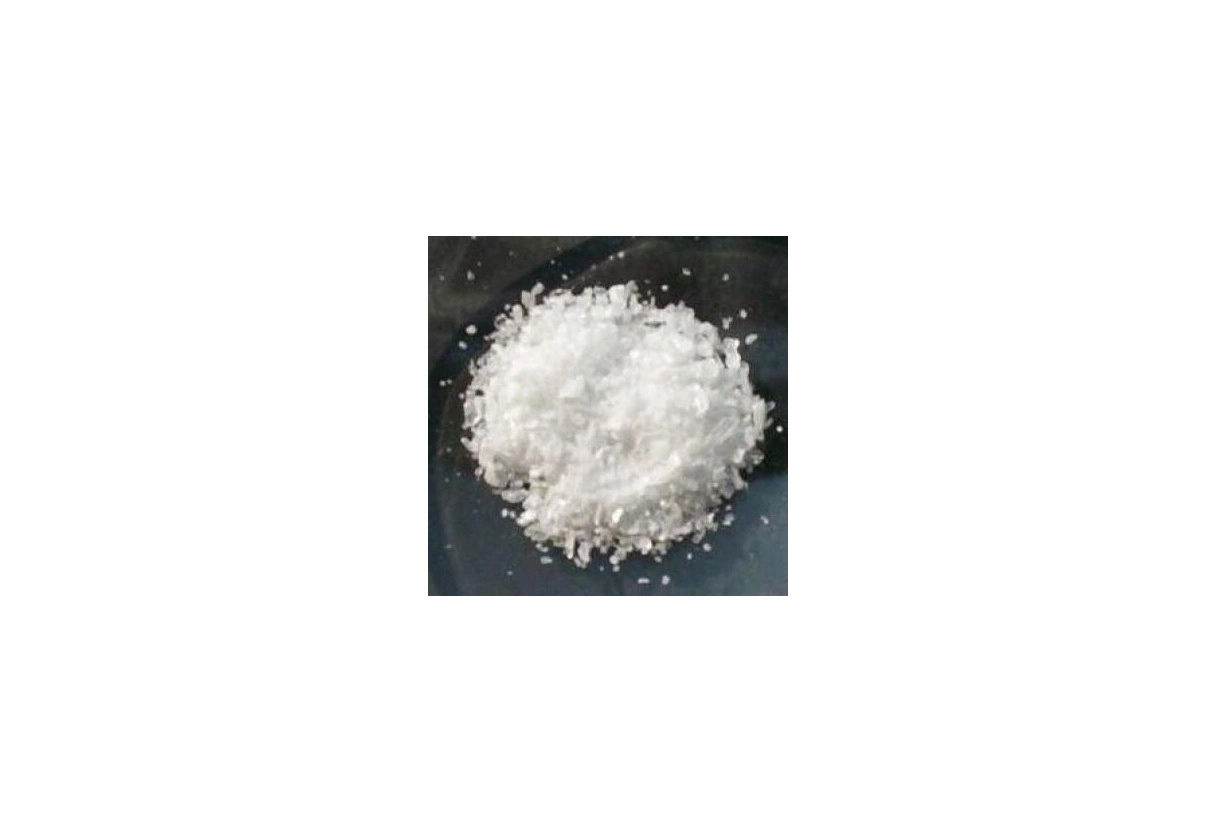
Boric Acid (H3BO3) is the standard pH buffer of nickel and cobalt plating. Added to Watts nickel, sulfamate nickel and nickel electroforming solutions at 30-50 g/L, it holds the cathode film pH in the range where nickel deposits smoothly instead of precipitating basic nickel salts that burn, roughen and pit the work. In QLQ's finishing plants boric acid is part of the bright nickel, semi-bright nickel and nickel electroforming baths behind zipper sliders, belt buckles and small hardware. It is a white crystalline powder, mildly acidic in solution, fully water soluble, and it has no plating role in acid copper or zinc baths - it is bought for nickel and cobalt lines and for nothing else. Two commercial families exist: technical/plating grade (≥ 99.5% assay, low chloride, sulfate and heavy metals) and agricultural/fertilizer grades sold on boron content alone, which can carry chloride and metal residues. For a plating tank the assay and impurity spec matter more than the boron figure, because a nickel bath has no appetite for chloride or iron.
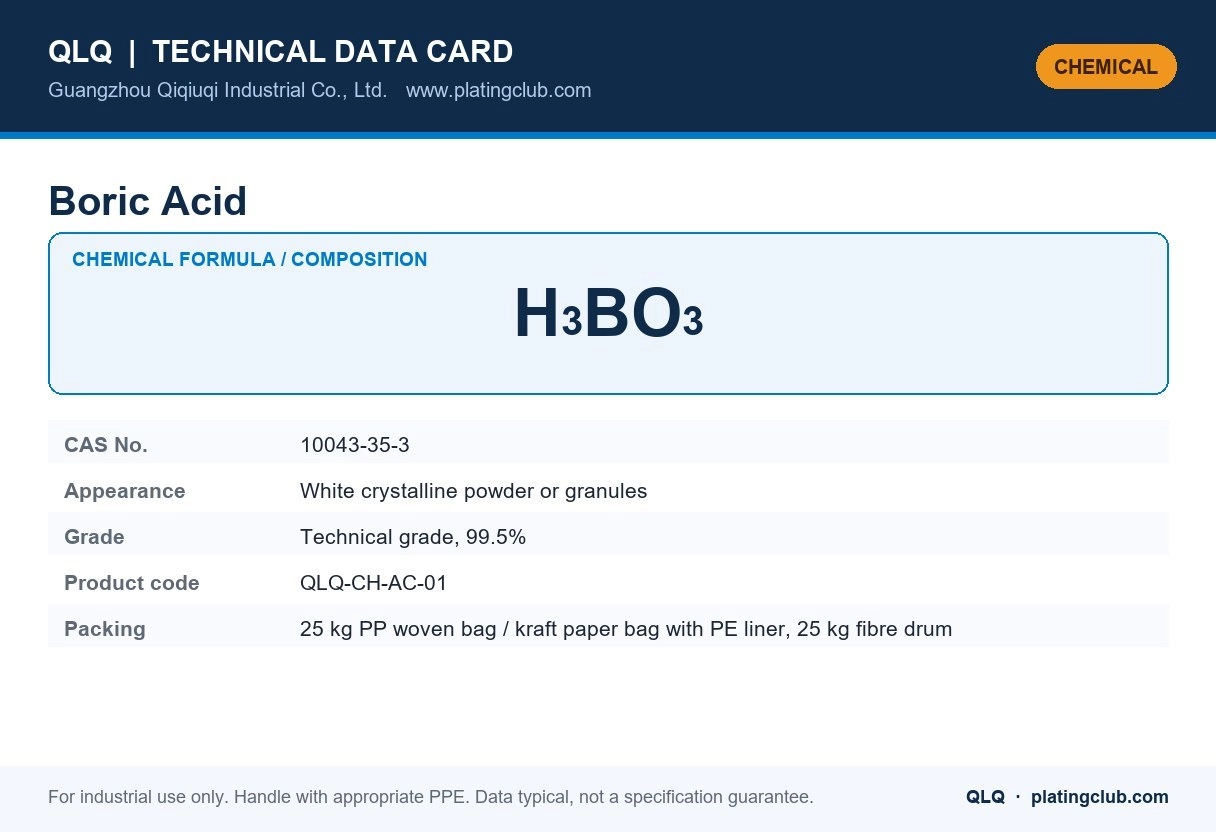
Product Identity (Encyclopaedia Card)
| Property | Value |
|---|---|
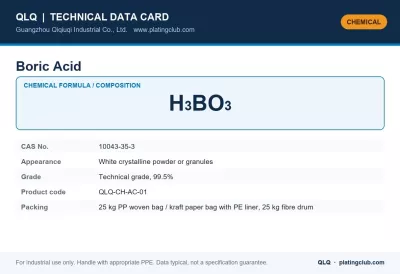
| Chemical name | Boric Acid |
| Chemical formula | H3BO3 |
| CAS number | 10043-35-3 |
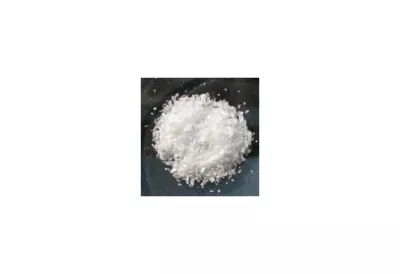
| Appearance | White crystalline powder or granules |
| Grade / type | Technical grade, 99.5% |
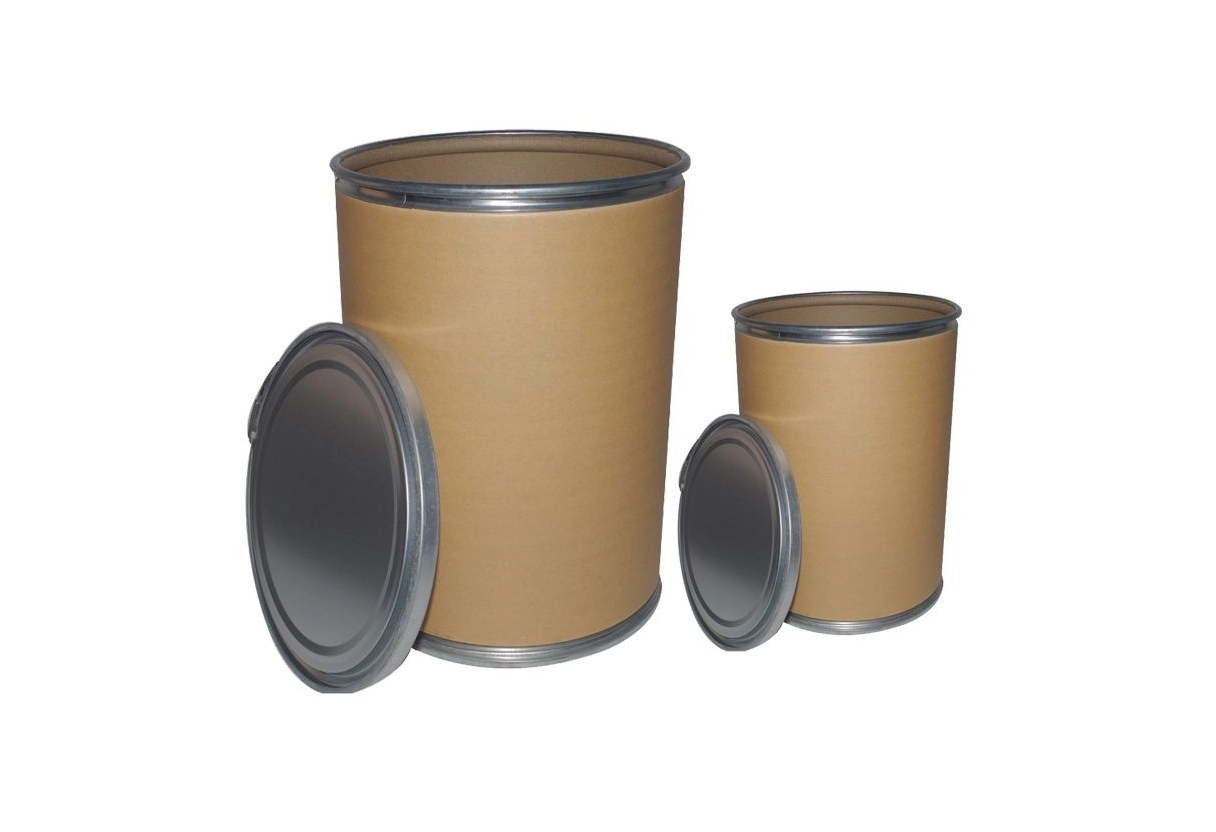
| Standard packing | 25 kg PP woven bag or kraft paper bag with PE inner liner; 25 kg fibre drum |
What it is and what it does. Boric acid is the buffer of the nickel plating bath. It holds the cathode film pH in the range where nickel deposits brightly, and it is the classic additive that improves the appearance of nickel and cobalt deposits.
- White crystalline powder, only slightly soluble at room temperature - its limited solubility is the reason the bath analysis drifts.
- Buffers the cathode film near pH 3.8-4.5, preventing hydroxide inclusion and pitting.
- Also used as a flux, as a fire retardant and as a mild cleaner ingredient.
Typical Use in a Plating / Finishing Line
| Item | Typical guidance |
|---|---|
| Watts nickel bath | 40-50 g/L boric acid |
| Operating pH | 3.8-4.5 at 50-60 C |
| Analysis | Boric acid by titration with mannitol addition |
| Maintenance | Top up on analysis, not on appearance, because the solubility is limited |
Safety, Handling & Storage
| Item | Requirement |
|---|---|
| Hazard classification | Irritant (GHS07) — causes serious eye irritation |
| Personal protective equipment | Safety goggles and acid-resistant gloves; dust mask when handling powder |
| Spill / first aid | Sweep up dry powder, or dilute and neutralise small liquid spills, then rinse to the effluent treatment system |
| Storage | Cool, dry, ventilated store; keep sealed against moisture, away from alkalis and oxidisers |
| Transport | Classified and packed according to IATA/IMDG for the hazard class; UN number and packing group stated on the shipping documents |
Quality Documents Shipped With Every Batch
| Document | Comment |
|---|---|
| COA (certificate of analysis) | Provided with the shipment; batch traceable to the production date |
| MSDS (safety data sheet) | Provided with the shipment; batch traceable to the production date |
| Packing list | Provided with the shipment; batch traceable to the production date |
| Commercial invoice | Provided with the shipment; batch traceable to the production date |
| Certificate of origin on request | Provided with the shipment; batch traceable to the production date |
Buyer Questions We Answer Every Week
| Question | Answer |
|---|---|
| Why does the boric acid settle in the dosing tank? | Because the solubility is only about 5% at room temperature; dissolve it in hot water or dose it directly against the analysis. |
| Is boric acid restricted? | It is classified as reprotoxic in some jurisdictions; handle as a hazardous substance with dust control. |
| Item | Typical Value |
|---|---|
| Chemical formula | H3BO3 (orthoboric acid) |
| Assay | ≥ 99.5% (plating grade) |
| Appearance | White crystalline powder or granular, free-flowing |
| Chloride (Cl) | ≤ 0.005% |
| Sulfate (SO4) | ≤ 0.01% |
| Iron (Fe) | ≤ 0.001% |
| Water insolubles | ≤ 0.005% |
| Standard packing | 25KG woven bag with PE inner liner |
How It Works in the Bath (Why Buffer Range Matters)
At the cathode, hydrogen evolution raises the pH of the thin film of solution against the part. If nothing stops that rise, nickel hydroxide and basic nickel salts form in the film and are dragged into the deposit as dark, rough or burnt growth at high current density. Boric acid works as a buffer right where it is needed: it is present at 40-50 g/L in the bulk, it migrates and adsorbs at the cathode film, and it absorbs the hydroxyl ions that hydrogen evolution produces, holding film pH near the bath pH of 3.8-4.8 instead of letting it climb past about 5.5 where nickel hydroxide precipitates. The practical symptoms of weak buffering are burning and roughness at edges, pH drift between additions, and milky deposits after shutdowns. Below about 30-35 g/L a nickel bath loses its safety margin and burns parts at the very current densities every decorative rack and barrel line uses.
| Bath type | Boric acid | pH | Working note |
|---|---|---|---|
| Watts bright / semi-bright nickel | 40-50 g/L | 3.8-4.8 | Keep ≥ 35 g/L; analyze weekly |
| Sulfamate nickel (electroforming) | 30-45 g/L | 3.5-4.5 | Lower stress, still buffered |
| Nickel strike (Woods type) | 20-40 g/L | 1.5-2.5 approx. | Mainly conductivity/leveling; follow supplier make-up |
| Cobalt and nickel-cobalt alloys | 40-50 g/L | 4.0-5.0 | Same buffering role as nickel |
Boric acid dissolves slowly in cold water and is close to its room-temperature solubility limit at the working 40-50 g/L, so make-up is always done in hot water and analysis is done by titration, not by topping up on a schedule.
How to Check Quality Before Loading a Batch
| Check | Method | Pass Criteria |
|---|---|---|
| Appearance | Visual | White, free-flowing crystals; no grey or yellow tint (iron, organics) |
| Assay | Titration with NaOH in the presence of mannitol | ≥ 99.5% |
| Chloride | Silver nitrate test on a 10% solution | No white precipitate beyond faint haze; Cl ≤ 0.005% |
| Sulfate | Barium chloride test on a 10% solution | No heavy white precipitate |
| Solubility check | Dissolve 50 g in 1 L hot water, cool to 25°C | Clear solution; only light crystals may return on cooling - no sludge or dark residue |
How QLQ controls it: boric acid deliveries are checked against COA assay, chloride and iron figures before the bags enter the nickel-line store, and a full tank analysis is run whenever a new lot is first used. The recorded lot number lets the lab trace any pH or deposit anomaly back to the exact delivery within a day, which is how QLQ keeps nickel baths running for years without full dumps.
Common Problems & Fixes (Workshop Table)
| Problem | Root cause | Fix |
|---|---|---|
| Burning and roughness at high-current-density edges | Boric acid below ~30-35 g/L; film pH climbing out of control | Analyze, raise boric acid to 40-45 g/L dissolved hot; verify pH before loading |
| pH drifts upward fast between additions | Buffer exhausted by drag-out or under-additions | Titrate boric acid weekly; restore by amp-hour and analysis, not guesswork |
| White crystals in filters after cold nights | Boric acid near solubility limit crystallizing as bath cools | Keep 40-45 g/L (not 50+), insulate lines, dissolve filter residue in hot water and return it |
| Milky or hazy deposit after a weekend | pH rose while idle; iron may also be precipitating | Adjust pH down before start-up; filter; run low-current dummy plate |
| Pitting on horizontal surfaces | Gas pitting; buffering too weak for agitation level | Confirm boric acid level, increase agitation, check wetting agent |
Handling & Safety for the Plating Line
- Health: boric acid is classified as toxic to reproduction in the EU (R60-61); pregnant operators and pregnant workers should not handle the powder. Wear gloves and a dust mask when opening bags and weighing.
- Dissolving: always dissolve in hot water (60-80°C) with stirring; boric acid dissolves too slowly in cold water to be dosed directly into a working tank without local saturation.
- Dust control: fine crystals generate dust when bags are emptied; use a dust mask, empty slowly and keep the dosing area ventilated.
- Storage: bags stay sealed on dry pallets; boric acid does not degrade but absorbs damp and cakes, which slows dissolving and upsets weighing.
- Spills: sweep and re-use clean powder, or dissolve spilled material into the make-up water. Boric acid is not a drain hazard at shop concentrations, but do not bulk-discharge concentrated solution without checking local limits.
What It Does on Iron, Zinc Alloy, Copper and Stainless Steel Parts
| Substrate | Role of boric acid in the line on this substrate | Recommended practice |
|---|---|---|
| Iron / steel small hardware | Prevents burning and rough nickel on high-current-density edges of steel stampings | Nickel 6-10 μm over steel; keep boric acid ≥ 40 g/L so barrel loads plate evenly |
| Zinc alloy (sliders, buckles) | Die cast burns easily; buffer stability protects the nickel over the copper underlayer | Boric acid 40-45 g/L, pH 4.0-4.4, moderate current; avoid long dwell in acid dips |
| Copper / brass | Bright nickel over brass needs clean edges for the classic nickel-silver look | Keep agitation and boric acid up; 3-6 μm nickel; rinse thoroughly between stages |
| Stainless steel | Buffering supports sound nickel buildup after the adhesion strike on stainless | Use a Woods strike first, then standard buffered nickel; keep chloride constant |
FAQ
| Question | Answer |
|---|---|
| Can I use fertilizer-grade boric acid in my nickel bath? | Not recommended. Fertilizer grades are sold on boron content with looser chloride and metal limits, and chloride is exactly what a nickel bath must not receive from its boric acid. |
| Why does my boric acid not fully dissolve? | Cold water dissolves boric acid slowly and the 40-50 g/L working level is near its cold solubility limit. Always pre-dissolve in hot water. |
| How often should boric acid be analyzed? | Weekly in continuous lines, by the mannitol titration. Drag-out and filters quietly remove it; the first symptom of shortage is burning on edges. |
| Does boric acid improve brightness? | Indirectly. It prevents the roughness, burning and haze that destroy brightness; the brightening itself comes from the organic additive system. |
| Does QLQ supply plating-grade boric acid with support? | Yes. QLQ supplies boric acid with COA covering assay, chloride, sulfate and iron, and engineers help with bath make-up and pH/buffer control for nickel lines. |
Nickel bath burning edges or drifting pH? QLQ supplies plating-grade boric acid with COA and engineers who help customers across 10+ countries with buffer control and defect diagnosis. Contact us with your bath analysis.
Shipping cost is based on weight. Just add products to your cart and use the Shipping Calculator to see the shipping price.We want you to be 100% satisfied with your purchase. Items can be returned or exchanged within 30 days of delivery.