
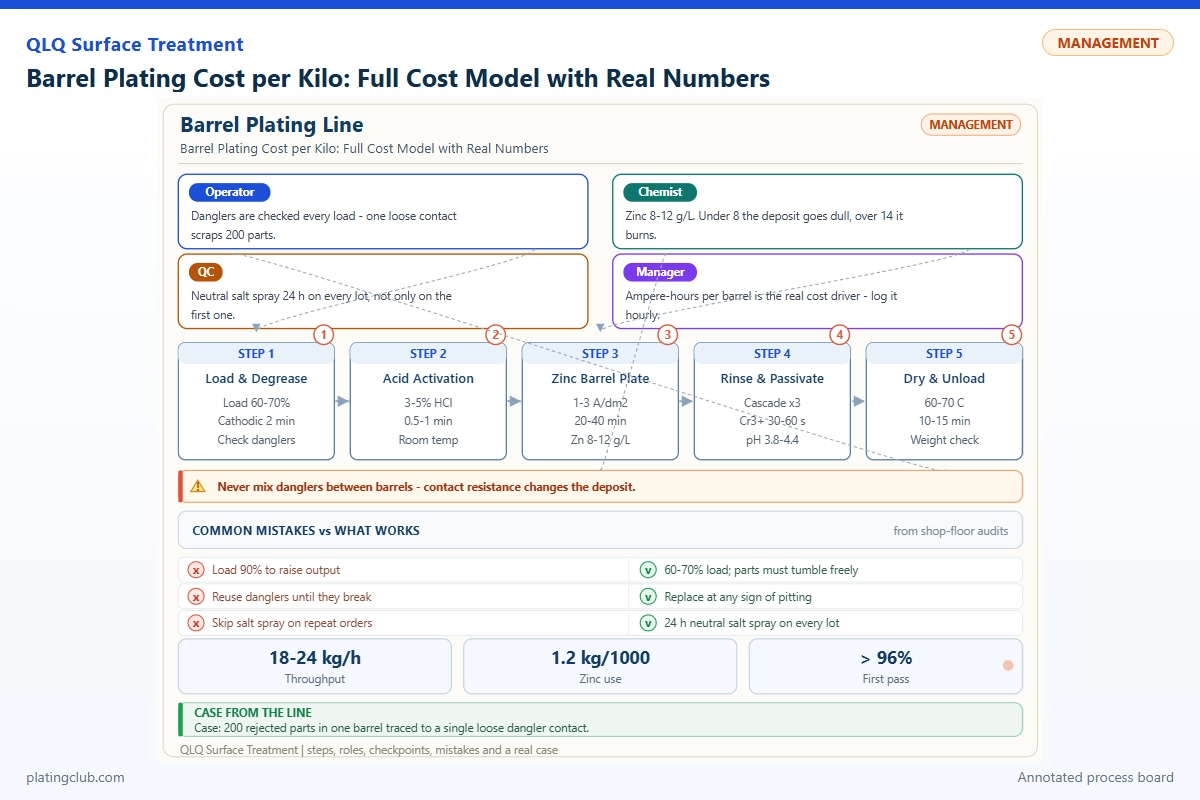
Barrel Plating Cost per Kilo: Full Cost Model with Real Numbers
For a senior barrel-plating technician, the useful question is not “How cheaply can this barrel run?” It is “What does one accepted kilogram cost at the specified minimum thickness, appearance and adhesion?” A fast cycle that produces thin recesses can increase shipped cost, even when electricity consumption falls.
Evidence boundary: These are explicit engineering assumptions, not a QLQ quotation, customer invoice or measured production trial. No verified batch-test report was available. The comparison below contains calculated thickness predictions, not experimental observations. Replace assumptions with your own signed records before quoting or changing production.
1. Define the coating route before comparing prices
This model covers small, non-hardened low-carbon-steel hardware receiving a nominal 8 micrometre dull nickel deposit from a Watts-type bath. It includes cleaning, activation, rinsing, nickel plating, drying and inspection. It excludes purchased parts, freight, tax, profit, copper undercoats and decorative topcoats. Zinc-alloy bag hardware requires a separately qualified preparation and undercoat route; do not put bare zinc alloy directly through this steel process.
We assume four 100 kg loads per eight-hour shift. Each kilogram presents 0.18 m² of exposed area. The resulting 72 m² per shift is the quantity that drives nickel consumption. Establish area by drawing-based calculation or representative-part measurement, and record the part mix. Two loads of identical weight can have very different surface areas.
QLQ's local barrel-plating notes identify small parts, collision damage, overloading and poor electrical contact as practical concerns. Their generic guidance includes 30–50% volume loading and 8–15 rpm. Those are screening ranges, not permission to operate every geometry at their upper limits. The bath-specific temperature below is separate from the generic note's 20–45°C range.
2. Working Data & Formula Notes
The following is a complete inorganic, unbrightened Watts base formulation, not a proprietary bright-nickel package. Standard concentration ranges are supported by the Nickel Institute Nickel Plating Handbook. Typical values are selected model setpoints. Nickel sulphate supplies metal, chloride assists anode dissolution, and boric acid buffers the cathode environment.
| Component | Range | Typical | Function | Replenishment |
|---|---|---|---|---|
| Nickel sulphate, NiSO4·6H2O | 240–300 g/L | 270 g/L | Main nickel source | Restore analysed deficit; account for anode dissolution and drag-out. |
| Nickel chloride, NiCl2·6H2O | 30–90 g/L | 45 g/L | Anode activity and conductivity | Correct from chloride analysis, not total nickel alone. |
| Boric acid, H3BO3 | 30–45 g/L | 40 g/L | Local buffering | Replace titrated loss; dissolve through the approved mixing procedure. |
| Deionised water | Balance to working volume | 1,000 L final bath | Solvent | Restore marked level before interpreting concentration. |
| Approved pH correction reagent | As required by titration | No fixed dose | Bulk pH adjustment | Use a laboratory aliquot to calculate the addition; follow the bath SOP. |
A 1,000 L initial bath therefore contains 270 kg sulphate, 45 kg chloride and 40 kg boric acid at final volume. This inventory is not consumed every shift. If brighteners or wetting agents are needed, obtain their supplier-specific analytical limits and consumption factors; arbitrary additive doses invalidate this base model.
For any analysed constituent, replacement mass in kilograms equals deficit in g/L multiplied by working litres, divided by 1,000. A verified 3 g/L boric-acid deficit in 1,000 L requires 3 kg, after correcting for bath level and sampling error.
Deposited nickel (kg) = input mass (kg) × area (m²/kg) × thickness (µm) × 0.0089. The coefficient uses nickel density of approximately 8,900 kg/m³. Here, 400 × 0.18 × 8 × 0.0089 = 5.1264 kg. This average-thickness calculation does not prove minimum thickness inside a recess.
Required Ah = deposited nickel (g) ÷ (1.095 × cathode efficiency). Assuming 95% efficiency gives approximately 4,928 Ah per shift, or 1,232 Ah per load. A 100 kg load has 1,800 dm² area; at 0.70 A/dm², current is 1,260 A and calculated plating time is 58.7 minutes. Verify efficiency by actual deposit mass, not by copying this assumption.
3. Full shift cost: keep the denominator honest
All monetary inputs below are illustrative USD assumptions, not current market prices. Use delivered invoices, site tariffs, payroll and approved accounting allocations. We assume 98% accepted yield, leaving 392 kg shipped and 8 kg rejected. No rework cost or scrap credit is included; if rejected material is reprocessed, add its actual incremental costs and count final accepted mass only once.
| Cost item | Explicit assumption | USD/shift |
|---|---|---|
| Nickel anode consumption | 5.13 kg rounded deposition allowance × $24/kg | 123.12 |
| Bath chemicals and consumables | Analysed make-up, net drag-out, filters and approved consumables | 30.00 |
| Preparation chemistry | Cleaner and activation consumption allocation | 24.00 |
| Electricity | 160 kWh × $0.12/kWh, whole route | 19.20 |
| Direct labour | 12 attributable person-hours × $10/hour | 120.00 |
| Water and effluent treatment | Metered water plus treatment and sludge allocation | 18.00 |
| Maintenance | Wear parts and preventive service allocation | 12.00 |
| Fixed production allocation | Depreciation, occupancy, supervision and laboratory costs | 80.00 |
| Total | All included costs | 426.32 |
Accepted cost/kg = (route costs + actual rework costs − recoverable credits) ÷ accepted output. Therefore, $426.32 ÷ 392 = $1.0876/kg, rounded to $1.09. Dividing by 400 instead gives $1.0658/kg and hides the rejection burden. Selling price requires separate margin and commercial-risk allowances.
At an assumed 6 V and 85% rectifier efficiency, plating electricity is approximately 6 × 4,928 ÷ 850 = 34.8 kWh. The remaining 125.2 kWh allowance covers heating, extraction, pumps, rotation, preparation and drying. Submeter those consumers; rectifier nameplate power is not a whole-line energy bill.
Do not double-count nickel metal as both anode cost and purchased salts replacing that same metal. Conversely, nickel lost to drag-out or treatment is additional consumption. Reconcile opening inventory, purchases, closing inventory, deposited metal and waste rather than assuming anode loss equals useful deposition.
4. Batch comparison: qualify the savings experimentally
This is a numerical trial-planning table. Predicted values follow the same Faraday calculation; actual measurements, adhesion results and corrosion performance are unavailable and require confirmation. Run at least three repeat loads per condition, holding preparation and chemistry constant. Sample ten actual parts per load and three defined locations per part; a loose flat coupon alone does not reproduce recessed-part contact.
| Trial | Test condition | Calculated mean nickel | Measured minimum | Adhesion / corrosion |
|---|---|---|---|---|
| A: reference | 100 kg; 1,260 A; 58.7 min; 95% assumed efficiency; 0.18 m²/kg | 8.00 µm | Not measured | Not tested |
| B: shorter cycle | Same load, area, current and efficiency; 50.0 min | 6.81 µm | Not measured | Not tested |
| C: heavier loading | 120 kg; same area/kg; 1,260 A; 58.7 min; 95% assumed efficiency | 6.66 µm | Not measured | Not tested |
Measure thickness with calibrated XRF appropriate to the substrate and layer stack; cross-section difficult locations where needed. Record instrument settings, calibration reference, measurement uncertainty and sampling position. Apply the customer's agreed adhesion method. If salt spray is required, specify exposure, coating stack and failure criterion before testing; do not infer salt-spray hours from nickel thickness.
For a hypothetical 6 µm local-minimum requirement, even Trial A remains unqualified until measurements establish distribution. Trial B's mean leaves little margin for recesses. Trial C also ignores possible efficiency deterioration with loading. A lower predicted mean is an engineering warning, not evidence of a measured failure.
5. Normal bands versus stop-and-investigate thresholds
The following are proposed commissioning limits for this model, not universal defect boundaries or supplier specifications. Validate them against product geometry, bath instructions and replicated measurements. “Danger” means hold the affected lot and investigate; it does not mean a defect occurs instantly at that number.
| Parameter | Proposed normal band | Danger threshold | Action and cost consequence |
|---|---|---|---|
| Bulk pH | 4.0–4.5 | <3.5 or >5.0 | Confirm calibrated reading; investigate efficiency or hydroxide-related roughness. |
| Bath temperature | 50–55°C | <45 or >60°C | Check heater and probe; verify deposit before extending time. |
| Nickel sulphate | 260–280 g/L | <240 or >300 g/L | Analyse level-corrected sample; recalculate make-up. |
| Nickel chloride | 40–50 g/L | <30 or >90 g/L | Inspect anodes and voltage trend; correct only after analysis. |
| Boric acid | 35–42 g/L | <30 or >45 g/L | Titrate; verify dissolution and filter condition. |
| Volume loading | 35–45% | <30 or >50% | Check mixing and contact; isolate uneven or damaged parts. |
| Rotation | 8–10 rpm, qualified geometry | <8 or >15 rpm | Verify tachometer and part movement; inspect collision damage. |
| Area-based current density | 0.65–0.75 A/dm² | <0.50 or >1.00 A/dm² | Recalculate actual area; examine low coverage or edge burning. |
Trend voltage at constant current, concentration, temperature and loading. A sustained rise relative to the qualified baseline can indicate contact or flow trouble, but its alarm level must come from your own line. Do not cure an electrical problem by repeatedly adding chemistry.
6. Two distinct cost investigations
Scenario A: thin recessed surfaces
Illustrative arithmetic, not a customer case: if accepted yield falls from 98% to 94% with unchanged shift costs, accepted output becomes 376 kg and cost rises to $1.134/kg. Map thickness by location, inspect conductive contacts and compare qualified loading against the current load. Recovering throughput without recovering local minimum thickness is not a saving.
Scenario B: excess deposit on high-area parts
Illustrative arithmetic: reducing a uniform mean from 10 to 8 µm on the model's 72 m² saves 1.2816 kg nickel, or $30.76 at the assumed metal rate. At 392 kg accepted, metal-only saving is about $0.078/kg. Claim it only after proving minimum thickness, adhesion and customer performance. Heating and labour do not automatically fall by 20% when thickness falls by 20%.
These investigations address different mechanisms: distribution and yield versus unnecessary average thickness. Keep separate trial records, otherwise an apparent chemical saving may simply transfer cost into rework or customer rejection.
7. Engineer Notes
- Weigh each dry load, record part count or average piece mass, and update area estimates when the drawing or part mix changes.
- Log integrated ampere-hours rather than nominal current multiplied by scheduled time; capture interruptions and contact losses.
- Clean and inspect contact assemblies during the approved isolated maintenance procedure; compare voltage before and after servicing.
- Perform a controlled drainage-time trial and measure retained solution. Extend drainage only within the validated transfer window.
- Standardise thickness sampling by feature and location. Keep failed parts for examination rather than stripping away diagnostic evidence immediately.
- Reconcile chemistry purchases and bath inventory weekly. Separate evaporation replacement from chemical-bearing drag-out losses.
- Change one controllable factor per trial. Release altered conditions only after replicated quality results and a revised accepted-kilogram cost sheet.
8. Shift Checks
| Shift stage | Check item | Frequency | Acceptance criterion | Record |
|---|---|---|---|---|
| Before shift | Bath level, pH and temperature | Before first load | Marked working level; qualified operating bands | Probe checks, readings and adjustments |
| Before shift | Contacts, barrel and extraction | Daily inspection | Approved maintenance and ventilation checks passed | Inspection checklist and work orders |
| During shift | Load, rotation and ampere-hours | Every barrel | Validated recipe; calculated area and load within limits | Lot ID, mass, rpm, Ah and interruptions |
| During shift | pH, temperature and voltage | Hourly and after adjustment | Qualified bands; no unexplained trend | Time-stamped trend and operator action |
| During shift | Thickness and appearance | First load and every lot under control plan | Customer local-minimum specification and approved visual standard | Locations, readings, defects and disposition |
| After shift | Accepted, rejected and rework mass | Shift close | Mass balance reconciled; holds identified | Yield ledger and rejection reasons |
| After shift | Energy, water and chemicals | Shift close | Complete meter differences and addition records | Cost sheet with inventory reconciliation |
9. Technician-to-AI FAQ
These are example technician prompts, not quotations from verified customer correspondence.
“AI, my cost per kilo increased although nickel prices stayed flat. What should I check first?”
Check accepted mass, product area per kilogram, thickness distribution and rework before investigating chemical prices. Reconcile the same accounting period. A smaller denominator or a higher-area part mix can explain the increase without any change in the purchase rate.
“AI, can I reduce plating time by ten minutes and still keep the same quality?”
Not from time alone. Compare integrated charge, assumed versus measured efficiency, and local thickness. In this model, 50 minutes predicts only 6.81 µm mean. Conduct controlled repeat loads and verify the agreed acceptance tests before approving a shorter recipe.
“AI, how do I prove that a bigger barrel load really saves money?”
Hold chemistry and part geometry constant, then record accepted kilograms per line-hour, local minimum thickness, damage, energy and labour. Include extra processing and rejected material. A larger load is economical only if total accepted-kilogram cost falls without compromising the release specification.
10. What Would You Like to Solve?
Send your substrate, part drawings, kilograms per barrel, exposed area, coating stack, minimum thickness, integrated Ah, accepted yield and shift consumption to [email protected]. Ask for help reconciling the numbers, not an unsupported universal price. QLQ's surface-treatment line, equipment, chemicals and support overview explains the broader engineering scope.
Source traceability: Local QLQ notes consulted: “Rack and Barrel Plating” in the Surface Treatment Process folder; “019 — Barrel Plating” in the IMA Company Knowledge Base Extracts; and “Electroplating Defect Analysis” in the Surface Treatment Process folder. These are English identifiers for the local source notes, not additional test reports. The external handbook supports the Watts base chemistry. All costs, commissioning bands and scenarios are explicitly model assumptions; experimental confirmation remains required.