
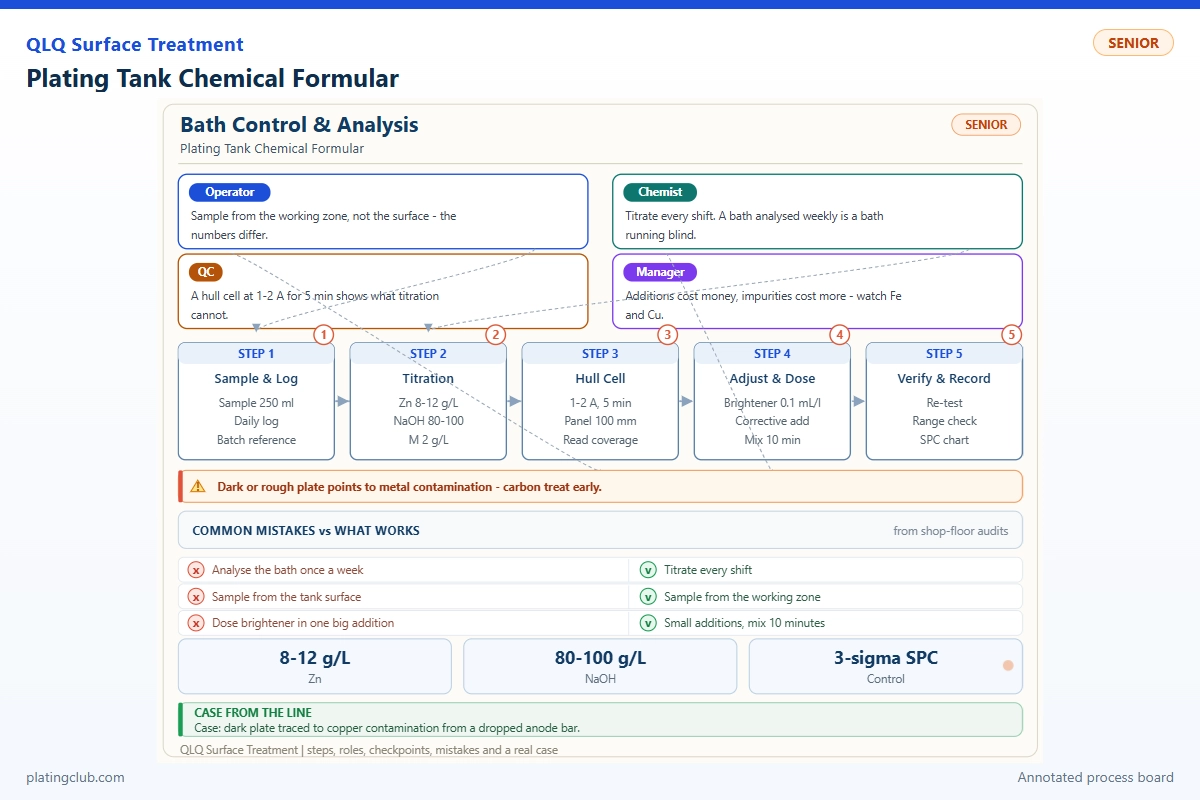
📖 Tank Make-up Manual: Rack Plating (Zinc Alloy)
Phase I: Pre-treatment Tanks (The "Adhesion" Zone)
1. Hot Soak Degreasing (Chemical Cleaning)
Tank Material: 304 Stainless Steel (with Ultrasonic).
Make-up for 1000L:
[QLQ Product] Zinc Liquid Dewaxing Agent: 50 – 80 Liters.
Pure Water: Balance.
Operating Parameters:
Temp: 70°C – 80°C.
Time: 5 – 10 mins.
Master’s Note: Do not just add water. Add the chemical when the tank is 50% full, then fill up. Heat helps dissolve the surfactants.
2. Cathodic Electrolytic Degreasing (Electro-Clean)
Tank Material: Mild Steel or PP with SS Anodes.
Make-up for 1000L:
[QLQ Product] Zinc Electro-cleaning Salt: 50 kg (50 g/L).
Optional: [Purchase Locally] Potassium Hydroxide: 10 kg (Only if pH < 12).
Operating Parameters:
Temp: 50°C – 60°C.
Voltage: 4 – 6 V.
Polarity: Workpiece = Negative (-).
⚠️ Danger: NEVER use the same electro-cleaner used for Steel parts. High caustic soda will dissolve the Zinc zipper pulls instantly.
3. Acid Activation (Neutralization)
Tank Material: PP / PVC.
Make-up for 1000L:
[QLQ Product] Zinc Activation Salt (Fluoride-based): 20 kg (20 g/L).
[Purchase Locally] Sulfuric Acid: 5 Liters (0.5% vol).
Operating Parameters:
Temp: Room Temp.
Time: 5 – 15 seconds.
⚠️ Danger: NO Hydrochloric Acid (HCl). HCl causes severe Hydrogen Embrittlement in the stainless steel springs.
Phase II: Base Plating (Copper & Nickel)
4. Cyanide Copper Strike (Alkaline Copper)
Tank Material: Steel or PP (Heating required).
Make-up for 1000L:
[Purchase Locally] Copper Cyanide (CuCN): 45 kg.
[Purchase Locally] Sodium Cyanide (NaCN): 65 kg.
[Purchase Locally] Rochelle Salt: 45 kg.
[Purchase Locally] Sodium Hydroxide: 5 kg (to adjust pH to 12.5).
Optional: [QLQ Product] Copper Anode Activator: 2 Liters.
Process:
Dissolve NaCN in warm water (50°C) first. Toxic Gas Risk!
Add CuCN slowly into the NaCN solution (it will turn clear).
Add Rochelle Salt.
Check Free Cyanide: Maintain at 15 – 18 g/L.
Master’s Note: If Free Cyanide is too low, the anodes will turn "black" (passivate). If too high, the plating will blister.
5. Acid Copper (High Leveling)
Tank Material: PP (Air Agitation + Cooling required).
Make-up for 1000L:
[Purchase Locally] Copper Sulfate (CuSO₄·5H₂O): 200 kg.
[Purchase Locally] Sulfuric Acid (H₂SO₄): 60 kg (approx 33 Liters).
[Purchase Locally] Hydrochloric Acid: ~100 ml (Target 60-80 ppm Chloride).
[QLQ Product] Mu (Make-up Agent): 5 – 8 Liters.
[QLQ Product] A (Leveler): 0.5 Liters.
[QLQ Product] B (Brightener): 0.5 Liters.
Process:
Dissolve Copper Sulfate in hot water.
Add Sulfuric Acid slowly (Exothermic reaction - generates heat!).
Treat with [QLQ] Carbon Powder (2 kg) and filter before adding brighteners.
Add Chloride and Additives last.
⚠️ Danger: Chloride control is critical. Too much Cl⁻ = Dull plating. Too little Cl⁻ = Burned/Rough plating.
6. Bright Nickel (Watts Nickel)
Tank Material: PP (Continuous Filtration).
Make-up for 1000L:
[Purchase Locally] Nickel Sulfate: 280 kg.
[Purchase Locally] Nickel Chloride: 50 kg.
[Purchase Locally] Boric Acid: 45 kg.
[QLQ Product] Nickel Softener (Carrier): 10 Liters (High dose for flexibility).
[QLQ Product] Nickel Brightener (Main): 0.5 Liters.
[QLQ Product] Wetting Agent (Anti-Pit): 1 Liter.
Process:
Dissolve Nickel salts in hot water (70°C).
Dissolve Boric Acid separately in boiling water (it is hard to dissolve).
Adjust pH to 4.2 using Sulfuric Acid or Nickel Carbonate.
Dummy plate for 4 hours before production.
Phase III: Color Finishes (The QLQ Specialties)
7. Imitation Gold (Brass Alloy)
Make-up for 1000L:
[QLQ Product] Imitation Gold Salt: 120 kg (120 g/L).
[Purchase Locally] Potassium Cyanide: 10 kg (Only if specified by formulation).
[Purchase Locally] Ammonium Hydroxide: Small amount for color adjustment.
Operating Parameters:
Temp: 30°C – 40°C.
pH: 9.5 – 10.5.
Anodes: 70/30 Brass Plates or Stainless Steel.
Master’s Note: Color is controlled by Current and Temp.
Too Red? $\rightarrow$ Increase Current / Lower Temp.
Too Yellow/White? $\rightarrow$ Decrease Current / Raise Temp.
8. Gunmetal (Tin-Nickel / Tin-Cobalt)
Make-up for 1000L:
[QLQ Product] Gunmetal Make-up Salt: 300 kg.
[QLQ Product] Gunmetal Additive A & B: As per manual.
[Purchase Locally] Hydrochloric Acid: To adjust pH to 2.0.
Operating Parameters:
Temp: 60°C – 65°C.
Anodes: Carbon Graphite or Nickel (Inert).
Master’s Note: This bath is very sensitive to metallic impurities (Copper/Zinc). Retrieve fallen parts immediately!
9. Rose Gold
Make-up for 1000L:
[QLQ Product] Rose Gold Premixed Solution: 1000 Liters (Ready to use).
Self-mixing is difficult and results in unstable color.
Operating Parameters:
Temp: 45°C $\pm$ 1°C.
10. Antique Bronze (Oxidizing)
Make-up for 1000L:
[QLQ Product] Antique Blackener: 100 Liters (10% concentration).
Pure Water: 900 Liters.
Phase IV: Post-Treatment
11. Electrolytic Passivation
Make-up for 1000L:
[QLQ Product] Electrolytic Passivation Salt: 50 kg.
Parameters: Room Temp, 3-5 Volts, 30 seconds.
12. Rack Lacquer (Water-based)
Make-up:
[QLQ Product] Clear Acrylic Dip Lacquer: Use pure (100%) or dilute 1:1 with pure water depending on viscosity.
🌟 Master's "Golden Rules" for Tank Maintenance
Dissolving Sequence (Crucial):
Never dump powder directly into the main tank. It will settle at the bottom and create a solid "rock."
Rule: Dissolve in a separate bucket with hot water, then filter it into the main tank.
The "Dummying" Ritual (New Tank):
A newly mixed Nickel or Acid Copper tank is "raw" and harsh.
Action: You MUST perform "Dummy Plating" (Low current electrolysis at 0.1 A/dm²) for 4-8 hours to remove trace impurities from the raw chemicals before putting in the first real product.
Water Quality:
Do not use tap water to make up these tanks. Tap water contains Chlorine and Calcium that ruin Acid Copper and Passivation. Use RO Pure Water.
Live Entry :
For the Cyanide Copper tank: The rectifier must be ON (preset to ~3V) before the Cage Rack enters the liquid.
Why? If the zinc parts touch the liquid without current, the copper will deposit loosely (immersion). The plating will peel off during the "Bend Test."
Softener Overdose for Springs:
For Zipper Pulls with springs: Maintain the [QLQ] Nickel Softener concentration at 120% of the standard level. This ensures the nickel layer is ductile enough to flex without snapping the brittle spring underneath.
FAQ - Plating Tank Chemical Formular
Straight answers from the shop floor. Ask us on WhatsApp if your case is different.
How do I prepare the parts before this step?
What safety and environmental controls are required?
What is the practical takeaway for the workshop?
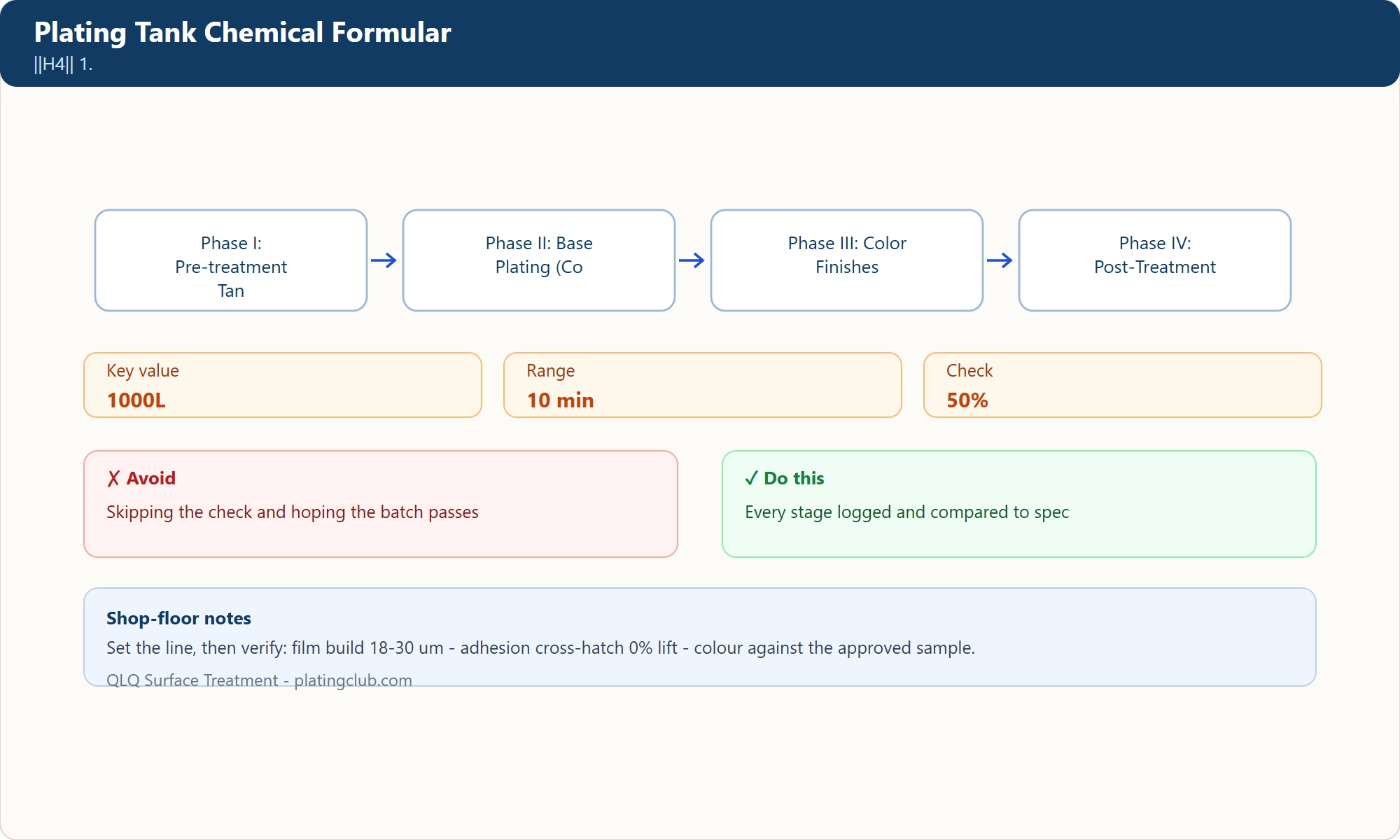
Quick reference - what to check and why
| Stage | What it means on the line |
|---|---|
| Phase I: Pre-treatment Tanks (The "Adhesion" Zone) | ||H4|| 1. |
| Phase II: Base Plating (Copper & Nickel) | ||H4|| 4. |
| Phase III: Color Finishes (The QLQ Specialties) | ||H4|| 7. |
| Phase IV: Post-Treatment | ||H4|| 11. |
| 🌟 Master's "Golden Rules" for Tank Maintenance | Dissolving Sequence (Crucial): Never dump powder directly into the main tank. |
| FAQ - Plating Tank Chemical Formular | Straight answers from the shop floor. |