
🛡️ The Rack Plating Master’s Protocol (QLQ System)
Target: Zero Spring Failures( it is for zipper slider), < 2% Rejection Rate, Optimized Chemical Cost.
☀️ I. Daily Routine (The "Heartbeat" of the Factory)
07:30 – 08:00 | The Pre-Flight Check (Before the Rectifiers Turn On)
The "Contact" Audit (Crucial for Racks):
Action: Inspect the V-Blocks (Copper saddles) on the main tank bars. Sandpaper them if they are green/black.
Standard: Contact surface must be bright copper color. Poor contact = Arcing = Spark marks on zipper pulls.
Temperature Patrol:
Acid Copper: Check Chiller. Temp must be 22°C – 26°C. (Above 28°C = Foggy plating).
Chrome/Gunmetal: Check cooling.
Degreasing/Nickel: Check Heaters. Temp must be > 55°C.
The "Hull Cell" Morning Ritual:
Action: Take a sample from the Acid Copper and Nickel tanks. Run a 10-minute Hull Cell panel.
Goal: Determine exactly how many mL of [QLQ] Brightener and Leveler to add for the day's start. Do not add additives based on "feeling."
09:00 – 16:00 | Production Quality Control (The "Hawk Eye")
The "Spring Safety" Check (Every 2 Hours):
Action: Pull 5 zipper pulls off the line after baking. Use pliers to pull the pull-tab 90°.
Standard: Zero breakages. If one breaks, STOP the line immediately. Check the [QLQ] Softener level and Oven Temp.
The "White Glove" Pre-treatment Check:
Action: Go to the end of the Cleaning Line (before Copper). Wipe a rack of parts with a white cloth.
Standard: No black smut, no water beads (Water Break Free).
Ampere-Hour Dosing Verification:
Action: Compare the pump counter with the rectifier output.
Standard: Ensure the [QLQ] Brightener is actually being consumed. (Sometimes pumps suck air, causing dull parts).
17:30 – 18:00 | The "Money Saving" Shutdown
Gold/Gunmetal Preservation:
Action: Cover the Imitation Gold and Gunmetal tanks with tight lids.
Reason: Evaporation changes the color tone and wastes money.
Fallen Part Recovery (The "Magnet Sweep"):
Action: Use a magnet rake in the Nickel Tank.
Standard: Must be done daily. A zinc zipper pull dissolving in the Nickel tank causes "Black Streaks" on tomorrow's production.
📅 II. Weekly Routine (The "Precision Tuning")
Monday Morning | The "Chemist" Mode
Full Titration Analysis:
Action: Titrate Copper Sulfate, Nickel Sulfate, Chlorides, and Acids.
Target:
Acid Copper H₂SO₄: 60 ± 5 g/L.
Nickel Chloride: 50 ± 5 g/L.
Chloride (Acid Cu): 60 - 80 ppm (Critical for leveling).
Output: Issue a "Chemical Add Sheet" to the warehouse for [Purchase Locally] commodities.
Wednesday | The "Flow" Check
Filter Maintenance:
Action: Check pressure gauges on Acid Copper/Nickel filters.
Standard: If Pressure > 1.5 Bar (20 psi), clean or replace filter cores.
Goal: Maintain flow rate at 8-10 turnovers per hour to prevent roughness.
Friday Afternoon | The "Rack Doctor"
Rack Stripping (Jig Maintenance):
Action: Inspect the cage racks. Are the contact tips built up with thick copper/nickel "trees"?
Standard: Send racks to the Stripping Station (Nitric Acid dip). Thick buildup steals current from the zipper pulls, causing "Low Current Shadow" defects.
Anode Bag Inspection:
Action: Lift 3 random anode baskets. Check bags for holes.
Standard: No sludge leakage. Sludge = Roughness (Sandpaper feel).
🗓️ III. Monthly Routine (The "System Reset")
1st Weekend of Month | The "Deep Clean" (Carbon Treat)
Action: Pump the Acid Copper and Nickel solutions into a spare tank.
Process: Add 2-3 kg/ton of [QLQ] Activated Carbon. Agitate for 4 hours. Filter back to the main tank.
Goal: Remove organic breakdown products (TOC).
Result: Restores the "ductility" (flexibility) of the plating and restores the "White" color of the Nickel.
2nd Weekend of Month | The "Dummy" Run (Impurity Removal)
Action: Hang corrugated steel sheets (Dummy Cathodes) in the tank.
Process: Run at Ultra-Low Current (0.1 A/dm²) for 10-12 hours (overnight).
Goal: Plate out metallic impurities (Copper, Zinc, Lead, Iron).
Visual Check: The dummy sheets should turn grey/black. If they are bright, the current is too high.
End of Month | The "Boss's Report" (KPIs)
Cost Analysis:
Calculate: Total Chemicals Used ÷ Total KG Produced.
Target: Keep cost stable (e.g., $0.25/kg for chemicals). If it jumps to $0.35, explain why (e.g., Drag-out leaks?).
Rejection Report:
Target: < 2% Re-work rate.
Analyze top defect: Is it Blistering? Roughness? Color variation?
🏆 IV. How the Boss Evaluates this Master (KPIs)
Mr. Boss, here is how you know your Master is doing a good job:
The "Morning Silence":
If the Master is running around screaming at 9:00 AM, he failed.
If he is sitting in the lab reading a Hull Cell panel while the line runs quietly, he is winning.
The "Spring" Guarantee:
Zero customer complaints about broken zipper pullers for 3 consecutive months.
The "Color Consistency":
The "Imitation Gold" plated on Monday looks exactly the same as the one plated on Friday. (This means he is managing the [QLQ] Additives and Temp correctly).
The "Clear Floor":
No yellow puddles (Chromate/Cyanide) on the floor. A clean floor means good drag-out control = Money Saved.
FAQ - SOP for Rack Plating Master
Straight answers from the shop floor. Ask us on WhatsApp if your case is different.
What result should I expect?
How do I fix it on the line?
What must be checked before running?
What does this document cover?
What is the root cause of the problem?
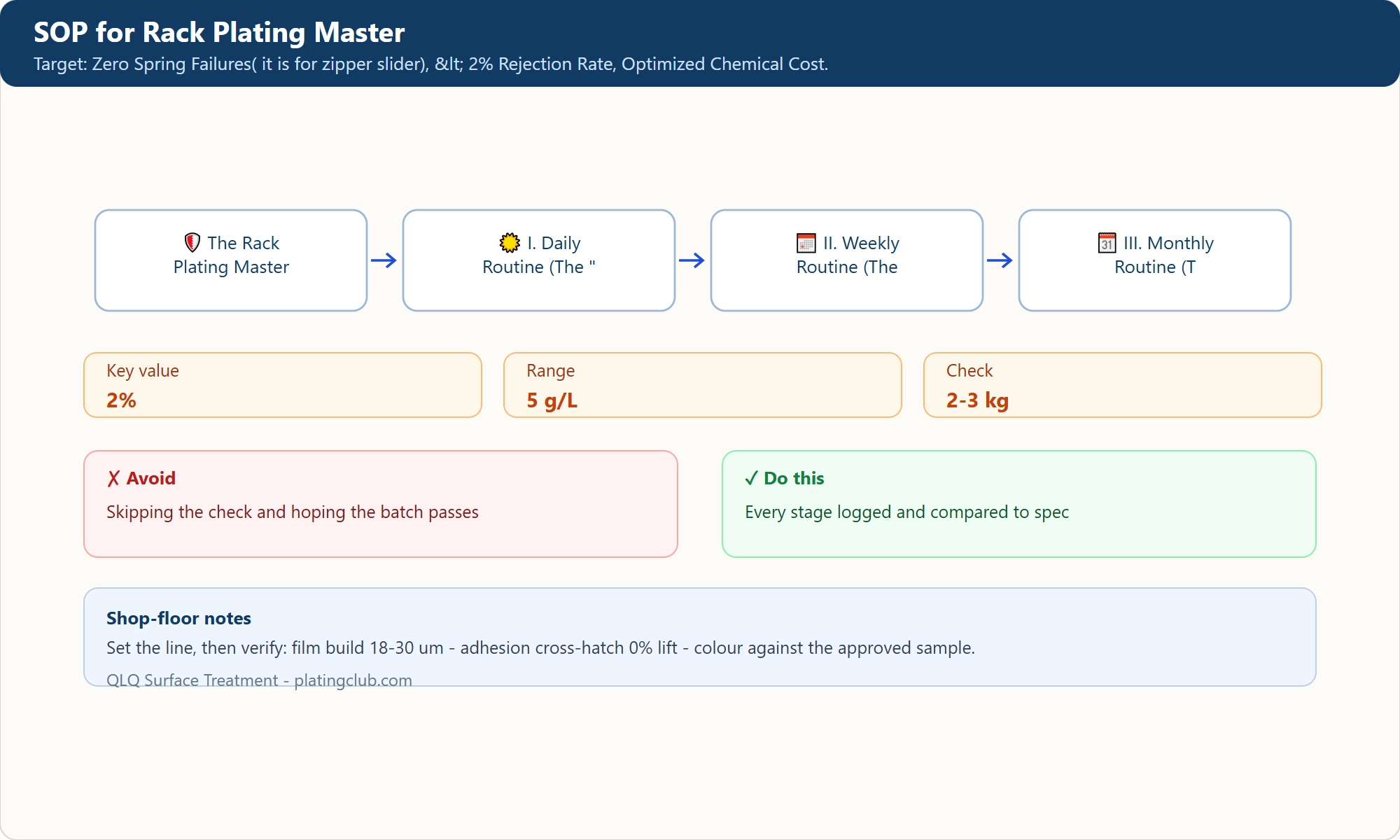
Quick reference - what to check and why
| Stage | What it means on the line |
|---|---|
| 🛡️ The Rack Plating Master’s Protocol (QLQ System) | Target: Zero Spring Failures( it is for zipper slider), < 2% Rejection Rate, Optimized Chemical Cost. |
| ☀️ I. Daily Routine (The "Heartbeat" of the Factory) | 07:30 – 08:00 | The Pre-Flight Check (Before the Rectifiers Turn On) The "Contact" Audit (Crucial for Racks): Action: Inspect the V-Blocks (Copper saddles) on the main tank bars. |
| 📅 II. Weekly Routine (The "Precision Tuning") | Monday Morning | The "Chemist" Mode Full Titration Analysis: Action: Titrate Copper Sulfate, Nickel Sulfate, Chlorides, and Acids. |
| 🗓️ III. Monthly Routine (The "System Reset") | 1st Weekend of Month | The "Deep Clean" (Carbon Treat) Action: Pump the Acid Copper and Nickel solutions into a spare tank. |
| 🏆 IV. How the Boss Evaluates this Master (KPIs) | Mr. |
| FAQ - SOP for Rack Plating Master | Straight answers from the shop floor. |