
Curing Ovens & Tunnel Ovens — Paint Cure Profile, Temperature Control & Troubleshooting
The cure cycle is the final quality gate: under-cure = sticky parts, over-cure = brittle discolored rejects. Master the ramp, soak and cool phases.
The Cure Cycle — Ramp, Soak & Cool
The oven is the last chance to get quality right — profile matters more than peak temperature
1The Cure Profile — Ramp, Soak & Cool
Ramp (3–8 min): bring part to cure temperature at controlled rate. Soak (15–25 min): hold at target temp for cross-linking. Cool (5–10 min): slow cool prevents thermal shock and crack formation. Profile varies by paint chemistry.
2Tunnel Oven vs Box Oven
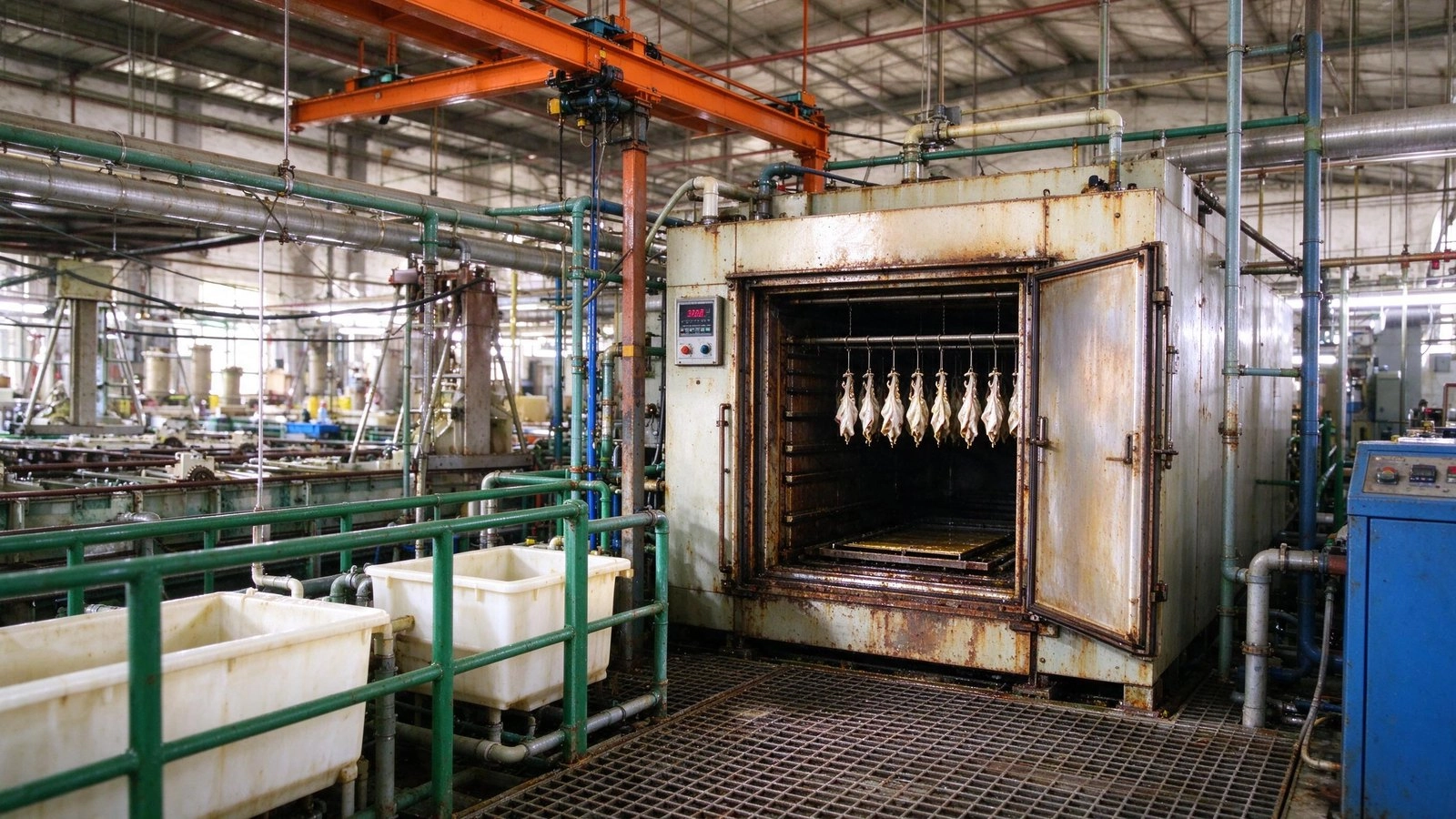
Tunnel oven: continuous conveyor, parts move through zones (pre-heat → soak → cool). Box oven (batch): whole load heats together. Tunnel = high throughput, consistent profile. Box = flexible, good for mixed batches.
3Temperature Uniformity (±5 °C)
Uniformity across the oven width (left-center-right) must be within ±5 °C. Hot spots = over-cured edges; cold spots = under-cured centers. Use 9-point thermocouple grid per zone to validate. Burner tuning and airflow baffles maintain balance.
4Common Troubleshooting — Under vs Over Cure
Under-cure (sticky/tacky): too short soak time, low temp, or thick film. Over-cure (yellowing/brittle): too long soak, high temp, or wrong catalyst. Use MEK rub test and pencil hardness to verify cure level.
5Energy Consumption & Capacity Matching
Tunnel ovens consume 300–800 kWh per ton of product. Match oven speed to production rate — running empty belt wastes energy. Heat recovery from exhaust (economizer) cuts 15–30% gas use. Insulation thickness ≥ 150 mm mineral wool.
Troubleshooting Common Oven Problems
Diagnose and fix the five most frequent curing issues
| Problem | Likely Cause | Check This | Fix |
|---|---|---|---|
| Sticky / tacky parts (under-cure) | Soak time too short or temp too low | Thermocouple reading at part surface | Increase soak 3–5 min or raise temp 5–10 °C |
| Yellowing / darkening (over-cure) | Temp too high or dwell too long | Oven zone temp log and belt speed | Reduce soak time or lower temp 5–10 °C |
| Orange peel surface | Flash-off too short before cure | Pre-heat zone temp and air velocity | Extend pre-heat or reduce paint viscosity |
| Pinholing / popping | Solvent trapped under cured skin | Ramp rate too fast | Slow ramp rate to 10–15 °C/min |
| Belt-side parts under-cured | Temperature gradient across belt | 9-point thermocouple map | Adjust airflow dampers or add baffles |
📌 Curing Oven Cheat Sheet
FAQ
How often should I profile my oven?
What is the ideal ramp rate for waterborne paint?
Can I use one oven for different paint chemistries?
Why is my energy bill rising if throughput hasn't changed?
What is the maximum belt speed for 25 μm e-coat cure?
Get a Free Quote Today
Send us your samples or drawings — our engineers reply within 24 hours with pricing and technical advice.
Contact UsCuring oven: settings and checks
| Item | Typical | Watch |
|---|---|---|
| Temperature uniformity | Within +/- 5 C | Cold spots give under-cured parts |
| Air flow | Filtered, balanced | Stagnant zones cause colour shift |
| Belt speed / cycle | Per paint TDS | Faster belt = soft film |
| Exhaust | Solvent removal | Solvent build-up dulls the finish |
| Temperature record | Every batch | Chart is your evidence |
FAQ
How do we prove the oven cured the film?
Solvent rub or MEK double rub plus adhesion test on a coupon from each batch.
Why do parts at the oven edge fail adhesion?
Uneven temperature. Map the oven with a data logger before adjusting the recipe.