
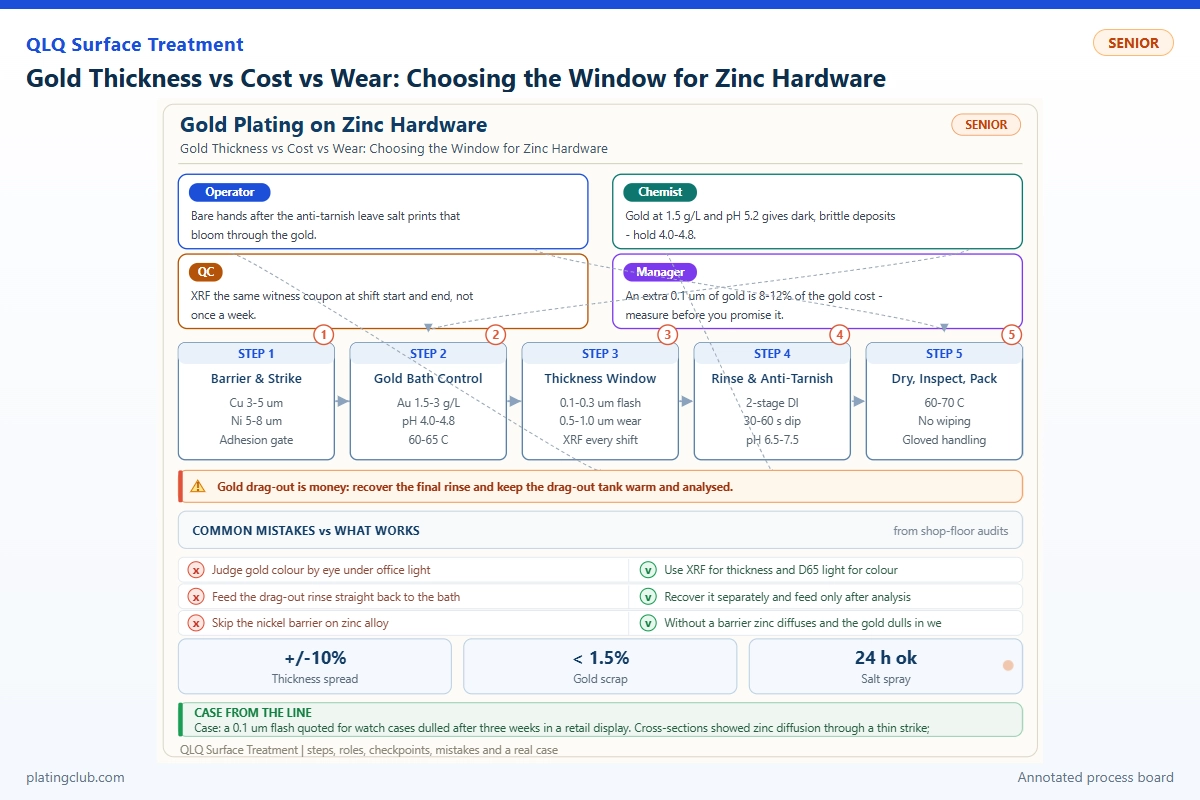
Two shops can quote the same part and differ by 40% in gold cost - and both can be right. The difference is the wear assumption. This is how to choose a thickness window that survives the customer's real use, not the spec sheet.
8-12%
Cost per 0.1 um
500-2000 cycles
Wear test
< 1 dE
Colour shift
Thickness selection by service condition
| Service condition | Gold thickness | Barrier | Notes |
|---|---|---|---|
| Display only | 0.10-0.15 um | Ni 3-5 um | Thin gold shows substrate if chipped |
| Handled occasionally | 0.3-0.5 um | Ni 5-8 um | Most fashion hardware |
| Daily handling | 0.8-1.0 um | Ni 5-8 um + Cu 3 um | Clasps, buckles, keys |
| Abrasion plus sweat | 1.5-2.0 um | Cu + Ni + gold alloy | Test with artificial sweat |
Wear data from a rotary abrasion test (500 cycles, 250 g)
| Thickness | Colour shift (dE) | Exposed substrate | Verdict |
|---|---|---|---|
| 0.1 um | 4.2 | Yes, at edges | Display only |
| 0.3 um | 1.6 | No | Good for light handling |
| 0.5 um | 0.8 | No | Standard wear |
| 1.0 um | 0.4 | No | Heavy wear |
Cost and process trade-offs per 1,000 parts
| Option | Gold cost index | Bath time | Risk |
|---|---|---|---|
| 0.1 um flash | 1.0 | Shortest | Claims from wear-through |
| 0.35 um | 1.9 | Medium | Balanced for fashion |
| 0.8 um | 3.4 | Longer | Needs stable current density |
| 1.5 um + alloy | 5.6 | Longest | Harder colour control |
Watch out
Thickness is not a single number on a drawing - it is edge, face and recess thickness. Specify where the measurement is taken or the argument will happen at goods-in.
Common mistakes and the fix
| ✗ Specify gold thickness without a measurement point | ✓ Name the face and the distance from the edge |
| ✗ Skip the barrier to save a step | ✓ Diffusion ruins colour in weeks - the barrier is the cheap part |
| ✗ Test wear with a cloth rub | ✓ Use a defined abrasion test so numbers compare |
| ✗ Treat colour as independent of thickness | ✓ Below 0.2 um the substrate shifts the colour |
What each role watches
| Operator | "Hold current density steady; thickness varies with contact quality." |
| Chemist | "Trend gold analysis and pH together; a drifting pH changes colour before thickness." |
| QC | "XRF face, edge and recess and report all three." |
| Manager | "Agree the wear assumption with the customer in writing before quoting." |
From the shop floor
Case: a customer specified 0.3 um for watch cases worn daily. Field returns at 8% forced a review; rotary abrasion tests showed 0.3 um exposing edges at 500 cycles. Moving to 0.8 um with a nickel barrier cut returns to below 0.5% at a 2.4x gold cost that was recovered in one season of returns.
FAQ
How much does each 0.1 um of gold cost?
Typically 8-12% of the gold cost per 0.1 um on a small part, excluding added bath time.
Is a copper layer needed under nickel on zinc?
For heavy wear yes - it cushions the barrier and improves corrosion performance.
How do I check wear resistance without a lab?
A defined rotary abrasion pad at fixed load and cycle count gives comparable numbers week to week.
Where to go next
- Level guide for this trade: Gold & Precious Plating — technician levels
- Other levels: Junior, Intermediate, Management
- Owner view: Process Overview for owners
- Supplier view: Chemistry & Supply · Find content by trade + level
Related reading in this trade
FAQ - Gold Thickness vs Cost vs Wear: Choosing the Window for Zinc Hardware
Straight answers from the shop floor. Ask us on WhatsApp if your case is different.
What problem does this article address?
Two shops can quote the same part and differ by 40% in gold cost - and both can be right. The difference is the wear assumption. This is how to choose a thickness window that survives the customer's real use, not the spec sheet.
What are the practical steps or checks?
Operator Bare hands after the anti-tarnish leave salt prints that bloom through the gold. Chemist Gold at 1.5 g/L and pH 5.2 gives dark, brittle deposits - hold 4.0-4.8. QC XRF the same witness coupon at shift start and end, not once a week. Manager
What should the workshop do differently?
Supplier view: Chemistry & Supply · Find content by trade + level