
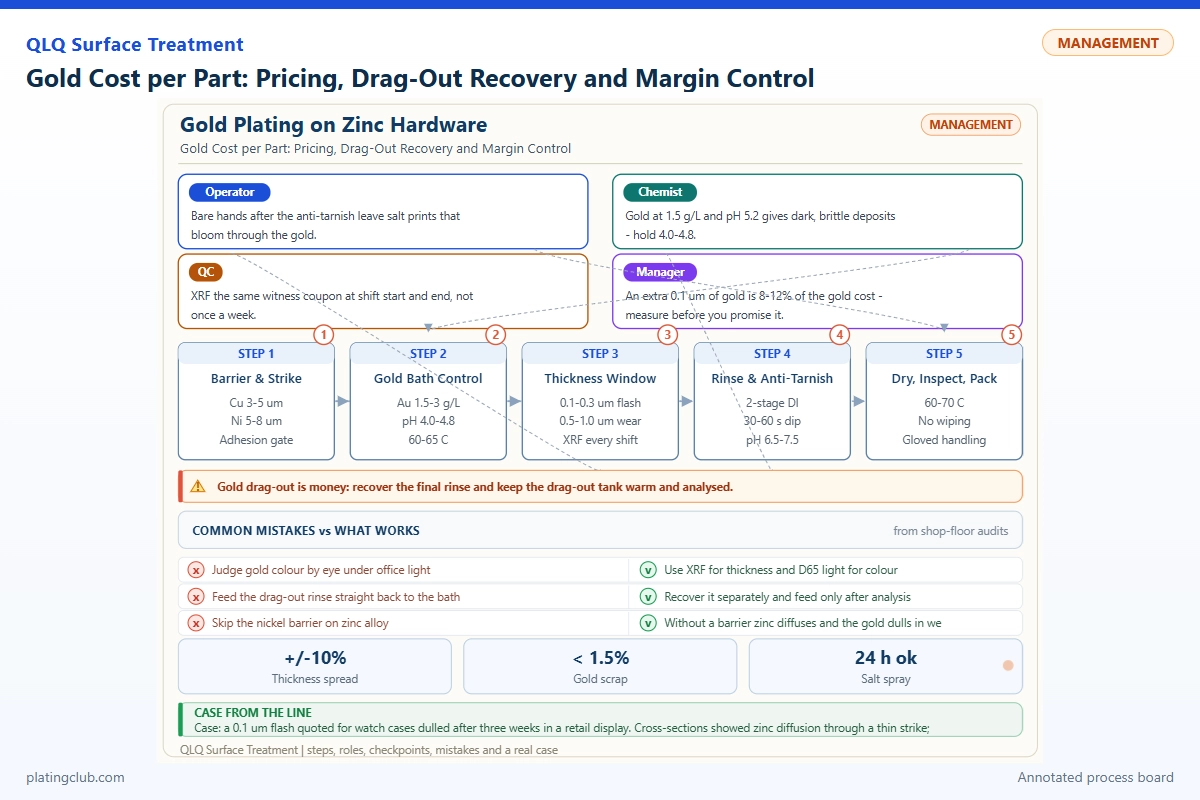
Gold is the only input on a plating line that is priced by the gram and quoted by the micron. Management that measures drag-out and scrap recovery turns a volatile cost into a controllable one.
85-95%
Gold recovery
5-15%
Drag-out share
18-25%
Margin floor
Gold cost per 1,000 parts by thickness (0.5 dm2 per part)
| Thickness | Gold volume | Gold cost index | Comment |
|---|---|---|---|
| 0.1 um | 0.005 cm3 | 1.0 | Display |
| 0.3 um | 0.015 cm3 | 3.0 | Fashion |
| 0.5 um | 0.025 cm3 | 5.0 | Standard wear |
| 1.0 um | 0.050 cm3 | 10.0 | Heavy wear |
Where gold is lost and how much you can get back
| Loss path | Typical share | Recovery method | Recovered |
|---|---|---|---|
| Drag-out in rinse | 5-15% | Static drag-out tank, then electrowin | 70-90% |
| Rejected parts | 1-5% | Strip and re-plate or refine | 80-95% |
| Filters and resins | 1-3% | Burn/refine | 60-80% |
| Anode residues and bags | < 2% | Refine | 50-70% |
Pricing discipline that protects margin
| Rule | Why | How to enforce |
|---|---|---|
| Quote the thickness band | Wear-through claims start with a single number | Specify face + range |
| Add a gold surcharge clause | Metal price moves | Review monthly |
| Charge for stripping and re-plating | Rework is not free | Itemise on the quote |
| Monthly gold reconciliation | Catches theft and loss early | Compare purchase vs plated area |
Watch out
A reconciliation gap above 5% between gold purchased and gold plated is a red flag. Check drag-out first, then the scrap route - and keep records that let you talk to a refiner credibly.
Common mistakes and the fix
| ✗ Quote gold at today's metal price for a 12-month contract | ✓ Use a surcharge clause instead |
| ✗ Let rework absorb into overhead | ✓ Rework hides the real thickness requirement |
| ✗ Recover drag-out without analysis | ✓ Unanalysed recovery contaminates the bath |
| ✗ Treat scrap as waste | ✓ Sorted scrap has real refining value |
What each role watches
| Operator | "Keep drag-out drip time consistent - that is where recovery starts." |
| Chemist | "Analyse recovered solution before it goes back to the bath." |
| QC | "Tag rejected racks for the scrap route; never mix with waste." |
| Manager | "Reconcile gold in versus gold out every month." |
From the shop floor
Case: a shop plating 120,000 parts a year found a 9% gap between purchases and plated area. Adding a static drag-out tank and sorting rejects recovered enough gold to fund a new rectifier within eight months.
FAQ
How much gold is really in the rinse water?
Typically 5-15% of consumption; with a static drag-out tank plus electrowinning, 70-90% of it is recoverable.
Should we refine in-house?
Only with training and permits. Most small shops collect and sell to a certified refiner.
How often should plating prices be reviewed?
Monthly metal review with a quarterly full cost review is the practical rhythm.
Where to go next
- Level guide for this trade: Gold & Precious Plating — technician levels
- Other levels: Junior, Intermediate, Senior
- Owner view: Process Overview for owners
- Supplier view: Chemistry & Supply · Find content by trade + level
Related reading in this trade
FAQ - Gold Cost per Part: Pricing, Drag-Out Recovery and Margin Control
Straight answers from the shop floor. Ask us on WhatsApp if your case is different.
What problem does this article address?
Gold is the only input on a plating line that is priced by the gram and quoted by the micron. Management that measures drag-out and scrap recovery turns a volatile cost into a controllable one.
What are the practical steps or checks?
Operator Bare hands after the anti-tarnish leave salt prints that bloom through the gold. Chemist Gold at 1.5 g/L and pH 5.2 gives dark, brittle deposits - hold 4.0-4.8. QC XRF the same witness coupon at shift start and end, not once a week. Manager
What should the workshop do differently?
Supplier view: Chemistry & Supply · Find content by trade + level