
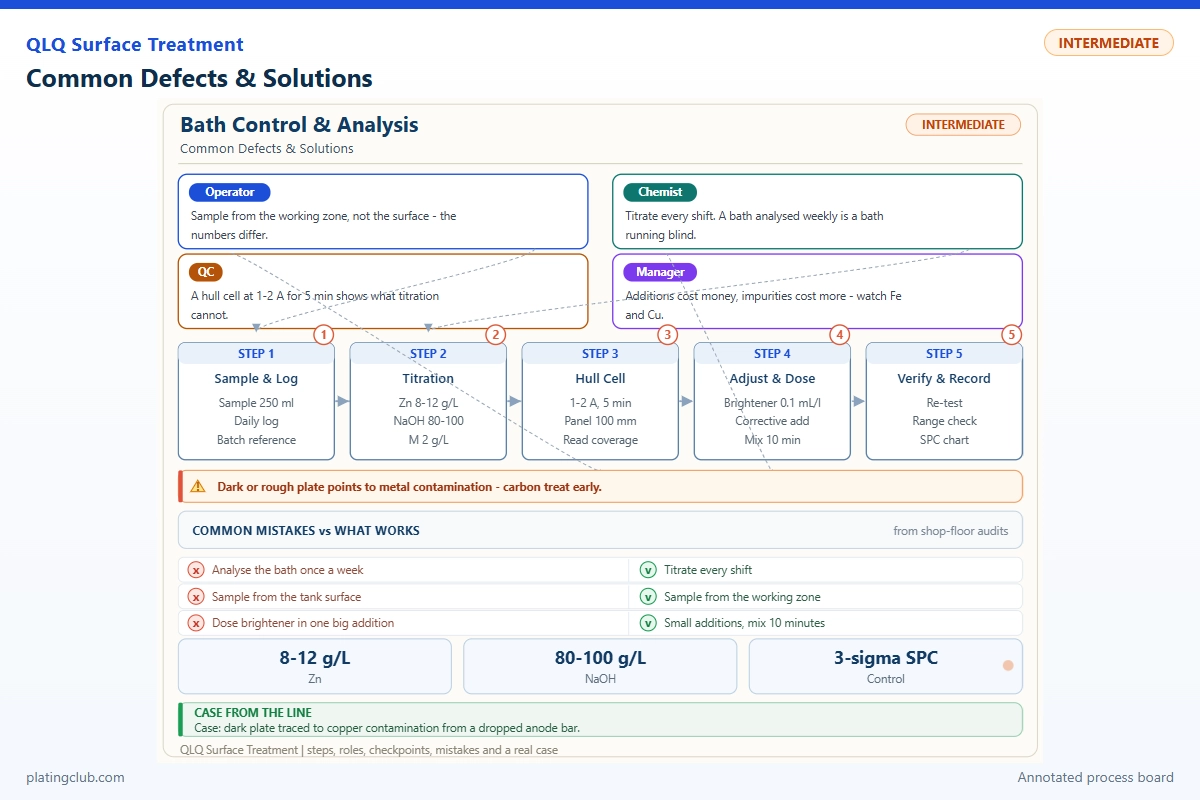
The Barrel Plating Troubleshooting Bible: Common Defects & Solutions
Context: Barrel plating is efficient, but because parts tumble randomly, issues like "shading," "bi-polar effects," and "nesting" are common. This guide addresses the root causes for Zinc Alloy and Iron/Steel products.
1. Adhesion Failure (Blistering & Peeling)
The most severe defect. If it peels, it's scrap.
Problem A: Blistering on Zinc Alloy (Small bubbles appear after acid copper or baking)
Root Cause 1: Over-pickling. The acid activation was too strong, attacking the zinc surface and creating a loose smut layer.
Solution: Stop using HCl. Switch to [QLQ Product] Acid Activation Salts (15-20 g/L). Limit time to <10 seconds.
Root Cause 2: Thin Copper Strike. The Cyanide Copper layer was too thin (<5µm), allowing the acidic copper bath to penetrate and corrode the zinc.
Solution: Extend Cyanide Copper time to 30 mins. Ensure pH is >12.0.
Root Cause 3: Cold Dye Castings. Plating cold parts in a warm cyanide bath can cause condensation/reaction issues.
Solution: Warm up parts in a hot water rinse (50°C) before entering the alkaline copper tank.
Problem B: Peeling on Stainless Steel (The coating flakes off like foil)
Root Cause: Passive Layer Intact. The stainless steel surface oxide was not removed.
Solution: Implement the "Woods Nickel Strike" (Nickel Chloride + HCl). You must see energetic gassing at the workpiece. Use [QLQ Product] Woods Nickel Additive to improve coverage.
Root Cause: Current Interruption. If the barrel stops rotating or loses contact for even a second during the Strike phase, the steel re-oxidizes.
Solution: Check the "Dangler" cables. Ensure tight contact. Keep the barrel rotating before entering the tank (Live Entry).
2. Cosmetic Defects (Roughness, Pitting, Dullness)
Problem C: Roughness / "Sandpaper" Feel
Root Cause 1: Solid Particles. Dust, anode sludge, or fallen parts dissolving in the bottom of the tank.
Solution:
Check Anode Bags (ensure no holes).
Increase Filtration (Change filter cores to 5-10µm).
Magnet Sweep: Use a magnet to clear iron filings from the bottom of the tank daily.
Root Cause 2: Current Too High. "Burning" at the edges of the zipper pulls.
Solution: Reduce Voltage. Add [QLQ Product] Anti-Burn Salt to the bath to allow higher current density range.
Problem D: Pitting (Tiny pinholes in the plating)
Root Cause 1: Hydrogen Gas Bubbles. Gas bubbles stick to the surface and prevent plating.
Solution: Add [QLQ Product] Wetting Agent to reduce surface tension. Increase barrel rotation speed slightly to dislodge bubbles.
Root Cause 2: Organic Contamination. Breakdown of brighteners or oil drag-in.
Solution: Perform Carbon Treatment using [QLQ Product] Activated Carbon.
Problem E: Dullness / Haze (Not Mirror Bright)
Root Cause 1: Temperature Too High. (Especially in Acid Copper).
Solution: Check the Chiller. Temp must be <28°C.
Root Cause 2: Imbalance of Brighteners.
Solution: Don't just dump in "Brightener B". You might need "Carrier A" (Softener). Perform a Hull Cell Test to determine the missing component. Send a sample to QLQ Lab for analysis.
3. Barrel-Specific Issues (Unique to Tumbling)
Problem F: "Barrel Eye" or "Eye Marks"
Description: A pattern matching the barrel holes appears on the parts (usually dark spots).
Root Cause: The barrel rotation is too slow, or the load is too heavy. Parts sit against the holes too long, shielding them from current.
Solution:
Increase barrel rotation speed (RPM).
Reduce the load per barrel (from 20kg $\rightarrow$ 15kg).
Use a High-Efficiency Barrel with smaller, more frequent holes.
Problem G: Nesting / Cup-to-Cup Sticking
Description: Flat parts or buttons stick together, resulting in unplated centers.
Root Cause: Surface tension and shape geometry.
Solution:
Add Conductive Media: Mix usually small steel balls or copper-plated beads into the load to break up the "nest."
Intermittent Rotation: Set the rectifier/motor to a "Forward-Stop-Reverse" cycle to shake parts loose.
Problem H: Bi-Polar Effect (Dark/Peeling Patches)
Description: Parts look dark or peel between layers (e.g., Nickel peeling off Copper).
Root Cause: "Floating" in the tank without current. When a barrel enters a tank without power, the chemical attack creates a passive film.
Solution: Live Entry. Ensure the rectifier is ON (at a low voltage, e.g., 2-3V) before the barrel touches the liquid.
4. Post-Plating Issues (The "Time Bomb")
Problem I: Spotting Out (White/Grey spots appearing days after plating)
Root Cause: Plating solution (Cyanide or Acid) trapped in the pores of the die-casting oozes out later due to humidity.
Solution:
Hot/Cold Rinse Cycle: Alternate between hot water (80°C) and cold water rinses to expand/contract pores and pump out salts.
Neutralization: Use a weak acid dip (Tartaric Acid) after Cyanide plating to neutralize trapped alkali.
Baking: The step we mentioned earlier (180°C) dries out the pores.
Problem J: Yellowing of Gunmetal/Silver
Root Cause: Oxidation of the top layer.
Solution:
Change the final rinse water frequently (Dirty water leaves salts).
Use [QLQ Product] Anti-Tarnish Dip immediately after the final rinse.
Ensure the [QLQ Product] Lacquer is fully cured in the oven.
FAQ - Common Defects & Solutions
Straight answers from the shop floor. Ask us on WhatsApp if your case is different.
What does this document cover?
What is the root cause of the problem?
How do I fix it on the line?
What must be checked before running?
What result should I expect?
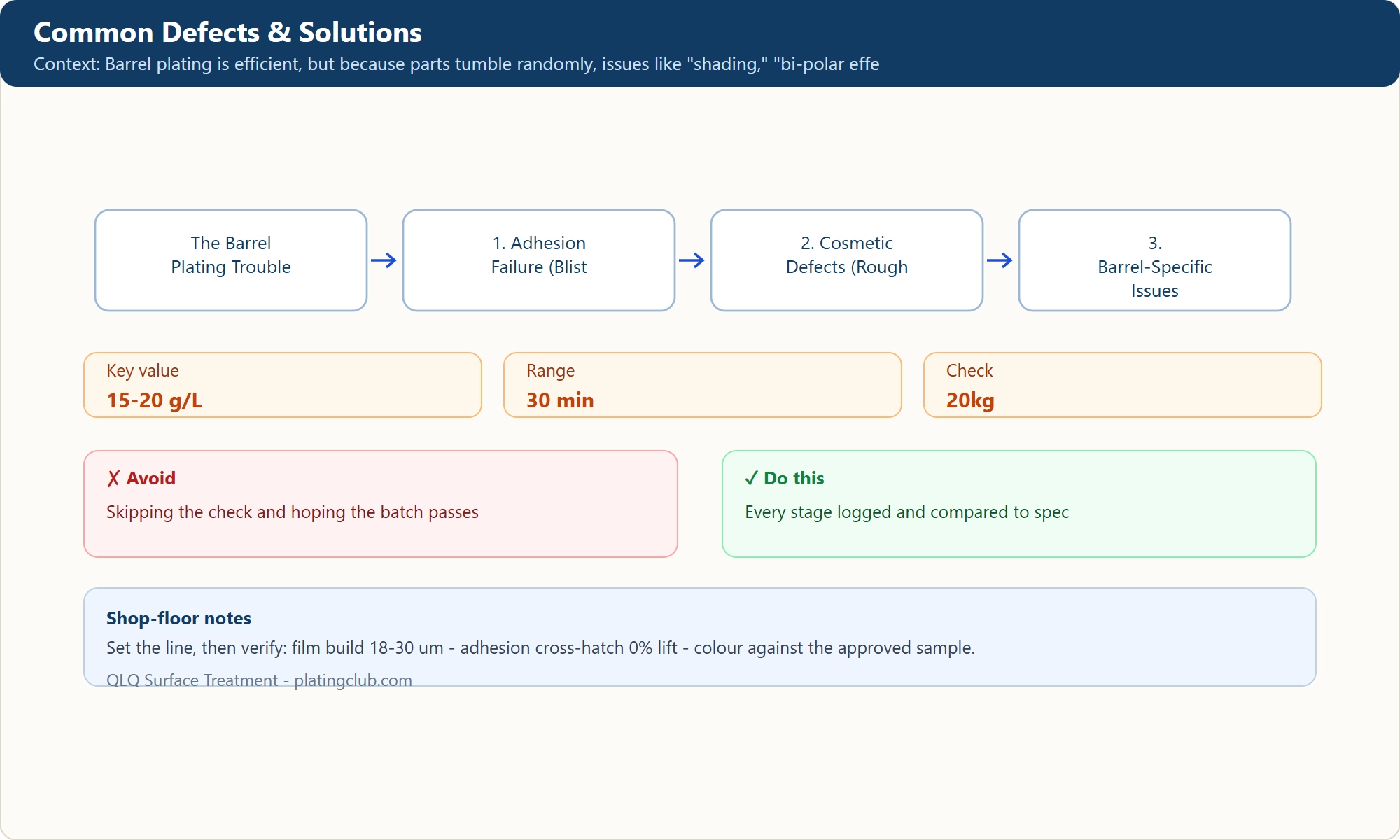
Quick reference - what to check and why
| Stage | What it means on the line |
|---|---|
| The Barrel Plating Troubleshooting Bible: Common Defects & Solutions | Context: Barrel plating is efficient, but because parts tumble randomly, issues like "shading," "bi-polar effects," and "nesting" are common. |
| 1. Adhesion Failure (Blistering & Peeling) | The most severe defect. |
| 2. Cosmetic Defects (Roughness, Pitting, Dullness) | ||H4|| Problem C: Roughness / "Sandpaper" Feel Root Cause 1: Solid Particles. |
| 3. Barrel-Specific Issues (Unique to Tumbling) | ||H4|| Problem F: "Barrel Eye" or "Eye Marks" Description: A pattern matching the barrel holes appears on the parts (usually dark spots). |
| 4. Post-Plating Issues (The "Time Bomb") | ||H4|| Problem I: Spotting Out (White/Grey spots appearing days after plating) Root Cause: Plating solution (Cyanide or Acid) trapped in the pores of the die-casting oozes out later due to h |
| FAQ - Common Defects & Solutions | Straight answers from the shop floor. |