
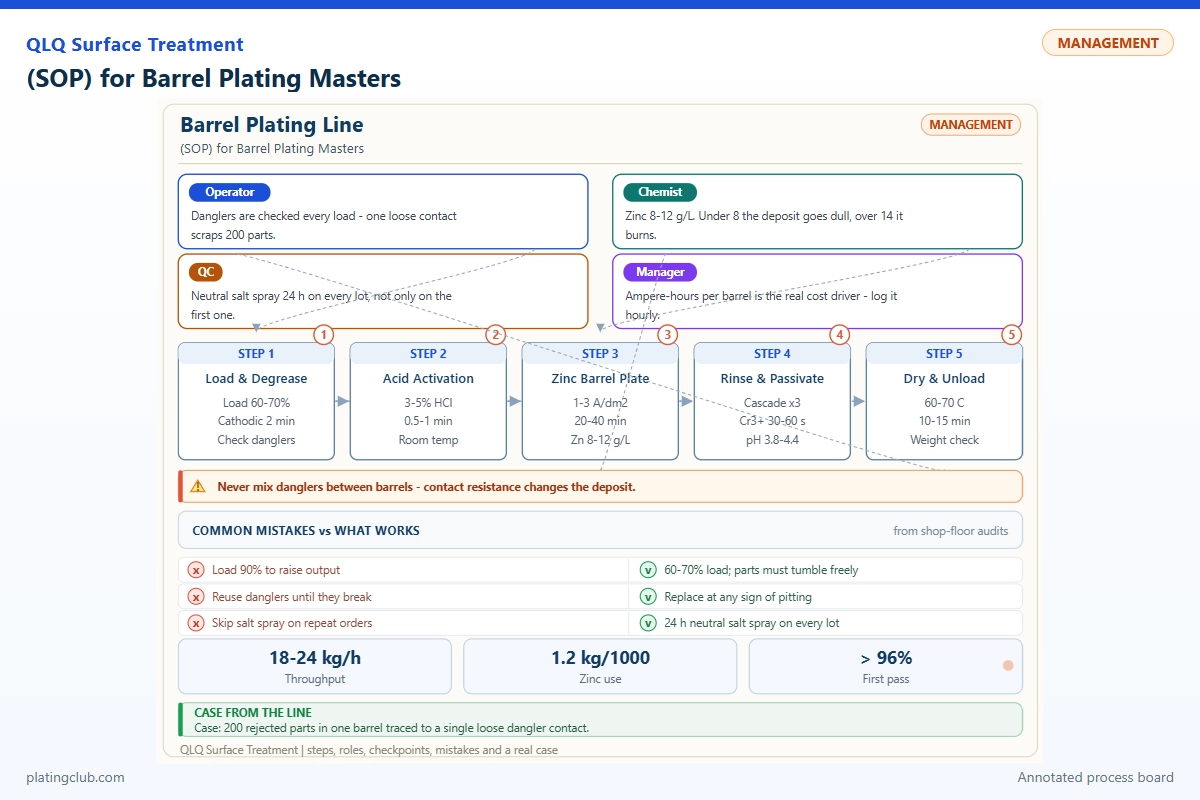
🏆 Standard Operating Procedure (SOP) for Barrel Plating Supervisors/Masters
Core Principle: Trust Data, Not Feelings. Prevention is better than Cure.
I. Daily Routine (Like a Pilot's Pre-Flight Check)
1. Pre-Start Preparation (07:30 - 08:00)
Dangler (Cathode Contact) Inspection: Personally check the contact points of every dangler cable.
Standard: Is it hot to the touch? Is the connection loose? Is the insulation broken? Strip off thick crystallized copper from the heads (this is the #1 killer of current stability).
Level & Temperature Control:
Confirm Acid Copper Tank is < 26°C (Is the Chiller working?).
Confirm Degreasing/Alk-Copper temps are > 60°C.
Top up all tank levels (Must use Pure Water; tap water is strictly forbidden for plating tanks).
pH Calibration:
Calibrate the pH pen using [QLQ Product] Standard Buffer Solution (Do not rely on paper strips).
Measure Nickel (4.0–4.8), Acid Copper (Check specific gravity/color), and Cyanide Copper (pH > 12).
2. Production Monitoring (09:00 - 16:00)
Hull Cell Test —— The Mark of a Master:
At 9:00 AM Sharp: Take samples from the Acid Copper, Nickel, and Cyanide Copper tanks.
Purpose: Detect if brighteners are low or impurities are high before the main production batch fails.
Action: Guide the dosing staff to add [QLQ Product] Make-up/Brighteners based on the panel results, not by guessing.
First Article Inspection (FAI):
You must personally inspect the first barrel from every new batch.
Focus: Wipe with a white cloth (check for black smut/film); Perform a Bend Test (check if the spring breaks).
Ampere-Hour Management:
Check the readings on the Automatic Dosing Pumps. Confirm if the consumption of brightener matches the production output.
Standard: Prevent pump blockages that lead to "starved" tanks.
3. End-of-Shift Maintenance (17:30 - 18:00) —— The Most Critical Step
Magnet Sweep (Salvaging Fallen Parts):
Mandatory Action: Use a powerful magnet rake to dredge the bottom of tanks for iron parts/springs; use a plastic net for zinc parts.
Reason: Zinc alloy dissolving at the bottom causes zinc impurity in Nickel tanks, turning parts black. If you don't sweep for one day, the chemistry is contaminated the next.
Precious Metal Management:
Seal the [QLQ Product] Imitation Gold / Gunmetal tanks. Cover them tightly to prevent evaporation and dust contamination.
Anode Inspection:
Check the Titanium Baskets. Are the Copper Balls/Nickel Corners "Bridging" (stuck with empty space below)?
Action: Ram them down with a titanium rod to ensure solid contact. Empty space = High Voltage = Brightener Breakdown.
II. Weekly Routine (Adjustment & Recovery)
1. Precision Titration Analysis
Time: Monday Morning.
Task: Titrate the main salts.
Measure exact
g/Lfor Copper Sulfate, Nickel Sulfate, Nickel Chloride, Sodium Cyanide, and Acid content.Action: Calculate the deficit and perform a "One-Time Make-up" of [Purchase Locally] commodity chemicals (Salts/Acids).
2. Filter Maintenance
Time: Wednesday or Thursday.
Task:
Clean filter cores for Acid Copper and Nickel tanks.
Standard: If pressure gauge reads > 0.5 bar above normal, change the cores immediately.
Check if Carbon Powder bags need replacing.
3. Anode Bag Inspection
Task: Lift random titanium baskets and check Anode Bags for tears or leaks.
Reason: A pinhole-sized tear can cause "Roughness/Pitting" on the entire week's production.
4. Barrel Maintenance
Task: Check the barrel "Eyes" (Holes).
Action: Zinc plating eventually clogs barrel holes, restricting current. Soak barrels in dilute acid to clear the holes and ensure flow.
III. Monthly Routine (System Overhaul)
1. Carbon Treatment —— For Organic Impurities
Target: Acid Copper and Bright Nickel tanks.
Action: Pump solution to a spare tank, add [QLQ Product] Activated Carbon Powder, stir for 2 hours, settle overnight, and filter back.
Purpose: Remove organic breakdown products of brighteners to restore solution "crispness" and ductility (crucial for preventing spring hydrogen embrittlement).
2. Dummy Plating (Low Current Electrolysis) —— For Metallic Impurities
Time: Combine with Carbon Treatment or do it over the weekend.
Action: Insert corrugated dummy cathode plates. Plate at ultra-low current (0.1–0.2 A/dm²) for 4–8 hours.
Purpose: "Magnetize" and plate out Copper, Zinc, and Lead impurities onto the dummy plate (if the plate turns black/grey, it's working).
3. Rectifier & Equipment Dusting
Action: Open rectifier casings and blow out dust with compressed air.
Reason: Plating workshops have acidic air. Moist dust corrodes circuit boards, causing voltage fluctuation and color variation.
4. Inventory & Procurement
Action: Count warehouse stock.
Focus: Order next month's [QLQ Product] Brighteners, Softeners, Imitation Gold Salts, Gunmetal Salts from QLQ Company two weeks in advance to ensure no downtime.
IV. The "Quick Reaction Card" for Troubleshooting
As a Master, when a worker yells "We have a problem," check in this order:
Check Ammeter/Voltmeter: Is voltage abnormally high? (Check Danglers? Check Anode bridging?).
Check Temperature: Is it too cold? (Causes peeling/burning).
Check Pre-treatment: Walk to the acid pickle tank. Is the water dirty? Is the acid weak?
Hull Cell Test: Do not guess. Run a panel. In 10 minutes, you will know if it is a lack of brightener or contamination.
FAQ - (SOP) for Barrel Plating Masters
Straight answers from the shop floor. Ask us on WhatsApp if your case is different.
What must be checked before running?
What does this document cover?
How do I fix it on the line?
What is the root cause of the problem?
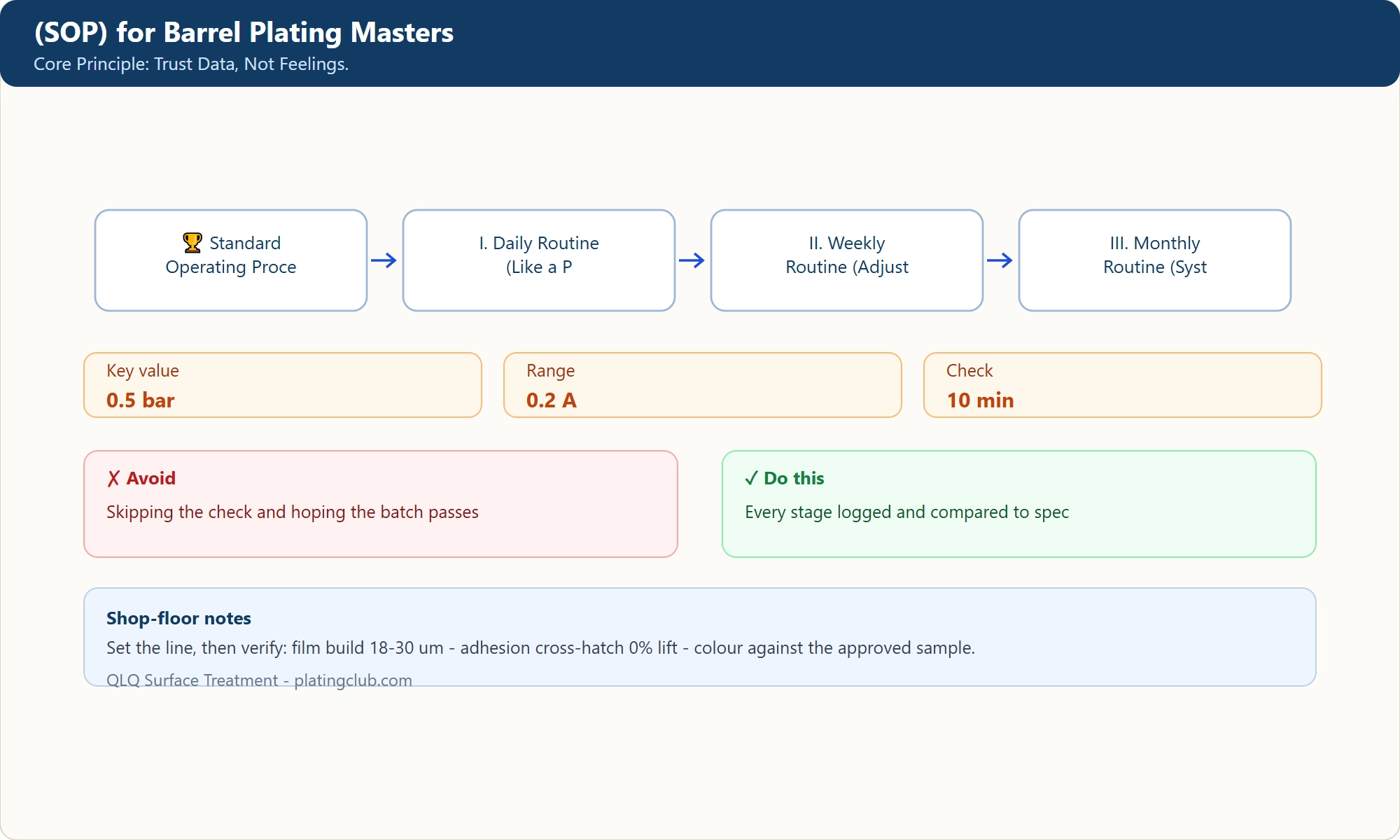
Quick reference - what to check and why
| Stage | What it means on the line |
|---|---|
| 🏆 Standard Operating Procedure (SOP) for Barrel Plating Supervisors/Masters | Core Principle: Trust Data, Not Feelings. |
| I. Daily Routine (Like a Pilot's Pre-Flight Check) | ||H4|| 1. |
| II. Weekly Routine (Adjustment & Recovery) | ||H4|| 1. |
| III. Monthly Routine (System Overhaul) | ||H4|| 1. |
| IV. The "Quick Reaction Card" for Troubleshooting | As a Master, when a worker yells "We have a problem," check in this order: Check Ammeter/Voltmeter: Is voltage abnormally high? |
| FAQ - (SOP) for Barrel Plating Masters | Straight answers from the shop floor. |