
Target Market: Europe & USA (High cosmetic standards, strict performance requirements).
Capacity: 1000KG/Day (Semi-Automatic Line).
This plan focuses on preventing Hydrogen Embrittlement (to protect the stainless steel springs) and ensuring a high-gloss, blister-free finish using the QLQ High-Performance Chemical System.
Here is the comprehensive professional plating process proposal, translated into English. It has been customized to feature QLQ Company products exclusively, replacing the "Light Gold" (real gold) process with a "QLQ Imitation Gold" (Alloy) process, and ensuring all chemical agents, salts, and additives are branded as QLQ products.
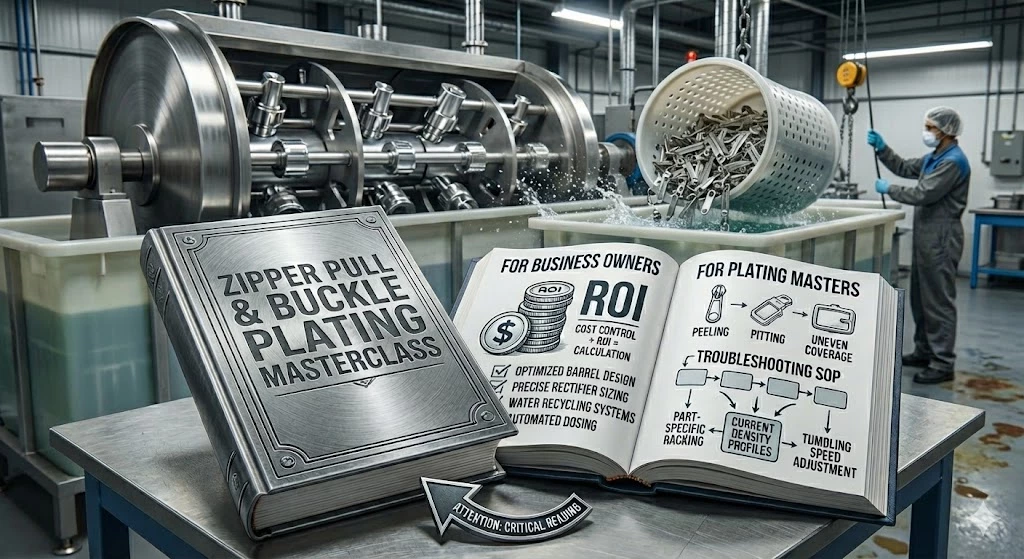
Professional Barrel Plating Workshop Planning for Zinc Alloy Products (QLQ System)
Production Line Overview
Line Type: Semi-Automatic Gantry Barrel Plating Line (Double-arm hoist recommended).
Throughput: Approx. 50-60 barrels/day (10-hour shift). Output frequency: 1 barrel every 10-12 minutes.
Barrel Specs: Hexagonal PP High-Efficiency Barrel.
Dimensions: $\phi300 \text{mm} \times 600 \text{mm}$.
Load Capacity: 15–18 kg per barrel (Approx. 15,000–20,000 zipper pulls).
Phase I: Pre-treatment (Crucial for Adhesion & Spring Safety)
Principle: Use "Weak Alkali, Low Temperature, Short Time." Strictly avoid strong acids to prevent spring fracture.
Step 1: Hot Soak Degreasing
Purpose: Removal of polishing wax and heavy oils.
Chemicals:
QLQ Zinc Alloy Dewaxing Powder: 50–80 g/L.
Parameters:
Temperature: 65–75°C.
Time: 8–10 mins (Ultrasonic assistance recommended).
Note: Continuous filtration with oil-water separation required.
Step 2: Counter-current Rinsing
Setup: 2 or 3-stage flowing water rinse.
Step 3: Cathodic Electrolytic Degreasing (The Key Step)
Purpose: Precision cleaning and surface activation.
Chemicals:
QLQ Electrolytic Degreasing Salt: 40–60 g/L (Specialized formulation for zinc alloy).
Parameters:
Temperature: 50–60°C.
Time: 30–60 seconds (Strictly controlled to prevent base metal corrosion).
Voltage: 4–6V.
Polarity: Workpiece as Cathode (-) only. Never use Anodic (+) cleaning.
Step 4: Weak Acid Activation
Purpose: Neutralize alkali film and remove oxidation without damaging the stainless steel spring.
Chemicals:
QLQ Acid Activation Salt: 15–20 g/L (or QLQ Fluoride Activator).
Warning: Do NOT use Hydrochloric Acid (HCl).
Parameters:
Temperature: Room Temperature.
Time: 5–15 seconds.
Phase II: Base & Intermediate Plating (Leveling & Brightness)
Step 5: Cyanide Copper Strike (Alkaline Copper)
Purpose: Create a dense base layer to prevent the acid copper from attacking the zinc substrate.
Chemicals:
QLQ Copper Cyanide: 45–50 g/L.
QLQ Sodium Cyanide: 60–65 g/L (Free CN: 15–18 g/L).
QLQ Rochelle Salt (Complexing Agent): 40–50 g/L.
QLQ Copper Anode Activator: As per instruction.
Parameters:
Temperature: 50–55°C.
pH: 12–13.
Time: 20–30 mins (Thickness must be 5–8µm).
Current: Start with impact current (2 A/dm²), then reduce to 1–1.5 A/dm².
Step 6: Acid Dip
Chemicals: QLQ Neutralization Acid Salt (3-5%).
Purpose: Neutralize alkaline film before entering the Acid Copper tank.
Step 7: Acid Copper Plating (The "Shine" Factor)
Purpose: High leveling to fill base metal pores and provide a mirror finish.
Chemicals:
QLQ High-Purity Copper Sulfate: 180–200 g/L.
Sulfuric Acid: 60–70 g/L.
Chloride Ion: 60–80 ppm (Precise control required).
QLQ Acid Copper Make-up Agent (Mu): Consult QLQ.
QLQ Acid Copper Brightener (B): Consult QLQ.
QLQ Acid Copper Leveler (A): Consult QLQ.
Parameters:
Temperature: 20–28°C (Chiller System Required).
Current: 2–4 A/dm² (Voltage 6–8V).
Time: 30–40 mins.
Anode: Phosphorized Copper Balls (0.04-0.06% P) in Titanium Baskets.
Filtration: Continuous, 4-5 turnovers per hour.
Step 8: Bright Nickel Plating
Purpose: Barrier layer providing hardness and silver-white color.
Chemicals:
QLQ Nickel Sulfate: 260–300 g/L.
QLQ Nickel Chloride: 50–60 g/L.
QLQ Boric Acid: 40–45 g/L.
QLQ Nickel Softener (Carrier): High concentration required for flexibility.
QLQ Nickel Brightener (Main): Consult QLQ.
Parameters:
Temperature: 50–60°C.
pH: 4.0–4.8.
Current: 0.5–1.5 A/dm².
Time: 15–20 mins.
Note: Ensure adequate QLQ Nickel Softener to prevent the coating from cracking when the zipper pull tab is bent.
Phase III: Color Finishes (Using QLQ Special Processes)
A. Imitation Gold (Brass Alloy Process)
Note: Replaces expensive real gold with a brass-based alloy matching the color of 18K/24K gold.
Chemicals:
QLQ Imitation Gold Salt (Base): Consult QLQ.
QLQ Imitation Gold Complexing Agent: Consult QLQ.
QLQ Zinc/Copper Alloy Salts: Consult QLQ.
QLQ Color Stabilizer: To prevent redness.
Parameters:
Temperature: 30–40°C.
pH: 9.5–10.5.
Voltage: 3–5V.
Time: 30–60 seconds.
Anode: Soluble Brass Anodes or Stainless Steel (depending on QLQ specific instruction).
B. Rose Gold (Copper-Based Alloy)
Chemicals:
QLQ Rose Gold Premix Salt: Consult QLQ.
QLQ Rose Gold Conductive Salt: Consult QLQ.
Parameters:
Temperature: 45–50°C.
Time: 30–50 seconds.
Control: Strictly monitor temperature and current to maintain consistent color (prevent yellowish/reddish shift).
C. Gunmetal / Black Nickel (Tin-Alloy Series)
Recommendation: Use QLQ Tin-Nickel or Tin-Cobalt for superior wear resistance compared to traditional black nickel.
Chemicals:
QLQ Gunmetal Salt A & B: Consult QLQ.
QLQ Gunmetal Complexing Agent: Consult QLQ.
QLQ Blackening Additive: Adjusts shade from light gunmetal to dark black.
Parameters:
Temperature: 60–65°C.
pH: 2.0–2.5.
Time: 5–10 mins.
D. Antique Bronze (Oxidation Process)
Plating: Plate a layer of Brass (60/40) using QLQ Brass Salts.
Blackening: Dip in QLQ Antique Blackening Solution (1-2 mins) until fully black.
Physical Processing: Tumble in a vibratory finishing machine with corn cob/walnut shell media to remove the black oxide from high points, revealing the bronze color underneath.
Phase IV: Post-treatment (Quality Assurance)
Step 9: Passivation
Chemicals: QLQ Anti-Tarnish Solution (Chrome-free).
Purpose: Prevent oxidation before lacquering.
Step 10: Hydrogen Relief Baking (Mandatory for Stainless Steel Springs)
Timing: Must be performed within 4 hours of plating.
Equipment: Industrial Oven.
Parameters: 180°C – 200°C for 2–3 hours.
Standard: Meets GAP/H&M/YKK requirements to prevent spring breakage.
Step 11: Lacquering / Sealing
Chemicals:
QLQ Water-Based Acrylic Lacquer; or
QLQ Electrophoretic Clear Coat (E-Coat).
Process: Dip/Spin or E-Coat -> Curing (100–120°C).
Phase V: QLQ Expert Recommendations (SOP)
Filtration Management:
The QLQ Acid Copper and QLQ Bright Nickel tanks require 24-hour continuous filtration.
Perform carbon treatment monthly using QLQ Activated Carbon.
Additive Maintenance:
Do not add chemicals manually once a day. Use automatic dosing pumps based on Ampere-Hours.
Consult QLQ Company for the specific consumption rates (ml per KAh) for all Brighteners and Softeners.
Impurity Control:
Fallen zinc die-castings must be removed from the tank bottom daily using a magnet (for springs) or rake.
Regularly use QLQ Impurity Precipitant or low-current dummy plating to remove metallic impurities.
Supply Chain:
For all Salts, Anodes, Brighteners, and Complexing Agents listed above, please contact QLQ Company to ensure compatibility and performance guarantees.
FAQ - Barrel Plating Workshop for Zinc Alloy Products
Straight answers from the shop floor. Ask us on WhatsApp if your case is different.
What safety and environmental controls are required?
What is the step-by-step procedure?
What problem does this article solve?
What is the practical takeaway for the workshop?
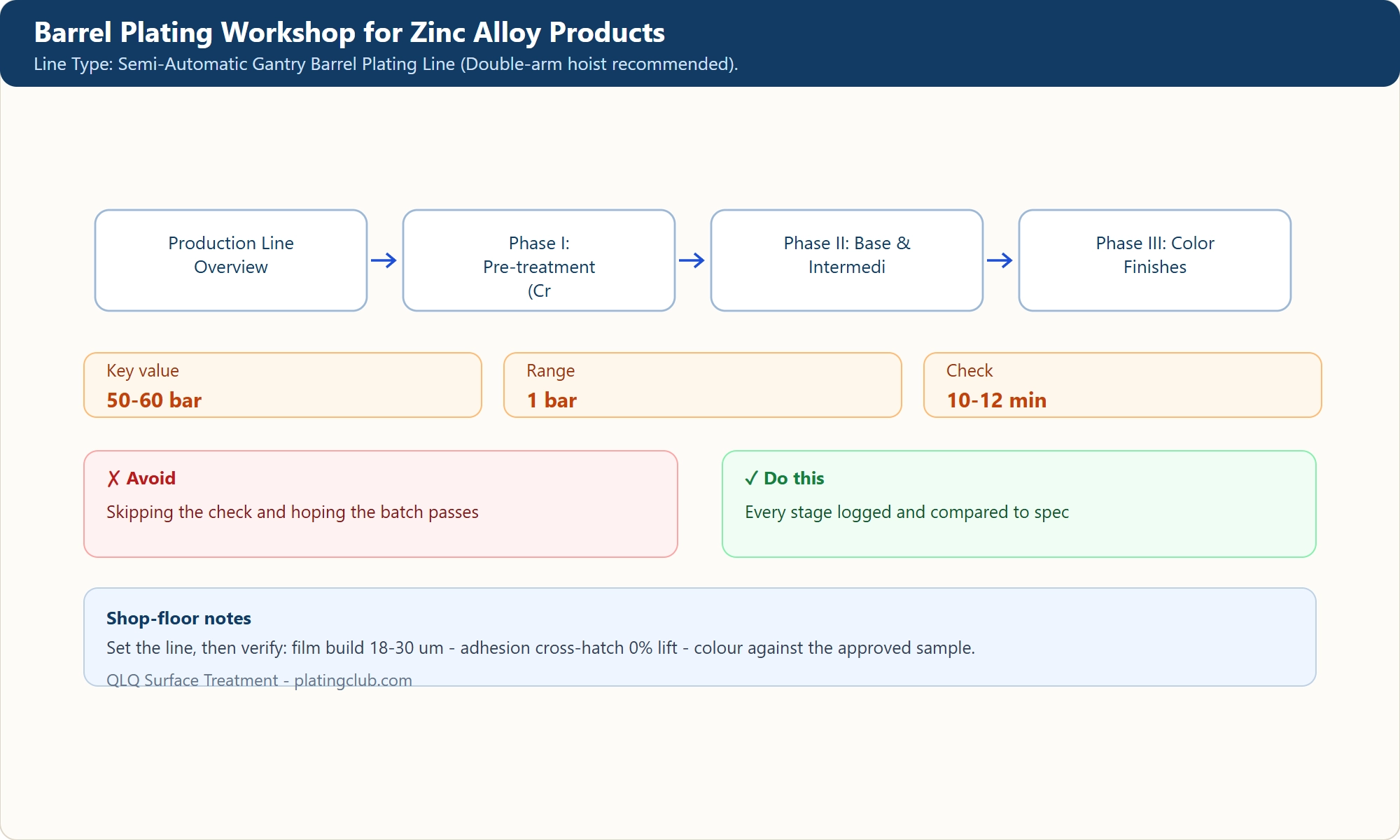
Quick reference - what to check and why
| Stage | What it means on the line |
|---|---|
| Production Line Overview | Line Type: Semi-Automatic Gantry Barrel Plating Line (Double-arm hoist recommended). |
| Phase I: Pre-treatment (Crucial for Adhesion & Spring Safety) | Principle: Use "Weak Alkali, Low Temperature, Short Time." Strictly avoid strong acids to prevent spring fracture. |
| Phase II: Base & Intermediate Plating (Leveling & Brightness) | ||H4|| Step 5: Cyanide Copper Strike (Alkaline Copper) Purpose: Create a dense base layer to prevent the acid copper from attacking the zinc substrate. |
| Phase III: Color Finishes (Using QLQ Special Processes) | ||H4|| A. |
| Phase IV: Post-treatment (Quality Assurance) | ||H4|| Step 9: Passivation Chemicals: QLQ Anti-Tarnish Solution (Chrome-free). |
| Phase V: QLQ Expert Recommendations (SOP) | Filtration Management: The QLQ Acid Copper and QLQ Bright Nickel tanks require 24-hour continuous filtration. |