
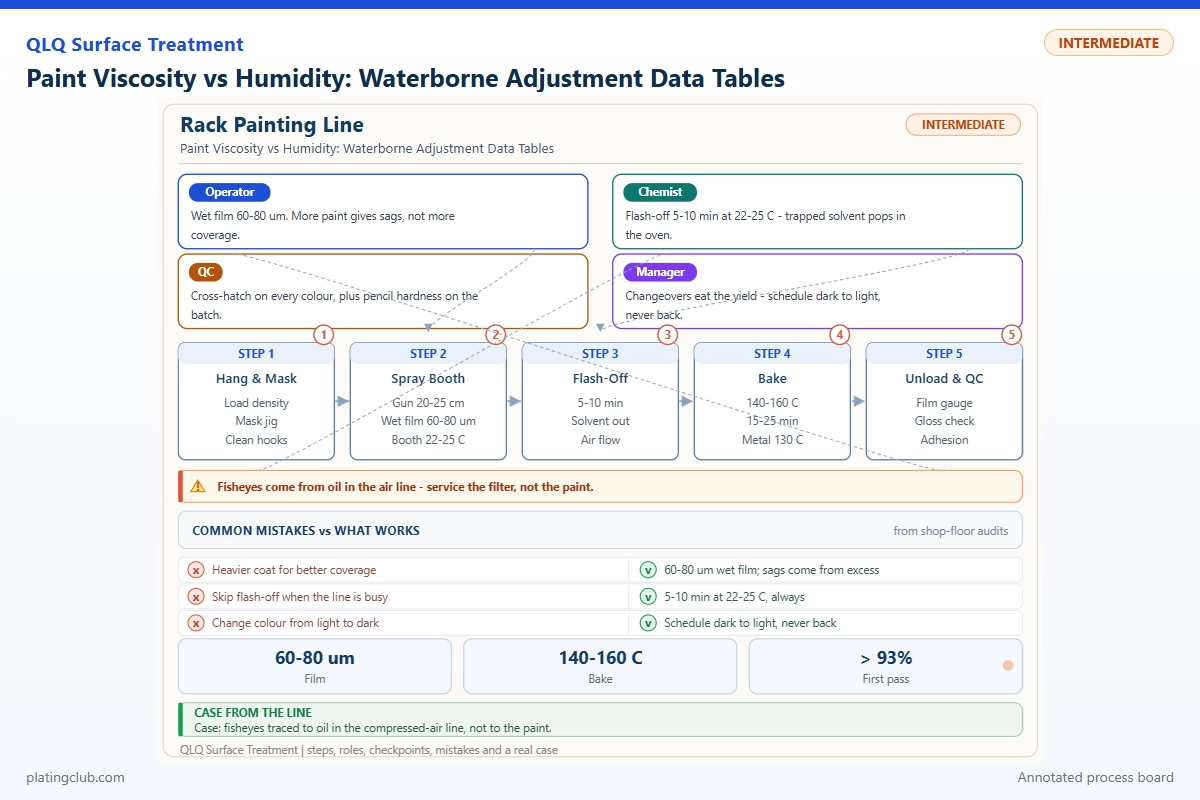
Painting technician reference | Junior level | Waterborne spray finishing
Paint Viscosity vs Humidity: Waterborne Adjustment Data Tables
A humid morning does not automatically require thinner paint. For technicians coating zinc-alloy bag hardware, zipper pulls, or plated components, the first job is to separate liquid viscosity from water evaporation. A cup reading describes the paint under a stated test condition; relative humidity describes the surrounding air. Confusing them creates unnecessary dilution, sagging, weak coverage, and delayed handling.
1. What humidity changes, and what it does not
Waterborne paint contains dispersed or dissolved binder, water, and formulation-dependent additives. Increasing humidity reduces the evaporation driving force when other conditions remain comparable. A film can remain wet longer even though paint from a closed container has the same viscosity. Temperature, water loss from an open pot, mixing history, contamination, and rheology additives can change the measured liquid behavior independently.
Consequently, there is no defensible universal table saying “add another one percent water for every ten percent humidity.” High humidity may require conditioned air or a validated longer flash-off, not additional water. Low humidity may encourage tip drying or dry spray; adding water without a trial can also reduce deposited solids and worsen coverage.
Scope: The operating examples below concern a one-component acrylic spray coating. They are not instructions for two-component polyurethane, electrophoretic baths, or every baking enamel. The coating supplier's technical data sheet, safety data sheet, and approved production card take precedence. Waterborne does not mean harmless: maintain extraction and use the specified protective equipment.
2. Establish a repeatable viscosity measurement
Use the exact cup type specified on the production card. Ford No. 4, DIN 4, and ISO 4 readings are not interchangeable. If the paint is strongly shear-thinning or does not produce a clean flow endpoint, ask the laboratory for a rotational method with spindle, speed, and temperature recorded.
- Take a representative sample after the approved mixing cycle. Keep the container covered and let entrained bubbles clear.
- Condition the sample to the card's test temperature; the training examples use 25 ± 1°C. Do not measure a hot circulation return and compare it directly with yesterday's cool sample.
- Clean and inspect the cup orifice. Time the flow using the instrument's specified endpoint and repeat the reading.
- Record both readings, paint temperature, cup identification, paint lot, and cumulative added water. Reject the measurement if foam or an obstructed orifice makes it unreliable.
For a provisional Ford No. 4 target of 25–30 seconds at 25°C, a repeat pair of 27 and 28 seconds supports consistency. It does not establish coating quality by itself. Check the supplier's valid cup measurement range before adopting that target.
3. Working Data & Formula Notes
This complete 100 kg mass-balance example illustrates industrial-scale ingredient proportions for a white, one-component waterborne acrylic topcoat. It is an illustrative laboratory starting point, not a verified QLQ recipe or a production mixing instruction. Exact grades, compatibility, pigment dispersion, corrosion performance, and regulatory suitability remain to be confirmed. Ranges are alternative development windows, not independently additive allowances.
| Component | Range | Typical | Function | Replenishment |
|---|---|---|---|---|
| Metal-compatible acrylic dispersion, nominal 45% solids | 55–65% | 60.00% | Film-forming binder; grade-specific adhesion and film-formation temperature | Fresh approved paint only; no raw binder at the booth |
| Deionized water | Balance to 100%; approximately 10–22% | 16.00% | Carrier and viscosity adjustment | Only within the supplier-approved thinning allowance |
| Rutile titanium dioxide | 15–22% | 20.00% | White opacity; requires controlled dispersion | No dry pigment additions during a shift |
| Compatible dispersant, supplied solution | 0.5–1.5% | 1.00% | Maintains pigment dispersion | Laboratory reformulation only |
| Approved coalescent | 1–3% | 2.00% | Supports particle coalescence | Never add as an improvised humidity correction |
| Compatible defoamer, supplied product | 0.1–0.4% | 0.20% | Controls entrained air | Only after a documented compatibility trial |
| Substrate-wetting additive, supplied product | 0.1–0.4% | 0.20% | Improves wetting of prepared metal | Laboratory approval; excess may cause defects |
| Associative thickener, supplied solution | 0.2–0.8% | 0.40% | Controls flow, leveling, and sag resistance | No direct booth addition |
| Compatible neutralizer, diluted supplied product | 0–0.3%; set by approved pH | 0.20% | Grade-dependent dispersion and rheology stability | Laboratory-controlled adjustment only |
For this example, binder solids contribute 60 × 0.45 = 27 kg per 100 kg paint. Pigment contributes another 20 kg; total nonvolatile content must be measured because additive solids differ. Do not substitute weight solids for volume solids when calculating dry film thickness.
Dilution calculation: Water addition = current paint mass × approved addition fraction. A 20 kg pot receiving an authorized 0.5% trial addition needs 0.10 kg water. If its starting measured weight solids are 45%, the calculated diluted solids become 9 ÷ 20.10 × 100 = 44.78%. This mass balance predicts solids, not the new cup time; remeasure viscosity after mixing.
4. Normal fluctuation bands versus stop thresholds
The following are proposed trial-card limits, not universal material specifications. An engineer must approve them for the chosen paint and equipment. Values between the normal band and stop threshold require investigation and a coupon check, not automatic permission to continue.
| Parameter | Normal fluctuation band | Danger / hold threshold | First action |
|---|---|---|---|
| Ford No. 4 efflux at 25°C | 25–30 s | <23 or >33 s | Repeat temperature-controlled test; hold adjustment |
| Paint test temperature | 24–26°C | Outside this band invalidates comparison | Condition sample, then retest |
| Booth relative humidity | 45–65% | <35% or >80% | Hold pending ventilation and film-formation review |
| Booth air temperature | 20–28°C | <15°C or >32°C | Check supplier minimum application temperature |
| Surface temperature minus dew point | At least 3°C, stable | <3°C or visible moisture | Stop spraying; condition parts and air |
| Paint pH, for an approved alkaline grade | 8.0–8.8 | <7.5 or >9.2 | Repeat calibrated measurement; contact laboratory |
| Cumulative added water | 0–2% of original pot mass | >3%, or supplier limit exceeded | Quarantine pot; no extra water |
| Dry film thickness | 20–30 µm | <15 or >35 µm | Hold affected parts; check deposition and cure |
QLQ's internal painting process note lists 15–30 µm as a general hardware coating thickness and explicitly leaves viscosity to the coating instructions. It does not validate the other example limits. The dew-point margin is consistent with Sherwin-Williams' condensation-prevention guidance; the product data sheet may require a stricter margin.
5. Humidity adjustment decision table
| Observed condition | Viscosity result | Permitted next trial | Do not do this |
|---|---|---|---|
| 45–65% RH; clean, dry parts | Within approved band | Keep recipe; confirm witness coupon | Add water “for safety” |
| 65–80% RH; slow flash-off | Within approved band | Condition air or trial approved longer flash-off | Dilute to cure a drying problem |
| 35–45% RH; tip buildup | Above approved band at reference temperature | Inspect pot exposure; trial authorized 0.5% water increment | Add an unapproved retarder |
| Any RH; liquid too thin | Below approved band | Hold pot and ask laboratory about recovery | Evaporate water by leaving the lid open |
| Any RH; condensation risk | Any reading | Stop and restore surface-temperature margin | Spray over invisible or visible moisture |
After an authorized water increment, mix using the validated cycle, allow bubbles to clear, and repeat the reference-temperature measurement. Spray a coupon before restarting saleable parts. If acceptable viscosity still gives poor atomization, inspect the gun, filter, and air supply instead of continuing dilution.
6. Experimental data: humidity can reduce film hardness
A published model-latex experiment provides actual paired hardness results. Films on glass were applied with a 120 µm applicator and dried for one week at 23°C and 50% RH, then conditioned as shown. Results are König pendulum oscillation counts, not seconds or pencil grades. Two coatings contributed to each mean and standard deviation. Source: Gonzalez-Martinez and colleagues, Polymers 2018, Table 1.
| Specimen group | Test condition | Hardness after 7 days | Hardness after 14 days | Thickness / salt spray |
|---|---|---|---|---|
| Reference latex films | 23°C; equilibration at 50% RH | 60.5 ± 0.7 oscillations | 63.5 ± 0.7 oscillations | 120 µm applicator; DFT and salt spray not reported in this comparison |
| High-humidity latex films | 23°C; equilibration at 100% RH | 43.0 ± 4.2 oscillations | 35.0 ± 7.1 oscillations | Same application method; no salt-spray claim |
These results demonstrate humidity sensitivity in that material, not a viscosity correction coefficient for your paint. A factory trial should compare at least three identically prepared coupons per condition, recording paint lot, added water, viscosity, RH, film thickness, flash-off, and cure. Measure hardness at the same age. Commission salt-spray testing only against an agreed substrate, pretreatment, thickness, exposure duration, and acceptance criterion.
7. Two troubleshooting scenarios to practice
Scenario A: wet-looking plated zipper pulls after a humid shift
This is a training scenario, not a reported customer case. Paint remains within its cup band, but parts stay tacky after the usual flash-off. Check local RH at the rack, air movement, surface moisture, and actual part-temperature cure history. Compare baseline coupons with coupons flashed in approved conditioned air. Keep formulation constant. Release only after the specified handling, adhesion, and hardness checks pass.
Scenario B: rough finish on zinc-alloy buckles in dry air
This second training scenario concerns tip drying and an uncovered pot. Restore the lid, inspect the nozzle, and test a cooled representative sample. If viscosity is genuinely high, trial a weighed, supplier-authorized water increment. If viscosity is normal, investigate atomization and spray distance. Compare roughness and film thickness before changing multiple gun settings. Neither scenario justifies an invented improvement percentage.
8. Engineer Notes
- Zero the scale with the adjustment container fitted. Weigh water; do not estimate it from a bottle cap.
- Label each pot with original paint mass and cumulative additions. Never reset the dilution total at shift handover.
- Measure humidity where parts flash off, away from direct supply-air jets. Compare with a checked reference sensor.
- Measure substrate temperature with a suitable contact probe when shiny plated surfaces make infrared readings unreliable.
- Use the approved filter grade and inspect removed material. A filter cannot repair destabilized paint or microbial contamination.
- Keep wet-film checks on witness coupons separate from dry-film checks. Use volume solids for thickness calculations.
- Do not copy a solventborne baking schedule onto acrylic latex. Confirm film-formation requirements and actual part temperature.
9. Shift Checks
| Shift stage | Check item | Frequency | Acceptance standard | Record |
|---|---|---|---|---|
| Before shift | Paint identity, lot, shelf life, mixing | Each opened container | Matches approved card; no contamination | Lot and operator |
| Before shift | Reference-temperature viscosity; booth climate | Before first spray | Approved bands; surface ≥3°C above dew point | Two readings, temperature, RH, margin |
| During shift | Viscosity and cumulative dilution | Hourly and after additions | Card limits; addition traceable | Pot ID, water mass, readings |
| During shift | RH, dew point, part temperature | Hourly; after weather or HVAC change | No condensation; within validated window | Time-stamped climate log |
| During shift | Witness appearance and thickness | First-off, after adjustments, hourly | No sag or pinholes; approved DFT | Coupon ID and measurements |
| After shift | Retained coupons, cure and quality status | Every lot | Required tests complete or lot held | Test age, results, disposition |
| After shift | Pot closure, gun cleaning, handover | Before leaving station | Approved storage and cleaning procedure | Remaining mass, total dilution, next checks |
10. Technician questions to ask an AI assistant
These are example technician-to-AI prompts, not quotations from actual customer conversations.
“Humidity is 78% today, but my paint still reads 28 seconds. Should I add water?”
Not because of humidity alone. Confirm the cup and sample temperature, check the approved RH limit and dew-point margin, and examine flash-off on a coupon. If viscosity is already acceptable, additional water may make the film sag without resolving slow drying. Escalate climate control or flash-off changes for approval.
“The cup time rose overnight. Can I add water until it matches yesterday?”
First compare readings at the same temperature and check storage, mixing, skin formation, and contamination. Use only an approved incremental addition and track the cumulative amount. If paint contains coagulum or viscosity does not respond consistently, quarantine it rather than chasing the reading.
“Our panels look good, so can I skip hardness and corrosion checks?”
No. Appearance does not establish cure, adhesion, or corrosion resistance. Follow the customer specification and quality plan, with consistent test age and film thickness. Humidity-exposed panels may need investigation even when glossy. AI can organize your measurements; it cannot certify an untested production lot.
What Would You Like to Solve?
For a recurring humidity-related painting problem, send paint identity, substrate and pretreatment, cup method, measured temperature, RH history, cumulative dilution, film thickness, and cure record to [email protected]. Identify the failed acceptance test rather than asking only for a thinner recipe. See integrated surface-treatment equipment, chemicals, and process support for the broader line context.
Internal grounding: QLQ knowledge-base notes “Painting Process” and “Painting Defect Analysis,” located under 02-Product Knowledge / 07-Surface Treatment Processes. These draft notes support the hardware workflow and defect-check sequence, not the illustrative formulation or trial-card limits. Product-specific viscosity, approved additives, and operating windows require supplier confirmation.