
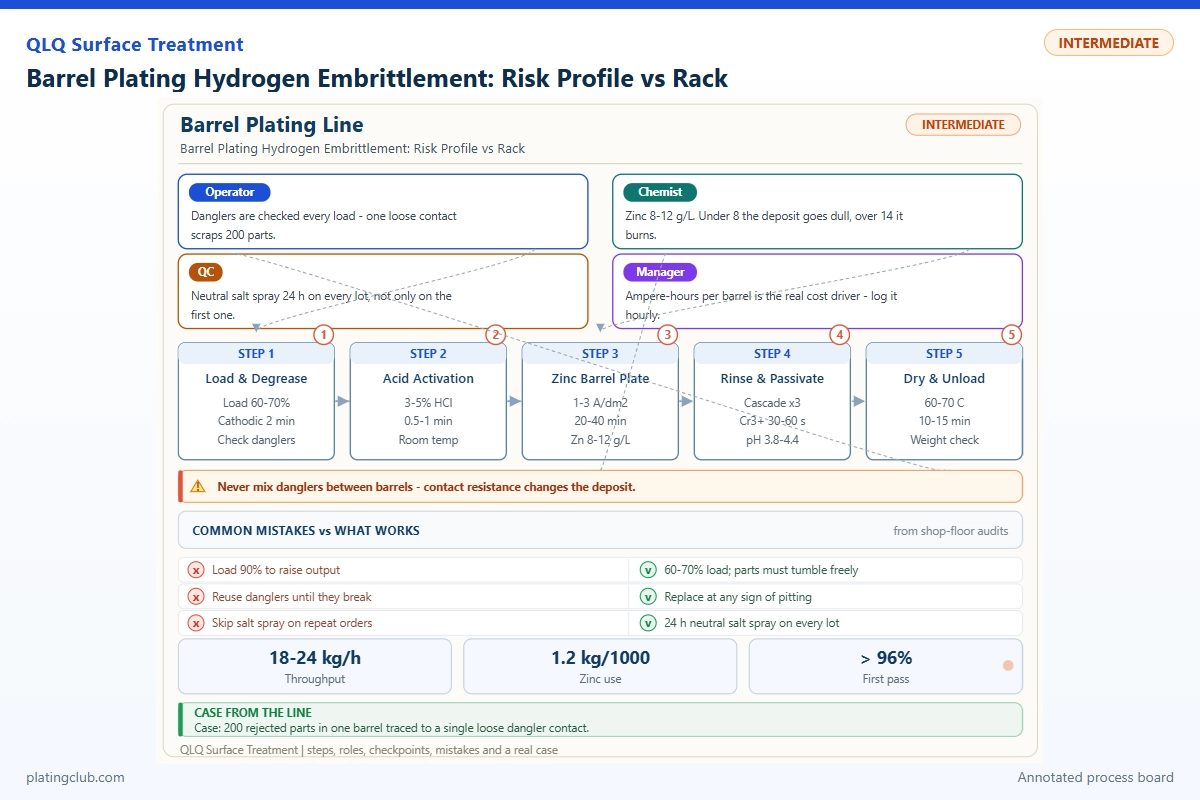
BARREL PLATING / INTERMEDIATE TECHNICIAN GUIDE
Barrel Plating Hydrogen Embrittlement: Risk Profile vs Rack
Barrel plating is not automatically more embrittling than rack plating, and changing the handling method does not eliminate hydrogen risk. The decisive combination is susceptible steel, hydrogen introduced during processing, and tensile stress. Barrel operation changes contact stability, solution exchange, exposure time, and batch traceability; rack operation changes current distribution, fixture contact, and handling. Compare complete qualified routes, not equipment labels.
Use this guide to investigate hardened steel clips, springs, screws, and small hardware. Do not apply steel hydrogen-relief schedules to zinc-alloy die castings merely because both products use a barrel.
1. Establish the material risk before changing the line
Start with the drawing, material certificate, heat-treatment record, hardness requirement, and service loading. A hardened spring clip and a soft decorative fitting can look similar while requiring different finishing routes. Unknown material identity is a hold condition, not permission to use the standard mixed-hardware cycle.
Hydrogen charging can occur before the plating tank. Acid activation, repeated pickling, and cathodic cleaning deserve the same scrutiny as deposition. A late fracture therefore cannot be assigned to the barrel simply because the final coating was barrel plated. NASA's historical investigation specifically identifies preliminary cleaning, pickling, and activation as potentially important hydrogen sources. NASA investigation of processing-related hydrogen.
Distinguish delayed cracking under load from immediate tumble damage, poor adhesion, or coating blisters. Preserve failed parts and unfailed retain samples. Record the fracture location, time after processing, assembly load, and any stripping or replating. Escalate suspected hydrogen-assisted cracking to the responsible materials engineer; appearance alone cannot establish the mechanism.
| Risk driver | Barrel route | Rack route | Technician action |
|---|---|---|---|
| Electrical contact | Moving part-to-part contacts can interrupt deposition. | Individual contacts can loosen or become insulated. | Inspect conductors; log actual current and voltage, not just setpoints. |
| Solution renewal | Packed loads and blocked perforations restrict exchange. | Shielded recesses and dense rack spacing restrict exchange. | Verify load geometry, flow access, and minimum-thickness locations. |
| Exposure time | Long cycles may compensate for poor effective contact. | Overplating may compensate for poor distribution. | Investigate cycle extensions before approving them. |
| Mechanical stress | Tumbling can bend thin sections or damage edges. | Fixture force can distort a spring or introduce local stress. | Compare dimensions before and after handling. |
| Traceability | Mixed bins can obscure material and bake history. | Rack identity can be lost during unloading. | Carry one controlled lot identifier through all transfers. |
These are engineering investigation priorities, not a measured ranking of hydrogen uptake. QLQ's local knowledge-base note, “Rack and Barrel Plating” (English translation of the filename; surface-treatment process folder, draft dated July 26, 2026), supports checking loading, rotation, solution access, and rack conductivity. It provides no hydrogen-embrittlement qualification results.
2. Experimental evidence: baking is not a universal reset
The published specimen comparison below is real research, not a QLQ production trial. Hino and colleagues used SK85 steel, average substrate hardness 640 HV, and 10 µm coatings. Testing used three-point bending at 0.05 mm/min with a 27 mm support span. Their embrittlement index is loss of rupture stress relative to unplated steel, not percentage of parts failing.
| Specimen condition | Film thickness | Substrate hardness | Test condition | Embrittlement index | Salt spray |
|---|---|---|---|---|---|
| Zinc, unbaked | 10 µm | 640 HV average | Sulfate-bath deposit; bending | 55% | Not reported |
| Zinc, baked | 10 µm | Same substrate condition | Immediate bake, 200°C, 24 h; bending | 46% | Not reported |
| Zinc–silica, baked | 10 µm | Same substrate condition | Immediate bake, 200°C, 24 h; bending | 38% | Not reported |
| Zinc–nickel, unbaked | 10 µm | Same substrate condition | Sulfate-bath deposit; bending | 50% | Not reported |
| Zinc–nickel, baked | 10 µm | Same substrate condition | Immediate bake, 200°C, 24 h; bending | Approximately 0% | Not reported |
The result demonstrates coating-dependent bake response, not barrel superiority or rack superiority. Neither the experimental temperature nor the alloy substitution is an automatic production authorization. Source: Hino et al., Materials Transactions 61 (2020), 2302–2306, sections 2 and 3.2.
For a local comparison, split one traceable steel lot into matched barrel and rack groups. Keep pretreatment, coating specification, passivation, and approved bake conditions controlled. Compare equivalent minimum coating thickness rather than equal tank time. Log thickness distribution, substrate hardness, corrosion results, and the required mechanical test separately. Use independent repeat batches; a single successful batch does not characterize normal process variation.
3. Working chemistry: a complete acid-chloride zinc example
This supplier-specific example is a chemistry reference, not an embrittlement-safe recipe or a QLQ formulation. Concentrations refer to final working volume. Confirm additive compatibility and obtain the current supplier instructions before making or altering a production bath.
| Component | Range | Typical | Function | Replenishment |
|---|---|---|---|---|
| ZnCl2, anhydrous equivalent | 39.6–62.5 g/L, calculated | 52.1 g/L = 25 g/L Zn | Zinc source | Anode dissolution; analysis-led salt correction |
| KCl | Coupled to total chloride: 120–135 g/L | Approximately 213 g/L at 25 g/L Zn and 127 g/L chloride | Conductivity | Replace dragout after chloride analysis |
| H3BO3 | 19–30 g/L | 25 g/L | Buffer | Analysis-led dragout replacement |
| COLSID K-250 WETTER | 30–50 mL/L | 40 mL/L | Carrier/wetting | Dragout and Hull-cell assessment |
| COLSID K-250 BRIGHTENER | Supplier-controlled; no concentration range published | 1 mL/L initial makeup | Brightness | Approximately 0.19–0.25 L/1,000 Ah |
| Dilute hydrochloric acid | As required for pH 4.8–5.9 | pH 5.2 | pH adjustment | Meter-guided increments |
| Process water | Balance | Final volume | Solvent | Restore level before analysis |
Source: Columbia Chemical COLSID K-250 technical data, March 16, 2021. The barrel analysis range differs from the bulletin's general makeup example; do not combine their upper values indiscriminately.
The salt conversions use molecular mass balance: ZnCl2 = zinc-metal concentration × 136.28/65.38; KCl = [total chloride − zinc-metal concentration × 70.90/65.38] × 74.55/35.45. These calculated equivalents assume pure salts. Correct for assay, hydration, and chloride introduced by other additions. Never treat zinc-metal concentration as zinc-chloride concentration.
For a proposed correction, calculate mass = concentration deficit × measured working volume. Submit the calculation for approval, account for chemical purity, and verify the mixed bath analytically. This is a material-balance tool, not permission to dose by appearance.
4. Trend bands and intervention thresholds
The narrower normal bands below are proposed commissioning controls, not universal hydrogen thresholds. Supplier boundaries apply only to the chemistry above. Qualify site-specific limits using actual parts and the governing specification.
| Parameter | Normal operating band | Danger / hold threshold | Response |
|---|---|---|---|
| pH | 5.1–5.4 | Below 4.8 or above 5.9 | Verify meter; correct before restarting. |
| Zinc metal | 24–27 g/L | Below 19 or above 30 g/L | Reanalyse; check anodes and dragout. |
| Total chloride | 125–130 g/L | Below 120 or above 135 g/L | Check level and coupled salt balance. |
| Boric acid | 24–27 g/L | Below 19 or above 30 g/L | Confirm analysis and dissolution. |
| Bath temperature | 25–32°C, proposed | Outside supplier 21–48°C | Check probe, cooling, and heater. |
| Load mass | 95–105% of qualified target | Outside validated loading envelope | Reweigh; inspect packing and circulation. |
| Cycle duration | 95–105% of validated cycle, proposed | Beyond approved maximum; investigate above 110% immediately | Hold; inspect contact before adding time. |
| Bake-start delay | Within approved maximum, with scheduling margin | Any exceedance of contractual maximum | Quarantine; seek engineering disposition. |
The first five outer boundaries come from the supplier bulletin. Being inside them does not certify low hydrogen uptake. A simultaneous increase in voltage, cycle duration, and thickness scatter is an investigation trigger even when individual chemistry readings remain acceptable.
Do not invent a universal current-density window for a moving load. Calculate nominal current density from estimated wetted part area, but qualify it against contact behavior and measured deposit distribution. Rectifier amperage divided by barrel size is not a meaningful substitute.
5. Engineer Notes: seven actions that prevent uncontrolled rework
- Segregate material families. Label hardened steel separately from zinc-alloy hardware. Verify heat-treatment identity before loading; reject unidentified mixed bins.
- Time every acid exposure. Include activation, waiting in acid, and repeat cycles in the lot record. Never extend pickling simply because the barrel is waiting for a tank.
- Inspect contacts before increasing current. Clean approved contact surfaces, inspect danglers and cables, and compare loaded voltage with the qualified baseline. Lock out equipment before maintenance.
- Fix flow restrictions. Inspect perforations and load packing. Requalify changes to rotation or load mass; excessive movement may deform spring sections.
- Secure oven capacity before plating. Confirm the approved bake route and available load space. Measure representative part temperature; start the soak clock according to the approved procedure, not automatically at oven loading.
- Control post-treatment order. Use the specified sequence for baking, passivation, and sealing. Do not assume a corrosion finish tolerates an arbitrary bake.
- Treat stripping as a new risk event. Quarantine rejected hardened parts. Obtain written disposition before stripping, repickling, replating, or attempting a recovery bake.
ASTM B850 addresses post-coating treatment to reduce risk; it does not establish that any convenient bake makes a damaged lot safe. ASTM also lists B1031-26 covering pre- and post-coating heat treatments. Have quality confirm the edition and document required by the purchase order before changing the route. ASTM B850; ASTM B1031-26.
6. Shift Checks
| Shift stage | Check item | Frequency | Acceptance criterion | Record |
|---|---|---|---|---|
| Before shift | Material and route identity | Every incoming lot | Certificate, hardness requirement, and approved route agree | Traveler and certificate reference |
| Before shift | Bath analysis and instruments | Shift start; after major additions | Within approved bands; calibration valid | Analysis sheet and meter check |
| Before shift | Barrel, contacts, oven availability | Each setup | Clean flow openings, sound conductors, reserved bake capacity | Setup checklist |
| During shift | Load, current, voltage, rotation | Each load; trend during cycle | Qualified loading and electrical envelope | Batch trace and alarm history |
| During shift | Acid dwell and process transfers | Every load | No unapproved dwell extension or repeat exposure | Time-stamped traveler |
| During shift | Thickness and bake trace | Approved sampling plan; every bake load | Drawing thickness; approved delay and part-temperature soak | Measurement map and oven chart |
| After shift | Unreleased lots and rework | Shift close | Identified, segregated, disposition pending | Hold register |
| After shift | Consumption and handover | Shift close | Additions reconciled; no undocumented deviations | Ah log, additions, next-shift actions |
7. Two practical investigation scenarios
Scenario A: barrel-plated spring clips fracture after assembly
This is a worked troubleshooting scenario, not a claimed customer case. Hold the affected lot and compare its acid exposure, material identity, load mass, current trace, and bake chart with an accepted lot. A thin coating accompanied by a longer cycle suggests contact or circulation trouble; it does not justify another acid cycle. Retain samples for mechanical investigation and check whether assembly deflection exceeded the drawing.
Scenario B: a rack trial looks better but qualification is incomplete
A brighter rack deposit and a corrosion pass do not prove reduced embrittlement. First confirm equal minimum thickness and equivalent pretreatment. Then compare approved mechanical-test results and bake histories. If the rack route removes an uncontrolled barrel contact problem, it may improve consistency; document that specific improvement instead of claiming rack plating is inherently hydrogen-free.
ASTM F519 evaluates plating/coating processes mechanically. Its published scope specifies a sustained-load requirement of at least 200 hours at the applicable loading level, with an engineering-approved incremental-step-load alternative. Obtain the full applicable procedure for specimen selection, sensitivity verification, and acceptance. Ordinary flat coupons cannot silently replace specified specimens. ASTM F519-23 scope and requirements.
8. FAQ: questions a technician might ask an AI assistant
“Our barrel-plated clips pass salt spray but crack the next day. Can I release the batch?”
No. Corrosion performance does not demonstrate resistance to hydrogen-assisted cracking. Hold the batch, preserve samples, and review material, assembly stress, pretreatment, and bake records with quality. Release requires the applicable mechanical acceptance and authorized disposition.
“If I switch the same parts from barrel to rack, can I skip the hydrogen bake?”
Not without an approved route change. Rack plating still exposes steel to hydrogen-generating operations. Keep required relief treatment and qualification until the responsible engineering authority authorizes a different process on documented evidence.
“We missed the bake-start limit. Should I just bake longer and ship?”
No. Record the actual delay and quarantine the lot. A longer bake is not automatically an acceptable recovery action and cannot reverse established cracks. Follow the contractual nonconformance procedure; obtain written disposition before additional processing.
What Would You Like to Solve?
Send the steel grade, hardness requirement, part drawing, coating specification, load mass, acid dwell, electrical trace, and approved bake schedule to [email protected]. QLQ can discuss equipment, chemistry, and process-support needs without treating an unqualified operating recipe as a release guarantee. For coordinated line planning, see turnkey surface-treatment lines: equipment, chemicals, and support.
Evidence boundary: no verified QLQ barrel-versus-rack hydrogen-embrittlement dataset was available in the searched local knowledge base. The published specimen results above are explicitly attributed; proposed operating controls require local validation.