
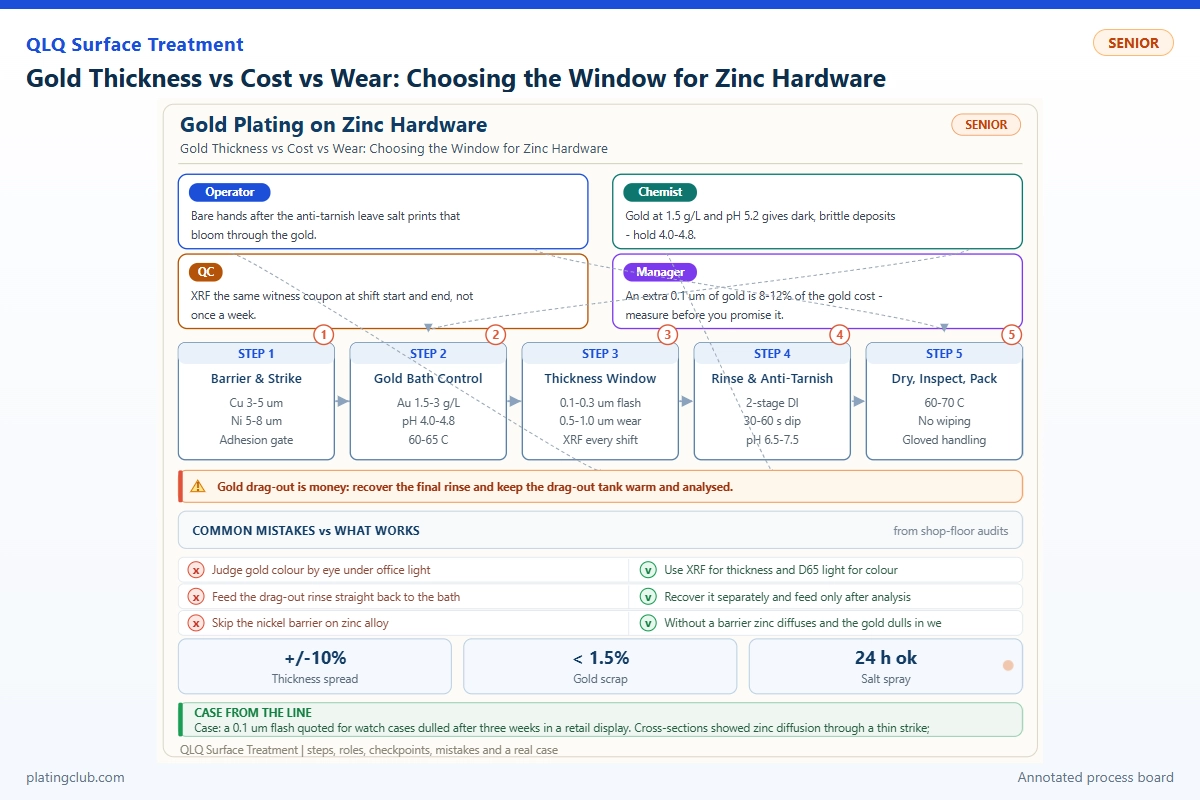
Two shops can quote the same part and differ by 40% in gold cost - and both can be right. The difference is the wear assumption. This is how to choose a thickness window that survives the customer's real use, not the spec sheet.
8-12%
Cost per 0.1 um
500-2000 cycles
Wear test
< 1 dE
Colour shift
Thickness selection by service condition
| Service condition | Gold thickness | Barrier | Notes |
|---|---|---|---|
| Display only | 0.10-0.15 um | Ni 3-5 um | Thin gold shows substrate if chipped |
| Handled occasionally | 0.3-0.5 um | Ni 5-8 um | Most fashion hardware |
| Daily handling | 0.8-1.0 um | Ni 5-8 um + Cu 3 um | Clasps, buckles, keys |
| Abrasion plus sweat | 1.5-2.0 um | Cu + Ni + gold alloy | Test with artificial sweat |
Wear data from a rotary abrasion test (500 cycles, 250 g)
| Thickness | Colour shift (dE) | Exposed substrate | Verdict |
|---|---|---|---|
| 0.1 um | 4.2 | Yes, at edges | Display only |
| 0.3 um | 1.6 | No | Good for light handling |
| 0.5 um | 0.8 | No | Standard wear |
| 1.0 um | 0.4 | No | Heavy wear |
Cost and process trade-offs per 1,000 parts
| Option | Gold cost index | Bath time | Risk |
|---|---|---|---|
| 0.1 um flash | 1.0 | Shortest | Claims from wear-through |
| 0.35 um | 1.9 | Medium | Balanced for fashion |
| 0.8 um | 3.4 | Longer | Needs stable current density |
| 1.5 um + alloy | 5.6 | Longest | Harder colour control |
Watch out
Thickness is not a single number on a drawing - it is edge, face and recess thickness. Specify where the measurement is taken or the argument will happen at goods-in.
Common mistakes and the fix
| ✗ Specify gold thickness without a measurement point | ✓ Name the face and the distance from the edge |
| ✗ Skip the barrier to save a step | ✓ Diffusion ruins colour in weeks - the barrier is the cheap part |
| ✗ Test wear with a cloth rub | ✓ Use a defined abrasion test so numbers compare |
| ✗ Treat colour as independent of thickness | ✓ Below 0.2 um the substrate shifts the colour |
What each role watches
| Operator | "Hold current density steady; thickness varies with contact quality." |
| Chemist | "Trend gold analysis and pH together; a drifting pH changes colour before thickness." |
| QC | "XRF face, edge and recess and report all three." |
| Manager | "Agree the wear assumption with the customer in writing before quoting." |
From the shop floor
Case: a customer specified 0.3 um for watch cases worn daily. Field returns at 8% forced a review; rotary abrasion tests showed 0.3 um exposing edges at 500 cycles. Moving to 0.8 um with a nickel barrier cut returns to below 0.5% at a 2.4x gold cost that was recovered in one season of returns.
FAQ
How much does each 0.1 um of gold cost?
Typically 8-12% of the gold cost per 0.1 um on a small part, excluding added bath time.
Is a copper layer needed under nickel on zinc?
For heavy wear yes - it cushions the barrier and improves corrosion performance.
How do I check wear resistance without a lab?
A defined rotary abrasion pad at fixed load and cycle count gives comparable numbers week to week.
Where to go next
- Level guide for this trade: Gold & Precious Plating — technician levels
- Other levels: Junior, Intermediate, Management
- Owner view: Process Overview for owners
- Supplier view: Chemistry & Supply · Find content by trade + level
Related reading in this trade