

Professional Zinc Alloy Surface Finishing Solutions
Ammonium Persulfate
Ammonium Persulfate
Generera QR-kod
-
Estimated Delivery:Oct 02 - Oct 06
-
Free Shipping & Returns: On all orders over $75
Product description
Shipping & Return
Product Overview
Ammonium Persulfate ((NH4)2S2O8) is the finishing and electronics industry's controlled copper etchant and micro-etchant. Where a plated or printed-copper surface must be cleaned, roughened or stripped to a precise depth - before electroplating, electroless copper, or soldermask - persulfate solutions dissolve copper smoothly and stop when the bath is spent, unlike peroxide systems that decompose on their own. In QLQ's finishing plants ammonium persulfate does the light copper micro-etch that keys subsequent plating layers on hardware and electronic parts. The market sells it as a white crystalline salt at 98%+ assay; the two specifications that matter for etching are assay (it is sold on active oxidizer content) and chloride, because chloride ions shift etch geometry toward pitting and undercut. Ammonium persulfate is a strong oxidizer - a fact that governs everything from storage to waste handling - and it is chosen over sodium persulfate where the higher solubility of the ammonium salt is wanted at high etch rates.
Product Identity (Encyclopaedia Card)
| Property | Value |
|---|---|
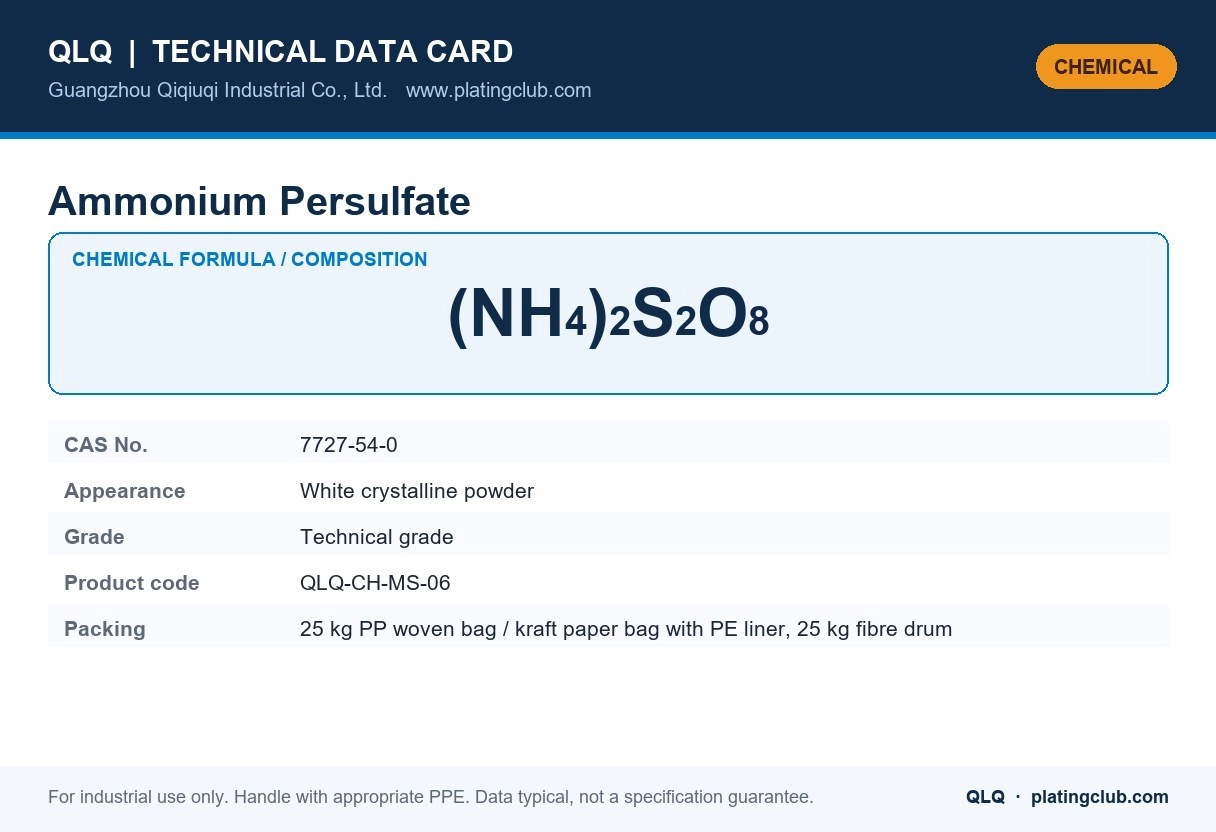
| Chemical name | Ammonium Persulfate |
| Chemical formula | (NH4)2S2O8 |
| CAS number | 7727-54-0 |
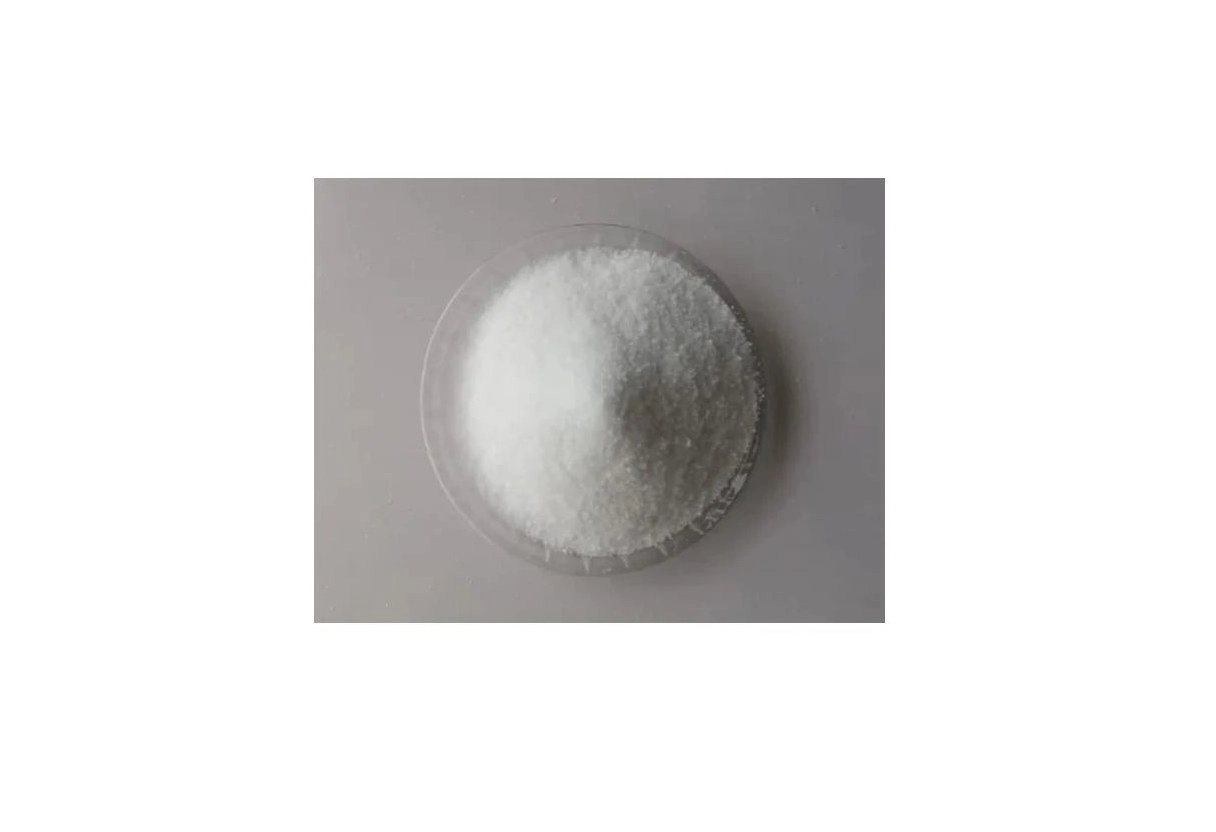
| Appearance | White crystalline powder |
| Grade / type | Technical grade |
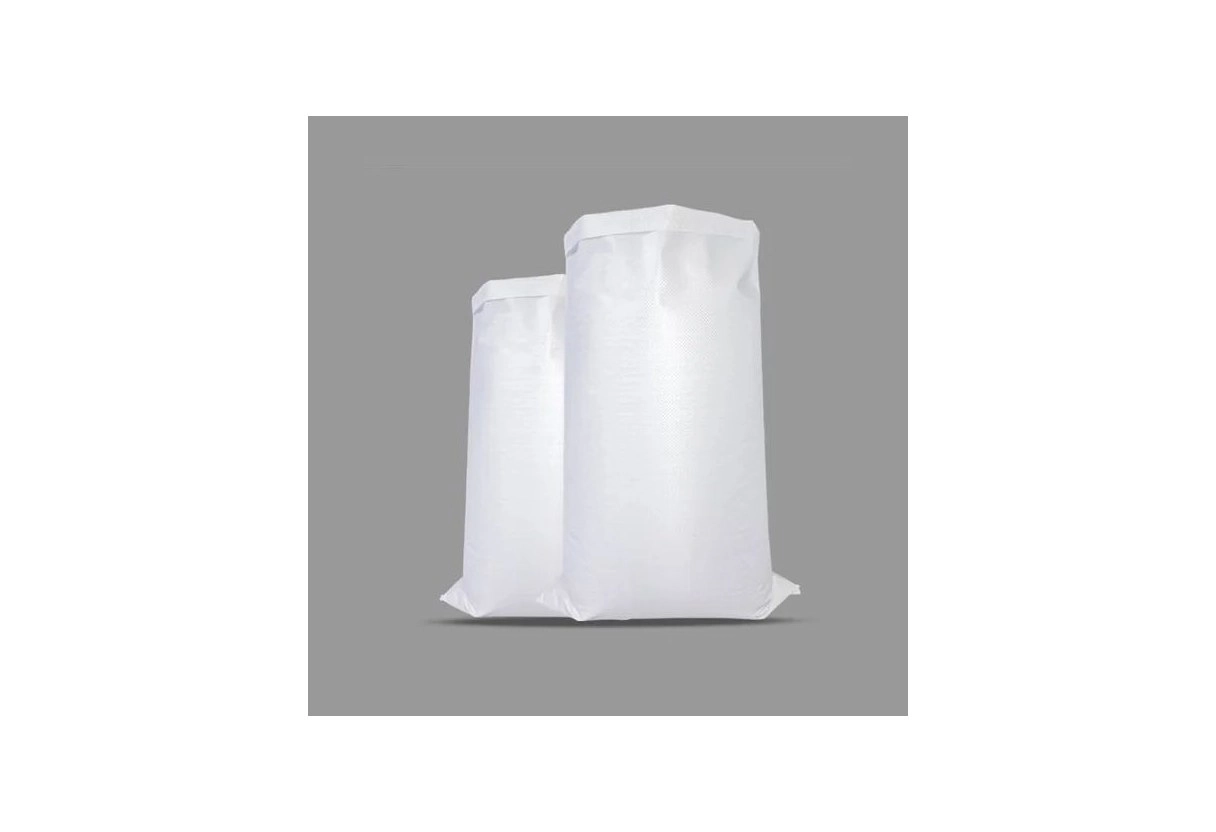
| Standard packing | 25 kg PP woven bag or kraft paper bag with PE inner liner; 25 kg fibre drum |
What it is and what it does. Ammonium persulfate is the standard oxidising etchant used to remove copper oxide and to micro-etch copper and nickel surfaces before plating, and to activate copper after polishing.
- White crystals, dissolves readily; when dissolved it slowly releases oxygen, so solutions are made up on the same shift they are used.
- Used as a 10-25% solution, often activated with a little sulfuric acid or with a proprietary activator, at room temperature.
- It is a strong oxidiser and must be kept away from reducing agents, solvents and combustible material.
Typical Use in a Plating / Finishing Line
| Item | Typical guidance |
|---|---|
| Copper micro-etch | 100-250 g/L in water, 1-3 minutes at room temperature |
| With sulfuric acid | 5-20 g/L added to improve etch uniformity |
| Control | Etch rate checked by weight loss on a test coupon |
Safety, Handling & Storage
| Item | Requirement |
|---|---|
| Hazard classification | Oxidiser + irritant (GHS03/GHS07) — strong oxidiser, may intensify fire |
| Personal protective equipment | Goggles, nitrile gloves, dust mask; avoid contact with skin and eyes |
| Spill / first aid | Sweep or dilute with water, do not mix with combustible material or reducing agents; rinse to effluent treatment |
| Storage | Cool, dry, ventilated store away from acids, reducing agents, solvents and combustible material; do not store next to heat sources |
| Transport | Classified and packed according to IATA/IMDG for the hazard class; UN number and packing group stated on the shipping documents |
Quality Documents Shipped With Every Batch
| Document | Comment |
|---|---|
| COA (certificate of analysis) | Provided with the shipment; batch traceable to the production date |
| MSDS (safety data sheet) | Provided with the shipment; batch traceable to the production date |
| Packing list | Provided with the shipment; batch traceable to the production date |
| Commercial invoice | Provided with the shipment; batch traceable to the production date |
| Certificate of origin on request | Provided with the shipment; batch traceable to the production date |
Buyer Questions We Answer Every Week
| Question | Answer |
|---|---|
| Why did my etchant stop working? | Persulfate solutions lose activity in a few days; make them fresh and do not store them in a warm place. |
| Can you supply smaller pack sizes? | Yes, 25 kg drums and 1 kg trial packs are both available. |
| Item | Typical Value |
|---|---|
| Chemical formula | (NH4)2S2O8 (ammonium persulfate) |
| Assay | ≥ 98.0% |
| Appearance | White crystalline powder or granules |
| Chloride (Cl) | ≤ 0.001% |
| Iron (Fe) | ≤ 0.0005% |
| Water insolubles | ≤ 0.005% |
| Standard packing | 25KG woven bag or drum with PE inner liner |
How It Works in the Etch Station (Chemistry and Control)
In acid solution the persulfate ion is a powerful oxidizer that converts metallic copper to soluble copper sulfate: the etch is controlled entirely by concentration, temperature and time, and it stops when the oxidizer is consumed. For a micro-etch - the 1-3 micron bite that keys a new plating layer onto an existing copper surface - the working bath is roughly 100-200 g/L ammonium persulfate with sulfuric acid in the tens of g/L, run at 25-40°C for 30 seconds to a few minutes. The same chemistry at higher concentration and temperature becomes a full etchant for stripping and pattern work. Two control habits keep the process honest: etch rate is measured by weight loss on a test coupon, never by clock alone, because the bath slows as persulfate is consumed and ammonium sulfate accumulates; and the bath is dumped on a schedule set by analysis, because an exhausted bath etches unevenly and leaves a rainbow oxide film that ruins adhesion.
| Parameter | Micro-etch range | Full etch / strip range |
|---|---|---|
| Ammonium persulfate | 100-200 g/L | 150-300 g/L |
| Sulfuric acid | 20-80 mL/L | 20-100 mL/L |
| Temperature | 25-40°C | 30-50°C |
| Immersion time | 30 s - 3 min (1-3 μm) | minutes, by thickness target |
| Agitation | Moderate work movement | Strong or spray for even rate |
Rinsing after the etch is a process step, not a formality: persulfate carried into a plating bath oxidizes organic brighteners, so a double rinse with good dwell is standard before the part sees a plating solution.
How to Check Quality Before Loading a Batch
| Check | Method | Pass Criteria |
|---|---|---|
| Appearance | Visual | White, free-flowing crystals; dampness or yellow tint means decomposition has begun |
| Assay | Iodometric titration (releases iodine from KI) | ≥ 98.0% |
| Chloride | Silver nitrate test on a 5% solution | No precipitate; Cl ≤ 0.001% avoids pitting and undercut |
| Etch rate test | Weigh a clean copper coupon, etch 60 s at 30°C in a 150 g/L bath, re-weigh | Uniform matte etch, no pitting, rate within the established band |
| Solution clarity | 100 g in 1 L DI water at 25°C | Clear solution; residue or gas bubbles signal deterioration |
How QLQ controls it: persulfate lots are checked for assay and chloride on arrival, and the etch rate of every new lot is measured against the retained standard before the bags reach the line. Because an etch bath is only as good as its oxidizer, lot records sit beside the etch-rate log so an adhesion failure can be traced to chemical, time or temperature in minutes.
Common Problems & Fixes (Workshop Table)
| Problem | Root cause | Fix |
|---|---|---|
| Etch slows down over the day | Persulfate consumed; ammonium sulfate building | Replenish by analysis to working range; dump on schedule set by titration |
| Uneven etch, rainbow oxide film | Exhausted bath, weak agitation, or carry-in of chloride | Fresh make-up; increase agitation; verify rinse and chloride level |
| Pitting or undercut on fine features | Chloride contamination or etch too aggressive for the geometry | Check chloride in the salt and water; lower temperature or concentration; shorten time |
| Adhesion failure of the next plating layer | Under-etch (too little bite) or oily residue on the copper | Confirm 1-3 μm removed by coupon; clean before etch; dry without fingerprints |
| Crystals damp or caking in store | Humidity; persulfate slowly decomposes and loses assay | Seal containers, store cool and dry below 30°C, rotate stock, discard damp lots |
Handling & Safety for the Plating Line
- Oxidizer: ammonium persulfate is a Class 5.1 oxidizer. Store away from acids, reducing agents, organics, metals dust and flammables; a contaminated oxidizer can self-heat and start a fire.
- Cyanide rule: never let persulfate contact cyanide solutions or waste - oxidizers and cyanide react violently and can liberate toxic gas. Segregate the etch station completely from cyanide lines.
- Health: persulfate salts are respiratory and skin sensitizers - allergy can develop after months of trouble-free handling. Wear gloves, goggles and a dust mask; ventilate the make-up area.
- Dissolving: add crystals to water with stirring; dissolution is endothermic (solution cools). Do not add water to the salt and do not heat solutions above about 50°C - decomposition accelerates.
- Storage: keep cool, dry and sealed; damp or warm storage decomposes the salt and can cause caking and container stress. Store below 30°C and use oldest stock first.
- Waste: spent etch is copper-bearing acid waste - collect for metal recovery or treatment; check residual oxidizer before discharge.
What It Does on Iron, Zinc Alloy, Copper and Stainless Steel Parts
| Substrate | Behavior of persulfate etch on this material | Recommended practice |
|---|---|---|
| Iron / steel small hardware | Etches steel aggressively and unevenly - not used for steel surface prep | Keep persulfate work on copper-bearing parts; steel racks need resist or removal before etch |
| Zinc alloy (sliders, buckles) | Acid oxidizer attacks zinc rapidly; never expose die cast to the etch bath | Etch only copper-plated or copper parts; zinc substrate stays protected by its copper layer |
| Copper / brass | The intended substrate - clean matte micro-etch with controlled depth | Etch 1-3 μm, double-rinse, and plate promptly for maximum adhesion |
| Stainless steel | Barely attacked; the passive film resists the acid oxidizer | Stainless racks survive the etch but must be rinsed to avoid cross-contamination |
FAQ
| Question | Answer |
|---|---|
| Ammonium or sodium persulfate - which should I use? | Both etch copper the same way. Ammonium persulfate dissolves to higher working concentrations, useful where fast etch rates are wanted; sodium persulfate avoids ammonia in the waste stream. Follow the line design. |
| Why does my etch stop working even though I keep adding salt? | Copper sulfate and ammonium sulfate accumulate and slow the reaction while the pH drifts. Replenish to the working analysis band, then dump and rebuild on schedule instead of forever topping up. |
| Can persulfate replace hydrogen peroxide etchants? | For controlled micro-etching, yes - persulfate is more stable and predictable than peroxide, which decomposes on its own. Each chemistry has its fans; the choice is about control and waste treatment. |
| Is the etch bath dangerous to the plating tanks? | Only through poor rinsing. Persulfate carried into a plating bath oxidizes organic brighteners; install a good double-rinse and monitor drag-in if etch precedes plating. |
| Does QLQ supply ammonium persulfate with support? | Yes. QLQ supplies ammonium persulfate with COA covering assay and chloride, and engineers help with etch-rate control and process design for customers in 10+ countries. |
Etching uneven or plating adhesion failing? QLQ supplies ammonium persulfate with COA and engineers who help customers in 10+ countries set etch rates and diagnose adhesion faults. Contact us with your coupon weights.
Shipping cost is based on weight. Just add products to your cart and use the Shipping Calculator to see the shipping price.We want you to be 100% satisfied with your purchase. Items can be returned or exchanged within 30 days of delivery.