
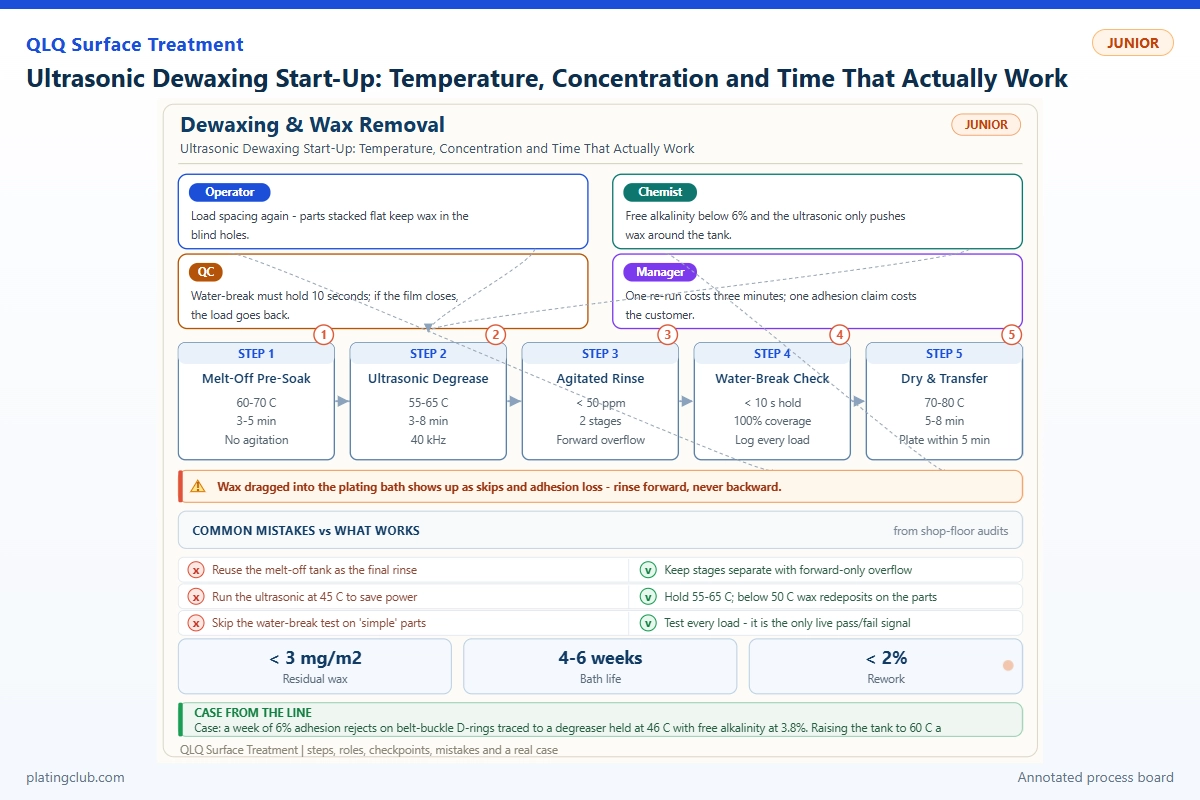
Starting an ultrasonic dewaxing tank is a fifteen-minute job that decides the next four weeks of adhesion performance. These are the start-up numbers, the first-load test, and the three signs that tell you the tank is already drifting.
15-20 min
Start-up time
<= 60%
Load factor
Water-break 10 s
First-load gate
Start-up parameter sheet
| Parameter | Target | Range that still works | Why it matters |
|---|---|---|---|
| Bath temperature | 60 C | 55-65 C | Below 50 C wax re-deposits |
| Free alkalinity | 7.5% | 6-9% | Emulsifies the wax, keeps it suspended |
| Ultrasonic frequency | 40 kHz | 28-40 kHz | 28 kHz hits heavy compound, 40 kHz cleans blind holes |
| Detergent dose | per maker sheet | +/-10% | Overdose leaves a film that blocks the rinse |
| Load factor | 50-60% | <= 60% | Shadowed parts never see cavitation |
First-load test (do this before production parts)
| Step | What you do | What pass looks like |
|---|---|---|
| 1 | Clean a scrap part in solvent by hand | Wipe test: cloth stays white |
| 2 | Run it through the new tank | No difference vs the hand-cleaned part |
| 3 | Water-break the part | Film holds 10 s across the whole surface |
| 4 | Dry and inspect under D65 light | No dull patches, no tacky feel |
Tank drift: the three early warnings
| Signal | What it means | Action |
|---|---|---|
| Loads take longer to break water | Wax building up in the bath | Skim, filter, top up alkalinity |
| Foam on the surface | Detergent overdose or oil load | Reduce dose, add a weir skimmer |
| Parts come out warm and tacky | Rinse stages too cold or too slow | Warm the first rinse, increase overflow |
Watch out
Never take a new tank straight into a customer order. The first-load test costs one scrap part; a bad start costs the whole first week of production.
Common mistakes and the fix
| ✗ Fill the tank while it is cold | ✓ Heat first, then dose, then load |
| ✗ Judge the tank by temperature only | ✓ Check free alkalinity and water-break as well |
| ✗ Run the ultrasonic dry of the load schedule | ✓ Write the schedule on the tank: time, temp, load |
| ✗ Ignore the rinse stages | ✓ The rinse removes what the tank lifted - keep it overflowing |
What each role watches
| Operator | "Load within the marked line; the line is there because shadowed parts fail." |
| Chemist | "Titrate free alkalinity at start-up and after every top-up." |
| QC | "First-load test signed off before production starts." |
| Manager | "Keep one scrap part as a reference: it beats every argument about 'clean'." |
From the shop floor
Case: a new 600 L tank started at 48 C with 5% alkalinity. The first week looked normal, the second week produced a 4% adhesion reject rate. Start-up at 60 C and 7.5% removed it completely.
FAQ
How often should the ultrasonic tank be rebuilt?
Typically every 4-6 weeks in single-shift operation; sooner if you see foam or the water-break time climbing.
Is 28 kHz better than 40 kHz?
28 kHz is more aggressive and better for heavy compound; 40 kHz reaches blind holes better. Most small-hardware shops run 40 kHz.
Can I use the same tank for aluminium parts?
Not without checking compatibility - alkaline degreasers attack aluminium. Keep tanks dedicated.
Where to go next
- Level guide for this trade: Dewaxing & Ultrasonic Cleaning — technician levels
- Other levels: Intermediate, Senior, Management
- Owner view: Process Overview for owners
- Supplier view: Chemistry & Supply · Find content by trade + level
Related reading in this trade
FAQ - Ultrasonic Dewaxing Start-Up: Temperature, Concentration and Time That
Straight answers from the shop floor. Ask us on WhatsApp if your case is different.
What problem does this article address?
Starting an ultrasonic dewaxing tank is a fifteen-minute job that decides the next four weeks of adhesion performance. These are the start-up numbers, the first-load test, and the three signs that tell you the tank is already drifting.
What are the practical steps or checks?
Operator Load spacing again - parts stacked flat keep wax in the blind holes. Chemist Free alkalinity below 6% and the ultrasonic only pushes wax around the tank. QC Water-break must hold 10 seconds; if the film closes, the load goes back. Manager On
What should the workshop do differently?
Supplier view: Chemistry & Supply · Find content by trade + level