
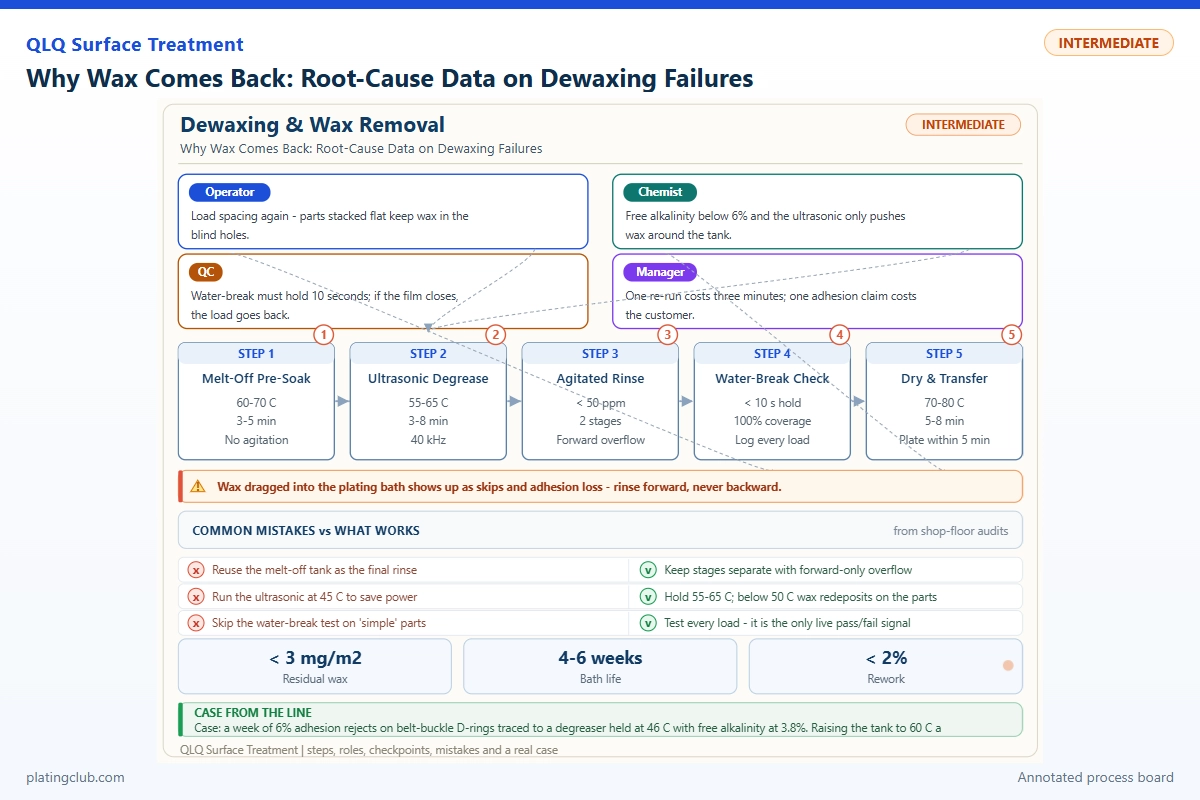
'The parts were clean' is not a diagnosis. Wax-related defects come from four different places, and each leaves a different fingerprint on the part. This is how to tell them apart in under ten minutes and fix the right one.
< 10 min
Diagnosis time
< 1.5%
Repeat rate target
4-6 weeks
Bath life
Four failure modes and their fingerprints
| Mode | Fingerprint | Where to look first | Corrective action |
|---|---|---|---|
| Redeposition | Uniform dull film, strongest low on the part | Bath temperature, free alkalinity | Raise to 60 C, rebuild to 7.5% |
| Carry-over | Defects clustered near rack contact points | Rinse stages, drip time | Add drip time, forward-only overflow |
| Rinse chemistry | Water-marks, hazy patches after drying | Final rinse conductivity | Keep < 50 ppm, DI final stage |
| Mechanical shadowing | Clean top faces, dirty undersides | Load factor, basket design | Reduce to 60%, rotate parts mid-cycle |
Five-day data set from a small-hardware line
| Day | Tank C | Free alkali % | Water-break | Adhesion rejects |
|---|---|---|---|---|
| Mon | 61 | 7.6 | Pass | 0.4% |
| Tue | 59 | 7.1 | Pass | 0.6% |
| Wed | 54 | 5.9 | Fail (11 s) | 2.8% |
| Thu | 52 | 5.4 | Fail | 4.1% |
| Fri | 62 | 7.4 | Pass | 0.5% |
Lab checks that settle arguments
| Check | Method | Limit | Frequency |
|---|---|---|---|
| Residual wax | Solvent extract on a sample | < 3 mg/m2 | Weekly |
| Rinse conductivity | Hand meter at the final stage | < 50 ppm | Every shift |
| Bath loading | Oil/soap split in a sample jar | <= 2% by volume | Weekly |
| Adhesion | Cross-hatch + tape | 0% lift | Every batch of a new part |
Watch out
The Wednesday-to-Thursday pattern above is not operator error: it is a tank drifting below 55 C. Fix the tank, and the rejects follow within one shift.
Common mistakes and the fix
| ✗ Blame the polishers for the wax | ✓ Measure the bath first - the fingerprint tells you which stage failed |
| ✗ Rebuild the tank every time | ✓ Try a top-up and skim first; full rebuilds cost water and heat |
| ✗ Judge cleanliness by sight | ✓ Use residual-wax numbers; the eye misses 3 mg/m2 |
| ✗ Skip the drip time to speed the line | ✓ Drag-out is the second-largest cause of cross-contamination |
What each role watches
| Operator | "Record tank temperature every two hours, not once a shift." |
| Chemist | "Trend free alkalinity; a steady slide means the load is dirty, not the chemistry." |
| QC | "Keep a photo board of each fingerprint - it trains judgement faster than any document." |
| Manager | "Ask for the five-day trend, not a single reading." |
From the shop floor
Case: a shop rebuilt its degreaser every Friday 'to be safe' and still lost 3% to adhesion. The trend sheet showed temperature falling through the week; a covered tank and a 60 C set point removed the problem and cut rebuilds to once every five weeks.
FAQ
How fast does a degreaser drift?
With a well-operating skimmer, 0.2-0.4 percentage points of free alkalinity a day in single-shift work. A drop of 1.5 points in a day means high soil load.
Do I need a DI final rinse?
For zinc hardware heading into plating, a DI final stage is the cheapest insurance against water-marks and hazy gold.
Is residual wax measured on the part or in the bath?
On the part. Bath analysis tells you the tank state; the part tells you what the customer will see.
Where to go next
- Level guide for this trade: Dewaxing & Ultrasonic Cleaning — technician levels
- Other levels: Junior, Senior, Management
- Owner view: Process Overview for owners
- Supplier view: Chemistry & Supply · Find content by trade + level
Related reading in this trade
FAQ - Why Wax Comes Back: Root-Cause Data on Dewaxing Failures
Straight answers from the shop floor. Ask us on WhatsApp if your case is different.
What problem does this article address?
'The parts were clean' is not a diagnosis. Wax-related defects come from four different places, and each leaves a different fingerprint on the part. This is how to tell them apart in under ten minutes and fix the right one.
What does the data say about redeposition?
Redeposition Uniform dull film, strongest low on the part Bath temperature, free alkalinity
What are the practical steps or checks?
Operator Load spacing again - parts stacked flat keep wax in the blind holes. Chemist Free alkalinity below 6% and the ultrasonic only pushes wax around the tank. QC Water-break must hold 10 seconds; if the film closes, the load goes back. Manager On
What should the workshop do differently?
Supplier view: Chemistry & Supply · Find content by trade + level