
Professional Zinc Alloy Surface Finishing Solutions
Nickel Sulfate
Nickel Sulfate
Wygeneruj kod QR
-
Estimated Delivery:Oct 02 - Oct 06
-
Free Shipping & Returns: On all orders over $75
Product description
Shipping & Return
Product Overview
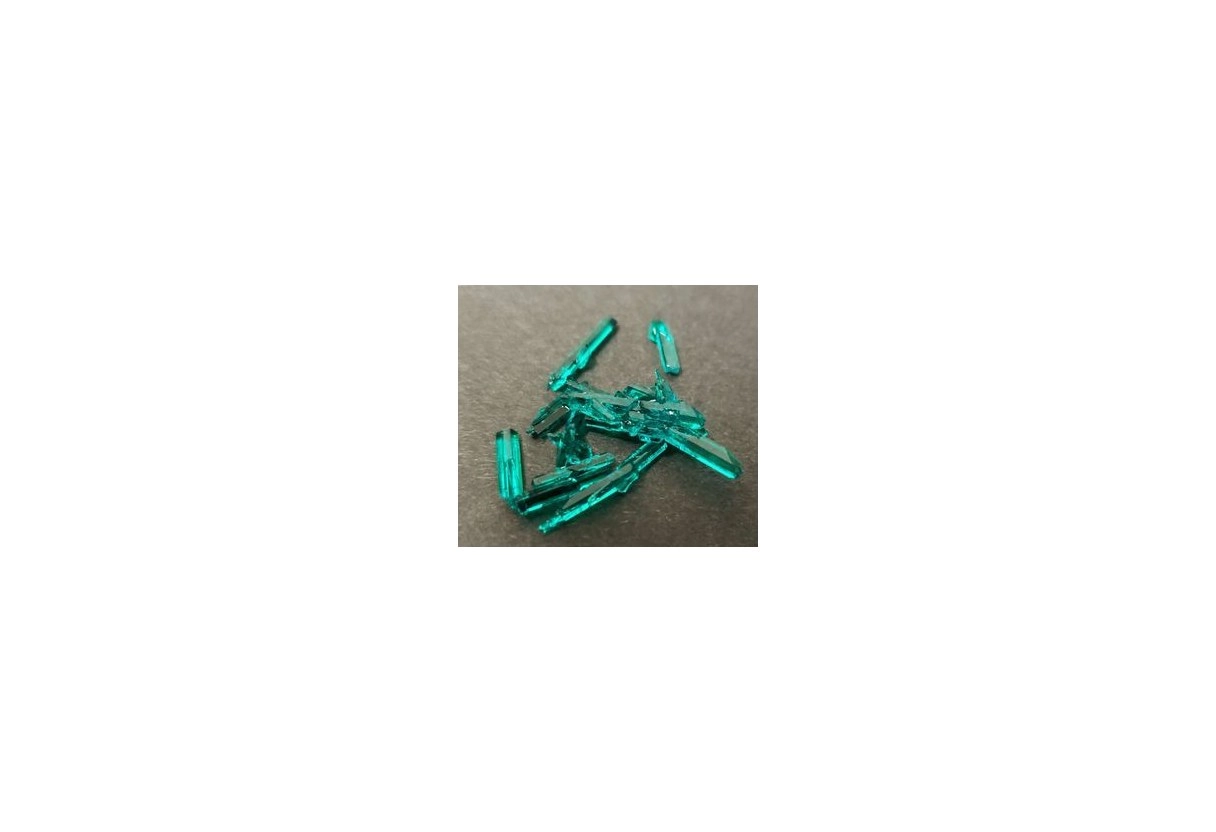
Nickel Sulfate (NiSO4·6H2O) is the backbone of every nickel plating bath - the main salt that supplies Ni2+ ions for the deposit. It is emerald-green hexagonal crystals, fully soluble in water, with a nickel content of approximately 22%. In QLQ's finishing plants it is used in bright nickel, semi-bright nickel, nickel-tin and copper-nickel-chromium lines for zipper sliders, belt buckles and small hardware. Commercial grades on the market differ mainly in purity: plating grade (Co ≤ 0.05%, Cu ≤ 0.001%, Zn ≤ 0.001%, Fe ≤ 0.001%), and lower-purity industrial grades sold for batteries or fertilizers. Battery grade must NOT be used for plating: its higher cobalt content changes deposit color and stress behavior.
Product Identity (Encyclopaedia Card)
| Property | Value |
|---|---|
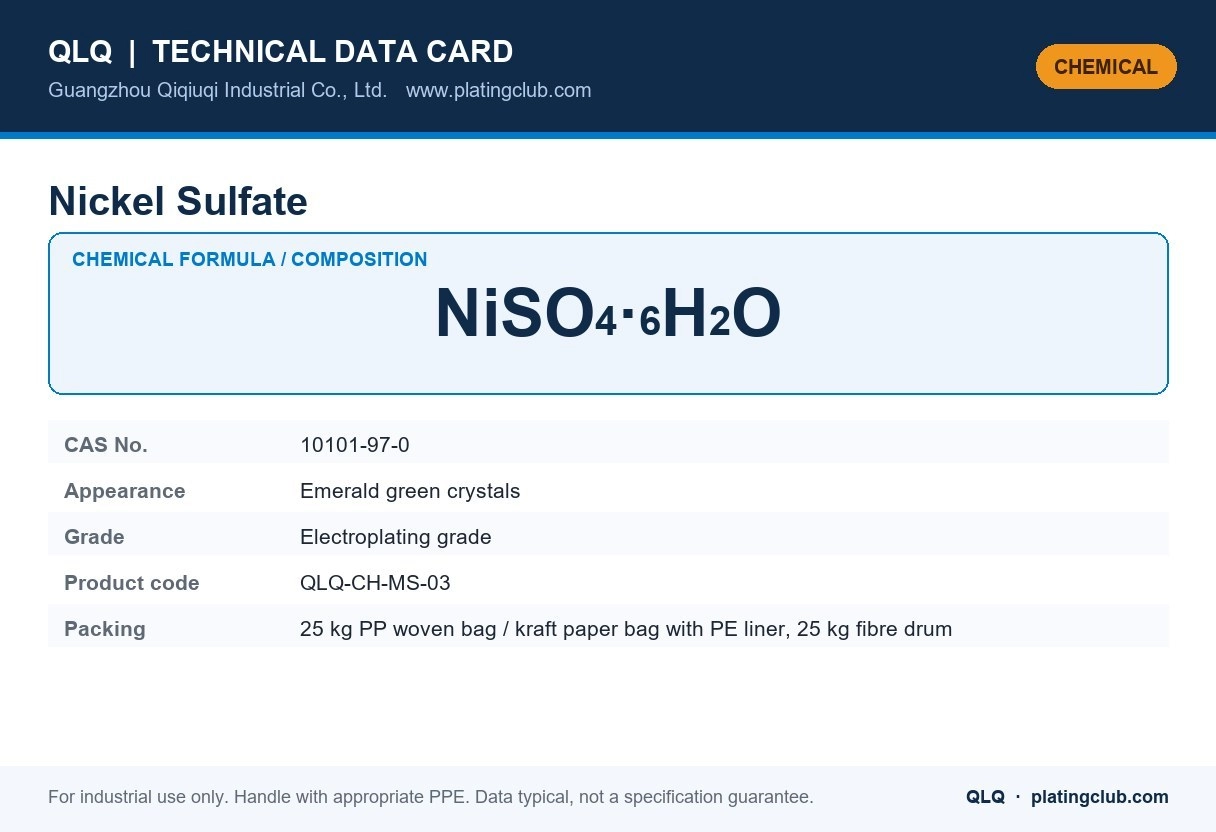
| Chemical name | Nickel Sulfate |
| Chemical formula | NiSO4·6H2O |
| CAS number | 10101-97-0 |
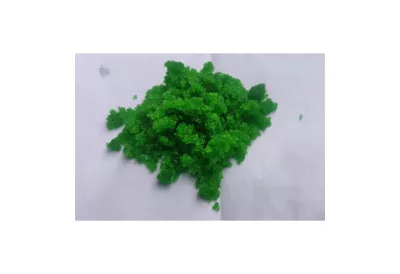
| Appearance | Emerald green crystals |
| Grade / type | Electroplating grade |
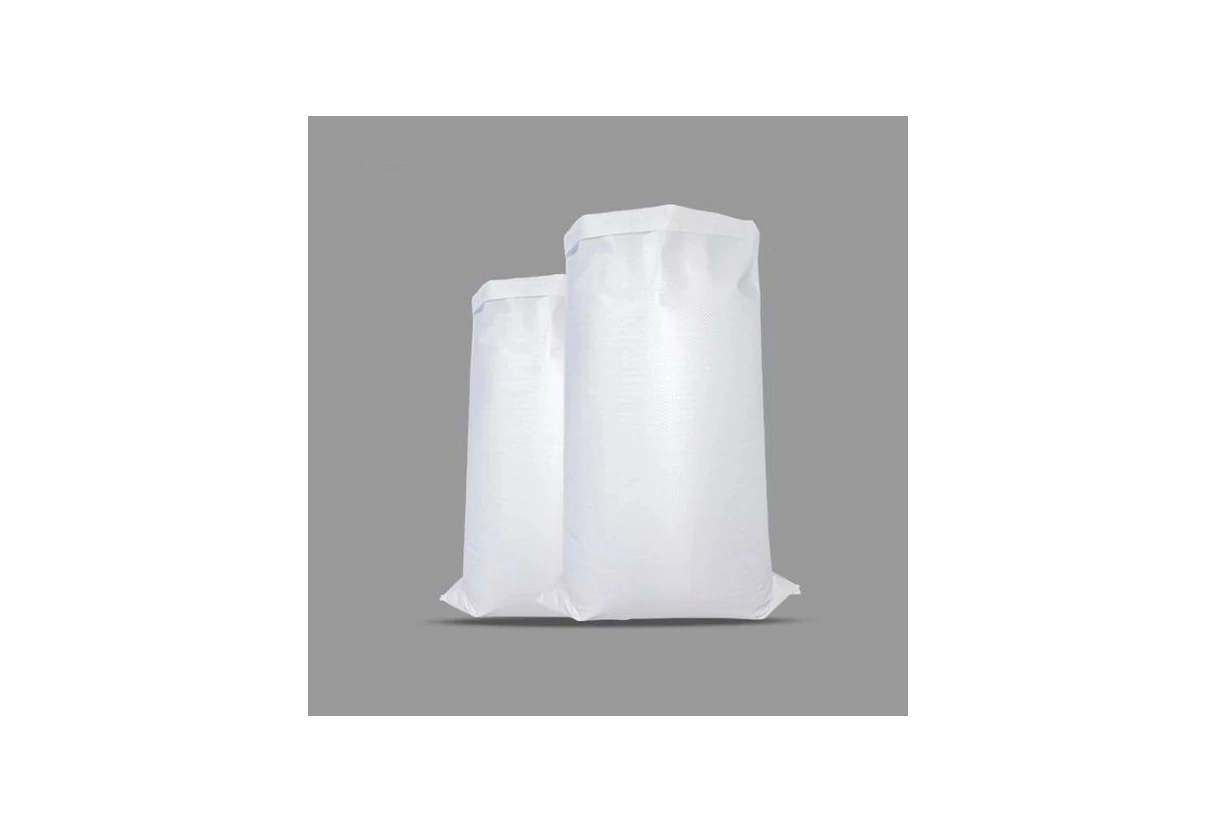
| Standard packing | 25 kg PP woven bag or kraft paper bag with PE inner liner; 25 kg fibre drum |
What it is and what it does. Nickel sulfate hexahydrate is the working horse of decorative and engineering nickel plating - the main nickel source of the Watts bath that gives the bright levelled layer under chrome on zipper sliders, buttons, buckles and bag hardware.
- Bright emerald-green crystals carrying about 22% nickel; the pH of a fresh solution is about 4.5.
- Iron, copper, zinc and organic contamination are the classic causes of dull, dark or brittle deposits, so the COA matters more than the price.
- Free sulfate accumulates as the bath is replenished; it is removed with a sulfate-removal programme or by high-current-density dummy plating.
Typical Use in a Plating / Finishing Line
| Item | Typical guidance |
|---|---|
| Watts nickel bath | 250-300 g/L NiSO4.6H2O with 40-60 g/L NiCl2.6H2O and 40-50 g/L boric acid |
| pH / temperature | 3.8-4.5 at 50-60 C |
| Cathode current density | 2-6 A/dm2 with air agitation and continuous filtration |
| Purification | Regular activated-carbon treatment and dummy plating keep the bath bright over years of production |
Safety, Handling & Storage
| Item | Requirement |
|---|---|
| Hazard classification | Skin sensitiser + respiratory sensitiser (GHS08) — nickel compounds are suspected carcinogens on inhalation |
| Personal protective equipment | Nitrile gloves, goggles, P2/P3 dust mask and coverall when handling powder; keep the work area dust-free |
| Spill / first aid | Sweep dry and drum for recovery; nickel-bearing rinse water must go to the effluent treatment plant, not to drains |
| Storage | Dry, sealed store; keep the bags closed, label clearly, and keep MSDS for nickel compounds with the batch record |
| Transport | Classified and packed according to IATA/IMDG for the hazard class; UN number and packing group stated on the shipping documents |
Quality Documents Shipped With Every Batch
| Document | Comment |
|---|---|
| COA (certificate of analysis) | Provided with the shipment; batch traceable to the production date |
| MSDS (safety data sheet) | Provided with the shipment; batch traceable to the production date |
| Packing list | Provided with the shipment; batch traceable to the production date |
| Commercial invoice | Provided with the shipment; batch traceable to the production date |
| Certificate of origin on request | Provided with the shipment; batch traceable to the production date |
Buyer Questions We Answer Every Week
| Question | Answer |
|---|---|
| Can the same salt be used for the semi-bright and bright layers? | Yes - the difference is in the additive system, not in the nickel sulfate. |
| How is the nickel content checked on arrival? | By EDTA complexometric titration or AAS; the value on the COA is normally 21.5-22.5% Ni. |
| Item | Typical Value |
|---|---|
| Chemical formula | NiSO4·6H2O |
| Ni content | ≥ 21.5% (plating grade) |
| Appearance | Emerald green crystals, no caking |
| Cobalt (Co) | ≤ 0.05% (lower is better) |
| Cu / Zn / Fe (each) | ≤ 0.001% |
| Water insoluble | ≤ 0.005% |
| Standard packing | 25KG woven bag, PE inner liner |
How to Check Quality Before Loading a Batch
| Check | Method | Pass Criteria |
|---|---|---|
| Color & form | Visual: compare with retained sample | Uniform emerald green; no yellow/brown tint (iron contamination), no white efflorescence (deliquescence or filler) |
| Solubility | Dissolve 10g in 100ml DI water | Clear green solution in 2 min; no cloudiness or residue |
| Cobalt (the hidden killer) | Supplier COA + periodic lab ICP check | Co ≤ 0.05%; high Co = deposit whitens, stress rises |
| Hull cell test | 267ml cell, 3A, 5 min on your own bath after adding 10% new salt | Bright range unchanged; no haze or brittleness at high CD |
How QLQ controls it: every incoming lot is quarantined until the COA is checked against our retained sample and a Hull cell panel is run in a live bath. Only lots that pass both checks are released to production; the batch number is recorded so any abnormality can be traced back within one day. This is why our nickel baths run stable for years without full dumps.
Typical Bath Formulations (Working Ranges)
| Component | Barrel Bright Nickel | Rack Semi-Bright Nickel |
|---|---|---|
| Nickel Sulfate | 250-300 g/L | 280-320 g/L |
| Nickel Chloride | 40-50 g/L | 35-45 g/L |
| Boric Acid | 40-45 g/L | 40-50 g/L |
| Brightener / Carrier | per supplier ml/L | semi-bright system |
| pH | 4.0-4.8 | 3.8-4.4 |
| Temperature | 45-55°C | 50-58°C |
| Cathode current density | 1-4 A/dm² (barrel) | 2-5 A/dm² |
These are workshop-proven ranges for zipper and hardware work; fine-tune 5-10% for your water quality and loading ratio.
Handling & Safety for the Plating Line
- Health: nickel salts are skin sensitizers and suspected carcinogens. Wear nitrile or PVC gloves, goggles and apron when dissolving or transferring. Never touch crystals or solution with bare hands - nickel itch dermatitis is cumulative.
- Dissolving: always add crystals to warm water (50-60°C) slowly with stirring; adding water to a pile of crystals causes caking and slow, uneven dissolution.
- Dust control: avoid breathing crystal dust when opening bags; use a dust mask and cut bags with the opening away from your face.
- Storage: keep bags sealed on pallets in a dry area. Nickel sulfate is not flammable but absorbs moisture and cakes, which slows dissolving and causes weighing errors. Shelf life is effectively unlimited if kept dry.
- Spills: sweep solids back into the system or collect as nickel-bearing waste; never wash nickel salts into the drain - effluent nickel limits are typically ≤ 0.5-1 mg/L.
- Bath contamination: the classic enemies are copper (from dropped parts left in the bath), zinc (brass substrates), and organics. Low-current-density dummy plating (0.2-0.5 A/dm², 1-2 h) removes Cu/Zn; activated carbon treatment 2-5 g/L removes organics.
Quality Analysis: Reading Defects Back to the Salt
| Defect on parts | Root cause related to nickel sulfate / bath | Fix |
|---|---|---|
| Deposit whitish or striped | Metal nickel content too low (under-salting) or high cobalt impurity | Analyze Ni; add salt to 250+ g/L; verify Co on COA |
| Burning at high current density areas | Ni too low, temperature too low, or boric acid below 35 g/L (pH drift) | Raise Ni salt + temperature; keep boric acid 40-45 g/L |
| Brittle deposit, cracks after lacquer | Organic contamination or wrong brightener balance; iron pickup from dissolved steel parts | Carbon treat, re-balance brighteners; check Fe in salt |
| Pinholes | Poor wetting (air or hydrogen sticking) - wetting agent exhausted, not the salt itself | Hull cell + wetting agent 1-2 ml/L; filter continuously |
| Rough, gritty surface | Insoluble particles: cheap salt with insolubles > 0.01%, or anode sludge entering the bath | Use ≤ 0.005% insoluble salt; check anode bags, filter 5 μm |
What It Does on Iron, Zinc Alloy, Copper and Stainless Steel Parts
| Substrate | Role of the nickel layer from this salt | Recommended practice |
|---|---|---|
| Iron / steel small hardware | Barrier corrosion layer under chrome or lacquer; stops rust bleeding through decorative coats | Strike nickel or alkaline copper first for adhesion; nickel 6-10 μm for indoor parts |
| Zinc alloy (sliders, buckles) | Covers the active zinc, prevents zinc migration into bright chrome; smooths after copper underlayer | Always copper + nickel double layer; avoid long acid activation or zinc dissolves and contaminates the bath |
| Copper / brass | Bright nickel gives the white-silver decorative finish directly; also levels before chrome | Activate in 3-5% sulfuric acid, nickel 3-6 μm; brass parts get the classic nickel-silver look |
| Stainless steel | Nickel strike (Woods or sulfamate type) builds adhesion bridge for subsequent copper/nickel/chrome | Activate (nickel chloride + HCl), strike nickel at high current density, then normal nickel |
FAQ
| Question | Answer |
|---|---|
| Can I use battery-grade nickel sulfate to save cost? | No. Its high cobalt shifts deposit color and stress, and spec limits run in the wrong direction for plating. Cost saving turns into full-bath treatment cost. |
| How do I know if my salt batch caused a problem? | Run a Hull cell comparing your live bath vs 90% live + 10% new-make-up with the suspect salt. A difference at the same additive levels points to the salt. |
| Why is my nickel bath slow to deposit even at normal amps? | Check metal nickel content first (usually drifted down from drag-out), then chloride below 35 g/L, then anode passivation (nickel anodes should dissolve at 99%+ efficiency). |
| Does QLQ supply nickel sulfate with technical support? | Yes. Each shipment includes COA, and our engineers help you set up the bath, train your staff on Hull cell testing, and diagnose defects remotely with photos. |
Need help with your nickel bath? QLQ's engineers support customers in Bangladesh, Pakistan, India and 10+ countries with free bath setup guidance and defect diagnosis. Contact us with your problem photos.
Shipping cost is based on weight. Just add products to your cart and use the Shipping Calculator to see the shipping price.We want you to be 100% satisfied with your purchase. Items can be returned or exchanged within 30 days of delivery.