Product Overview
Antique Bronze Coloring Solution QLQ-20B is QLQ's ready-to-use chemical coloring system that turns copper, brass and bronze-plated parts into the classic antique bronze / old-bronze finish - the dark brown-black relief look with highlighted edges that dominates belt buckles, bag hardware and decorative accessories. Unlike paint or plating, chemical coloring is a controlled conversion reaction: sulfur-bearing agents react with the copper surface to grow a uniform cupric-sulfide/tarnish film in seconds. Color depth is controlled by immersion time and temperature, not by current - which is why the finish follows every contour of the part perfectly. Comparable generic systems on the market (selenium-based or polysulfide "liver of sulfur" brews) need in-house mixing and are inconsistent between batches; QLQ-20B ships as a stabilized concentrate so your color matches from week to week.
Product Identity (Encyclopaedia Card)
| Property | Value |
|---|
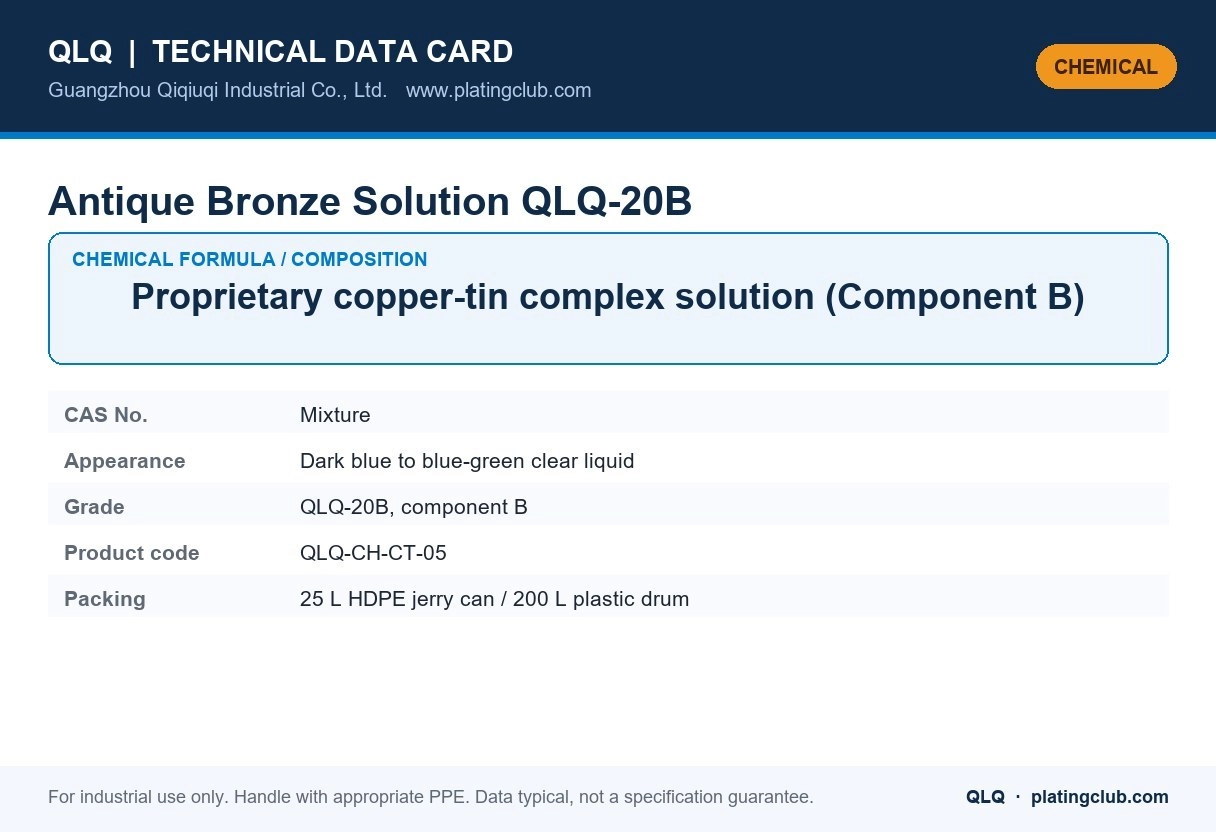
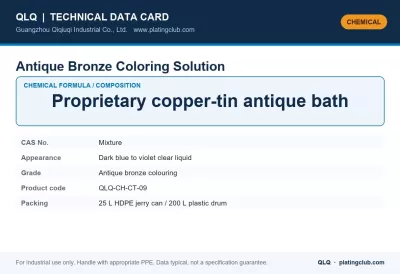
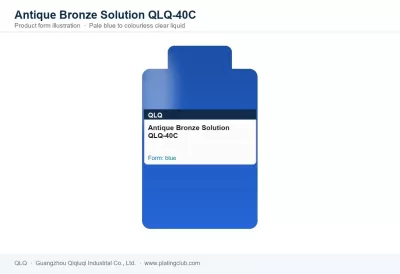
| Chemical name | Antique Bronze Solution QLQ-20B |
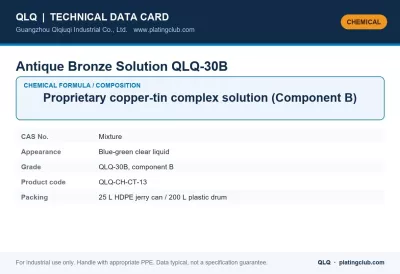
| Chemical formula | Proprietary copper-tin complex solution (Component B) |
| CAS number | Mixture |
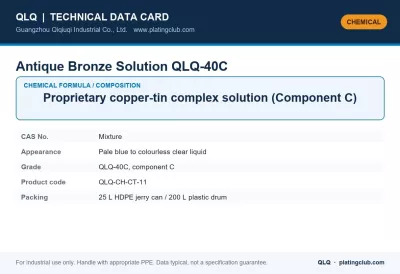
| Appearance | Dark blue to blue-green clear liquid |
| Grade / type | QLQ-20B, component B |
| Standard packing | 25 L HDPE jerry can; 200 L plastic drum |
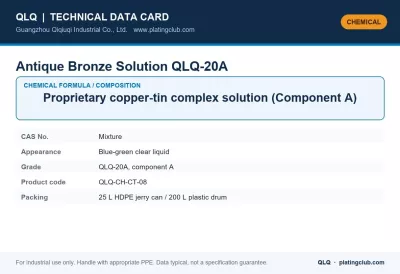
What it is and what it does. Antique bronze solution QLQ-20B is component B of the two-part QLQ-20 antiquing system for copper-tin alloy deposits, producing the warm brown antique bronze tone used on zipper sliders and bag hardware.
- Dark blue to blue-green clear liquid; used in a two-component system where the ratio of A to B sets the final colour.
- Works on bronze and imitation bronze deposits - the base deposit is what gives the finish its depth.
- Always add component B to the working bath slowly with agitation, never the other way round.
Typical Use in a Plating / Finishing Line
| Item | Typical guidance |
|---|
| Working bath | Mix QLQ-20A and QLQ-20B in the ratio stated on the process sheet |
| Operating conditions | Room temperature to 40 C, 30 seconds to 3 minutes depending on the depth of colour wanted |
| Control | Colour compared against a retained master sample; top up both components together |
Safety, Handling & Storage
| Item | Requirement |
|---|
| Hazard classification | Not classified as dangerous for transport in most cases; observe good industrial hygiene and dust control |
| Personal protective equipment | Dust mask, goggles and gloves for powder handling; general ventilation |
| Spill / first aid | Sweep up dry; material is a nuisance dust — avoid breathing the dust |
| Storage | Cool, dry, sealed store; keep bags closed, off the floor and away from moisture |
| Transport | Classified and packed according to IATA/IMDG for the hazard class; UN number and packing group stated on the shipping documents |
Quality Documents Shipped With Every Batch
| Document | Comment |
|---|
| COA (certificate of analysis) | Provided with the shipment; batch traceable to the production date |
| MSDS (safety data sheet) | Provided with the shipment; batch traceable to the production date |
| Packing list | Provided with the shipment; batch traceable to the production date |
| Commercial invoice | Provided with the shipment; batch traceable to the production date |
| Certificate of origin on request | Provided with the shipment; batch traceable to the production date |
Buyer Questions We Answer Every Week
| Question | Answer |
|---|
| How do I hold the colour constant? | By keeping the A to B ratio fixed and by replacing a portion of the bath on a schedule rather than only topping up. |
| Why is the colour coming out too dark? | Usually too long an immersion or a drifted metal content; shorten the time first and then check the analysis. |
| Item | Typical Value |
|---|
| System | Sulfur-based conversion coloring (aqueous) |
| Color produced | Antique bronze / chocolate brown-black relief |
| Working concentration | 20-50 ml/L in water (depth-dependent) |
| Temperature | 25-40°C (warmer = faster, darker) |
| Immersion time | 10-60 seconds |
| Bath life | 4-8 weeks depending on loading |
| Standard packing | 25KG drum / 5KG drum |
The Complete Antique Process (Where 20B Sits)
| Step | Operation | Typical |
|---|
| 1. Base plate | Bright copper or bronze-tone plate on parts | 3-8 μm copper |
| 2. Activate / clean | Alkaline soak + dilute acid dip | 1-2 min each |
| 3. Color with QLQ-20B | Immerse, agitate gently | 10-60 s to target depth |
| 4. Rinse | Two counterflow rinses | 30 s |
| 5. Highlight (relief) | Tumble / vibratory with media, or hand-nib on edges | 10-30 min |
| 6. Neutralize | Dilute QLQ neutralizing salt dip | 30 s |
| 7. Seal / lacquer | Clear lacquer (e.g. QLQ-L55) to stop tarnish drift | spray or dip |
The highlight step is what makes antique bronze "antique": high spots lose some color film and shine, recesses stay dark. Consistent coloring (step 3) is what makes every batch of buckles look identical - that is the QLQ-20B job.
Quality Control Points
| Check | Method | Pass |
|---|
| Color speed | Test panel in fresh 30 ml/L bath at 30°C | Deep even color in 20-40 s |
| Color uniformity | Compare 10 parts from same batch under D65 light | No patchiness, no red/green tint zones |
| Adhesion of film | Press tape on colored panel, rip | No film transfer to tape |
| Bath strength | Time-to-color vs fresh reference | When time doubles, add concentrate or remake |
How QLQ controls it: every 20B batch is made against a retained reference and verified on copper panels for color speed and hue before release. Customers in Bangladesh, Pakistan and India run monthly shade-matching checks with our engineers so a buckle colored today matches one colored six months ago - that consistency is what European bag brands audit.
Common Problems & Fixes (Workshop Table)
| Problem | Root cause | Fix |
|---|
| Color too light, slow | Bath exhausted or too cold | Add 20B to 40-50 ml/L; warm to 35°C |
| Black sooty patches | Bath too strong or parts not rinsed after acid | Dilute to 20 ml/L; improve rinse before coloring |
| Red / greenish tint | Surface still oxidized or chloride in water | Activate properly; use DI or low-chloride water |
| Color washes off in highlight | Film grown too thin; over-rinsing with hot water | Longer immersion; rinse cool and gently |
| Color drifts week to week | No bath analysis; eyes-only control | Keep time-to-color log; standardize temp with a thermometer, not feel |
Handling & Safety
- Ventilation: sulfur-based color baths release mild sulfurous odor - keep tanks ventilated; do not lean over the bath.
- PPE: gloves and goggles; the concentrate is irritating to skin and eyes. Wash splashes immediately with water.
- Never mix with acids in the same tank - releases toxic hydrogen sulfide gas. Keep the color tank strictly alkaline-neutral.
- Storage: closed drums, cool and dark. Partly-used drums must be resealed (air oxidation slowly weakens the solution). 12-month shelf life sealed.
- Waste: spent bath carries copper - collect for metal recovery or licensed disposal, never to drain.
What It Does on Iron, Zinc Alloy, Copper and Stainless Steel Parts
| Substrate | Role / behavior of 20B | Practice |
|---|
| Copper / brass parts | Direct coloring - the classic application; reaction is fastest and most uniform | Best substrate; 10-40 s immersion |
| Zinc alloy (sliders, buckles) | Does not color zinc evenly - parts must carry a copper or bronze plate first | Copper plate 3-6 μm, then color; standard slider route |
| Iron / steel hardware | Same as zinc: color only after copper underplate; also protects against red-rust show-through | Copper plate then color; seal well against humidity |
| Stainless steel | Chemical bronze color barely reacts - not the right tool; use plated-then-colored route | Avoid; plate copper/bronze first if antique look is wanted |
FAQ
| Question | Answer |
|---|
| Can I mix 20B with other antique solutions? | No. Sulfur chemistry is sensitive; mixing changes hue unpredictably. Keep dedicated tanks and tools. |
| Why does my color look different in summer? | Temperature drives reaction speed. Control bath at 30±3°C and time your immersion - then summer and winter match. |
| Do we still need lacquer after coloring? | Yes for wear parts. The sulfide film is decorative, not hard; a clear lacquer (QLQ-L55) locks color and adds abrasion life. |
| Can QLQ match a shade sample from our brand? | Yes. Send the physical sample; our lab adjusts the 20B working parameters and provides a written recipe with time/temperature for your line. |
Shade-matching trouble? QLQ supports antique-bronze lines in 10+ countries with recipes and on-site-style remote training. Contact us with your target sample.