
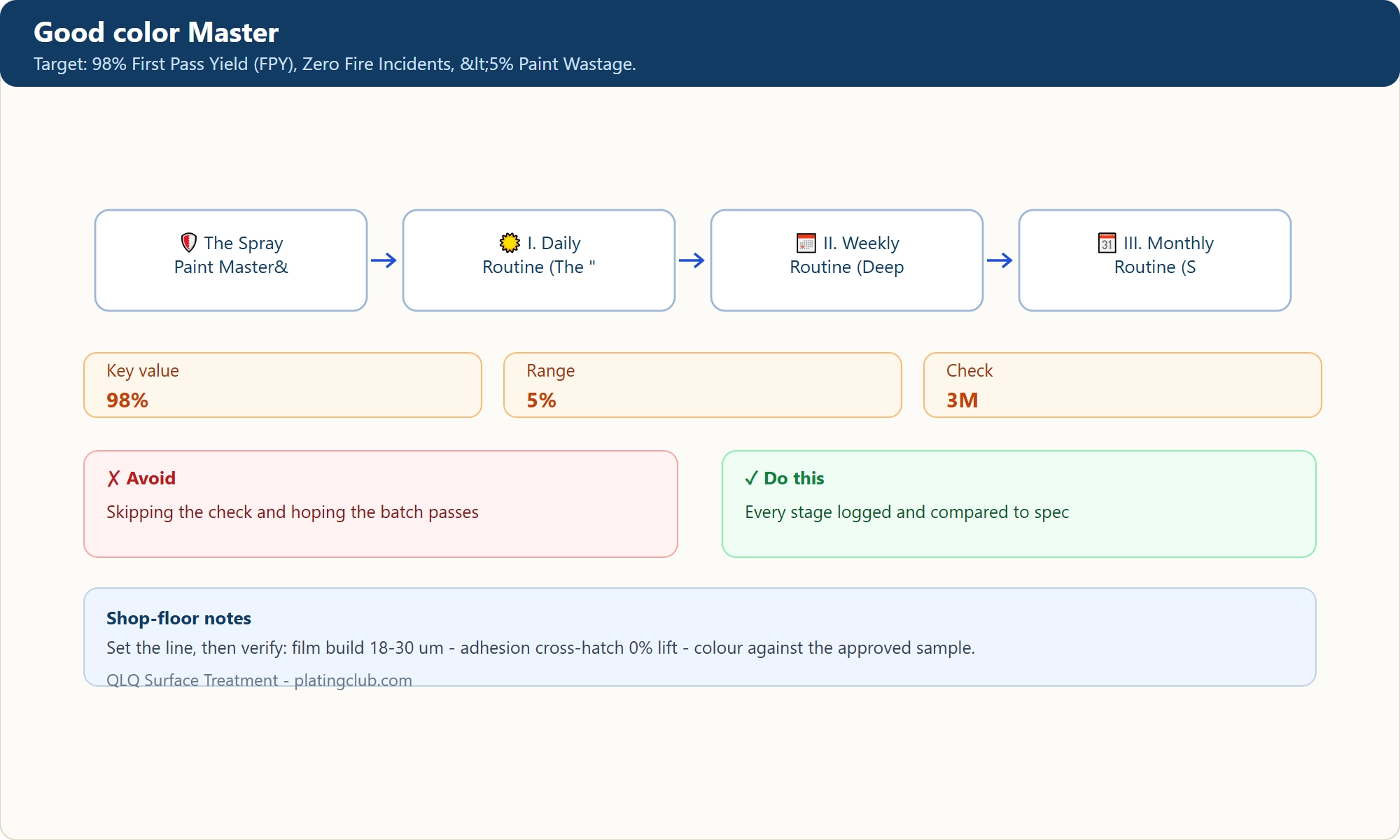
🛡️ The Spray Paint Master’s Protocol (QLQ System)
Target: 98% First Pass Yield (FPY), Zero Fire Incidents, <5% Paint Wastage.
☀️ I. Daily Routine (The "Clean Room" Discipline)
07:30 – 08:00 | The Pre-Start Safety & Hygiene Check
The "Positive Pressure" Check:
Action: Check the Air Supply Unit (MAU) and Exhaust Fans.
Standard: The room pressure must be higher than the outside. Open the door slightly; air should blow out, not suck dust in.
Water Curtain / Booth Prep:
Action: Turn on the water pump. Skim off floating paint sludge ("Paint Kill").
Standard: Water curtain must be unbroken/smooth. Gaps in the water curtain = Paint sticking to the wall = Fire hazard.
Gun Logic Check:
Action: Blow thinner through the lines. Check the spray pattern on a piece of cardboard.
Standard: The pattern must be a perfect oval. If it is a "banana" shape or "split," clean the air cap immediately.
09:00 – 16:00 | Process Control (The "Viscosity Police")
The "Every 2 Hours" Viscosity Check:
Action: Dip the Ford Cup #4 into the mixed paint pot.
Standard: Hand Spray: 16–18 sec. Tumble: 14–16 sec.
Why? Thinner evaporates. If you don't add thinner every 2 hours, the paint gets thick $\rightarrow$ Orange Peel defect.
Oven Temperature Audit:
Action: Look at the thermometer probe inside the oven, not just the digital display.
Standard: Target 150°C. If the display says 150°C but the probe says 130°C, the paint will be soft (Fail).
First Article Inspection (FAI):
Action: Check the first rack coming out of the oven.
Test: Fingernail Test (Cure) and Visual Check (Dust/Sagging).
QLQ Standard: If dust is found, stop the line. Wipe down the spray booth floor with damp mops.
17:30 – 18:00 | The Shutdown (Fire Prevention)
Gun & Line Flushing:
Action: Flush all guns with [Purchase Locally] Washing Thinner. Leave solvent in the line to prevent hardening.
Waste Paint Management:
Action: Seal all open paint cans. Move waste rags/paper to the Fireproof Bin outside the building.
Reason: Solvent-soaked rags can self-ignite (Spontaneous Combustion).
Turn Off Compressors & Drain Tank:
Action: Open the drain valve on the air tank.
Standard: Drain water/oil. Water in air = Blisters in paint.
📅 II. Weekly Routine (Deep Cleaning & Maintenance)
Saturday Morning | The "Deep Clean"
Booth Sludge Removal:
Action: Scoop out the "Paint Sludge" from the bottom of the water curtain tank.
Add Chemical: Add [QLQ Product] Paint Flocculant (Coagulant) to make the paint float for easy removal.
Tumble Drum Maintenance:
Action: Check the inside of the Tumble Spray Drums.
Standard: If the paint buildup on the walls is loose/flaking, strip the drum. Flakes will fall onto new zipper pulls and ruin them.
Air Filter Replacement:
Action: Inspect the Ceiling Filters (Intake) and Floor Filters (Exhaust).
Standard: If they are covered in color, replace them. Clogged filters = Poor airflow = Dust settling on parts.
Monday Morning | Inventory & Calibration
Stock Check:
Action: Count [QLQ] Paint Base, Hardener, and Thinner.
Rule: Order when stock drops below 1 week's supply.
Grounding Check (Static Safety):
Action: Use a multimeter to check the grounding wire on the Spray Gun and the Conveyor Chain.
Standard: Resistance < 10 Ohms. Static electricity causes fires and attracts dust.
🗓️ III. Monthly Routine (System & Cost Analysis)
1st Week | The "Adhesion Audit"
Full Lab Test:
Action: Take 10 random samples from last month's production.
Test: Perform Cross-Cut (3M Tape), Boiling Water (1 hour), and MEK Rub.
Goal: Verify that the [QLQ] Adhesion Promoter is working and the Oven is curing correctly.
2nd Week | Equipment Service
Compressor Service:
Action: Check oil levels. Change air intake filters. Check the Refrigerated Air Dryer.
Standard: Air Dew Point must be < 5°C.
Oven Uniformity Test:
Action: Place temperature strips on the Top, Middle, and Bottom of the oven rack.
Goal: Ensure the top isn't burning while the bottom is under-cured.
End of Month | The "Boss Report" (Costing)
Yield Rate Calculation:
Formula:
(Total KG Produced - Scrap KG) / Total KG.Target: > 95% for Rack Spray, > 98% for Tumble.
Paint Consumption Efficiency:
Calculate:
Total Paint Used (kg) / Total Production (kg).Target: Compare with the standard cost model (e.g., 0.03kg paint per 1kg product). If usage is 0.05kg, the sprayers are wasting paint (overspray).
🏆 IV. How the Boss Evaluates this Master (KPIs)
Mr. Boss, here is how you spot a "Top Tier" Paint Master:
The "Smell" Test:
Walk into the spray room. If the smell of thinner knocks you over, he is failing.
A good Master maintains proper negative pressure exhaust. The air should be relatively clear.
The "Dust" Test:
Run your finger on the wall inside the spray booth.
Good Master: It is tacky (Sticky Coating applied) to trap dust.
Bad Master: It is dry and dusty. That dust is landing on your $0.50 buckle.
The "Thinner" Bill:
If Thinner consumption spikes in Winter but he hasn't switched to "Fast Dry Thinner," he doesn't understand chemistry.
The "Fire" Discipline:
He screams at anyone who brings a lighter or phone (non-EX) into the mixing room. He protects your asset.
Summary: A great Paint Master fights three enemies every day: Dust, Water, and Fire. If he controls these, your quality is guaranteed.
FAQ - Good color Master
Straight answers from the shop floor. Ask us on WhatsApp if your case is different.
What drives cost per part and how do I reduce it?
What line data should the supervisor track?
What does this cost if it is ignored?
What is the practical takeaway for the workshop?
Quick reference - what to check and why
| Stage | What it means on the line |
|---|---|
| 🛡️ The Spray Paint Master’s Protocol (QLQ System) | Target: 98% First Pass Yield (FPY), Zero Fire Incidents, <5% Paint Wastage. |
| ☀️ I. Daily Routine (The "Clean Room" Discipline) | 07:30 – 08:00 | The Pre-Start Safety & Hygiene Check The "Positive Pressure" Check: Action: Check the Air Supply Unit (MAU) and Exhaust Fans. |
| 📅 II. Weekly Routine (Deep Cleaning & Maintenance) | Saturday Morning | The "Deep Clean" Booth Sludge Removal: Action: Scoop out the "Paint Sludge" from the bottom of the water curtain tank. |
| 🗓️ III. Monthly Routine (System & Cost Analysis) | 1st Week | The "Adhesion Audit" Full Lab Test: Action: Take 10 random samples from last month's production. |
| 🏆 IV. How the Boss Evaluates this Master (KPIs) | Mr. |
| FAQ - Good color Master | Straight answers from the shop floor. |