

Professional Zinc Alloy Surface Finishing Solutions
Disodium EDTA
Disodium EDTA
QR 코드 생성
-
Estimated Delivery:Oct 02 - Oct 06
-
Free Shipping & Returns: On all orders over $75
Product description
Shipping & Return
Product Overview
Disodium EDTA (C10H14N2Na2O8·2H2O, edetate disodium) is the workhorse chelating agent of metal finishing - the compound that holds metal ions in solution when ordinary chemistry would let them fall out. Its complex with copper is among the strongest available (stability constant log K ≈ 18), which is exactly why the classic electroless copper bath for printed-circuit and decorative work is built around EDTA: at pH 12-13, where copper would otherwise precipitate as hydroxide, EDTA keeps a controlled reserve of copper in solution so the catalytic reaction can proceed hour after hour. It is equally valuable in cleaner and pre-treatment lines, where it sequesters calcium, iron and copper picked up from hard water and from the parts themselves. Market grades: technical EDTA for industrial chelation and higher-purity grades for electronics baths where chloride and heavy-metal limits matter; both are the same disodium salt dihydrate, and the difference is impurity control, which in a plating bath decides whether you get haze, skip-plate or years of clean running.
Product Identity (Encyclopaedia Card)
| Property | Value |
|---|---|
| Chemical name | Disodium EDTA |
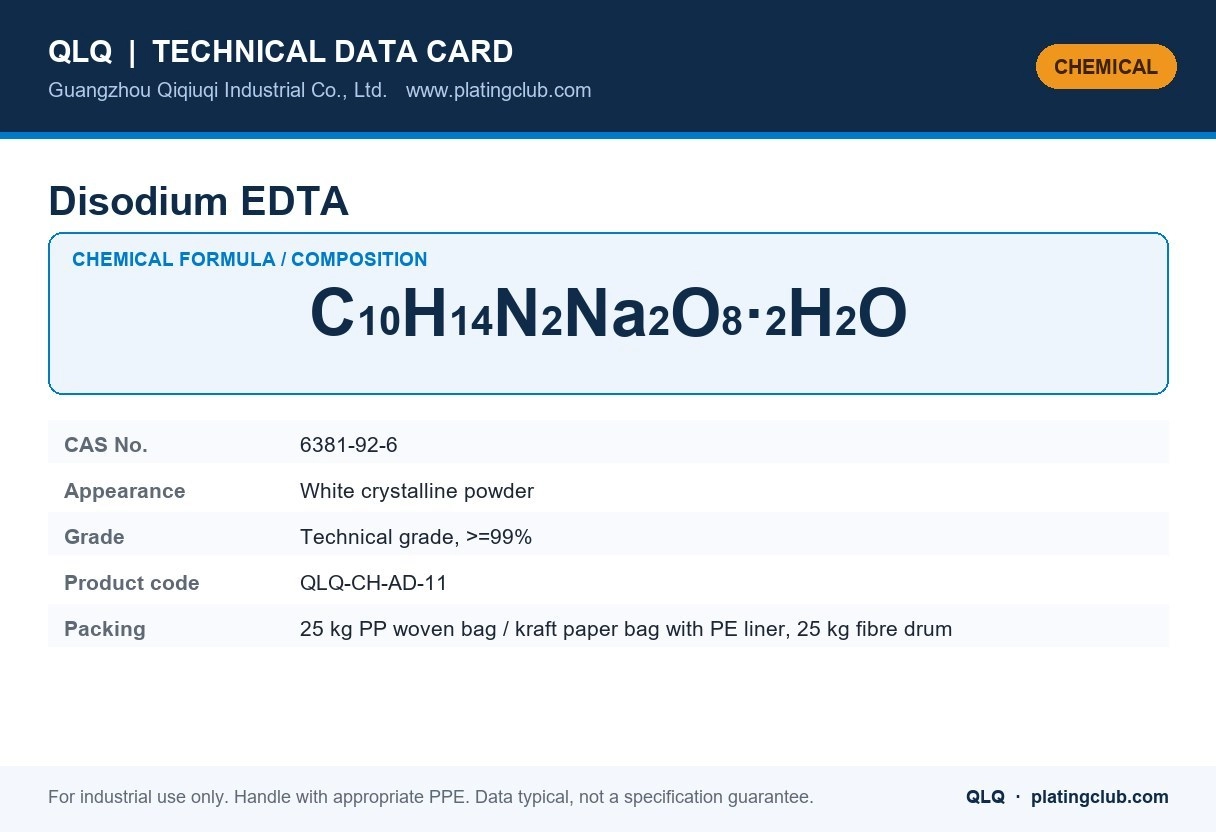
| Chemical formula | C10H14N2Na2O8·2H2O |
| CAS number | 6381-92-6 |
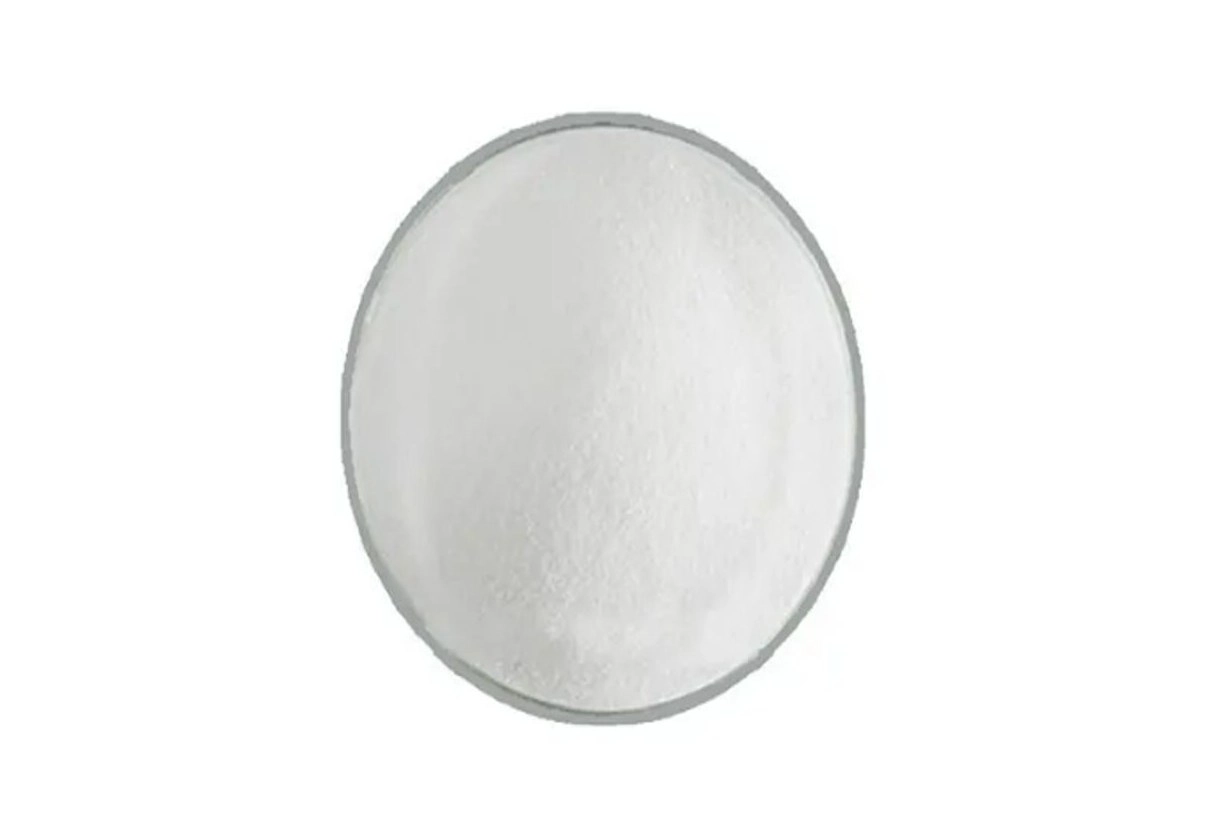
| Appearance | White crystalline powder |
| Grade / type | Technical grade, >=99% |
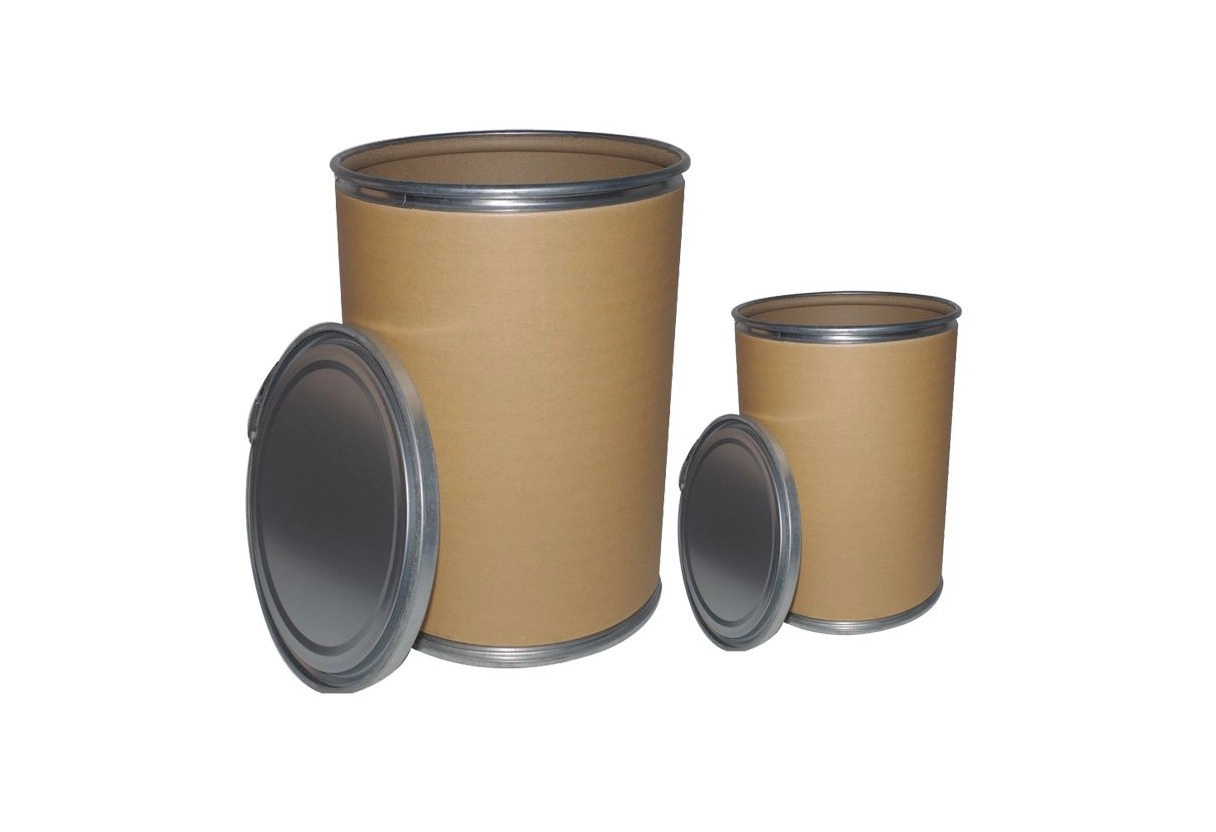
| Standard packing | 25 kg PP woven bag or kraft paper bag with PE inner liner; 25 kg fibre drum |
What it is and what it does. Disodium EDTA is the strong chelating agent used in electroless plating, in cleaning formulations and in effluent treatment, where it keeps metal ions in solution over a very wide pH range.
- White crystalline powder, very soluble; one of the strongest common chelants for copper, nickel and iron.
- Used as the complexant in electroless copper and in some electroless nickel systems.
- Not readily biodegradable - in effluent it keeps metals in solution and can defeat hydroxide precipitation.
Typical Use in a Plating / Finishing Line
| Item | Typical guidance |
|---|---|
| Electroless copper complexant | As specified by the bath formulation |
| Cleaner chelant | 1-10 g/L |
| Analysis | By titration with a standard metal solution |
Safety, Handling & Storage
| Item | Requirement |
|---|---|
| Hazard classification | Not classified as dangerous for transport in most cases; observe good industrial hygiene and dust control |
| Personal protective equipment | Dust mask, goggles and gloves for powder handling; general ventilation |
| Spill / first aid | Sweep up dry; material is a nuisance dust — avoid breathing the dust |
| Storage | Cool, dry, sealed store; keep bags closed, off the floor and away from moisture |
| Transport | Classified and packed according to IATA/IMDG for the hazard class; UN number and packing group stated on the shipping documents |
Quality Documents Shipped With Every Batch
| Document | Comment |
|---|---|
| COA (certificate of analysis) | Provided with the shipment; batch traceable to the production date |
| MSDS (safety data sheet) | Provided with the shipment; batch traceable to the production date |
| Packing list | Provided with the shipment; batch traceable to the production date |
| Commercial invoice | Provided with the shipment; batch traceable to the production date |
| Certificate of origin on request | Provided with the shipment; batch traceable to the production date |
Buyer Questions We Answer Every Week
| Question | Answer |
|---|---|
| Why do my metals not precipitate in the effluent plant? | EDTA holds them in solution; the plant needs a strong oxidant step to break the complex before precipitation. |
| Is there a biodegradable alternative? | NTA, gluconate and IDS are the usual replacements, but the chelating strength differs and the process must be re-validated. |
| Item | Typical Value |
|---|---|
| Chemical formula | C10H14N2Na2O8·2H2O |
| Assay | ≥ 99.0% |
| Chelating power | ≥ 245 mg CaCO3 per gram |
| Appearance | White crystalline powder |
| Solubility (20°C) | ≈ 100 g/L in water, more when heated or pH raised |
| pH (1% solution) | 4.0-5.0 (dissolve with NaOH for alkaline use) |
| Chloride | ≤ 0.005% (electronics grade ≤ 0.002%) |
| Iron (Fe) | ≤ 0.001% |
| Heavy metals (as Pb) | ≤ 0.001% |
| Standard packing | 25KG woven bag with PE inner liner |
How to Check Quality Before Loading a Batch
| Check | Method | Pass Criteria |
|---|---|---|
| Appearance | Visual | White uniform powder; grey or yellow tint = contamination or degradation |
| Solubility | Dissolve 50 g in 100 ml warm DI water, raise pH to 9-10 with NaOH | Clear, colourless solution, no residue |
| Assay / chelating value | COA (zinc or calcium titration) | ≥ 245 mg CaCO3/g; reject below 240 |
| Chloride | Silver nitrate test on 5% solution | No heavy white precipitate - chloride poisons electroless copper stability |
| Coupon test | Make up or top up an electroless copper bath, plate a test panel | Coverage, rate and bath stability match the reference within the shift |
How QLQ controls it: electroless copper baths run on the edge of stability by design, so the complexant must be exactly what the certificate says. Each lot is quarantined, chelating-value verified against the COA and coupon-tested in a live bath before release; the batch number is recorded for full traceability.
How It Works in the Bath (Electroless Copper)
In an electroless copper bath, formaldehyde (or another reducer) donates electrons to copper ions on the catalytic surface. Without a complexant, the strongly alkaline bath (pH 12-13) would hold almost no free copper - everything would fall out as hydroxide and the reaction would starve. EDTA forms a soluble copper-EDTA complex that acts as a reservoir: the surface reaction pulls free copper from the complex, the complex re-dissolves from the reservoir, and plating continues evenly. Too little EDTA and the bath precipitates or plates rough; too much and the free-copper level drops so low that deposition slows or stops - the classic "over-complexed" failure. This is why electroless copper baths are replenished by analysis of both copper and EDTA, and why stabilizer chemistry (ppm-level) is tuned to the complexant level.
| Component | Classic EDTA electroless copper | Role |
|---|---|---|
| Copper sulfate CuSO4·5H2O | 10-16 g/L | Copper source |
| Disodium EDTA (this product) | 30-45 g/L | Complexant holding Cu soluble at high pH |
| Formaldehyde (37%) | 8-15 ml/L | Reducing agent |
| Sodium hydroxide | to pH 12.0-12.5 | Activates the reducer |
| Stabilizers (2,2-bipyridyl, K4Fe(CN)6, etc.) | mg/L / ppm level | Prevent spontaneous decomposition |
| Temperature | 45-60°C | Rate and stability window |
| Plating time / thickness | 20-40 min for 1-3 μm | Build depends on load ratio |
Typical consumption follows the copper: about 2.5-3.5 kg of EDTA per kg of copper deposited when replenishing by analysis. In cleaner and scale-control roles (2-10 g/L in alkaline blends) the same chemistry sequesters calcium and iron so they do not deposit as scale on tanks, heaters or parts.
Common Problems & Fixes (Workshop Table)
| Problem | Root cause | Fix |
|---|---|---|
| Bath precipitates (blue-green sludge) | Under-complexed: EDTA low vs copper, or pH crashed | Analyse Cu and EDTA; re-dose EDTA to molar balance; restore pH |
| Slow or stopped deposition | Over-complexed: free copper too low, or bath aged with EDTA build-up | Add copper to restore ratio; partial bath replacement if EDTA excess is chronic |
| Spontaneous decomposition (black powder in bath) | Stabilizer exhausted or chloride/contaminant spike; over-heating | Dump or treat per supplier; check chloride in make-up water and stabilizer level |
| Rough or nodular deposit | Free copper too high (ratio low), particles in bath, or poor filtration | Raise EDTA-to-copper ratio slightly; filter at 1-5 μm continuously |
| Roughing on plating line glassware/tanks | Scale from hard water - cleaner chelant dose too low | Raise EDTA in cleaner blend; treat feed water |
| Skip-plate on plastic panels | Catalyst poisoned or over-complexed surface - bath chemistry or pre-treatment | Check accelerator step; verify free-copper and stabilizer balance |
Handling & Safety
- Health: EDTA dust is a mild irritant; gloves and dust mask are adequate. The acid form of the salt makes acidic stock solutions - handle with the same care as any acid salt.
- Dissolving: disodium EDTA dissolves slowly in plain water and much faster when pH is raised. For electroless copper, dissolve it in hot water with sodium hydroxide to make a clear alkaline stock, then add the copper salt separately.
- Storage: keep bags sealed and dry. EDTA is stable in storage for years if dry; moisture causes caking, not decomposition.
- Effluent - the big one: EDTA is one of the least biodegradable chelants and it holds copper and nickel through conventional hydroxide treatment. Spent electroless copper baths and complexed rinse water must go to a treatment route that breaks the complex (strong oxidation) or removes it (specialised resin/sulfide polishing), or discharge limits will be missed.
- Incompatibility: keep EDTA away from strong oxidizers and from chlorinated bleach tanks; and never mix copper-EDTA waste with sulfide-bearing acid streams without ventilation control.
What It Does on Iron, Zinc Alloy, Copper and Stainless Steel Parts
| Substrate | How EDTA chemistry serves the part | Practice note |
|---|---|---|
| Iron / steel parts | In cleaner and desmut steps EDTA lifts iron and scale without aggressive etching, protecting surface finish before plating | Use in inhibited alkaline or acid-citrate blends; verify no over-cleaning of soft steel |
| Zinc alloy die-castings | EDTA in soak cleaners sequesters zinc dissolved from flashings and buffing soils, stopping redeposited grey smut | Keep cleaner pH moderate and time short; check for etching under load |
| Copper / brass | Electroless copper on copper-seeded surfaces builds uniform layers; EDTA also keeps immersion copper off brass in acid dips | Balance complexant vs stabilizer exactly; monitor copper loading per litre of bath |
| Stainless steel | Alkaline EDTA cleaners remove iron smut and heat tint from stainless surfaces without the pitting risk of straight acids | Follow with a proper rinse; confirm passivity is intact on critical surfaces |
FAQ
| Question | Answer |
|---|---|
| Why does my electroless copper bath suddenly precipitate overnight? | Almost always a ratio failure: copper topped up without the matching EDTA, or pH dropped below 11.5. Analyse both copper and EDTA first thing, correct the molar balance, and check stabilizer and temperature before restarting. |
| EDTA, NTA or citrate - which complexant should my bath use? | It depends on the process pH and how hard the metal must be held. EDTA suits strongly alkaline electroless copper; citrate suits acid electroless nickel; NTA sits between. Never swap complexants in a working proprietary bath - each needs its own stabilizer and replenishment balance. |
| Is disodium EDTA the same as tetrasodium EDTA for dosing? | No - they differ by two sodiums and by molecular weight. Dose on the molar EDTA content and account for the pH shift: the tetra salt is alkaline, the di salt is mildly acidic. |
| Does QLQ help with electroless bath support? | Yes - COA with every shipment, plus remote engineering support for electroless copper and cleaner lines in 10+ countries, including ratio-analysis training and defect diagnosis from photos. |
Electroless bath unstable? Send QLQ your copper/EDTA analysis and a photo of the bath and panels - engineers diagnose ratio, stabilizer and contamination issues and return a written recovery plan. Contact us.
Shipping cost is based on weight. Just add products to your cart and use the Shipping Calculator to see the shipping price.We want you to be 100% satisfied with your purchase. Items can be returned or exchanged within 30 days of delivery.