

Professional Zinc Alloy Surface Finishing Solutions
Nitrilotriacetic Acid (NTA)
Nitrilotriacetic Acid (NTA)
Luo QR-koodi
-
Estimated Delivery:Oct 02 - Oct 06
-
Free Shipping & Returns: On all orders over $75
Product description
Shipping & Return
Product Overview
Nitrilotriacetic Acid (NTA, N(CH2COOH)3, C6H9NO6) is an aminopolycarboxylic chelating agent - a compact, water-treatment-style cousin of EDTA that forms strong, water-soluble complexes with copper, nickel, zinc, iron and calcium ions. The free acid is a white crystalline solid that is only slightly soluble in water; in plating chemistry it is normally dissolved with ammonia, caustic or its own sodium salts, which are freely soluble. Its position between citrate and EDTA on the complex-strength scale makes it genuinely useful rather than just a cheaper EDTA: it binds copper and nickel firmly enough to stop hydroxide and phosphite precipitation, yet it releases metal ions to the electrode or catalytic surface more readily than EDTA does, so it slows baths less. Plating-factory uses are in electroless nickel (secondary complexant and stabilizer), in electroless copper systems, and in soak/cleaner and descaling formulations where hard-water and oxide metals must be sequestered. Market grades: general technical grade (98%) and higher-purity bath grade with tightly controlled chloride, iron and heavy metals; the acid form and the trisodium salt monohydrate are the two common physical forms, and they are not interchangeable by weight - dose by mole, not by bag count.
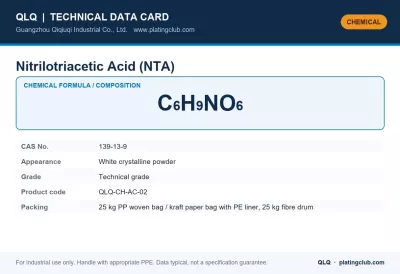
Product Identity (Encyclopaedia Card)
| Property | Value |
|---|---|
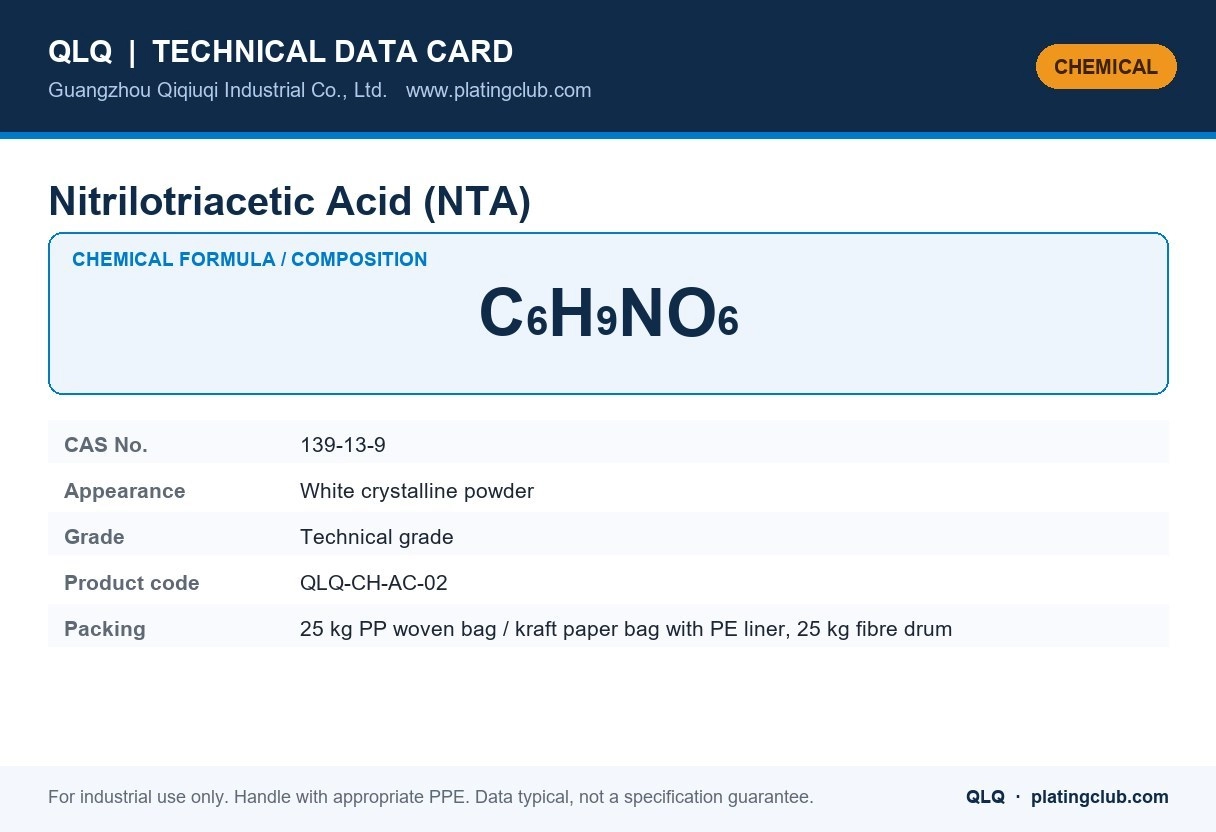
| Chemical name | Nitrilotriacetic Acid (NTA) |
| Chemical formula | C6H9NO6 |
| CAS number | 139-13-9 |
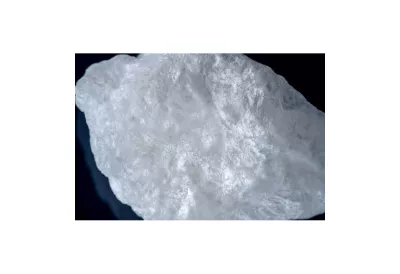
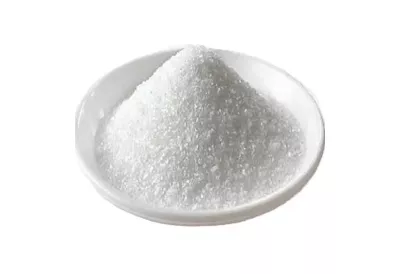
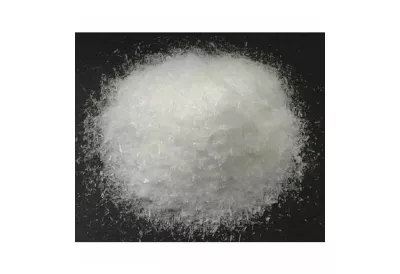
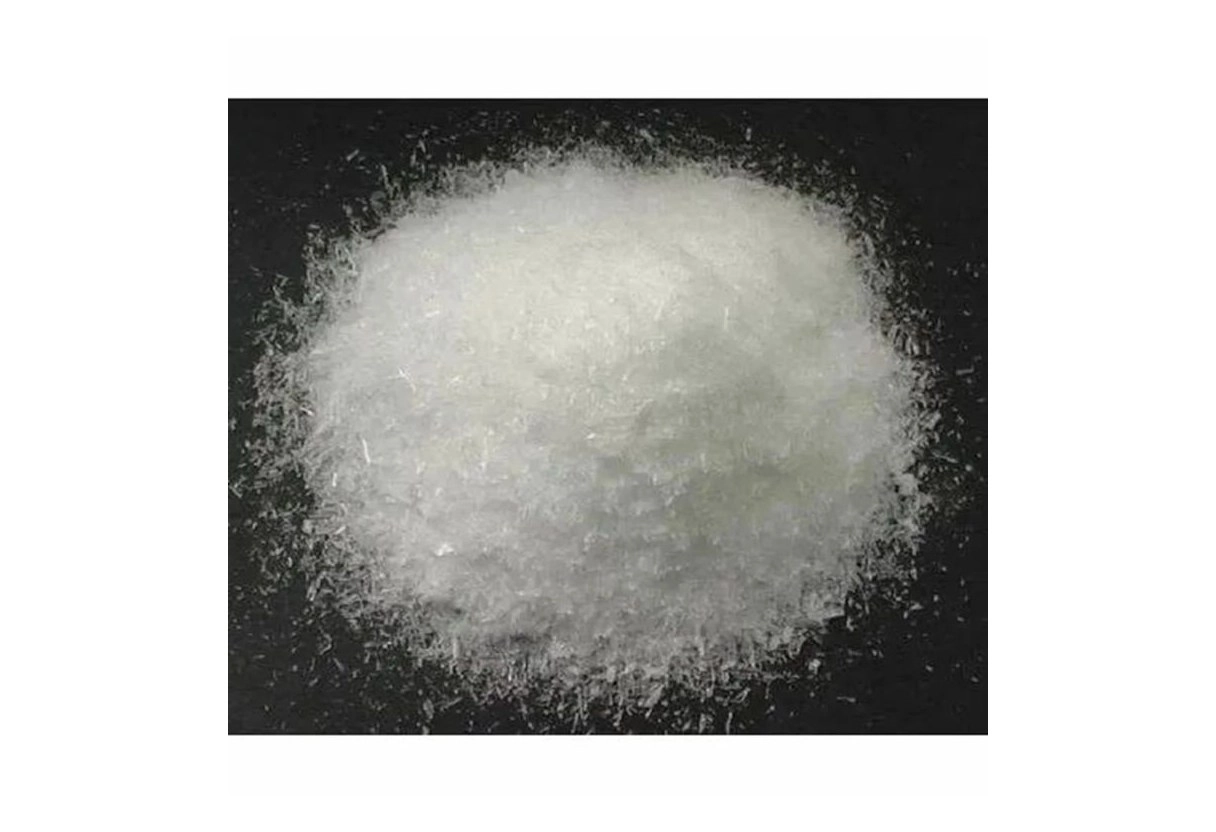
| Appearance | White crystalline powder |
| Grade / type | Technical grade |
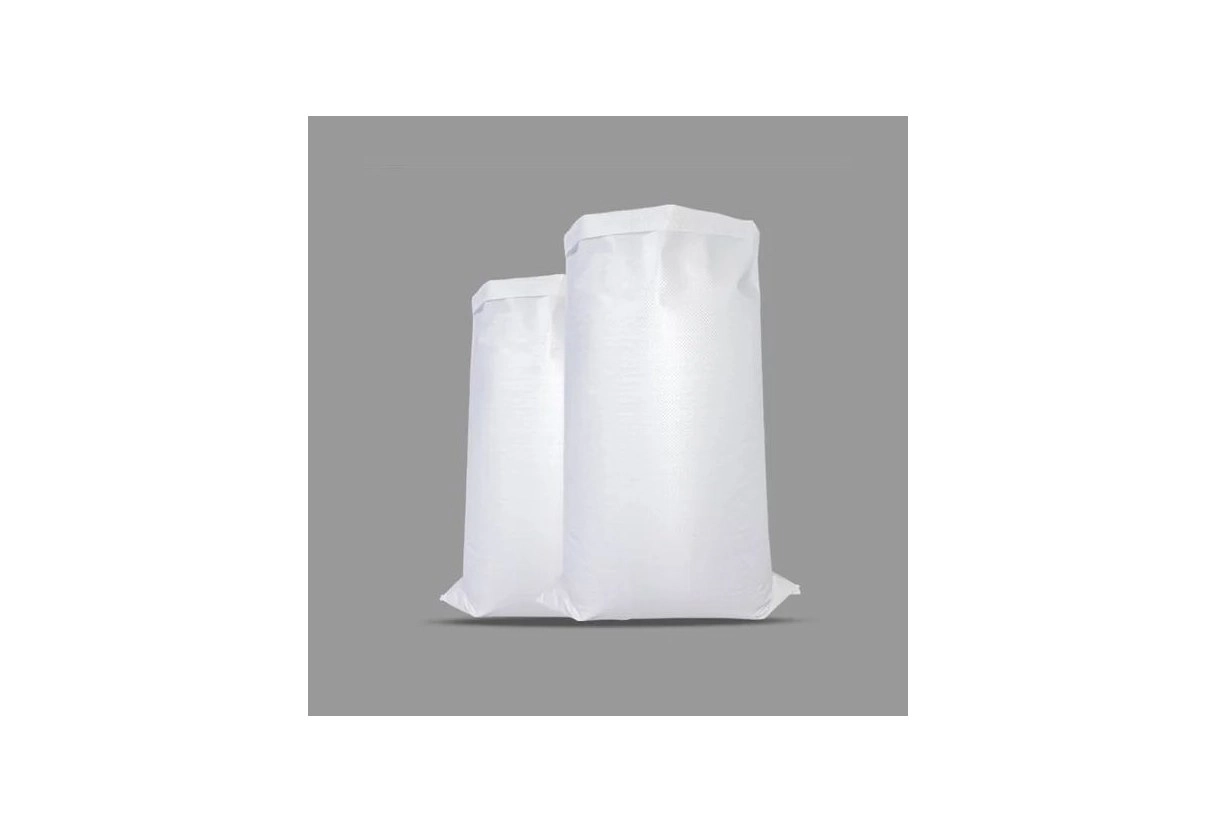
| Standard packing | 25 kg PP woven bag or kraft paper bag with PE inner liner; 25 kg fibre drum |
What it is and what it does. Nitrilotriacetic acid (NTA) is a biodegradable aminopolycarboxylic chelant used in cleaning, deoxidising and plating make-up where EDTA is either too persistent or restricted.
- White crystalline powder with a high chelating capacity for calcium, iron and copper.
- More readily biodegradable than EDTA, which is why it appears in modern cleaning formulations.
- Also used to keep iron in solution in acid cleaners so that it rinses away instead of re-depositing.
Typical Use in a Plating / Finishing Line
| Item | Typical guidance |
|---|---|
| Acid cleaning formulations | 5-30 g/L depending on the iron load expected |
| Electroless plating | As the chelant in some systems, pH and ratio per the process booklet |
Safety, Handling & Storage
| Item | Requirement |
|---|---|
| Hazard classification | Irritant (GHS07) — causes serious eye irritation |
| Personal protective equipment | Safety goggles and acid-resistant gloves; dust mask when handling powder |
| Spill / first aid | Sweep up dry powder, or dilute and neutralise small liquid spills, then rinse to the effluent treatment system |
| Storage | Cool, dry, ventilated store; keep sealed against moisture, away from alkalis and oxidisers |
| Transport | Classified and packed according to IATA/IMDG for the hazard class; UN number and packing group stated on the shipping documents |
Quality Documents Shipped With Every Batch
| Document | Comment |
|---|---|
| COA (certificate of analysis) | Provided with the shipment; batch traceable to the production date |
| MSDS (safety data sheet) | Provided with the shipment; batch traceable to the production date |
| Packing list | Provided with the shipment; batch traceable to the production date |
| Commercial invoice | Provided with the shipment; batch traceable to the production date |
| Certificate of origin on request | Provided with the shipment; batch traceable to the production date |
Buyer Questions We Answer Every Week
| Question | Answer |
|---|---|
| Can I simply swap EDTA for NTA? | The molar chelating capacity differs; the replacement ratio must be recalculated and the process re-validated. |
| Does it work in alkaline solutions? | Yes, and this is one of its advantages over many other chelants. |
| Item | Typical Value |
|---|---|
| Chemical formula | C6H9NO6 (free acid) / N(CH2COONa)3·H2O (trisodium salt) |
| Assay (acid form) | ≥ 98.0% |
| Appearance | White crystalline powder, faint odour |
| Solubility | Slightly soluble as free acid; freely soluble as sodium salt / in ammoniacal solution |
| Chloride | ≤ 0.05% (bath grade ≤ 0.02%) |
| Iron (Fe) | ≤ 0.005% |
| Heavy metals (as Pb) | ≤ 0.001% |
| Complexing strength order | EDTA > NTA > citrate (for Cu/Ni/Zn at bath pH) |
| Standard packing | 25KG woven bag with PE inner liner |
How to Check Quality Before Loading a Batch
| Check | Method | Pass Criteria |
|---|---|---|
| Appearance & colour | Visual | White, uniform crystals; grey or yellow tint indicates contamination or old stock |
| Solubility test | Dissolve 10 g acid in 100 ml DI water + ammonia to pH 9-10 | Clear solution, no cloud, no residue after 5 min |
| Assay | COA (acid-base or complexometric titration) | ≥ 98%; reject below 97% |
| Chloride check | Silver nitrate spot test on 5% solution | Only faint opalescence; heavy white precipitate = chloride too high for EN baths |
| Coupon test (EN) | Add the trial dose to a small electroless nickel bath, plate a steel coupon | Plating rate within 10% of reference; no skip-plating or loss of brightness |
How QLQ controls it: because NTA works at gram-per-litre level, small purity differences change bath behaviour noticeably. Each lot is quarantined, its COA verified against the QLQ retained reference, and a deposition-rate coupon run before release. The lot number travels with the shipment so a slow-bath complaint can be re-tested against the exact batch delivered.
How a Chelant Behaves in Electroless and Cleaning Chemistry
Nickel and copper ions precipitate as hydroxides above certain pH and as nickel phosphite during electroless plating. A chelant holds a fraction of the metal in a soluble complex, which sets the free (uncomplexed) metal ion level - the real dial that controls both bath stability and deposition rate. Too little chelant and the bath hazes or decomposes spontaneously; too much and the metal is held so tightly that the surface reaction starves and the rate falls. NTA sits in the useful middle: it gives the stability of a strong complexant with less rate suppression than EDTA, and it is often blended with lactate, glycolate or citrate in proprietary electroless nickel systems rather than used alone.
| Application | Typical role | Working range / notes |
|---|---|---|
| Electroless nickel (acid, 85-95°C) | Secondary complexant / stabilizer alongside lactate or citrate | 1-10 g/L; raise if nickel phosphite haze appears, cut back if rate falls below target |
| Electroless nickel (ammoniacal, on Al / Zn) | Complexant holding Ni without attacking active substrates | 5-15 g/L in ammonium-based systems; keep pH 8.5-10 as specified |
| Electroless copper (formaldehyde type) | Co-complexant with EDTA/tartrate in trial and low-build systems | 5-20 g/L as partial EDTA replacement; verify on test panels first |
| Soak / ultrasonic cleaners | Sequesters Ca, Fe, oxide metals from hard water and soils | 1-5 g/L in alkaline cleaner blends, pH 9-12 |
| Scale / oxide removal baths | Chelant cleaning of iron and calcium scale on equipment | 2-20 g/L at pH 9-11, warm, with inhibitor check for steel tanks |
These are published starting ranges, not universal recipes - proprietary electroless systems specify their own complexant blends, so confirm with the process supplier before altering a working bath. The universal rule: change one variable, verify with a coupon.
Common Problems & Fixes (Workshop Table)
| Problem | Root cause | Fix |
|---|---|---|
| EN bath hazes or plates rough | Under-complexing: chelant too low for the metal loading, phosphite precipitating | Analyse nickel; raise complexant blend within process limits; reduce metal drag-in |
| Plating rate suddenly slow | Over-stabilization from chelant (or stabilizer) build-up during replenishment | Verify free-metal level; reduce complexant additions, raise temperature 2-3°C, check pH |
| Skip-plating / gas streaking on parts | Too much stabilizer/chelant combined with poor pre-treatment wetting | Improve activation, lower complexant to spec, check for organic drag-in from cleaners |
| Electroless copper fails to start on plastic | Over-complexed copper: free Cu too low for the catalyst | Cut chelant to the minimum stable dose; verify catalyst/accelerator step |
| Cleaner leaves white film on parts | Calcium soap / scale re-depositing because chelant dose too low for water hardness | Raise NTA level or switch to a harder-water cleaner blend |
Handling & Safety
- Health: NTA dust irritates eyes and airways; handle the powder with a dust mask and gloves. Some countries classify NTA as a suspected carcinogen for detergent use - it is strictly an industrial chemical, never a food-contact additive.
- Dissolving: the free acid is acidic and barely soluble in plain water. Dissolve it in water while adding ammonia or caustic (with stirring, in a ventilated area) to make a 20-30% stock solution at pH 7-9; never dump dry acid powder into an operating electroless bath.
- Dosing: chelants are dose-critical at g/L or ppm level. Add via calibrated stock solution, never by scoops, and record every addition.
- Storage: keep bags sealed and dry. The acid form is stable and does not decompose in storage, but moisture pick-up makes weighing inaccurate.
- Waste: chelated metals do not settle out in simple hydroxide treatment - the complex holds Ni/Cu in solution, so effluent pH adjustment alone may not meet discharge limits. Use a strong oxidizing break or sulfide/polishing step, and confirm your local limit for chelated metals.
- Incompatibility: keep away from strong oxidizers (hypochlorite) - NTA solutions are eventually biodegradable but react with chlorine-based bleaches.
What It Does on Iron, Zinc Alloy, Copper and Stainless Steel Parts
| Substrate | How NTA chemistry serves the part | Practice note |
|---|---|---|
| Iron / steel parts | In EN the stabilized bath gives a uniform Ni-P barrier layer on complex steel geometry without anodes or current-density effects | Activate steel properly (acid dip); keep complexant in spec or corrosion protection scatters |
| Zinc alloy die-castings | Ammoniacal NTA-nickel systems can plate zinc alloys that would dissolve in acid electroless baths | Low pH and short dwell; verify adhesion by heat-quench test before production |
| Copper / brass | In electroless copper the complexant holds Cu ions so the catalytic layer builds only where designed - no stray immersion plate | Balance chelant vs stabilizer; copper loading swings are the first suspect when skip-plate appears |
| Stainless steel | NTA-based descaling/chelant rinses lift iron oxide smut without the pitting of strong inhibited acids on passivated surfaces | Use warm alkaline chelant step before acid pickle to shorten etch time |
FAQ
| Question | Answer |
|---|---|
| Can NTA simply replace EDTA in my electroless copper bath? | Not by weight and not one-for-one. EDTA binds copper much harder, so replacing it with NTA raises the free-copper level and bath stability changes. Work out the molar equivalent, re-test rate and stability on coupons, and expect to re-balance the stabilizer. |
| Why does my EN bath slow down after I add more complexant to cure haze? | Because free nickel falls as chelant rises. Haze and rate fight each other through the same dial. Raise the complexant only enough to clear the haze, then confirm the rate - and check that nickel metal itself has not drifted low. |
| Which form should I buy - acid or trisodium salt? | If the line already uses ammonia or caustic for pH, the free acid is fine and costs less per mole. If you dose into a neutral stock tank, the sodium salt dissolves directly. Match the form to your make-up habit and dose by moles either way. |
| Does QLQ help with chelant troubleshooting? | Yes - every shipment carries a COA, and QLQ engineers support electroless and cleaner lines in 10+ countries with coupon-test procedures and remote diagnosis from photos and analysis sheets. |
Bath stability or rate trouble? Send QLQ your analysis values and a test coupon photo - engineers check complexant balance, free metal and stabilizer levels and return a step-by-step correction. Contact us.
Shipping cost is based on weight. Just add products to your cart and use the Shipping Calculator to see the shipping price.We want you to be 100% satisfied with your purchase. Items can be returned or exchanged within 30 days of delivery.