Product Overview
1,2,3-Benzotriazole (BTA, C6H5N3) is the plating industry's standard anti-tarnish and corrosion-inhibition agent for copper and its alloys. A single BTA molecule is small enough to pack tightly on a copper surface, where it forms a transparent, self-repairing film only a few nanometers thick that stops oxygen, humidity and sulfur gases from reaching the metal. In a hardware plating line BTA earns its place in three everyday situations: protecting freshly copper-plated work that must wait before nickel (overnight racks, weekend barrels), stopping tarnish on brass and copper-tone finishes during storage and export packing, and acting as a functional component inside proprietary copper brighteners and process coolants. Market grades: technical BTA at ≥ 99% assay is the plating norm; cheaper grades carry higher sodium sulfate and organics that leave films or foam. BTA is directly water-soluble in warm water (about 2% at 25°C), which makes it far easier to handle than the alkali-soluble sulfur azoles.
Product Identity (Encyclopaedia Card)
| Property | Value |
|---|
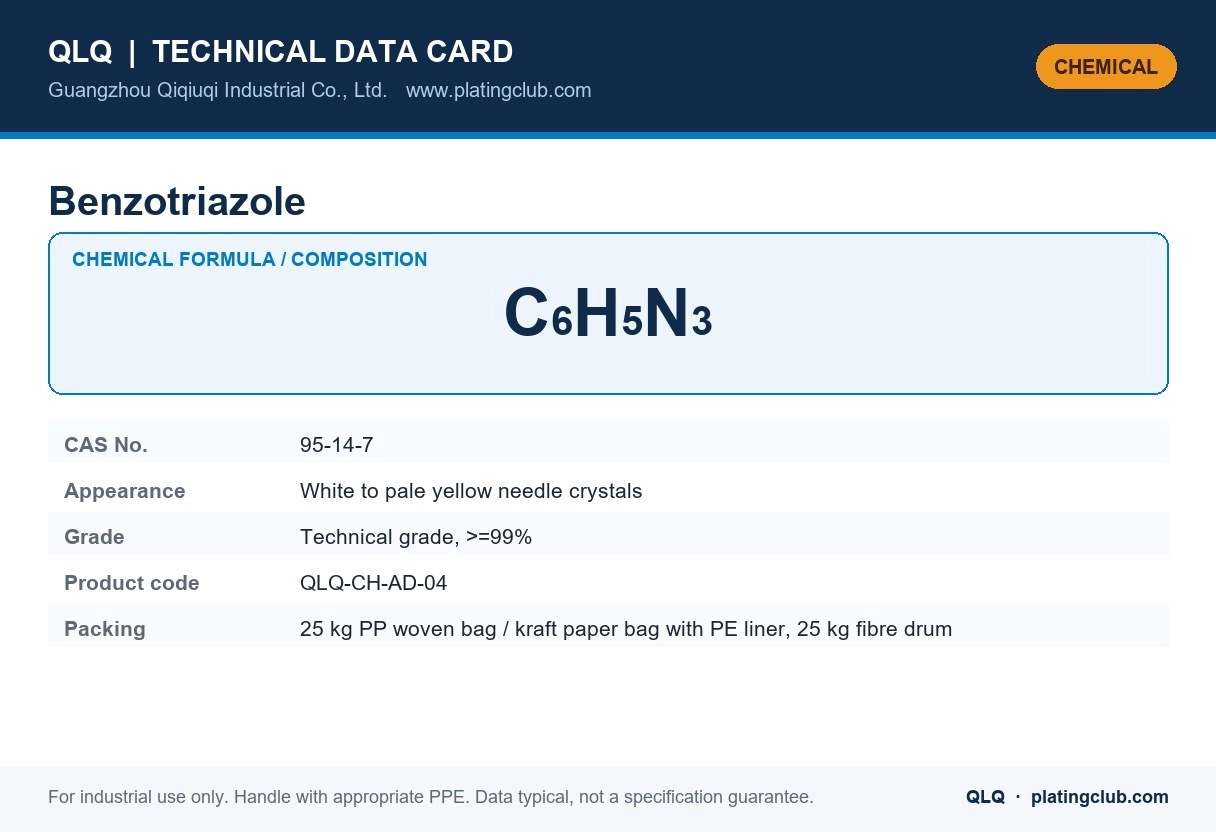
| Chemical name | Benzotriazole |
| Chemical formula | C6H5N3 |
| CAS number | 95-14-7 |
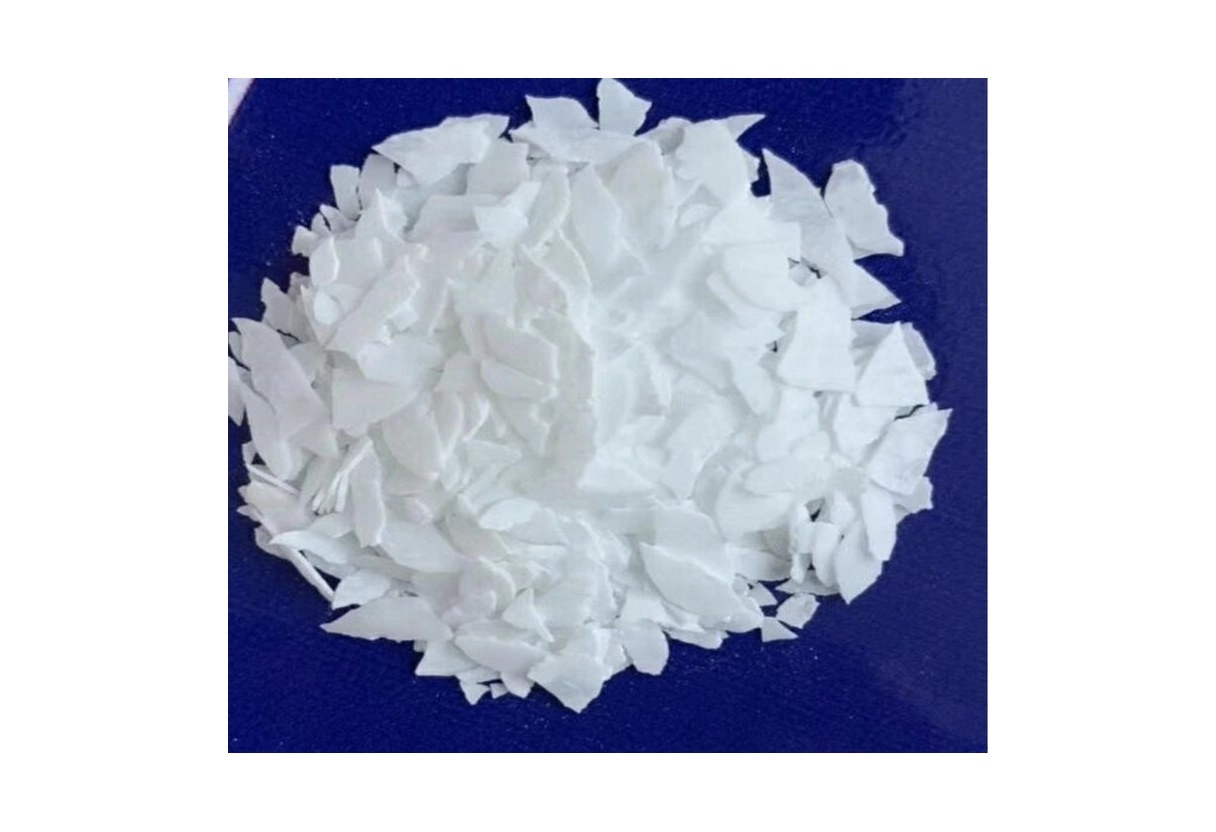
| Appearance | White to pale yellow needle crystals |
| Grade / type | Technical grade, >=99% |
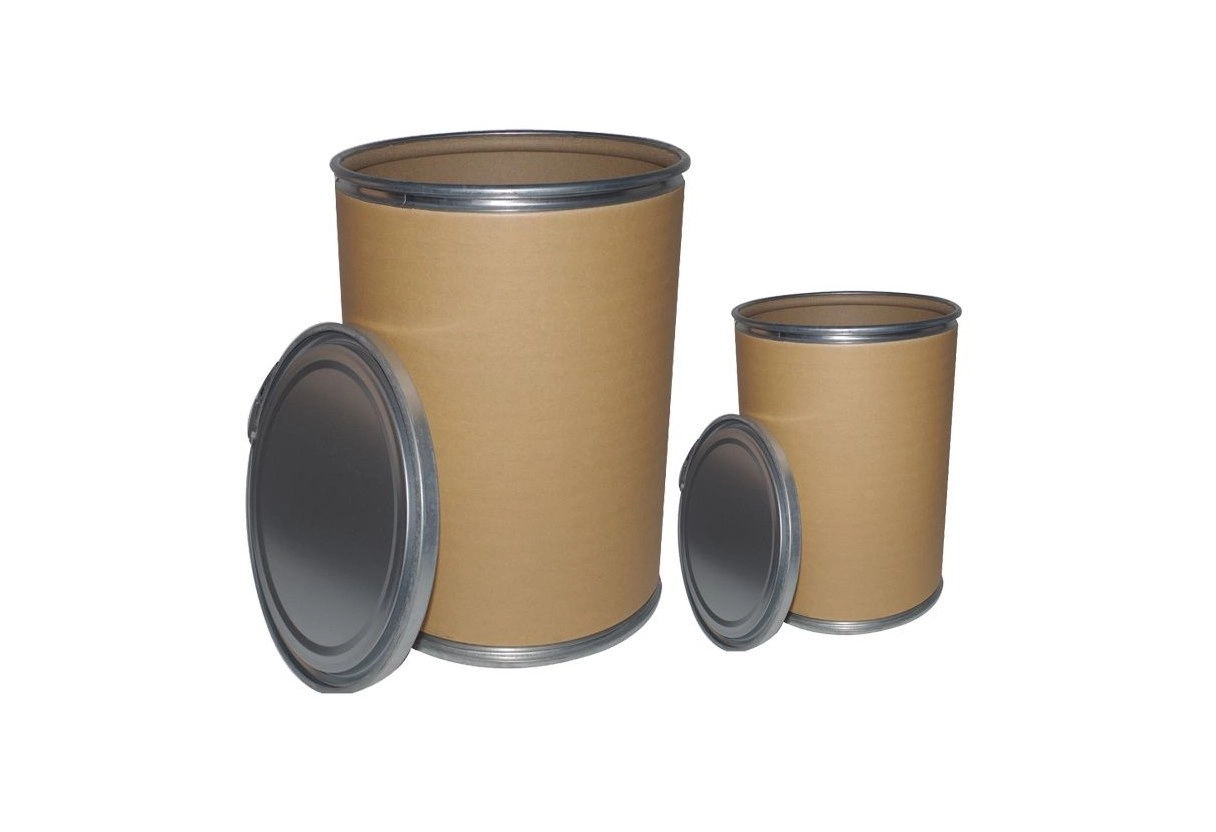
| Standard packing | 25 kg PP woven bag or kraft paper bag with PE inner liner; 25 kg fibre drum |
What it is and what it does. Benzotriazole (BTA) is the copper corrosion inhibitor added to acid copper baths, to passivation rinses and to lacquer formulations, where it forms a protective film on the copper and zinc surface.
- White to pale yellow needle crystals; used at 20-200 mg/L in rinses and at low mg/L in plating baths.
- Forms a chemisorbed film on copper and on zinc that stops tarnishing and reduces staining of the plated parts.
- Also used in cooling-water treatment and in anti-tarnish papers and lacquers.
Typical Use in a Plating / Finishing Line
| Item | Typical guidance |
|---|
| Anti-tarnish rinse | 0.5-2 g/L at pH 5-6, 30-60 seconds |
| Copper bath additive | 1-50 mg/L |
| Note | Dissolve in a small amount of warm water or alcohol before addition |
Safety, Handling & Storage
| Item | Requirement |
|---|
| Hazard classification | Not classified as dangerous for transport in most cases; observe good industrial hygiene and dust control |
| Personal protective equipment | Dust mask, goggles and gloves for powder handling; general ventilation |
| Spill / first aid | Sweep up dry; material is a nuisance dust — avoid breathing the dust |
| Storage | Cool, dry, sealed store; keep bags closed, off the floor and away from moisture |
| Transport | Classified and packed according to IATA/IMDG for the hazard class; UN number and packing group stated on the shipping documents |
Quality Documents Shipped With Every Batch
| Document | Comment |
|---|
| COA (certificate of analysis) | Provided with the shipment; batch traceable to the production date |
| MSDS (safety data sheet) | Provided with the shipment; batch traceable to the production date |
| Packing list | Provided with the shipment; batch traceable to the production date |
| Commercial invoice | Provided with the shipment; batch traceable to the production date |
| Certificate of origin on request | Provided with the shipment; batch traceable to the production date |
Buyer Questions We Answer Every Week
| Question | Answer |
|---|
| How long does the anti-tarnish effect last? | Weeks to months indoors depending on the humidity; for long storage combine it with a lacquer. |
| Does it affect the colour? | At the recommended concentration it forms a monolayer that is visually invisible; overdosing can leave a haze. |
| Item | Typical Value |
|---|
| Chemical identity | 1,2,3-Benzotriazole, C6H5N3 |
| Appearance | White to off-white crystalline powder |
| Assay | ≥ 99% |
| Melting point | 96-100°C |
| Solubility | Soluble in hot water, ethanol, chloroform; ~20 g/L in water at 25°C |
| pH (1% solution) | 5.5-7.5 |
| Ash | ≤ 0.1% |
| Standard packing | 25KG/DRUM, PE-lined |
How It Works: BTA Film Formation and Its Limits
BTA chemisorbs on copper and brass through its triazole ring and cross-links into a protective polymer film. Because the bond forms and repairs continuously at room temperature, a BTA dip does not need heat to work - but temperature and pH control decide whether the film is thick and uniform or patchy:
| Condition | Effect on protection |
|---|
| 1-3 g/L, 50-60°C, 1-3 min (normal) | Uniform barrier; passes H2S-vapor and humidity testing |
| Cold bath (20-30°C) | Film forms but slower; extend immersion to 3-5 min |
| pH below 4 in the dip | Film thins; acid attacks copper and defeats protection |
| Above 80°C | No benefit - film stability drops; keep baths below 70°C |
| Bath loaded with oils/soils | Soil blocks adsorption - patchy film, localized tarnish |
Standard verification is the same sulfur-vapor test used across the industry: a treated panel must stay bright over 30 minutes in dilute ammonium-sulfide vapor while an untreated panel darkens within minutes.
Working Concentrations on the Line
| Application | Concentration | Notes |
|---|
| Inter-process dip (copper before nickel) | 1-2 g/L, 50-60°C, 30-120 s | Prevents edge tarnish on work held overnight; rinse before nickel |
| Final copper/brass anti-tarnish | 1-3 g/L, 40-60°C, 1-3 min | Optional silicate or wax top for export |
| Barrel copper rework protection | 1 g/L, ambient, 2-5 min | Cold bath needs longer time |
| Coolant / grinding additive | 0.05-0.2% | Stops copper staining in water-based coolants |
| Brightener formulation raw material | per blender | Component in copper additive packages |
BTA is consumed almost entirely by drag-out. A dip tank that plates a known surface area loses roughly 5-15 g per 1000 dm² of work; top up to keep the measured concentration, and carbon-polish the tank monthly to remove oils that block film formation.
Quality Checks Before Use
| Check | Method | Pass |
|---|
| Appearance | Visual vs retained sample | White free-flowing powder; no yellowing or caking |
| Assay | COA (HPLC) | ≥ 99% |
| Melting point | Melting-point apparatus | 96-100°C (narrow range = pure) |
| Solubility | 20 g in 1 L warm water | Clear solution; no film or residue |
| H2S vapor test | Copper panel dipped, then ammonium-sulfide vapor | No darkening for 30 min vs control |
How QLQ controls it: every lot is assay-verified and H2S-vapor tested on copper panels against a retained reference before release. Because a contaminated BTA lot (high sulfate, organics) shows up first as patchy tarnish on a customer's parts, the batch number travels with each drum and QLQ keeps a retained sample for 12 months for re-testing.
Common Problems & Fixes (Workshop Table)
| Problem | Root cause | Fix |
|---|
| Patchy tarnish after dip | Oils/soils on parts or bath loaded with drag-in | Clean before dip; carbon-polish bath; filter continuously |
| Film fails H2S test | Dose low, bath cold, or time too short | Verify 1-3 g/L by analysis; heat to 50-60°C; 1-3 min |
| White deposit on dried parts | Over-dosed bath or hard water salts | Cut to 1-2 g/L; use softened/DI water for make-up |
| Copper darkens after hot-air drying | Parts dried above ~80°C or too long before rinsing | Dry below 70°C; rinse before drying to remove excess BTA |
| Nickel skips on copper after BTA dip | Film too heavy - no acid desmut between dip and nickel | Add dilute acid dip (3-5% H2SO4, 15-30 s) before nickel |
Handling & Safety
- Health: BTA is a mild irritant; wear gloves and a dust mask when weighing, and avoid inhaling the powder. Wash hands after handling.
- Fire note: BTA is combustible as a dust - keep away from open flame and strong oxidizers; do not sweep into a dusty bin near ignition sources.
- Dissolving: add to warm water (50-60°C) with stirring; stock solutions of 5-10% are convenient for dosing. Do not boil - BTA sublimes slowly above 100°C.
- Storage: sealed drums in a cool, dry store. BTA is stable for 24 months sealed; protect from humidity and direct sun.
- Waste: dilute BTA dips are biodegradable, but used baths carry copper - treat as metal-bearing waste or recover the copper before discharge.
What It Does on Iron, Zinc Alloy, Copper and Stainless Steel Parts
| Substrate | Role / behavior of BTA | Practice note |
|---|
| Copper / brass parts | Direct anti-tarnish - protects the classic copper, brass and copper-tone finishes during storage and export | The standard application; 1-3 g/L at 40-60°C |
| Zinc alloy (sliders, buckles) | Keeps the copper underlayer of Cu-Ni-Cr stacks bright while parts queue for nickel and chrome | Short dip after copper; full rinse + acid dip before nickel to avoid skip-plating |
| Iron / steel hardware | Protects copper-plated steel against humidity staining before lacquer, packing or shipment | BTA film plus lacquer gives the humidity margin export buyers audit |
| Stainless steel | No film forms on bare stainless - no benefit; relevant only over a copper flash | Skip on bare stainless; use for copper-flashed stainless decorative work |
FAQ
| Question | Answer |
|---|
| Does BTA work on zinc or nickel plate? | Not effectively - BTA's protective film is specific to copper and its alloys (and somewhat to silver). Zinc and nickel need chromate/passivate routes, not BTA. |
| My parts tarnish two weeks after export. Was BTA useless? | Check dose, bath loading and the dry-off step first. Patchy films from soiled baths or over-hot drying are the usual causes - a properly formed BTA film survives weeks of humid packing. |
| Can I add BTA to the final rinse instead of a separate dip? | Yes, at 0.5-1 g/L in the last hot rinse, but control is harder and film thickness varies. A dedicated dip tank gives reproducible protection and is easier to analyze. |
| Does QLQ help with anti-tarnish system design? | Yes - BTA, MBI and matched concentrates ship with COAs, and QLQ engineers help set up dips, H2S-vapor testing and the rinse/desmut sequence before nickel. |
Copper finish tarnishing in humid weather or export? QLQ engineering runs H2S-vapor testing and humidity trials for plating customers in 10+ countries. Contact us with a sample of the failing part.