

Professional Zinc Alloy Surface Finishing Solutions
Fosfatare
Zinc Phosphating — The Complete Pretreatment for Painting & E-Coating
How a zinc phosphate conversion coating improves paint adhesion, corrosion resistance and wear life. Full process parameters, testing and troubleshooting.
Why Phosphate?
A 1.5–3.0 g/m² phosphate crystal layer changes everything for painted parts
▼
The 6-Stage Phosphating Line
Every stage matters — phosphating is a chain, and the weakest link decides quality
1Degreasing
Alkaline or acid degrease to remove oil, grease and surface contamination. Phosphating can't nucleate on oily surfaces — this step is make-or-break.
Key Parameters
Temp: 60–70 °C
Time: 3–5 min
2Water Rinse
Counter-current overflow rinse to remove chemical carry-over. Two-stage: first running water, then DI. Any drag-in of degreaser into the phosphate bath destabilizes the solution.
Key Parameters
Stages: 2 (running + DI)
pH target: 6.5–7.5
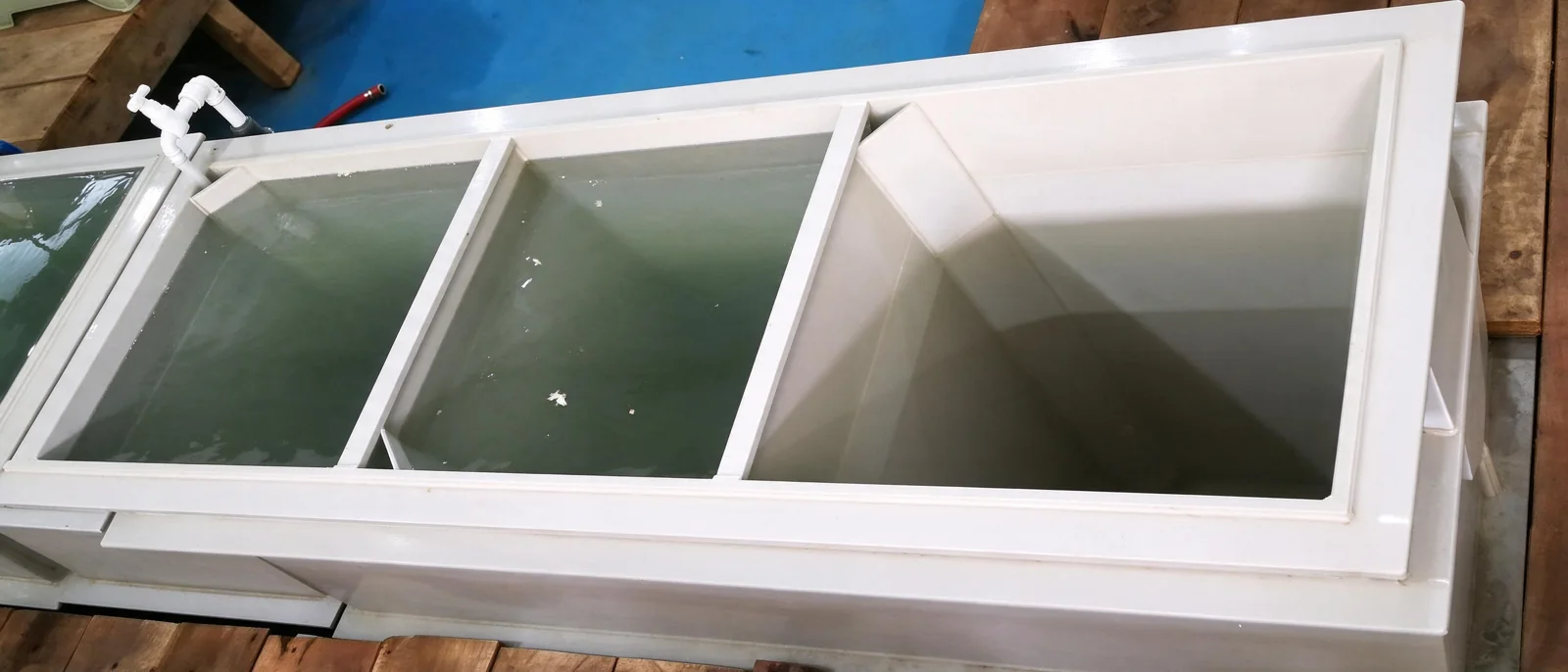 Conceptual illustration based on reference photographs; not test evidence.
3Surface Conditioning (Activation)
Titanium phosphate colloidal solution. Creates nucleation sites for uniform phosphate crystal growth. Without this step: coarse, patchy crystals. With it: fine, dense, uniform coating.
Key Parameters
Time: 30–60 s
Temperature: Room temp
Purpose: Nucleation activation
4Zinc Phosphating
Zinc phosphate bath (Zn²⁺, PO₄³⁻, NO₃⁻, Ni²⁺). Acidic pH 2.5–3.0 at 35–45 °C. Zinc alloy reacts with phosphoric acid to form crystalline Zn₃(PO₄)₂·4H₂O (hopeite). 3–5 min. Coat weight 1.5–3.0 g/m².
Key Parameters
Bath: Zinc phosphate (Zn²⁺)
Temp: 35–45 °C
Time: 3–5 min
Coat weight: 1.5–3.0 g/m²
5Final Water Rinse
DI water rinse to remove soluble phosphate salts. Salt residue on the surface causes osmotic blistering under paint. Hot DI (50–60 °C) speeds drying.
Key Parameters
Water quality: < 10 μS/cm
Temp: 50–60 °C
6Drying
Hot air drying at 100–120 °C for 5–10 min. Phosphate crystals are porous and hydrate easily — drying below 100 °C leaves bound water that outgasses during paint curing.
Key Parameters
Temp: 100–120 °C
Time: 5–10 min
▼
Phosphating Specifications
What we measure and guarantee on every batch
| Parameter | Target | Test Method | Frequency |
|---|---|---|---|
| Coating weight | 1.5–3.0 g/m² | Gravimetric (weigh strip) | Every batch |
| Crystal size | 3–10 μm | Microscopy (200×) | Daily |
| CuSO₄ spot test | ≥ 30 seconds | Copper sulfate drip | Every batch |
| Bath pH | 2.5–3.0 | pH meter | Every 2 hours |
| Bath temperature | 35–45 °C | Thermocouple | Continuous |
| Free acid (FA) | 8–12 points | Titration | Every 4 hours |
📌 Zinc Phosphating Quick Reference
Bath temp35–45 °C
Phosphating time3–5 min
Coating weight1.5–3.0 g/m²
CuSO₄ test (min)≥ 30 seconds
Bath pH range2.5–3.0
Applicable beforeSpray, e-coat, powder
💡 CuSO₄ spot test explainedA drop of copper sulfate solution on the phosphate surface. If the drop stays clear/blue for ≥ 30 seconds, the phosphate coating is dense enough. If it turns black (copper deposition) faster, the coating is too thin or porous — reject and re-run.
FAQ
What is the difference between zinc phosphating and iron phosphating?
Zinc phosphating (Zn₃(PO₄)₂) forms a heavier coating (1.5–3.0 g/m²) with better corrosion resistance. Iron phosphating gives a lighter film (0.3–0.8 g/m²) and is mainly used for indoor parts. For e-coat and spray paint, zinc phosphating is the standard.
Can you paint directly over phosphate without primer?
Yes — phosphate crystals provide mechanical keying for paint. Many e-coat and powder coating systems go directly over phosphate. For high-gloss wet paint, a primer layer is still recommended.
How long can phosphated parts sit before painting?
Phosphate is porous and absorbs moisture. Maximum hold time: 24 hours in dry storage (< 50% RH). Beyond 24 hours, the surface should be dehumidified or re-activated with a light phosphoric acid wipe.
What causes powdering (white dust) on phosphated parts?
Loose crystalline deposits — typically caused by high bath temperature (> 50 °C), high free acid (> 14 points), or insufficient surface conditioning. The fix: check and adjust bath parameters, and ensure the activation bath is fresh.
Is phosphating suitable for stainless steel?
No — stainless steel does not react with phosphate chemistry. For stainless steel, use passivation or electrolytic treatment. Phosphating is designed for steel, zinc alloy, and galvanized surfaces.
Phosphating Bath — Working Ranges (Quick Reference)
This reference concerns immersion zinc phosphating of steel. The requested formulation values below are provisional starting targets, not a validated production recipe. Confirm the chemical grade, bath supplier's analytical procedure and coating trials before make-up or replenishment. Do not apply these settings automatically to zinc-alloy hardware.
| Parameter | Range | Typical | Test method |
|---|---|---|---|
| Zn2+ | Supplier-specific; requires confirmation | Set from the approved bath specification; not from salt make-up alone | Supplier-approved zinc analysis, such as a validated complexometric or instrumental method |
| H3PO4 (free acid) | 3–5 free-acid points, provisional | 4 points, provisional midpoint | Free-acid titration using the supplier's specified sample volume, titrant strength and endpoint; not a direct H3PO4 concentration in g/L |
| Total acid | 25–35 total-acid points, provisional | 30 points, provisional midpoint | Total-acid titration using the same approved point definition and the prescribed total-acid endpoint |
| Accelerator (NaNO2) | 1–2 g/L requested make-up; operating residual requires confirmation | Do not assume the make-up dose equals the working residual | Supplier-approved nitrite assay; report the result as NaNO2, nitrite ion or accelerator points exactly as specified |
| Temperature | 55–65 °C requested starting window; QLQ general reference: 40–60 °C | 60 °C, provisional trial target | Calibrated immersed probe at the working zone; check variation across the tank under load |
| Time | 5–15 min | 10 min, trial midpoint | Timed immersion after complete wetting; confirm coating performance on representative steel coupons |
| Coating weight | 1–5 g/m2, QLQ general reference | Requires confirmation against the paint and substrate specification | Validated gravimetric stripping method: coating mass loss divided by the total coated area |
Acid points are method-dependent titration results, not g/L. Different suppliers' point values are not interchangeable. Free acidity measures the bath's acid demand under the specified test; it is not a selective assay of phosphoric acid alone.
Starting Formulation (Zinc Phosphate, Immersion)
Starting-point formulation — adjust per steel type and coating weight target
| Component | Make-up (g/L) | Control/Replenishment |
|---|---|---|
| Zn(H2PO4)2 | 40–60, provisional | Confirm hydrate form, assay and whether this denotes pure salt or a formulated concentrate. Replenish only against approved zinc and acidity analyses; do not calculate additions from drag-out alone. |
| Total acid | Not a make-up concentration | Requested target: 25–35 points. Confirm compatibility with the zinc salt dose and the approved titration method. |
| Free acid | Not a make-up concentration | Requested target: 3–5 points. Adjust only by the supplier's procedure after checking total acid and bath balance. |
| NaNO2 | 1–2, provisional; approval required before dosing | Confirm that this is the intended make-up basis, not accelerator points or a concentrate dose. Establish the permitted operating residual by assay; make controlled additions only under the approved procedure. |
| Temperature | Not applicable | Requested starting target: 55–65 °C. QLQ's general reference is 40–60 °C; operation above that reference requires supplier approval and coupon validation. |
| Time | Not applicable | 5–15 min. Select the validated dwell time from coating weight, coverage and subsequent paint-performance results. |
These rows combine chemical make-up values with operating controls; they must not all be interpreted as g/L additions. The requested salt, acidity and nitrite values have not been confirmed as one compatible bath formulation.
Engineer Notes — What Goes Wrong in Practice
- Sludge control: Trend sludge generation against processed area, temperature, free acid, zinc and nitrite results. Remove settled solids using the approved settling, filtration or tank-cleaning procedure; avoid stirring bottom sludge onto parts. A sudden increase calls for a bath-balance investigation, not extra accelerator.
- Excess free acid and powdery coatings: If a film rubs off or becomes powdery, check free and total acid together, then inspect temperature, accelerator, surface activation and sludge carry-over. High free acid can upset deposition, but powdering alone does not prove excessive acidity. Do not add neutralizer solely from appearance.
- Low temperature and thin films: Check the actual working-zone temperature under production load when coating weight is low. Compare it with the approved bath window, confirm immersion time and test representative coupons before changing dwell time or chemistry.
- Residual oil and missed coverage: Check for a continuous water film after cleaning and rinsing. Beading or water breaks indicate inadequate wetting and possible residual contamination. Correct cleaning and rinse carry-over before phosphating; increasing bath strength will not reliably correct an oily surface.
- Accelerator testing frequency: NaNO2 is a nitrite accelerator, not nitrate. Use the nitrite test specified for this bath. Establish testing frequency from measured depletion during production, and retest after approved additions or major load changes. Do not substitute a nitrate result or an unvalidated fixed dosing schedule.
Nitrite accelerator is an oxidizer — dosing above range causes excessive sludge and pinholes.
The applicable range must be the supplier-approved operating limit, not the provisional make-up entry above. Sludge and coating defects depend on the complete bath balance; the warning is not a diagnostic rule. Follow the current safety data sheet and approved handling procedure.
Reference basis: the supplied enhance_pretreatment_phosphating.txt defines the provisional recipe targets. QLQ knowledge-base file 02-Product Knowledge / IMA Company Knowledge Split / 035_Process Steps provides the general steel-phosphating temperature, time and coating-weight ranges. For formulation-specific effects on sludge, see Sludge reducing zinc phosphating process and composition; its results are not a validation of the requested recipe.
Get a Free Quote Today
Send us your samples or drawings — our engineers reply within 24 hours with pricing and technical advice.
Contact Us