
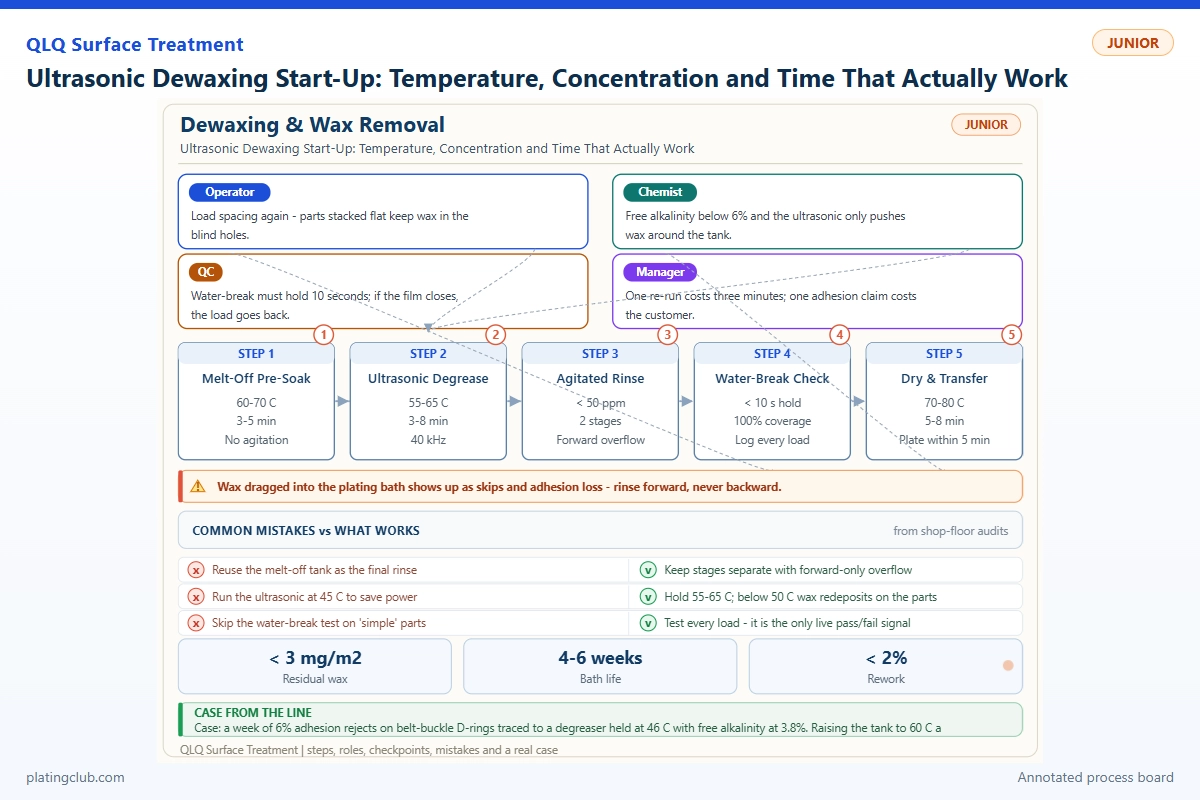
Starting an ultrasonic dewaxing tank is a fifteen-minute job that decides the next four weeks of adhesion performance. These are the start-up numbers, the first-load test, and the three signs that tell you the tank is already drifting.
15-20 min
Start-up time
<= 60%
Load factor
Water-break 10 s
First-load gate
Start-up parameter sheet
| Parameter | Target | Range that still works | Why it matters |
|---|---|---|---|
| Bath temperature | 60 C | 55-65 C | Below 50 C wax re-deposits |
| Free alkalinity | 7.5% | 6-9% | Emulsifies the wax, keeps it suspended |
| Ultrasonic frequency | 40 kHz | 28-40 kHz | 28 kHz hits heavy compound, 40 kHz cleans blind holes |
| Detergent dose | per maker sheet | +/-10% | Overdose leaves a film that blocks the rinse |
| Load factor | 50-60% | <= 60% | Shadowed parts never see cavitation |
First-load test (do this before production parts)
| Step | What you do | What pass looks like |
|---|---|---|
| 1 | Clean a scrap part in solvent by hand | Wipe test: cloth stays white |
| 2 | Run it through the new tank | No difference vs the hand-cleaned part |
| 3 | Water-break the part | Film holds 10 s across the whole surface |
| 4 | Dry and inspect under D65 light | No dull patches, no tacky feel |
Tank drift: the three early warnings
| Signal | What it means | Action |
|---|---|---|
| Loads take longer to break water | Wax building up in the bath | Skim, filter, top up alkalinity |
| Foam on the surface | Detergent overdose or oil load | Reduce dose, add a weir skimmer |
| Parts come out warm and tacky | Rinse stages too cold or too slow | Warm the first rinse, increase overflow |
Watch out
Never take a new tank straight into a customer order. The first-load test costs one scrap part; a bad start costs the whole first week of production.
Common mistakes and the fix
| ✗ Fill the tank while it is cold | ✓ Heat first, then dose, then load |
| ✗ Judge the tank by temperature only | ✓ Check free alkalinity and water-break as well |
| ✗ Run the ultrasonic dry of the load schedule | ✓ Write the schedule on the tank: time, temp, load |
| ✗ Ignore the rinse stages | ✓ The rinse removes what the tank lifted - keep it overflowing |
What each role watches
| Operator | "Load within the marked line; the line is there because shadowed parts fail." |
| Chemist | "Titrate free alkalinity at start-up and after every top-up." |
| QC | "First-load test signed off before production starts." |
| Manager | "Keep one scrap part as a reference: it beats every argument about 'clean'." |
From the shop floor
Case: a new 600 L tank started at 48 C with 5% alkalinity. The first week looked normal, the second week produced a 4% adhesion reject rate. Start-up at 60 C and 7.5% removed it completely.
FAQ
How often should the ultrasonic tank be rebuilt?
Typically every 4-6 weeks in single-shift operation; sooner if you see foam or the water-break time climbing.
Is 28 kHz better than 40 kHz?
28 kHz is more aggressive and better for heavy compound; 40 kHz reaches blind holes better. Most small-hardware shops run 40 kHz.
Can I use the same tank for aluminium parts?
Not without checking compatibility - alkaline degreasers attack aluminium. Keep tanks dedicated.
Where to go next
- Level guide for this trade: Dewaxing & Ultrasonic Cleaning — technician levels
- Other levels: Intermediate, Senior, Management
- Owner view: Process Overview for owners
- Supplier view: Chemistry & Supply · Find content by trade + level