
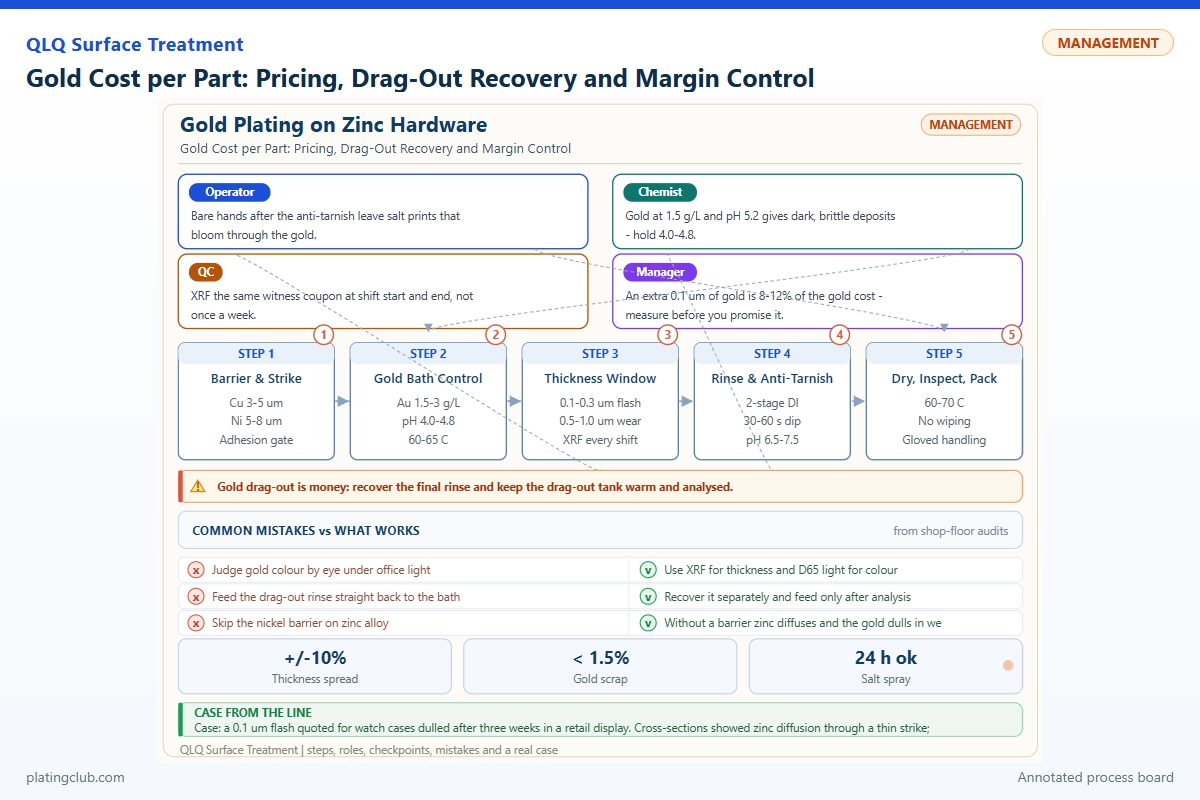
Gold is the only input on a plating line that is priced by the gram and quoted by the micron. Management that measures drag-out and scrap recovery turns a volatile cost into a controllable one.
85-95%
Gold recovery
5-15%
Drag-out share
18-25%
Margin floor
Gold cost per 1,000 parts by thickness (0.5 dm2 per part)
| Thickness | Gold volume | Gold cost index | Comment |
|---|---|---|---|
| 0.1 um | 0.005 cm3 | 1.0 | Display |
| 0.3 um | 0.015 cm3 | 3.0 | Fashion |
| 0.5 um | 0.025 cm3 | 5.0 | Standard wear |
| 1.0 um | 0.050 cm3 | 10.0 | Heavy wear |
Where gold is lost and how much you can get back
| Loss path | Typical share | Recovery method | Recovered |
|---|---|---|---|
| Drag-out in rinse | 5-15% | Static drag-out tank, then electrowin | 70-90% |
| Rejected parts | 1-5% | Strip and re-plate or refine | 80-95% |
| Filters and resins | 1-3% | Burn/refine | 60-80% |
| Anode residues and bags | < 2% | Refine | 50-70% |
Pricing discipline that protects margin
| Rule | Why | How to enforce |
|---|---|---|
| Quote the thickness band | Wear-through claims start with a single number | Specify face + range |
| Add a gold surcharge clause | Metal price moves | Review monthly |
| Charge for stripping and re-plating | Rework is not free | Itemise on the quote |
| Monthly gold reconciliation | Catches theft and loss early | Compare purchase vs plated area |
Watch out
A reconciliation gap above 5% between gold purchased and gold plated is a red flag. Check drag-out first, then the scrap route - and keep records that let you talk to a refiner credibly.
Common mistakes and the fix
| ✗ Quote gold at today's metal price for a 12-month contract | ✓ Use a surcharge clause instead |
| ✗ Let rework absorb into overhead | ✓ Rework hides the real thickness requirement |
| ✗ Recover drag-out without analysis | ✓ Unanalysed recovery contaminates the bath |
| ✗ Treat scrap as waste | ✓ Sorted scrap has real refining value |
What each role watches
| Operator | "Keep drag-out drip time consistent - that is where recovery starts." |
| Chemist | "Analyse recovered solution before it goes back to the bath." |
| QC | "Tag rejected racks for the scrap route; never mix with waste." |
| Manager | "Reconcile gold in versus gold out every month." |
From the shop floor
Case: a shop plating 120,000 parts a year found a 9% gap between purchases and plated area. Adding a static drag-out tank and sorting rejects recovered enough gold to fund a new rectifier within eight months.
FAQ
How much gold is really in the rinse water?
Typically 5-15% of consumption; with a static drag-out tank plus electrowinning, 70-90% of it is recoverable.
Should we refine in-house?
Only with training and permits. Most small shops collect and sell to a certified refiner.
How often should plating prices be reviewed?
Monthly metal review with a quarterly full cost review is the practical rhythm.
Where to go next
- Level guide for this trade: Gold & Precious Plating — technician levels
- Other levels: Junior, Intermediate, Senior
- Owner view: Process Overview for owners
- Supplier view: Chemistry & Supply · Find content by trade + level
Related reading in this trade