Product Overview
Fatty Acid Diethanolamide (coconut diethanolamide, type 6501) is the workhorse foam stabilizer and oil emulsifier of alkaline and neutral cleaning chemistry. It is made from coconut fatty acids reacted with diethanolamine, and plating suppliers stock it because a degreasing tank that only has a strong anionic surfactant foams high and rinses thin - the amide thickens and stabilizes the foam, lifts buffing compound and mineral oil into the emulsion, and helps the cleaner wet recessed zipper sliders and buckles. Type 6501 refers to the 1:1 or 1:1.5 amide ratio; the 1:1.5 type is a mobile liquid at room temperature and is the most common for cleaning blends. Market grades differ by acid value, amine value and color: a quality 6501 is light yellow and nearly odorless, while cheap, over-heated lots are dark amber, smell of amine and leave oily streaks on rinsed parts. QLQ selects the light-colored 1:1.5 grade with a controlled free-amine level so it never stains brass or copper pre-plate surfaces.
Product Identity (Encyclopaedia Card)
| Property | Value |
|---|
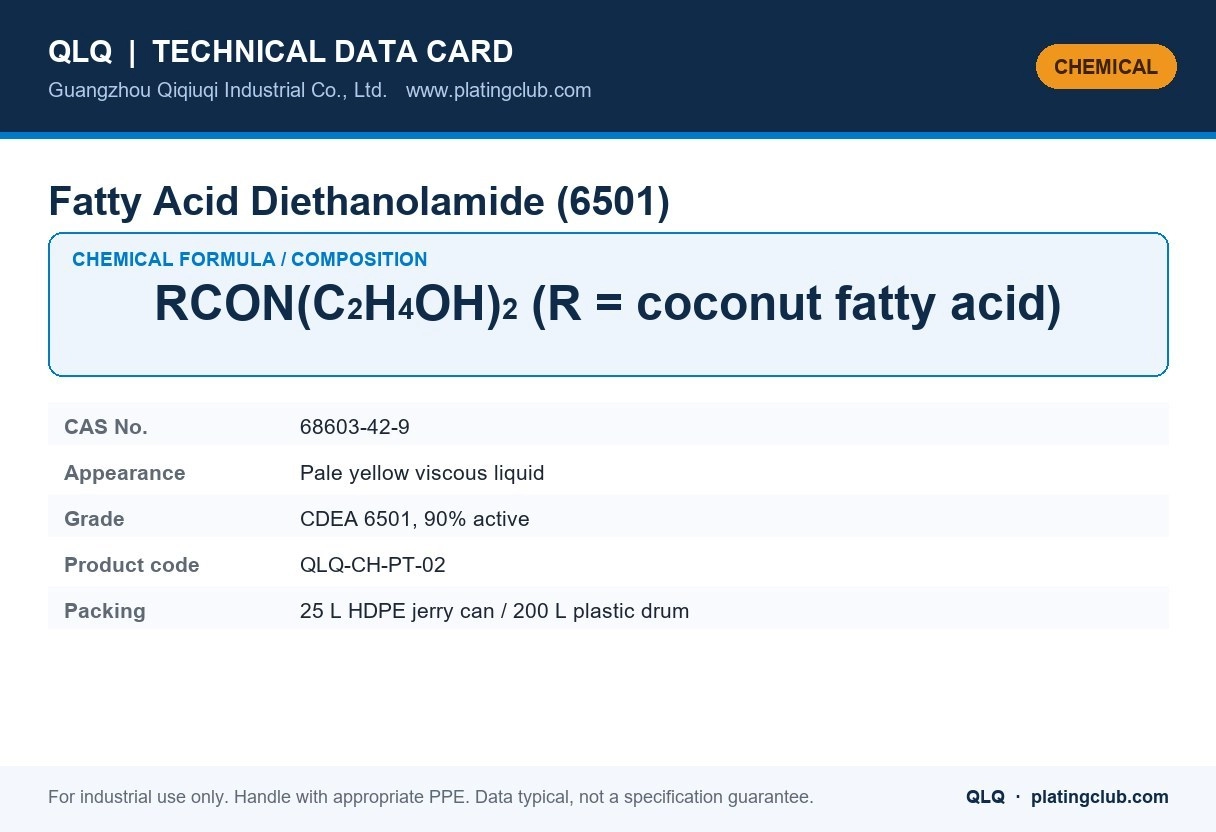
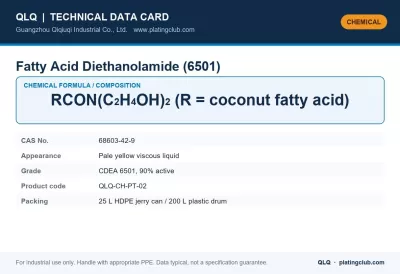
| Chemical name | Fatty Acid Diethanolamide (6501) |
| Chemical formula | RCON(C2H4OH)2 (R = coconut fatty acid) |
| CAS number | 68603-42-9 |
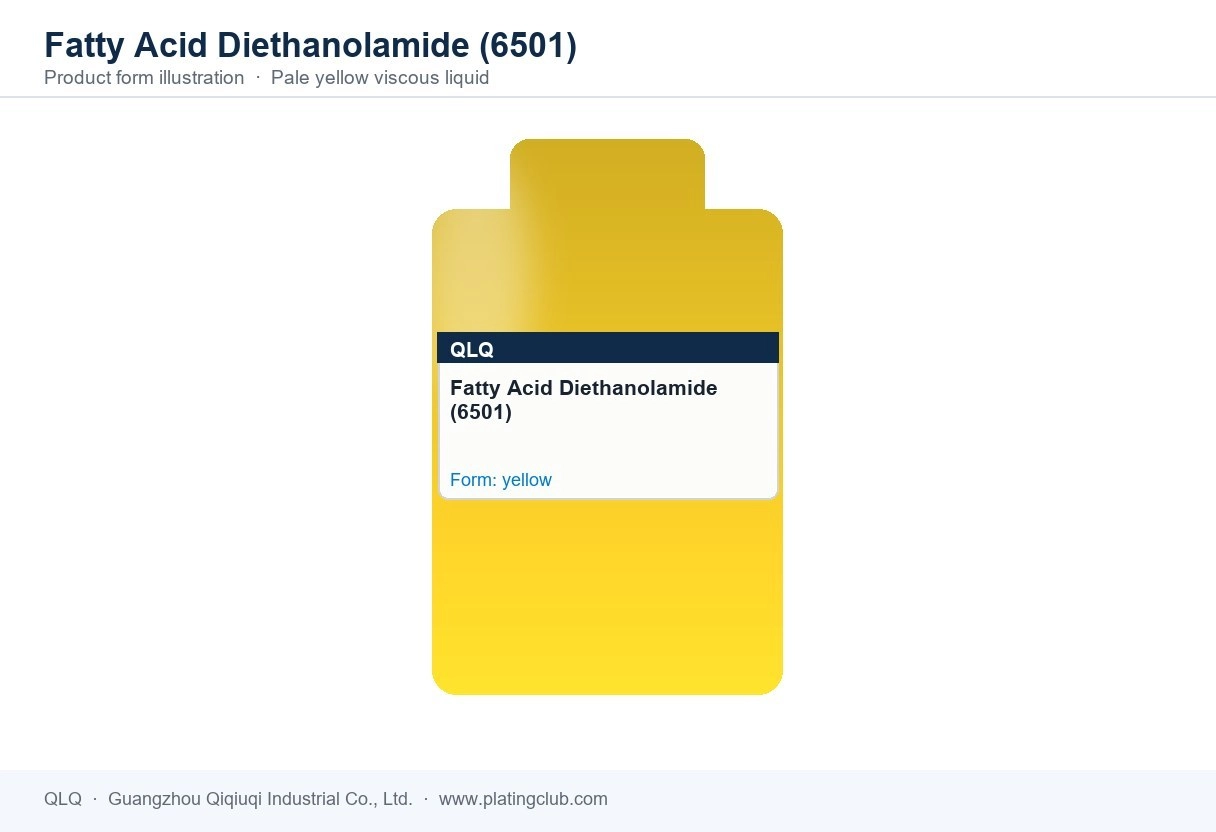
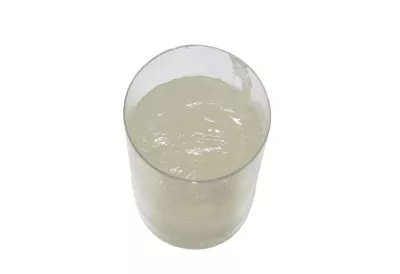
| Appearance | Pale yellow viscous liquid |
| Grade / type | CDEA 6501, 90% active |
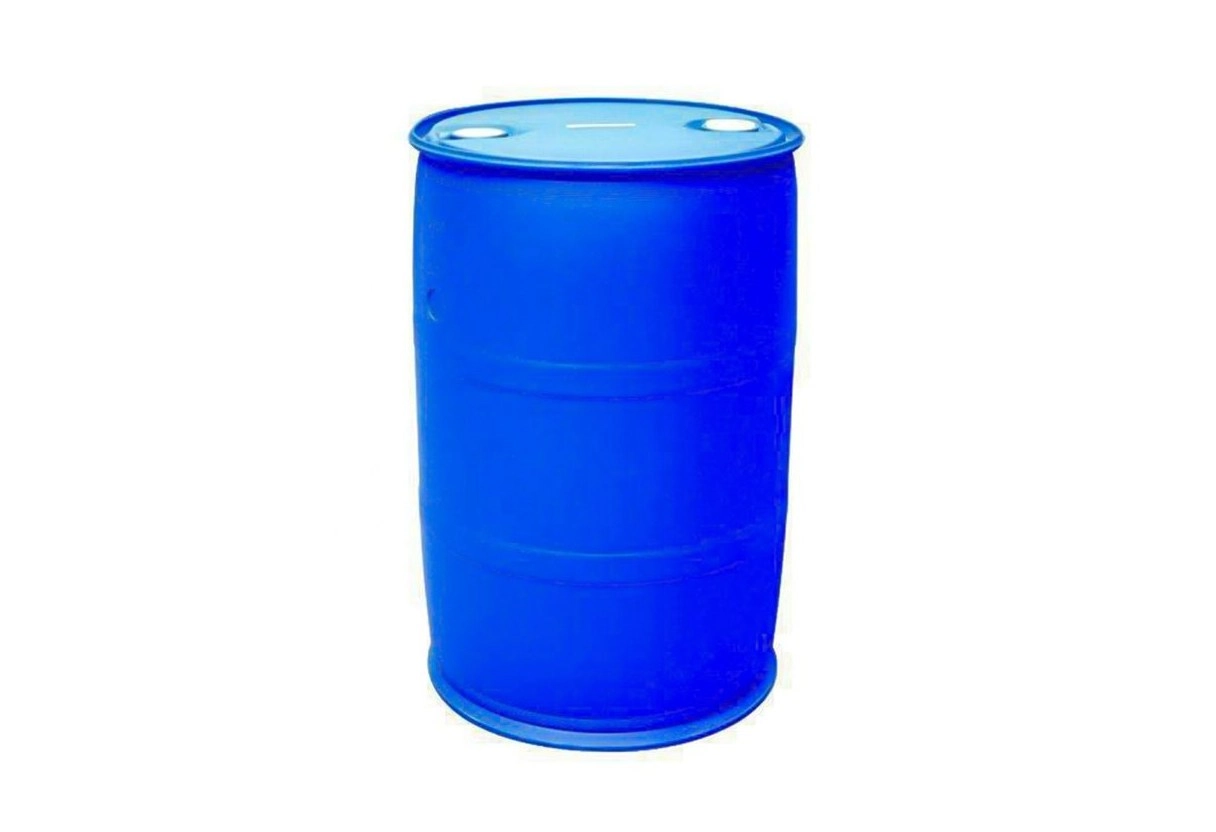
| Standard packing | 25 L HDPE jerry can; 200 L plastic drum |
What it is and what it does. Fatty acid diethanolamide (known as 6501) is the non-ionic foam booster and thickener of cleaners and degreasers, and the emulsifier that keeps oily soil dispersed in the cleaning bath.
- Pale yellow viscous liquid, made from coconut fatty acid; it is the most common foam booster in the trade.
- Improves soil emulsification, so oily soils rinse away instead of redepositing.
- Also used to thicken liquid detergents and to stabilise foam in hand cleaners.
Typical Use in a Plating / Finishing Line
| Item | Typical guidance |
|---|
| Cleaner formulation | 2-10 g/L |
| Degreaser booster | 1-5 g/L with the anionic surfactant |
| Note | Not recommended where low foam is required, such as spray cleaning |
Safety, Handling & Storage
| Item | Requirement |
|---|
| Hazard classification | Irritant (GHS07) — causes serious eye irritation; mild skin irritation on prolonged contact |
| Personal protective equipment | Safety goggles and nitrile gloves; avoid contact with eyes; use good general ventilation |
| Spill / first aid | Absorb or mop up; surfactant solutions are slippery — rinse the floor with plenty of water |
| Storage | Cool, dry, ventilated store; keep containers closed, protect paste and liquid grades from frost and from moisture pick-up |
| Transport | Classified and packed according to IATA/IMDG for the hazard class; UN number and packing group stated on the shipping documents |
Quality Documents Shipped With Every Batch
| Document | Comment |
|---|
| COA (certificate of analysis) | Provided with the shipment; batch traceable to the production date |
| MSDS (safety data sheet) | Provided with the shipment; batch traceable to the production date |
| Packing list | Provided with the shipment; batch traceable to the production date |
| Commercial invoice | Provided with the shipment; batch traceable to the production date |
| Certificate of origin on request | Provided with the shipment; batch traceable to the production date |
Buyer Questions We Answer Every Week
| Question | Answer |
|---|
| What does the number 6501 mean? | It is the traditional trade name for coconut diethanolamide in this market. |
| Can it be used in alkaline cleaners? | Yes, it is stable at the pH of normal alkaline cleaning baths. |
| Item | Typical Value |
|---|
| Chemical type | Coconut fatty acid diethanolamide (CDEA) |
| Appearance (25°C) | Light yellow viscous liquid to soft paste |
| Amide type | 6501 (1:1.5 ratio preferred) |
| Amine value | 30-60 mg KOH/g |
| Acid value | ≤ 10 mg KOH/g |
| pH (1% dispersion) | 9.0-10.5 |
| Solubility | Disperses in water; clear with co-surfactants |
| Standard packing | 25KG/BAG drum liner or HDPE drum |
How It Works in a Degreasing Tank
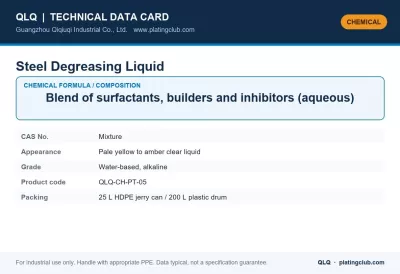
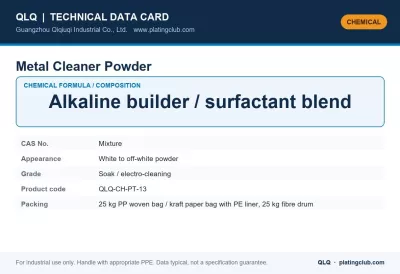
Diethanolamide sits at the oil-water boundary and does three jobs at once. It stabilizes foam so the air or cathode gas keeps scrubbing oils off the work; it emulsifies buffing wax and mineral oil into fine droplets that rinsing can remove; and it thickens the solution slightly, which slows drainage and gives the alkali more contact time on vertical surfaces. It is rarely used alone - the classic low-cost soak cleaner is a 6501 + caustic/phosphate builders + anionic surfactant blend:
| Role in blend | Typical share | What it does |
|---|
| Sodium hydroxide / metasilicate builders | 3-8% | Saponifies oils, softens water |
| Sodium carbonate / phosphate | 2-5% | Buffers pH, chelates hardness |
| 6501 amide | 1-3% | Foam stability + emulsification of wax/oil |
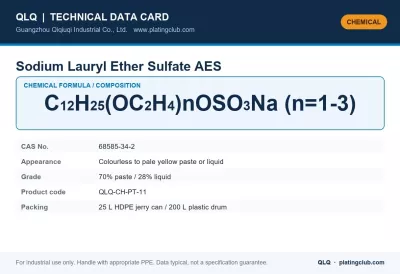
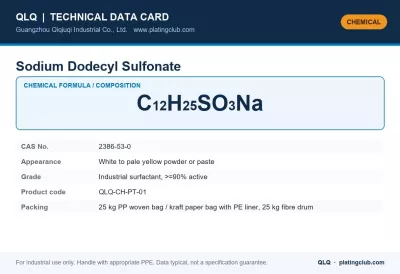
| Anionic surfactant (K12, SDS, AES) | 1-3% | Wetting and detergency |
| Water | balance | - |
Used directly as a tank additive (rather than in a bought concentrate), 6501 is dosed at roughly 0.5-2 g/L into an operating soak cleaner at 60-80°C, with co-surfactant adjusted to avoid over-foaming. The amide is consumed by drag-out and by oil loading, not by current, so additions follow weekly titration or water-break checks.
Quality Checks Before Use
| Check | Method | Pass |
|---|
| Color & odor | Visual / smell against retained sample | Light yellow, mild fatty note; no dark amber, no sharp amine smell |
| Acid / amine value | COA review | Acid value ≤ 10, amine value within declared band |
| Dispersion | 5 ml in 100 ml warm water, stir | Milky stable dispersion, no oil droplets on top |
| Foam stability | 0.5 g/L + 0.5 g/L K12, shake 10 s | Fine stable foam column holds 60 s |
| Rinse test | Clean a brass panel, rinse, dry | No oily streaks or iridescent film on brass |
How QLQ controls it: every 6501 lot is checked for acid value, amine value, color and rinse-film behavior on brass panels before release, and the batch number is kept traceable. A high free-amine lot can leave a faint yellow tint on bright copper and brass - the exact failure that QLQ's retained-sample check catches before material reaches your tank.
Common Problems & Fixes (Workshop Table)
| Problem | Root cause | Fix |
|---|
| Foam collapses mid-shift | Amide consumed by oil loading | Top up 0.3-0.5 g/L; skim floating oil regularly |
| Oily film on parts after drying | Over-loaded emulsion or cheap high-acid lot | Improve skimming, raise temperature, verify acid value of lot |
| Yellow tint on brass after cleaning | High free-amine lot or too-long contact | Cut contact time, rinse faster, switch to controlled-amine lot |
| Excessive foam in spray washer | Wrong product for spray (too much amide) | Use low-foam blend; reduce amide, add defoamer |
| Thickens or separates in winter | Product stored cold; 6501 viscosity rises | Warm drum to 25-30°C and mix before dosing |
| Poor cleaning of buffing wax | Blend missing solvent or emulsion stage | Add pre-degrease or emulsion cleaner step before the alkaline tank |
Handling & Safety
- Health: mildly irritating to skin and eyes; wear gloves and goggles. The product is alkaline - rinse splashes with water.
- Nitrosamine note: diethanolamide chemistry can form nitrosamines if combined with nitrite-based inhibitors. Keep it out of nitrite-containing rust-preventive tanks and use nitrite-free formulas where possible.
- Dosing: the material is viscous; warm the drum and dose by weight into a stirred tank, never splash cold lumps into hot alkali.
- Storage: keep drums sealed and cool. Long storage above 40°C darkens the product and raises the amine value; the recommended shelf life sealed is 12 months.
- Waste: spent emulsified cleaner is an oil-in-water emulsion - break it with acid and coagulant in the effluent plant before discharge; do not dump straight to drain.
What It Does on Iron, Zinc Alloy, Copper and Stainless Steel Parts
| Substrate | Role of the 6501 cleaning stage | Practice note |
|---|
| Iron / steel hardware | Removes stamping oil and shop dust so the first copper or nickel layer plates without skip-plating | Soak 3-5 min at 60-80°C, then anodic clean 1-2 min at 3-5 A/dm² |
| Zinc alloy (sliders, buckles) | Lifts buffing compound from die-cast recesses without etching the zinc | Keep cleaner pH moderate and time short; over-cleaning etches and causes copper blistering |
| Copper / brass | Oil-free surface prevents tarnish bands during acid activation before nickel | Use the controlled-amine grade; rinse with two tanks to stop amide carry-in to acid |
| Stainless steel | Removes passivation-breaking soils and forming lubricants before the nickel strike | Follow with a short acid dip; the amide itself does not etch stainless |
FAQ
| Question | Answer |
|---|
| 6501 is sold as a cleaner ingredient - do I add it to my tank directly? | Yes, at 0.5-2 g/L to an existing soak or electrocleaner, but best results come from using it inside a complete blend with builders and an anionic wetter. QLQ can supply the matched recipe for your water hardness. |
| What is the difference between 1:1 and 1:1.5 types? | Ratio of fatty acid to diethanolamine. The 1:1.5 type is more fluid, more water-dispersible and the common all-round cleaner grade; the 1:1 type is waxier and used where a thicker, high-viscosity product is wanted. |
| Why does my brass tarnish right after cleaning with 6501? | Most often a high free-amine lot, or the part dried before rinsing. Verify the lot's amine value and never let alkaline film dry on bright copper or brass. |
| Does QLQ supply the anionic surfactant to pair with it? | Yes - K12, dodecyl sulfonate, AES and nonionic AEO-9 are all stocked, and QLQ engineering will help you build the degreasing train that matches your plating line. |
Cleaning stage giving you skip-plating or oil films? QLQ engineering helps shops in 10+ countries rebuild degreasing chemistry from a tank photo and water analysis. Contact us.