

Professional Zinc Alloy Surface Finishing Solutions
Thiourea
Thiourea
Tạo mã QR
-
Estimated Delivery:Oct 02 - Oct 06
-
Free Shipping & Returns: On all orders over $75
Product description
Shipping & Return
Product Overview
Thiourea (CH4N2S) is a white crystalline sulfur compound with three real jobs in metal finishing: it is the ppm-level brightening and leveling additive in acid copper plating, a classic inhibitor in acid pickling of steel, and the sulfur building block from which many proprietary brightener and leveler molecules are made. In QLQ's finishing plants thiourea chemistry appears in the acid copper stages that underlay the decorative nickel-chrome finishes on zipper sliders and hardware, and in the inhibited pickles that protect spring steel from acid attack and hydrogen embrittlement. The commercial market sells industrial and premium grades; for plating work the specification that matters is assay and insolubles - thiourea is dosed in milligrams per liter, so a cheap lot carrying dirt or insoluble residue can drop straight into the deposit as roughness. Two related facts keep thiourea honest: it is not a brightener that can be dumped in by the gram - modern acid copper systems use it or its derivatives at levels close to the detection limit of the lab - and heating it in solution slowly decomposes it, which is why dosing is done cool and often.
Product Identity (Encyclopaedia Card)
| Property | Value |
|---|---|
| Chemical name | Thiourea |
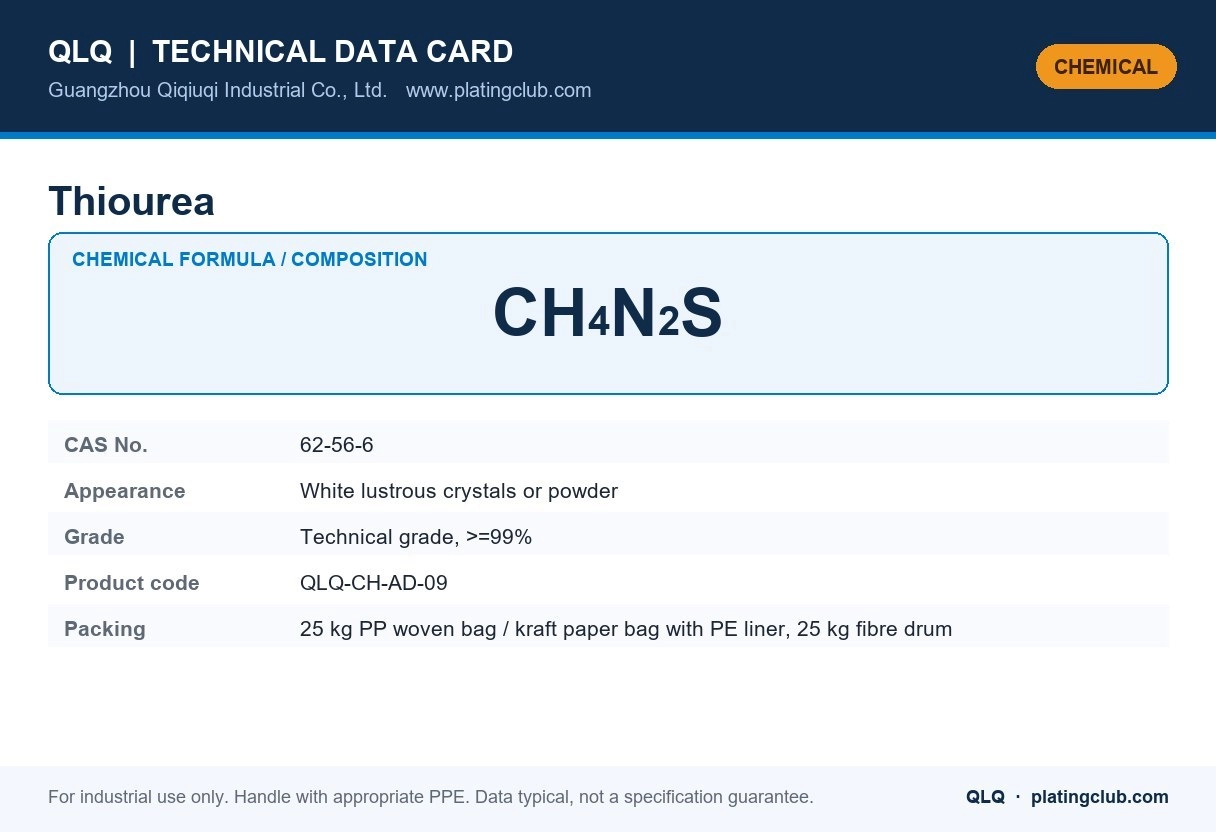
| Chemical formula | CH4N2S |
| CAS number | 62-56-6 |
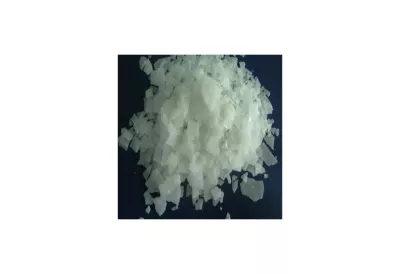
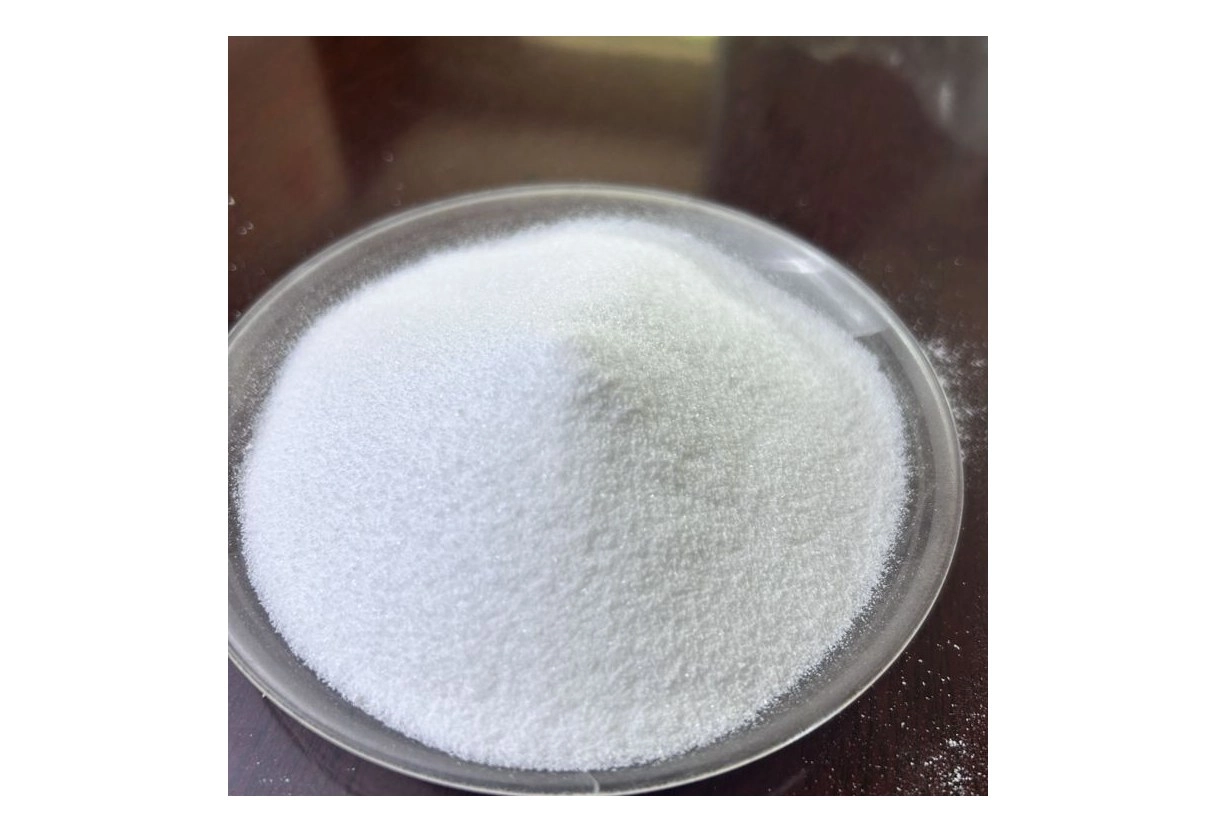
| Appearance | White lustrous crystals or powder |
| Grade / type | Technical grade, >=99% |
| Standard packing | 25 kg PP woven bag or kraft paper bag with PE inner liner; 25 kg fibre drum |
What it is and what it does. Thiourea is the grain refiner and brightener used in acid copper, in electroless nickel (as a stabiliser) and in the colouring and etching of copper alloys.
- White lustrous crystals; added at very low concentration in plating baths because it is a powerful brightener.
- It is also the classic accelerator in some phosphating and the complexant in electroless nickel stabiliser systems.
- Contains sulphur, so overdosing increases the deposit stress and can make the layer brittle.
Typical Use in a Plating / Finishing Line
| Item | Typical guidance |
|---|---|
| Acid copper brightening | 0.5-10 mg/L from a dilute stock solution |
| Electroless nickel stabiliser | 1-5 mg/L |
| Note | Dose from a dilute stock prepared the same shift |
Safety, Handling & Storage
| Item | Requirement |
|---|---|
| Hazard classification | Not classified as dangerous for transport in most cases; observe good industrial hygiene and dust control |
| Personal protective equipment | Dust mask, goggles and gloves for powder handling; general ventilation |
| Spill / first aid | Sweep up dry; material is a nuisance dust — avoid breathing the dust |
| Storage | Cool, dry, sealed store; keep bags closed, off the floor and away from moisture |
| Transport | Classified and packed according to IATA/IMDG for the hazard class; UN number and packing group stated on the shipping documents |
Quality Documents Shipped With Every Batch
| Document | Comment |
|---|---|
| COA (certificate of analysis) | Provided with the shipment; batch traceable to the production date |
| MSDS (safety data sheet) | Provided with the shipment; batch traceable to the production date |
| Packing list | Provided with the shipment; batch traceable to the production date |
| Commercial invoice | Provided with the shipment; batch traceable to the production date |
| Certificate of origin on request | Provided with the shipment; batch traceable to the production date |
Buyer Questions We Answer Every Week
| Question | Answer |
|---|---|
| Is thiourea a carcinogen? | It is classified as a suspected carcinogen; handle with gloves and dust control and keep the store locked. |
| Why is my deposit brittle? | Usually a thiourea overdose or the accumulation of its breakdown products; treat with carbon. |
| Item | Typical Value |
|---|---|
| Chemical formula | CH4N2S (thiourea, thiocarbamide) |
| Purity | ≥ 99.0% (premium ≥ 99.5%) |
| Appearance | White crystalline powder or prills |
| Melting point | 176-182°C |
| Water insolubles | ≤ 0.05% |
| Iron (Fe) | ≤ 0.001% |
| Standard packing | 25KG woven bag with PE inner liner |
How It Works in the Bath (Why Dosage Is in Milligrams)
Thiourea works by adsorbing on the growing copper surface and slowing deposition locally, which is exactly what a leveler must do: where the deposit grows fastest (peaks, edges, high current density) it is inhibited most, so valleys catch up and the surface levels and brightens. The effective band is narrow - studies and production practice place working concentrations from a few to roughly 60 mg/L depending on the bath chemistry, with excess thiourea dulling the deposit and eventually roughening it as decomposition products build. Because the working dose is so small, thiourea is always predissolved as a dilute stock solution (1 g/L or weaker) and added by measured volume against amp-hours, never scooped. In acid pickling the mechanism is different but equally simple: thiourea adsorbs on bare steel and blocks the acid attack on the metal surface while still allowing scale and rust to be loosened, cutting both metal loss and the hydrogen that causes embrittlement of hardened springs and fasteners.
| Application | Typical working level | Note |
|---|---|---|
| Acid copper brightening/leveling (sulfate & MSA baths) | A few to ~60 mg/L (bath-dependent) | Trim by Hull cell; excess dulls and roughens |
| Inhibited pickling of steel (HCl or H2SO4) | 0.1-1 g/L | Cuts metal loss and hydrogen embrittlement |
| Brightener raw chemistry | - | Feedstock for proprietary sulfur-bearing additives |
Contamination control belongs in the same paragraph as dosing: copper baths hold thiourea species in balance with chloride and the main brightener, so adding thiourea of unknown purity or history is a good way to spend a weekend carbon-treating.
How to Check Quality Before Loading a Batch
| Check | Method | Pass Criteria |
|---|---|---|
| Appearance | Visual | White, free-flowing crystals; grey, yellow or caked material is suspect |
| Assay | Iodate or HPLC assay from COA | ≥ 99.0% |
| Melting point | Melting point apparatus | 176-182°C; wide depression signals impurity |
| Solution clarity | 10 g in 100 mL DI water | Clear, colorless solution; residue fails the lot |
| Hull cell check | Add planned dose to a laboratory acid copper cell | Bright range and leveling reproduced; no haze at low CD |
How QLQ controls it: thiourea and its derivatives are bought against assay and insolubles limits, checked by melting point and clarity on arrival, and stored as dilute, dated stock solutions rather than bulk powder beside the plating tanks. Lot traceability on the additive log is what lets the lab explain a sudden haze - or rule the chemical out in an hour.
Common Problems & Fixes (Workshop Table)
| Problem | Root cause | Fix |
|---|---|---|
| Dull, hazy copper at low current density | Leveler/thiourea too low or decomposed | Analyze additive; add dilute stock; Hull cell to confirm |
| Rough or burnt deposit at high CD | Thiourea excess or breakdown products accumulating | Carbon-treat 2-5 g/L; rebuild additives by analysis; dose by amp-hours |
| Springs crack after acid pickling | Uninhibited acid absorbing hydrogen into the steel | Add 0.1-1 g/L thiourea inhibitor; shorten pickle; bake out hydrogen before plating |
| Bath behavior changes between shifts | Stock solution made too strong or stored warm, decomposing | Make 1 g/L stocks fresh, keep cool and dark, label with date |
| Sudden haze after changing additive lot | Insolubles or degradation products in the new lot | Verify clarity and melting point; return the lot if out of spec |
Handling & Safety for the Plating Line
- Health: thiourea is an irritant to eyes and skin and is classed as a suspected carcinogen in some jurisdictions; avoid inhaling dust and wash hands after handling. Use gloves, goggles and a dust mask when weighing.
- Dust control: fine powder disperses easily. Empty bags slowly in a ventilated area and keep containers closed between uses.
- Solution preparation: predissolve as a dilute stock (1 g/L or weaker for plating doses) in cool water; do not boil or hold stock hot, because thiourea decomposes with heat.
- Storage: keep dry, cool and sealed; thiourea is stable for years if dry but hydrolyzes slowly in damp air. Separate from oxidizers and acids in the store.
- Spills: sweep dry for disposal; small residues rinse away with water. Do not flush concentrated material into acid waste without dilution.
What It Does on Iron, Zinc Alloy, Copper and Stainless Steel Parts
| Substrate | Role of thiourea chemistry in the process | Recommended practice |
|---|---|---|
| Iron / steel small hardware | Inhibited pickling protects steel surface and spring properties before plating | Add 0.1-1 g/L to the acid; keep pickle time minimal; rinse and plate promptly |
| Zinc alloy (sliders, buckles) | Protects the die-cast surface indirectly - acid copper underlayer quality depends on leveling additives | Keep copper strike and leveling balanced; avoid thiourea overdosing that roughens thin copper |
| Copper / brass | Direct substrate for acid copper leveling and brightening | Dose at mg/L by analysis; Hull cell weekly; carbon-treat on schedule |
| Stainless steel | Not a thiourea substrate; stainless is cleaned and passivated by other routes | Keep stainless parts out of inhibited carbon-steel pickles to avoid contamination |
FAQ
| Question | Answer |
|---|---|
| Why is thiourea dosed in milligrams when I buy it in kilos? | Because it is a surface-active leveler - it works at the interface, not in the bulk. A kilo supports a long production run at mg/L doses; the purchase unit is just packaging economics. |
| Can I use thiourea to brighten my acid copper directly? | Only as part of a balanced system. Thiourea alone gives narrow brightness and quickly dulls the deposit; proprietary brighteners combine it (or its derivatives) with carriers and chloride control. |
| Does thiourea stop hydrogen embrittlement completely? | No inhibitor does. It sharply reduces hydrogen pick-up during pickling; baking after plating and short acid times are still required for hardened parts. |
| Why does my thiourea stock smell of ammonia? | Because it has decomposed - heat, age or contamination has hydrolyzed it. Discard and make fresh cool stock; never dose a bad stock into production. |
| Does QLQ supply thiourea with support? | Yes. QLQ supplies thiourea with COA covering assay, melting point and insolubles, and engineers help with acid copper additive balance and inhibited pickling. |
Acid copper hazing or springs failing after pickle? QLQ supplies thiourea with COA and engineers who help customers in 10+ countries balance copper additives and inhibited pickling. Contact us with your Hull cell panels.
Shipping cost is based on weight. Just add products to your cart and use the Shipping Calculator to see the shipping price.We want you to be 100% satisfied with your purchase. Items can be returned or exchanged within 30 days of delivery.