
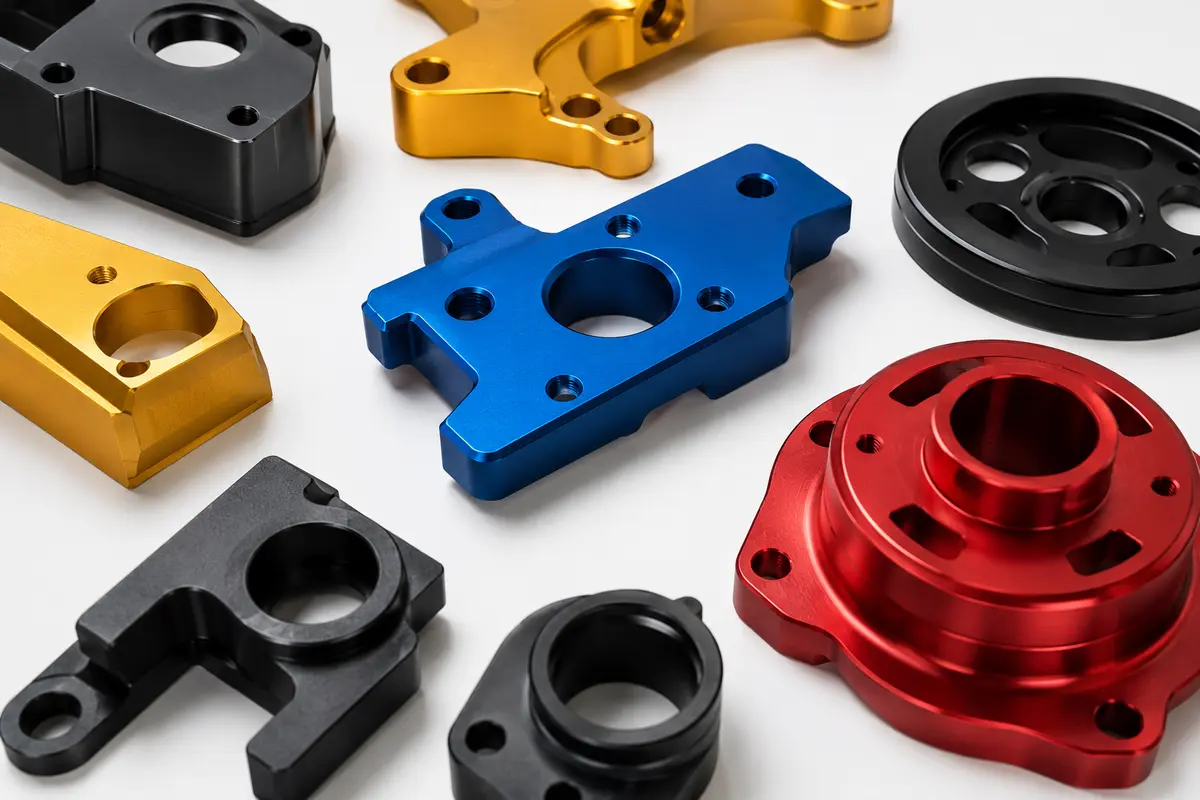
Key Takeaway: Anodizing is not a coating — it's an electrochemical conversion process that transforms the aluminum surface into a hard, durable, corrosion-resistant oxide layer. For B2B buyers sourcing aluminum hardware, understanding the different anodizing types can mean the difference between a part that lasts 2 years and one that lasts 20. This guide covers Type I, II, and III anodizing with practical selection advice.
What Is Anodizing and Why Does It Matter?
Unlike electroplating — which deposits a foreign metal onto a substrate — anodizing grows an oxide layer from the aluminum itself. Think of it as controlled rusting that produces a protective ceramic-like surface. The resulting aluminum oxide (Al₂O₃) is second only to diamond in hardness on the Mohs scale.
This matters for three reasons: durability (the oxide layer is integral to the metal — it won't chip or peel like paint), corrosion resistance (the sealed porous structure blocks moisture and chemicals), and aesthetics (the porous layer can absorb dyes, creating vibrant, fade-resistant colors).
Anodizing is used everywhere: architectural window frames, automotive trim, consumer electronics (think MacBook bodies), aerospace components, medical instruments, and marine hardware.
Anodizing vs. Electroplating — Key Differences
| Feature | Anodizing | Electroplating |
| Mechanism | Conversion — grows oxide from substrate | Deposition — adds foreign metal layer |
| Substrate | Aluminum (and titanium, magnesium) | Steel, zinc alloy, brass, copper, plastic |
| Adhesion | Molecular bond — won't peel | Mechanical/chemical bond — can peel |
| Thickness | 5–150 μm | 5–40 μm (typical) |
| Electrical Conductivity | Non-conductive surface | Conductive (metal coating) |
The Three Types of Anodizing (Per MIL-A-8625)
Type I — Chromic Acid Anodizing (CAA)
Thickness: 0.5–5 μm | Color: Grayish, thin film
Type I uses chromic acid as the electrolyte, producing the thinnest and most flexible oxide layer. Because the film is thin, it causes minimal dimensional change — critical for precision components with tight tolerances.
Best for: Aerospace structural parts, welded assemblies (chromic acid won't get trapped in weld joints and cause corrosion), fatigue-critical components. The thin film provides excellent corrosion protection without compromising the aluminum's fatigue strength.
Limitation: Limited dye absorption due to thinness. Not suitable for decorative applications. Environmental concerns around hexavalent chromium are driving a shift toward alternatives.
Type II — Sulfuric Acid Anodizing (SAA)
Thickness: 5–25 μm | Color: Clear/natural; can be dyed virtually any color
This is the workhorse — the most common anodizing type, accounting for over 90% of commercial applications. The sulfuric acid bath creates a thicker, more porous oxide layer that absorbs dyes exceptionally well.
Best for: Architectural aluminum (window frames, curtain walls), consumer products (phone cases, laptop bodies), automotive trim, sporting goods, and any application requiring both protection and aesthetics.
Type II is further classified by the sealing method: hot water seal (most common, slightly reduces corrosion resistance), nickel acetate seal (better corrosion resistance but may leave a slight green tint), or PTFE seal (adds lubricity for moving parts).
Type III — Hardcoat Anodizing (Hard Anodize)
Thickness: 25–150 μm | Color: Dark gray to black (natural); limited dye options
Sometimes called hard anodize or hardcoat, Type III is performed at near-freezing temperatures (0–5°C) with higher current density. The result is an extremely dense, wear-resistant surface with hardness values reaching 60–70 HRC.
Best for: Military equipment, hydraulic cylinders, pistons, gears, sliding components, cookware, and any part subject to heavy wear or abrasive environments. Type III can achieve 1000+ hours of salt spray resistance when properly sealed.
Trade-off: The thick coating reduces fatigue strength by 30–50% and adds 50% of the coating thickness to each surface (a 50μm coating adds ~25μm to the dimension). This must be accounted for in machining tolerances.
Anodizing Type Selection at a Glance
| Requirement | Recommended Type | Typical Thickness |
| Interior decorative trim | Type II — Clear or dyed | 5–10 μm |
| Outdoor architectural | Type II — Electrolytic colored | 15–20 μm |
| Aerospace structural | Type I or thin Type II | 3–8 μm |
| Wear surfaces / pistons | Type III — Hardcoat | 50–75 μm |
| Marine hardware | Type III + PTFE seal | 50–100 μm |
The Anodizing Process: Step by Step
Understanding the process helps buyers communicate effectively with suppliers and spot quality issues before they become production problems.
- Cleaning and Degreasing: The aluminum part is cleaned in an alkaline or solvent bath to remove oils, grease, and shop dirt. Any contamination at this stage will show as a blotch in the final finish.
- Etching: A caustic soda (NaOH) bath removes the natural aluminum oxide layer and creates a uniform matte surface. The duration controls the final gloss level — longer etching equals more matte. For a bright finish, chemical brightening (phosphoric/nitric acid mix) is used instead.
- Desmutting: After etching, a dark smut (alloying elements like copper, silicon) remains on the surface. A nitric acid or sulfuric acid dip removes this residue, leaving clean aluminum ready for anodizing.
- Anodizing: The part is immersed in the electrolyte bath (chromic, sulfuric, or mixed acid) and connected as the anode. DC current is applied — typically 12–18V for Type II, up to 75V for Type III. Oxygen ions migrate to the aluminum surface, forming Al₂O₃ in a honeycomb-like porous structure.
- Coloring (Optional): Immediately after anodizing, the porous layer can absorb dyes. Organic dyes offer vibrant colors but lower UV resistance. Electrolytic coloring (using tin, cobalt, or nickel salts) produces fade-proof bronze, black, and champagne tones. This is the preferred method for architectural applications.
- Sealing: The pores are closed by hydrating the oxide in boiling deionized water (hot water seal), nickel acetate solution, or PTFE dispersion. Sealing locks in dyes and maximizes corrosion resistance. An unsealed anodized part will stain and corrode rapidly.
Common Anodizing Defects and Their Causes
- Color variation / blotching: Poor cleaning, inconsistent alloy composition, or rack marks
- Burning / pitting: Excessive current density or poor bath agitation — localized overheating dissolves the oxide faster than it forms
- Chalking / powdering: Over-anodizing in too-aggressive electrolyte; the outer layer becomes friable and rubs off
- Poor dye absorption: Delayed transfer to dye bath (pores begin sealing on contact with air) or insufficient anodizing thickness
- Corrosion in service: Incomplete sealing — check sealing bath temperature and pH
- Contact marks (bare spots): Poor rack design — the electrical contact point blocks current flow to adjacent areas
Quality Standards and Testing
When specifying anodizing in a purchase order, reference these standards:
- MIL-A-8625F: The U.S. military specification covering Type I, II, and III anodizing. Still widely used in commercial specifications.
- ISO 7599: International standard for anodic oxidation coatings on aluminum.
- AAMA 611: Architectural anodizing specification (American Architectural Manufacturers Association).
Key tests to request: Coating thickness (eddy current gauge per ISO 2360), seal quality (dye spot test per ASTM B136), corrosion resistance (salt spray per ASTM B117 — typically 336 hours minimum for architectural), and abrasion resistance (Taber test for hardcoat).
How to Choose the Right Anodizing for Your Parts
Ask these four questions before specifying anodizing:
- What alloy are you using? Not all aluminum alloys anodize equally. 5000 and 6000 series (Al-Mg and Al-Mg-Si) produce the clearest, most consistent anodized finishes. 2000 series (Al-Cu) turns yellowish. 7000 series (Al-Zn) may darken. High-silicon casting alloys (A380, A383) anodize poorly and may turn dark gray.
- What is the service environment? Indoor decorative → Type II, 5–10μm. Outdoor architectural → Type II, 15–25μm with electrolytic coloring. Heavy wear or marine → Type III, 50–100μm with PTFE seal.
- Are tight tolerances critical? Type I or thin Type II for precision parts. For Type III, inform your machinist to adjust dimensions — the coating will add approximately 50% of its thickness per surface.
- What color and finish do you need? Clear/natural → Type II un-dyed. Vibrant colors → Type II + organic dye (note: will fade in direct sun). Permanent bronze/black → Type II + electrolytic coloring. Dark gray/black wear surface → Type III natural.
Looking for Custom Anodizing Solutions?
At PlatingClub, we provide Type II sulfuric acid anodizing and Type III hardcoat anodizing services for aluminum hardware, architectural components, and industrial parts. Our quality control includes coating thickness measurement, seal testing, and salt spray certification.
Contact us at [email protected] to discuss your project requirements.
Disclaimer: This guide is for informational purposes. Always consult with your anodizing supplier and reference the applicable standards for your specific application and industry requirements.