

Professional Zinc Alloy Surface Finishing Solutions
Potassium Citrate
Potassium Citrate
Buat kode QR
-
Estimated Delivery:Oct 02 - Oct 06
-
Free Shipping & Returns: On all orders over $75
Product description
Shipping & Return
Product Overview
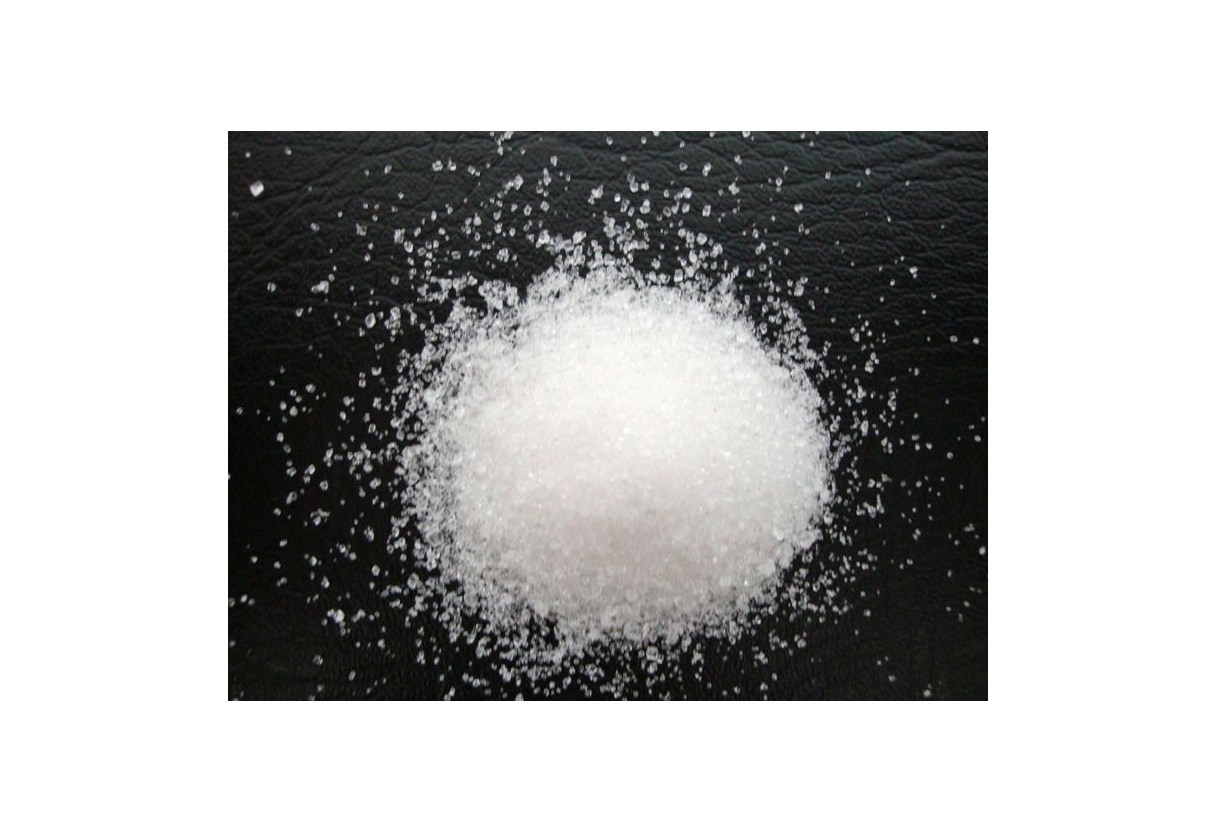
Potassium Citrate (C6H5K3O7·H2O, tripotassium salt of citric acid) is the potassium form of one of the finishing industry's most used buffer-complexants. It is a white, free-flowing crystalline salt, freely soluble in water, giving mildly alkaline solutions (1% pH about 8), and it does two jobs at once in a bath: it buffers the pH in the working zone of acid electroless and electroplating processes, and it complexes nickel, copper and iron ions so they stay dissolved instead of precipitating as hydroxides or phosphites. Compared with sodium citrate, the potassium salt gives higher solubility and better conductivity, which matters in concentrated baths and in cold weather storage. In QLQ's plants it appears in citrate-type electroless nickel make-ups, in strike and buffer roles on zinc-alloy work, and in soak-cleaner blends. Market grades: food / pharmaceutical citrate is the bulk of world supply, while technical plating grade is the same salt produced and certified for metal-limits (Fe, Pb, As, sulfate) relevant to a plating bath - the difference is traceability and analysis, not the molecule.
Product Identity (Encyclopaedia Card)
| Property | Value |
|---|---|
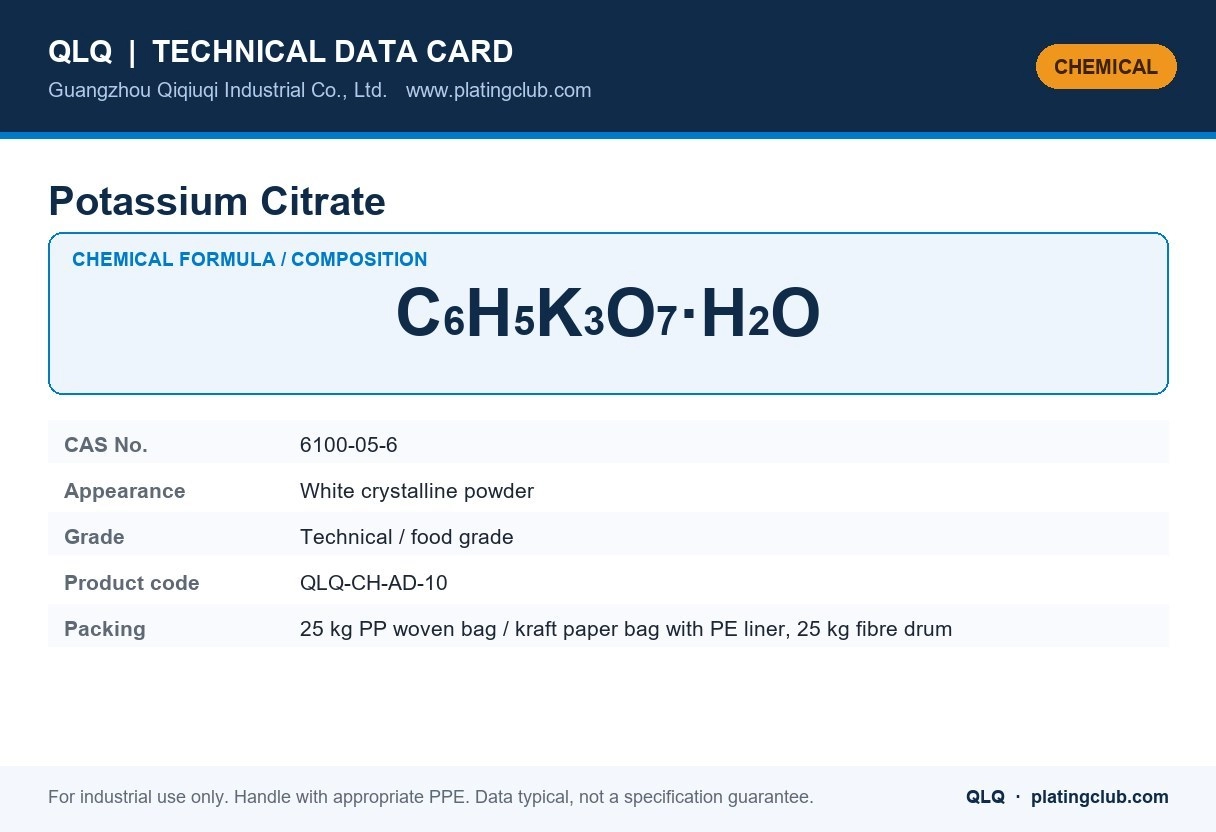
| Chemical name | Potassium Citrate |
| Chemical formula | C6H5K3O7·H2O |
| CAS number | 6100-05-6 |
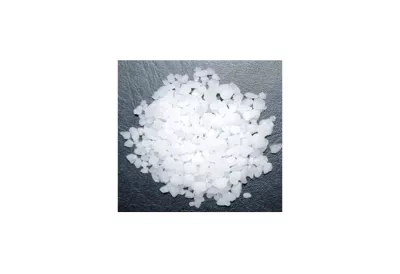
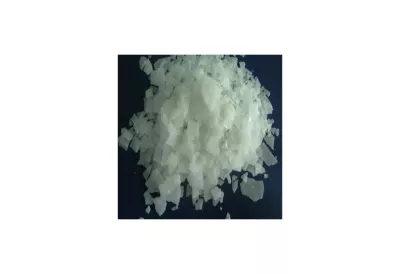
| Appearance | White crystalline powder |
| Grade / type | Technical / food grade |
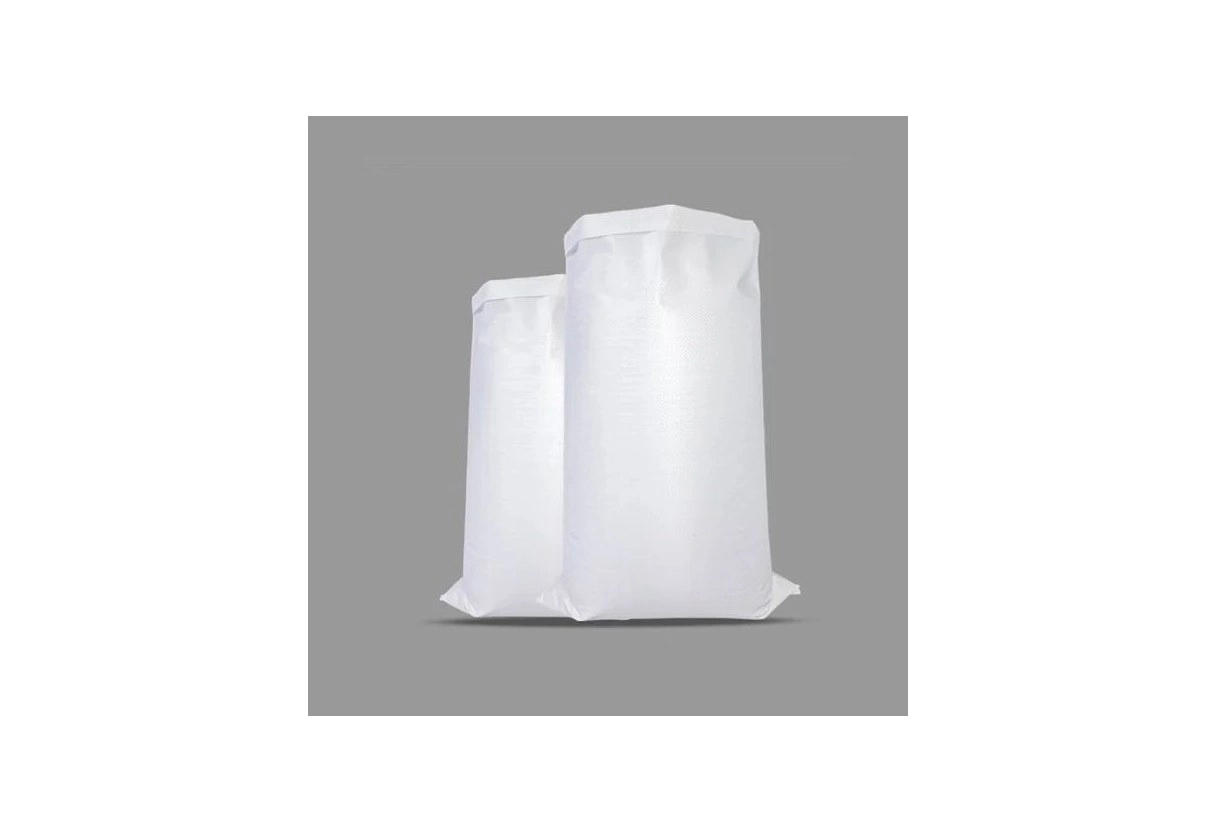
| Standard packing | 25 kg PP woven bag or kraft paper bag with PE inner liner; 25 kg fibre drum |
What it is and what it does. Potassium citrate is the complexant and buffering salt used in electroless nickel, in mild cleaning formulations and in metal colouring baths.
- White crystalline powder, very soluble; it holds metal ions in solution over a wide pH range.
- Used as the chelant in some electroless nickel systems and as a pH buffer in silver plating.
- A food-grade material, which makes it easy to source in consistent quality.
Typical Use in a Plating / Finishing Line
| Item | Typical guidance |
|---|---|
| Electroless nickel complexant | As specified by the bath formulation |
| Buffer | 10-50 g/L depending on the system |
| Analysis | By titration with perchloric acid or by the citrate colorimetric method |
Safety, Handling & Storage
| Item | Requirement |
|---|---|
| Hazard classification | Not classified as dangerous for transport in most cases; observe good industrial hygiene and dust control |
| Personal protective equipment | Dust mask, goggles and gloves for powder handling; general ventilation |
| Spill / first aid | Sweep up dry; material is a nuisance dust — avoid breathing the dust |
| Storage | Cool, dry, sealed store; keep bags closed, off the floor and away from moisture |
| Transport | Classified and packed according to IATA/IMDG for the hazard class; UN number and packing group stated on the shipping documents |
Quality Documents Shipped With Every Batch
| Document | Comment |
|---|---|
| COA (certificate of analysis) | Provided with the shipment; batch traceable to the production date |
| MSDS (safety data sheet) | Provided with the shipment; batch traceable to the production date |
| Packing list | Provided with the shipment; batch traceable to the production date |
| Commercial invoice | Provided with the shipment; batch traceable to the production date |
| Certificate of origin on request | Provided with the shipment; batch traceable to the production date |
Buyer Questions We Answer Every Week
| Question | Answer |
|---|---|
| What is the difference from sodium citrate? | Both complex metal ions; the potassium salt avoids introducing sodium and is often preferred in silver and electroless systems. |
| Does it degrade in the bath? | Citrate is stable; the build-up is of metal complexes and of reaction products (phosphite in electroless nickel). |
| Item | Typical Value |
|---|---|
| Chemical formula | C6H5K3O7·H2O (tri-potassium citrate monohydrate) |
| Assay | ≥ 99.0% (plating grade) |
| Appearance | White crystals/granules, odourless |
| pH (1% solution) | 7.5-8.5 |
| Iron (Fe) | ≤ 0.001% |
| Heavy metals (as Pb) | ≤ 0.001% |
| Sulfate | ≤ 0.02% |
| Water insoluble | ≤ 0.01% |
| Standard packing | 25KG woven bag with PE inner liner |
How to Check Quality Before Loading a Batch
| Check | Method | Pass Criteria |
|---|---|---|
| Appearance | Visual | White uniform crystals; yellowing or dark specks = contamination or degraded stock |
| Solubility / clarity | Dissolve 50 g in 100 ml DI water at 30°C | Clear, colourless solution; no sediment |
| Assay | COA (alkalimetric titration) | ≥ 99%; keep lot spread within ±0.5% |
| Heavy metals | Sulfide spot test on acidified 10% solution | No darkening; Pb/As per plating-grade certificate |
| Coupon test (EN) | Rebuild a small citrate EN bath with the new lot, plate steel coupon | Rate and brightness within 10% of the reference bath |
How QLQ controls it: citrate functions at tens of g/L, and impurities that would be harmless in food use can dull an electroless deposit. Every lot is quarantined, COA-verified and coupon-tested before release, with the batch number recorded so a slow-bath complaint can be traced to the exact delivery.
How It Behaves in the Bath (Buffer + Complexant)
Citrate works on two dials. As a buffer it holds pH in the 4-6 range that acid electroless nickel and several electroplating processes need, absorbing the acid generated by the reaction. As a complexant it keeps a controlled fraction of nickel and copper in soluble complex form, preventing hydroxide and nickel-phosphite precipitation while still releasing metal to the reacting surface. It is a softer chelant than EDTA or NTA - baths built on citrate are forgiving to dose and easy to re-start after downtime, which is why citrate remains the complexant of choice for small-tank and strike applications.
| Application | Role of potassium citrate | Typical working data |
|---|---|---|
| Citrate-type electroless nickel | Complexant + buffer holding Ni soluble at operating pH | 15-30 g/L with NiSO4 25-35 g/L, NaH2PO2 25-30 g/L, pH 4.6-5.2, 85-90°C |
| Nickel / Ni-alloy electro baths | Buffer and iron-complexing agent where parts dissolve iron into the bath | 5-20 g/L addition; watch carbonaceous breakdown on long service |
| Alkaline ammoniacal EN (zinc alloy work) | Keeps nickel soluble at pH 8-9 without attacking zinc substrates | 20-40 g/L with ammonia pH control, 70-85°C |
| Soak / electrolytic cleaners | Builder: sequesters hard-water and soil metals, boosts wetting | 2-10 g/L in alkaline blends, pH 9-12 |
| Copper alloy cleaning / brightening dips | Complexes Cu2+ so redeposited immersion copper stays off the surface | 5-30 g/L in inhibited acid blends |
Potassium citrate may be substituted mole-for-mole for sodium citrate in most formulations - the anion does the chemistry and the potassium only improves solubility and conductivity. Adjust the dose by analysis, not by feel, and verify with a coupon after any change.
Common Problems & Fixes (Workshop Table)
| Problem | Root cause | Fix |
|---|---|---|
| EN bath slows down after weeks of top-up | Citrate and by-product ortho-phosphite build-up from replenishment | Analyse; partial bath replacement to reset complexant and impurities |
| Haze or precipitate in a fresh bath | Complexant under-dosed for the nickel loading, or hard water in make-up | Raise citrate to spec; use DI water for make-up |
| Deposit dull, edges dark | pH drifted above range (buffer exhausted) or metal imbalance | Correct pH; check nickel and hypophosphite; re-verify citrate level |
| Black smut on zinc alloy after EN | Free alkali attack on zinc - pH too high or dwell too long | Lower pH/temperature, shorten dwell, verify the ammoniacal buffer blend |
| White film after cleaning line | Citrate cleaner leaving residues, or hard-water scale re-deposited | Improve rinsing; check cleaner concentration and water hardness |
Handling & Safety
- Health: citrate salts are low-hazard, but the dust irritates eyes and airways. Gloves and a dust mask are enough for weighing and dissolving; wash hands after handling.
- Dissolving: dissolves readily in warm water with stirring; make a 30-40% stock solution for dosing. The salt is mildly alkaline in solution - rinse splashes from eyes promptly.
- Storage: keep bags sealed and dry. Potassium citrate does not decompose in storage but picks up moisture, which makes weighing inaccurate.
- Effluent: citrate is biodegradable, but it adds BOD/COD to the waste stream, and spent electroless baths are high-load. Never dump whole baths to drain - treat or dispose through the licensed route.
- Complexant note: like other chelants, citrate holds metals in solution at hydroxide-treatment pH. If effluent nickel or copper drifts high, check the complexant load before blaming the precipitation system.
What It Does on Iron, Zinc Alloy, Copper and Stainless Steel Parts
| Substrate | How citrate chemistry serves the part | Practice note |
|---|---|---|
| Iron / steel parts | Citrate EN produces a uniform, mid-phosphorus Ni-P barrier on complex geometry - no anodes, no current-density limits | Acid activate steel; plate 10-25 μm for corrosion duty; heat-treat 200-400°C where hardness is needed |
| Zinc alloy die-castings | Ammoniacal citrate-EN or citrate strike lets nickel/copper deposit without the acid attack that pits zinc | Keep pH in the ammoniacal window, short immersion, verify adhesion by heat test |
| Copper / brass | Citrate in cleaning dips complexes copper ions so parts come out bright without immersion-redeposit smut | Use inhibited acid-citrate blends; rinse promptly and dry fully |
| Stainless steel | Ni-P from citrate baths plates evenly on stainless for wear/seal surfaces; citrate also cleans passivated surfaces gently | Activate stainless first; for EN on SS confirm adhesion with a bend test before production |
FAQ
| Question | Answer |
|---|---|
| Is potassium citrate better than sodium citrate for my bath? | Chemically they do the same complexing and buffering. Potassium gives higher solubility and better low-temperature stability and conductivity; sodium is usually cheaper. Use potassium where concentrated stock solutions or cold storage cause crystallisation. |
| Why does my electroless nickel need more complexant as the bath ages? | Replenishment adds nickel salt but the citrate is consumed more slowly and drag-out removes both unevenly. Also phosphite by-product accumulates. Analyse citrate and nickel together, and plan partial bath replacement when impurities build up. |
| Can I add citric acid instead of potassium citrate? | Yes, but citric acid will drop the pH - you must compensate with potassium hydroxide or ammonia. Dose on citrate ion content and finish by adjusting pH, not the reverse. |
| Does QLQ supply potassium citrate with technical support? | Yes - COA with every shipment, and QLQ engineers help with bath make-up, analysis routines and defect diagnosis remotely for customers in 10+ countries. |
Bath chemistry out of balance? Send QLQ your analysis values and a deposit photo - engineers check complexant, metal and pH balance and return a step-by-step correction plan. Contact us.
Shipping cost is based on weight. Just add products to your cart and use the Shipping Calculator to see the shipping price.We want you to be 100% satisfied with your purchase. Items can be returned or exchanged within 30 days of delivery.