

Professional Zinc Alloy Surface Finishing Solutions
Gelatin
Gelatin
Luo QR-koodi
-
Estimated Delivery:Oct 02 - Oct 06
-
Free Shipping & Returns: On all orders over $75
Product description
Shipping & Return
Product Overview
Gelatin is a purified protein colloid obtained by controlled hydrolysis of collagen, sold for electroplating as a grain refiner and leveling agent for acid copper and matte tin baths. In the plating tank gelatin does not react like a metal salt: it adsorbs on the growing cathode surface and temporarily slows deposition on peaks and protrusions, so the deposit grows smoother, finer-grained and more uniform. Market grades are the key decision point: technical/photographic grade (low ash, low chloride, low heavy metals, controlled jelly strength) is made for process baths, while edible and food-grade gelatins contain sulfite and other preservatives plus variable jelly strength and must not be used in plating. Cheap or over-aged lots hydrolyze into peptides that cause hazy, streaked deposits. QLQ selects low-ash technical gelatin with a documented jelly strength range and no preservatives for its plating-chemical program.
Product Identity (Encyclopaedia Card)
| Property | Value |
|---|---|
| Chemical name | Gelatin |
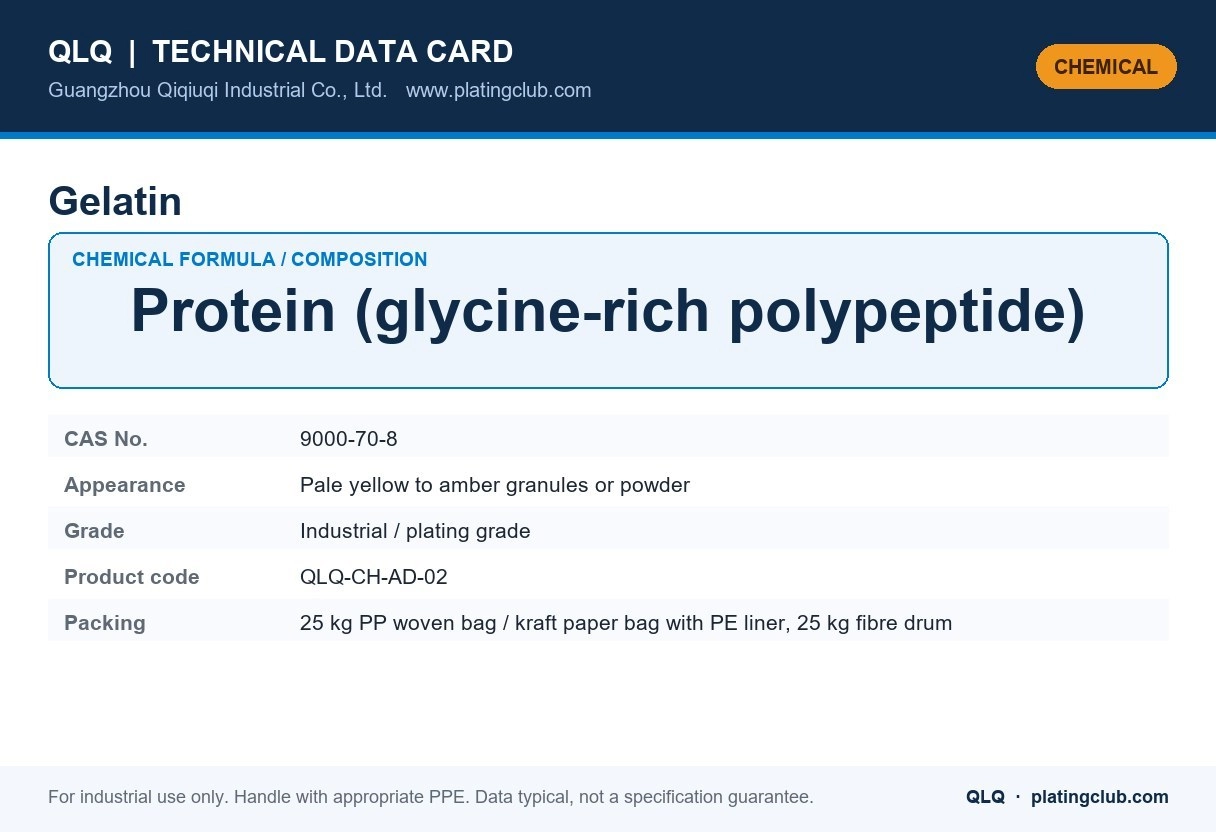
| Chemical formula | Protein (glycine-rich polypeptide) |
| CAS number | 9000-70-8 |
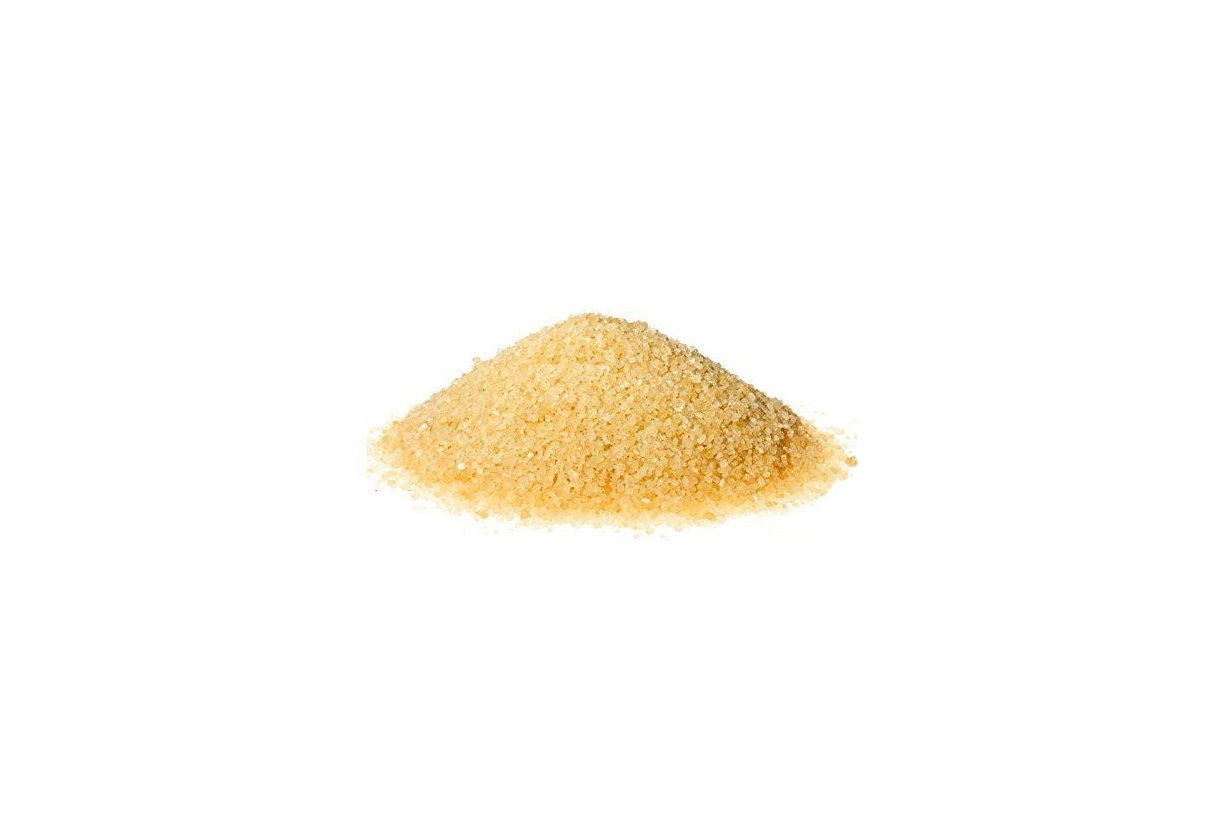
| Appearance | Pale yellow to amber granules or powder |
| Grade / type | Industrial / plating grade |
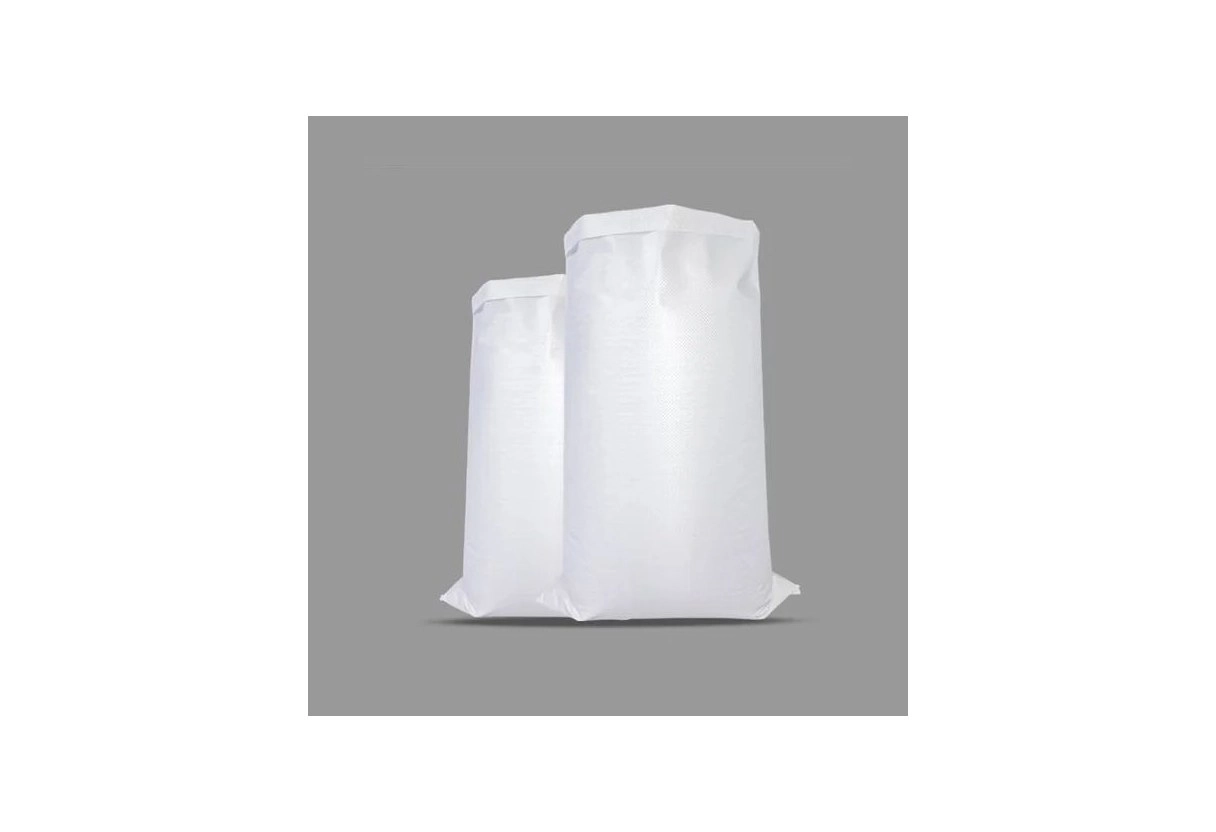
| Standard packing | 25 kg PP woven bag or kraft paper bag with PE inner liner; 25 kg fibre drum |
What it is and what it does. Gelatin is a traditional protein brightener and levelling agent for acid copper, bronze and brass baths, where it refines the grain and improves the throwing power of the deposit.
- Pale yellow to amber granules; dissolved in hot water before addition and dosed by the analysis or the Hull cell.
- Protein brighteners decompose slowly in the bath and their breakdown products also affect the deposit, so the level must be watched.
- Widely used in barrel bronze and brass plating of zipper sliders, where it gives a warm semibright deposit.
Typical Use in a Plating / Finishing Line
| Item | Typical guidance |
|---|---|
| Acid copper / bronze bath | 0.01-0.5 g/L depending on the system |
| Preparation | Dissolve in hot water and add as a dilute solution |
| Control | Hull cell panel appearance plus periodic carbon treatment |
Safety, Handling & Storage
| Item | Requirement |
|---|---|
| Hazard classification | Not classified as dangerous for transport in most cases; observe good industrial hygiene and dust control |
| Personal protective equipment | Dust mask, goggles and gloves for powder handling; general ventilation |
| Spill / first aid | Sweep up dry; material is a nuisance dust — avoid breathing the dust |
| Storage | Cool, dry, sealed store; keep bags closed, off the floor and away from moisture |
| Transport | Classified and packed according to IATA/IMDG for the hazard class; UN number and packing group stated on the shipping documents |
Quality Documents Shipped With Every Batch
| Document | Comment |
|---|---|
| COA (certificate of analysis) | Provided with the shipment; batch traceable to the production date |
| MSDS (safety data sheet) | Provided with the shipment; batch traceable to the production date |
| Packing list | Provided with the shipment; batch traceable to the production date |
| Commercial invoice | Provided with the shipment; batch traceable to the production date |
| Certificate of origin on request | Provided with the shipment; batch traceable to the production date |
Buyer Questions We Answer Every Week
| Question | Answer |
|---|---|
| Why does the deposit lose brightness over time? | Protein breakdown products accumulate; a regular activated carbon treatment removes them. |
| Can gelatin be replaced by a modern brightener? | Yes, but the substrate colour and the grain structure differ; a trial is needed. |
| Item | Typical Value |
|---|---|
| Appearance | Light yellow to tan powder / granules, free-flowing |
| Type | Technical / photographic grade, preservative-free |
| Jelly strength (Bloom) | 150-250 g (lot-certified) |
| pH (1% solution) | 4.5-7.0 |
| Moisture | ≤ 14% |
| Ash | ≤ 2.0% |
| Chloride | ≤ 0.1% (low-chloride lot) |
| Heavy metals (as Pb) | ≤ 10 ppm |
| Standard packing | 25KG/BAG, kraft bag with PE liner |
How It Works in the Bath (Dose-Response)
Gelatin molecules are long-chain proteins that diffuse to the cathode and adsorb preferentially where the current density is highest - exactly where a deposit would otherwise grow fastest and roughest. The adsorbed film raises the activation energy for metal deposition at those points, letting low-current areas catch up. The result is a smoother, denser, finer-grained deposit. Because the effect is physical adsorption, gelatin is consumed continuously and its breakdown products accumulate, which makes it a classic “little and often” additive:
| Gelatin in bath | Effect on acid copper deposit |
|---|---|
| 0 g/L | Coarse, columnar grain; roughness at edges; dull finish |
| 0.05-0.2 g/L (normal) | Fine grain, good leveling, smooth semi-bright deposit |
| 0.3-0.5 g/L | Leveling plateaus; risk of haze and pinholes rises |
| > 0.5 g/L (over-dosed) | Brittle, pitted deposit; low-current areas turn milky gray |
In matte tin plating the working range is higher (1-2 g/L, usually with β-naphthol) because the sulfate tin bath operates at higher temperature and consumes the colloid faster. Typical gelatin consumption in a decorative acid copper line is 2-5 g per 1000 Ah; top up in small doses after a Hull cell check rather than on a fixed calendar.
Typical Bath Formulations (Working Ranges)
| Component | Acid Copper (decorative) | Acid Tin (matte) |
|---|---|---|
| Copper sulfate pentahydrate | 180-240 g/L | - |
| Sulfuric acid | 55-75 g/L | 80-120 g/L |
| Chloride (as HCl) | 40-80 mg/L | - |
| Tin (as SnSO4) | - | 25-40 g/L |
| Gelatin | 0.05-0.2 g/L | 1-2 g/L |
| β-Naphthol | - | 0.5-1.0 g/L |
| Temperature | 22-32°C | 20-35°C |
| Cathode current density | 2-5 A/dm² (with agitation) | 0.5-2 A/dm² |
These are workshop-proven starting ranges for zipper and hardware lines; fine-tune 10-20% for water quality and loading ratio. Gelatin alone gives a semi-bright copper; where mirror copper is required it is combined with proprietary levelers or used as a backup leveler in formulations.
Quality Checks Before Use
| Check | Method | Pass |
|---|---|---|
| Appearance & odor | Visual against retained sample | Uniform tan color; mild protein smell, no rancid/fishy note |
| Solubility | Swell 10 g in cold water 30 min, then heat to 50°C | Clear amber solution, no undissolved specks, no surface scum |
| Ash / chloride | COA review | Ash ≤ 2%, chloride ≤ 0.1% (high chloride corrodes anodes) |
| Hull cell compare | Add 0.1 g/L to a fresh acid copper panel vs reference | Smoothing appears without haze or pits at high CD |
How QLQ controls it: every incoming gelatin lot is quarantined until the COA (Bloom value, ash, chloride, heavy metals) is checked and a Hull cell panel is run in a live acid copper bath. Because one high-ash or sulfite-preserved lot can contaminate an entire copper line, each shipped batch is traceable by number and a retained sample is kept for 12 months for re-testing.
Common Problems & Fixes (Workshop Table)
| Problem | Root cause | Fix |
|---|---|---|
| Rough, coarse deposit at edges | Gelatin exhausted or never added | Hull cell first, then top up 0.05 g/L increments |
| Milky haze in recesses | Over-dosed or aged breakdown peptides | Carbon treat 2-4 g/L, re-make additive, re-polish panel |
| Pinholes / pitting | Too much colloid; poor wetting; hydrogen bubbles stuck | Cut dose; add wetting agent; check air/mechanical agitation |
| Cloudy, lumpy make-up | Powder added to hot water directly | Always pre-swell in cold water, dissolve below 55°C |
| Bath smells, panels get streaky in summer | Protein stock solution spoiled (bacteria) | Make stock fresh weekly; keep stock cool; carbon treat tank |
| Bright range narrows suddenly | Wrong gelatin grade used (edible lot with sulfite) | Dump the dose, carbon treat, switch to technical grade |
Handling & Safety
- Health: gelatin is an animal protein powder; wear a dust mask and gloves when weighing. Dust can irritate the respiratory tract and protein is a sensitizer for some people.
- Dissolving: pre-swell in cold or lukewarm water for 20-30 minutes, then warm gently to 45-55°C with stirring. Never boil - heat above 60°C degrades the colloid and destroys its leveling power.
- Stock hygiene: aqueous gelatin stock supports bacteria and fungi, especially in tropical weather. Prepare small weekly volumes and store refrigerated or in a cool place; discard if it turns cloudy or smells.
- Storage: keep bags sealed in a cool, dry store. Heat and humidity accelerate hydrolysis; a lot older than 12 months should be Hull-cell re-verified before use.
- Waste: gelatin is biodegradable and adds only organic load; it does not complicate metal-bearing effluent treatment, but carbon-treatment sludge is still hazardous because of adsorbed metals.
What It Does on Iron, Zinc Alloy, Copper and Stainless Steel Parts
| Substrate | Role of the gelatin-refined deposit | Practice note |
|---|---|---|
| Iron / steel hardware | Fine-grained copper underlayer levels scratches and gives nickel a smooth base; gelatin cost-effectively controls copper grain on struck parts | Acid copper only after a thin strike (or Wood’s-type activation); never plate acid copper directly on passive steel |
| Zinc alloy (sliders, buckles) | Gelatin-refined acid copper improves the buffed appearance after a protective copper base; supports the Cu-Ni-Cr CASS stack | Zinc dissolves in acid copper - always cover with pyrophosphate or cyanide copper first, then acid copper |
| Copper / brass | Direct plating works well: gelatin levels the surface and tightens grain for the white nickel finish that follows | Activate in 3-5% sulfuric acid; keep gelatin at 0.05-0.15 g/L for barrel work |
| Stainless steel | In nickel-strike-then-copper routes, gelatin copper deposits a ductile layer that resists peeling during later forming | Strike nickel at high CD first; low gelatin dose keeps ductility high |
FAQ
| Question | Answer |
|---|---|
| Can I use supermarket (food) gelatin to save money? | No. Food grades contain sulfite and other preservatives that poison acid copper and tin baths, and their jelly strength varies wildly between batches. The bath-treatment cost will exceed any saving. |
| How do I dose gelatin correctly? | Start from the Hull cell: add 0.05 g/L steps until the high-current edge smooths without haze, then keep a log and top up in small doses as the panel drifts. |
| I over-dosed. How do I remove excess gelatin? | Activated carbon treatment (2-4 g/L powder, 50-60°C, 1-2 h with agitation), then filter and rebuild the additive by Hull cell. Electrolytic dummying alone removes colloid too slowly. |
| Does QLQ help with the rest of the copper-nickel system? | Yes. Gelatin ships with a COA, and QLQ engineers help balance it against copper brighteners, wetting agents and the nickel baths that follow - remotely or during line commissioning. |
Copper deposit rough or hazy? Send Hull cell photos to QLQ engineering - we diagnose additive balance for plating customers in 10+ countries. Contact us.
Shipping cost is based on weight. Just add products to your cart and use the Shipping Calculator to see the shipping price.We want you to be 100% satisfied with your purchase. Items can be returned or exchanged within 30 days of delivery.