
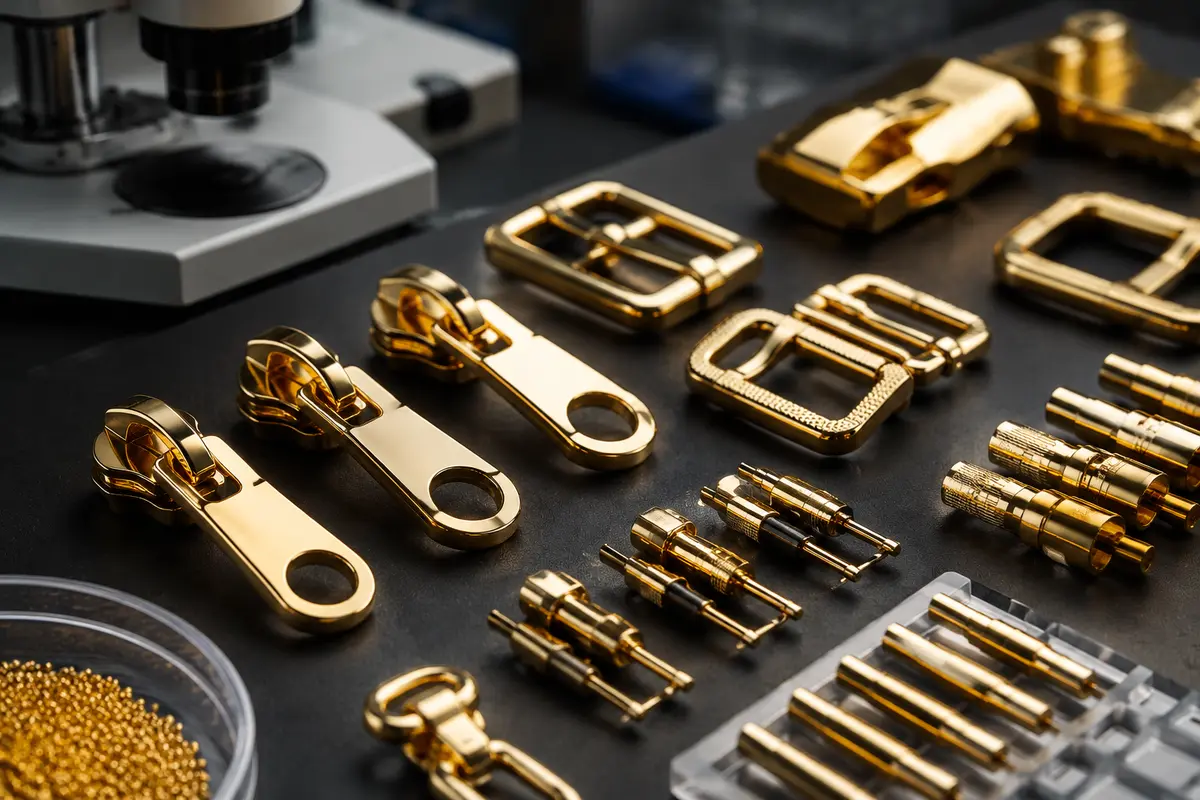
Gold plating is the gold standard — literally — for applications demanding superior electrical conductivity, corrosion resistance, and premium aesthetics. From high-reliability electronic connectors to luxury zipper pulls and decorative hardware, gold electroplating delivers performance that no other metal finish can match. Yet gold plating is not a single process: the thickness, underplate, alloy composition, and application method dramatically affect both performance and cost. This guide helps industrial buyers and engineers specify the right gold plating for their hardware components.
⚜️ Why Gold Plating? The Value Proposition
Gold offers unmatched tarnish resistance, stable contact resistance (3-5 mΩ), excellent solderability, and a premium aesthetic. But at ~$70-80/gram, every micron counts. Getting the specification right can save 30-50% on plating costs without compromising performance.
🔬 The Four Types of Gold Plating
Gold electroplating processes fall into four categories, each optimized for different applications. Selecting the wrong type is the #1 cause of premature failure in gold-plated components.
🥇 Type 1: Flash Gold (0.05–0.25 μm)
Best for: decorative hardware, zipper pulls, costume jewelry
Flash gold — also called gold flash or color gold — deposits an ultra-thin layer just thick enough to impart gold color. At 0.05-0.25 microns, the deposit is measured in atoms rather than microns. The purpose is purely aesthetic: providing a bright gold appearance at minimal cost.
- Thickness: 0.05–0.25 μm (2–10 micro-inches)
- Purity: Typically 23–24K (95.8–99.9% Au) for bright yellow; 14–18K alloys for rose/pink tones
- Underplate: Bright nickel (3–5 μm) is mandatory — without it, flash gold appears dull and tarnishes within weeks
- Cost factor: ~$0.02–0.05 per square inch
- Durability: Low — not suitable for wear surfaces or electrical contacts
- Typical use: Zipper pulls, belt buckles, fashion hardware, decorative trim
⚙️ Type 2: Hard Gold (0.75–2.5 μm)
Best for: connectors, switch contacts, edge connectors, sliding contacts
Hard gold is alloyed with 0.1–0.3% cobalt or nickel, dramatically increasing hardness (130–200 HK vs 60–80 HK for pure gold). This makes it ideal for connectors that undergo repeated insertion cycles. The cobalt/nickel codeposits as intermetallic particles, creating a wear-resistant composite.
- Thickness: 0.75–2.5 μm (30–100 micro-inches)
- Purity: 99.0–99.7% Au (0.1–0.3% Co or Ni hardener)
- Hardness: 130–200 Knoop (HK₂₅)
- Underplate: Bright nickel (2.5–5 μm) required as a diffusion barrier
- Contact resistance: 3–8 mΩ at 50g contact force — stable over 10,000+ cycles
- Typical use: USB connectors, SIM card contacts, PCB edge connectors, relay contacts
- Specification: ASTM B488 Type II, MIL-DTL-45204D Type II Grade C
🔌 Type 3: Soft Gold / Pure Gold (1.0–5.0 μm)
Best for: wire bonding, semiconductor packaging, thermocompression bonding
Soft gold is 99.99% pure with no alloying hardeners. This extreme purity is essential for semiconductor wire bonding, where gold wires are thermosonically welded to the gold-plated pad. Any alloying elements would interfere with the metallurgical bond.
- Thickness: 1.0–5.0 μm (40–200 micro-inches)
- Purity: ≥99.99% Au (4N gold)
- Hardness: 60–90 Knoop (HK₂₅)
- Underplate: Electroless nickel (3–7 μm) preferred — more uniform than electrolytic
- Key property: Excellent wire bondability, no Kirkendall voiding
- Typical use: IC packaging, ceramic substrates, RF/microwave circuits
💰 Type 4: Imitation Gold / Gold-Tone (Brass or Bronze Alloy)
Best for: cost-sensitive decorative hardware, large-area fashion accessories
Imitation gold is not gold at all — it's a brass (Cu-Zn) or bronze (Cu-Sn) alloy electroplated to produce a gold-like color. At 1/50th the cost of gold, it's widely used for fashion hardware, furniture fittings, and decorative items where gold appearance matters but durability requirements are moderate. Modern imitation gold baths produce remarkably convincing gold tones that are lacquer-sealed for tarnish protection.
- Composition: 70-85% Cu, 15-30% Zn, trace additives for color tuning
- Thickness: 0.5–2.0 μm
- Cost factor: ~$0.002–0.01 per square inch (1/20 to 1/50 of real gold)
- Must-have: Clear lacquer topcoat to prevent tarnishing
- Limitation: Not suitable for electrical contacts or extended outdoor use
- Typical use: Zipper sliders, handbag hardware, furniture handles, lamp parts
📏 Gold Plating Thickness Selection Table
Per ASTM B488 and MIL-DTL-45204. All thicknesses are minimum values at the functional surface.
| Application | Gold Type | Min. Thickness | Nickel Underplate | Grade |
|---|---|---|---|---|
| Decorative indoor hardware | Flash | 0.125 μm | 2.5 μm sulfamate Ni | ASTM B488 Class 0 |
| Consumer connectors (>100 cycles) | Hard | 0.75 μm | 2.5 μm sulfamate Ni | ASTM B488 Class 1 |
| Industrial connectors (>1000 cycles) | Hard | 1.25 μm | 5.0 μm sulfamate Ni | ASTM B488 Class 2 / MIL Grade C |
| Military/aerospace connectors | Hard | 2.5 μm | 5.0 μm sulfamate Ni | ASTM B488 Class 3 / MIL Grade A |
| Semiconductor wire bonding | Soft 99.99% | 1.5–5.0 μm | 3–7 μm EN (electroless Ni) | ASTM B488 Type III |
🔧 The Underplate: Why Nickel Is Non-Negotiable
Every gold-plated component — without exception — requires a nickel underplate. Here's why:
- Diffusion barrier: Without nickel, copper from the substrate (or copper underplate) diffuses through the gold layer within weeks at elevated temperatures, causing tarnish and increased contact resistance.
- Pore corrosion prevention: Thin gold deposits are inherently porous. The nickel underplate provides a second corrosion-resistant layer that protects the substrate when pores penetrate the gold.
- Mechanical support: Gold is soft. Under contact force, thin gold on a soft substrate displaces. A hard nickel layer (400-600 HK) provides mechanical backing, preventing gold from being pushed aside.
- Brightness enhancement: Bright nickel reflects light through the translucent gold layer, amplifying the perceived gold color and brightness.
Spec to use: Sulfamate nickel (per ASTM B689 Type IV or AMS 2424) — lowest stress, best ductility. For connectors, specify 2.5-5.0 μm minimum on the functional surface.
💡 Cost Optimization: Getting More Value from Your Gold Specification
Gold at $75/gram represents a significant material cost. Every 0.1 μm of unnecessary thickness on a single production run of 100,000 connectors can waste over $500 in gold.
✅ Selective Plating
Only plate the functional contact area — not the entire part. Strip-on-strip, controlled-depth, and brush plating technologies can reduce gold usage by 60-80% compared to full-immersion plating.
✅ Right-Size Your Thickness
Don't overspecify. A USB connector needs 0.75 μm hard gold, not 2.5 μm. Validate your durability requirement with actual insertion-cycle testing rather than using "thicker is better" logic.
✅ Consider Palladium-Nickel
For connectors requiring >1.25 μm gold, a Pd-Ni (80/20) underlayer with 0.2 μm gold flash can reduce gold usage by 80% while maintaining performance. ENEPIG is the PCB-industry standard for this approach.
✅ Use Imitation Gold for Decorative
If your product is fashion hardware — zipper pulls, buckles, handbag frames — imitation gold (brass alloy) with lacquer seal delivers 95% of the visual impact at 5% of the cost.
🔬 Quality Testing: Ensuring Your Gold Doesn't Peel
Gold plating adhesion failures are devastating — a single peeling contact can disable an entire electronic assembly. Per ASTM B571, these are the standard adhesion tests:
- Bend test (ASTM B571 §5): Bend the plated part 180° around a mandrel. No flaking or peeling allowed.
- Tape test (ASTM B571 §13 / ISO 2819): Apply pressure-sensitive tape, then rapidly peel. No gold on tape = pass.
- Thermal shock (MIL-STD-883): 5 cycles of -55°C to +125°C, 15 min dwell. No blistering or delamination.
- Thickness verification: X-ray fluorescence (XRF) per ASTM B568. ±10% accuracy at 0.5 μm. Cross-sectional SEM for dispute resolution.
- Porosity testing: Electrographic porosity test (ASTM B798) or nitric acid vapor test for gas-tight connector applications.
✅ Gold Plating Purchase Order Checklist
Communicate these 9 items to your plating supplier for zero-ambiguity specifications:
- Base material: Copper alloy (brass/bronze/BeCu), steel, or zinc alloy — each requires different pretreatment
- Nickel underplate: Sulfamate Ni, 2.5 μm or 5.0 μm per ASTM B689 Type IV
- Gold type: Flash / Hard (Co-alloyed) / Soft (99.99%) / Imitation (Cu-Zn alloy)
- Gold thickness: Minimum at functional surface per ASTM B488 Class (0/1/2/3)
- Plating area: Full-part or selective (define the contact zone)
- Adhesion test requirement: Bend test or tape test per ASTM B571
- Porosity requirement: If applicable — <1% porosity at functional surface
- Packaging: Interleaving paper, VCI, or sulfur-free tissue for tarnish protection
- Shelf life: 12 months minimum in sealed packaging at 25°C/50% RH
Need Precision Gold Plating for Your Hardware?
From flash gold on zipper pulls to MIL-spec hard gold on connectors — we deliver consistent quality with full XRF thickness certification and ASTM-standard adhesion testing. Contact our team to discuss your gold plating requirements.
Last updated: June 2026. This guide is for reference purposes. Always consult your plating supplier for application-specific recommendations and validate performance under actual service conditions.